

The best keyword rank checker depends on whose rankings you need. For your own site, Google Search Console is free and the most accurate source there is: it reports your real average position, clicks and impressions for every query you appear for. For a one-off check of any keyword and any domain, Ahrefs' free Keyword Rank Checker works in seconds. For daily tracking of a fixed keyword list with competitors and locations, SE Ranking ($129/month for 2,000 keywords checked daily) is the best value among full SEO suites, AccuRanker ($224/month) is the strongest dedicated tracker, and Wincher (from $49/month for 500 keywords) is a good low-cost daily option.
Below: a sortable comparison of 13 keyword ranking tools with prices checked on each vendor's pricing page in October 2026, the free options first, what each paid tracker is actually good at, and a four-question picker.
Key takeaways
- For your own site, the most accurate keyword ranking data is free: Google Search Console reports your average position, clicks and impressions for every query, with 16 months of history.
- A rank checker simulates one searcher in one place on one device. Use it for competitors, local rankings and daily alerts, and keep Search Console as the source of truth for your own traffic.
- Entry prices in October 2026: Wincher from $49/mo (500 keywords, daily), SE Ranking $129/mo (2,000, daily), Ahrefs Lite $129/mo (750, weekly), Semrush $139.95/mo (500, daily), AccuRanker $224/mo (2,000, daily).
- Compare cost per tracked keyword and update frequency, not the headline price: SE Ranking's entry plan works out to about $6.45 per 100 daily-tracked keywords, Semrush's to about $28.
- Since Google stopped supporting the &num=100 results parameter in September 2025, checking the top 100 takes ten page requests instead of one. Ask every vendor how deep it checks.
Keyword rank checker tools compared (October 2026)
Prices are the entry plan in USD, month to month unless noted, taken from each vendor's pricing page in October 2026. "Keywords" is how many keywords the entry plan tracks. Click a column header to sort.
Keyword rank checker and rank tracker tools, October 2026
| Google Search Console | $0/mo | All your queries | Daily data, about 2 to 3 days behind | Free forever | Your own site's real positions, clicks and impressions |
| Ahrefs Keyword Rank Checker | $0/mo | — | One-off check | Free tool | Checking one keyword for any domain, in any location |
| SEO PowerSuite Rank Tracker | $0/mo | Unlimited | Daily, weekly or monthly (you schedule it) | Free desktop version; Pro $179/year | Big keyword lists on a tiny budget |
| Keyword.com | $4/mo | — | Package-based | 14-day trial with 100 keywords | Pay-for-what-you-track Google and AI tracking ($4 is billed yearly) |
| SERPRobot | $4.99/mo | 75 | Daily (75 checks per bot per 24h) | 14-day free trial, free SERP checker | A handful of keywords for almost nothing |
| Mangools SERPWatcher | $37.70/mo | 200 | Weekly (daily on Agency) | Free account | Beginners who also want KWFinder (billed yearly) |
| Wincher | $49/mo | 500 | Daily | 7-day free trial | Simple daily tracking for small teams |
| Serpstat | $50/mo | 333 | Daily (10,000 checks a month) | 7-day free trial | Budget all-in-one suite (billed yearly) |
| Nightwatch | €79 | 500 | Daily | 14-day trial, no card | Local tracking across Google, Bing, YouTube and Maps (billed yearly) |
| SE Ranking | $129/mo | 2,000 | Daily | 14-day trial, no card | Best value all-in-one suite with daily tracking |
| Ahrefs Rank Tracker | $129/mo | 750 | Weekly | Ahrefs Free for your own site | Teams already using Ahrefs for links and research |
| Advanced Web Ranking | $139/mo | 7,000 | Scheduled and on-demand | Free trial, 30-day money-back | Agencies that report on many sites and locations |
| Semrush | $139.95/mo | 500 | Daily | Limited free plan, free trial | Teams that want tracking inside a full marketing suite |
| AccuRanker | $224/mo | 2,000 | Daily, plus on-demand refresh | None listed | Large keyword sets and fast refreshes |
Click a column header to sort.
How to read it: the tools under $50 are trackers first and everything else second. Semrush, SE Ranking, Ahrefs and Serpstat are suites where rank tracking is one module next to keyword research, audits and backlinks. AccuRanker, Advanced Web Ranking, Wincher and Nightwatch are dedicated trackers. If you only need rankings, you pay less per keyword with a dedicated tracker.
Free keyword rank checkers you can use right now
Start free. Most sites don't need a paid tracker until they want competitor data, local grids or alerts.
Google Search Console (free, your own site)
Google Search Console is Google's own report of how your site performs in Search. Open Performance → Search results, switch on Average position, and the Queries tab lists every query you showed up for with its clicks, impressions, CTR and position. Google defines average position as "the average position of the topmost result from your site," so it's a blend of every real search, not one snapshot (Google's help page).
It's free, it covers 16 months, and since late 2025 it can split branded from non-branded queries and smooth charts by week or month. The limits: it only works for sites you verify, the table shows 1,000 rows, and it can't track a keyword you don't rank for yet. Our step-by-step guide to tracking Google rankings in Search Console covers the setup and a 15-minute weekly routine.
Ahrefs Keyword Rank Checker and Ahrefs Free
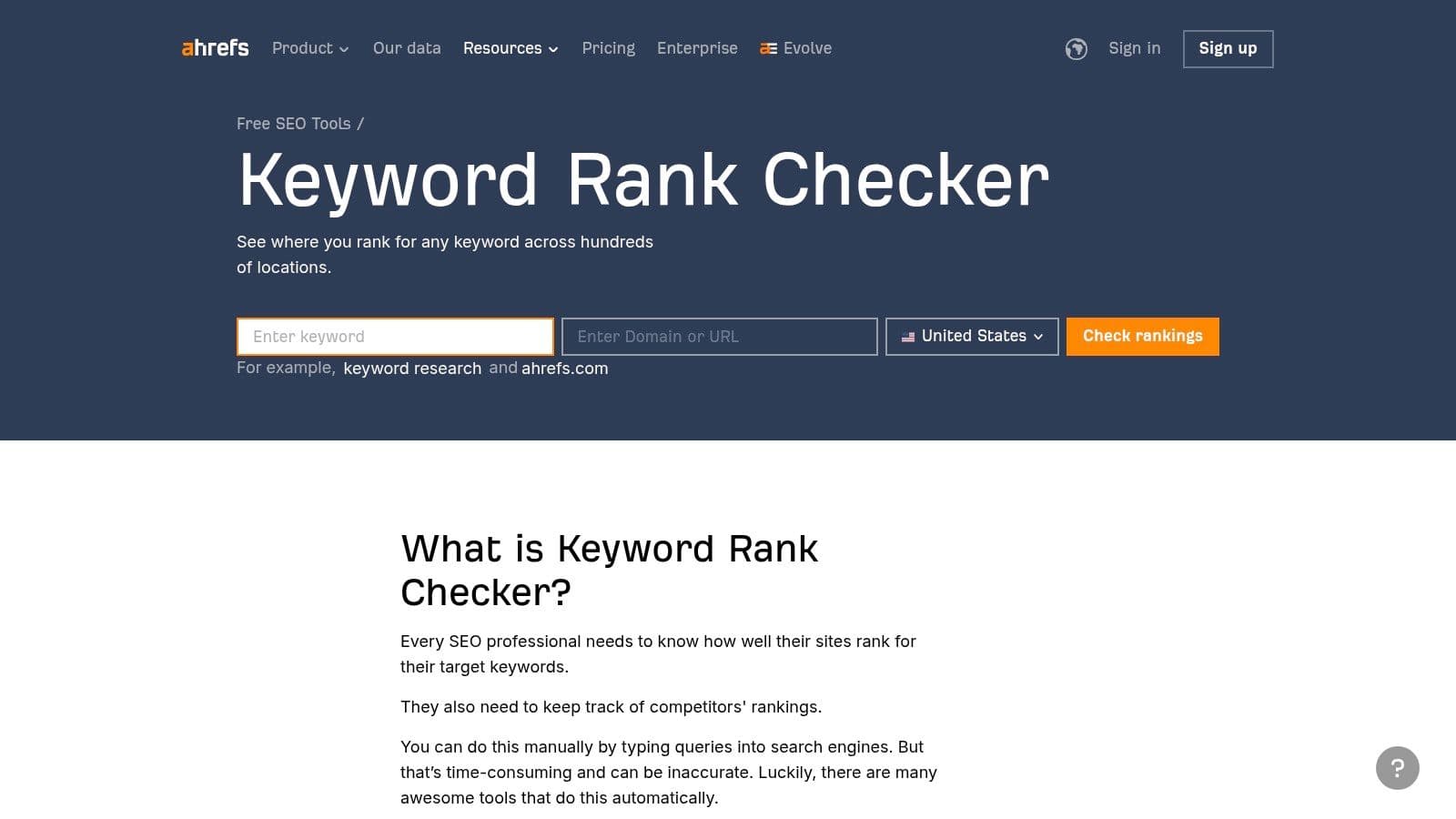
Ahrefs' free Keyword Rank Checker takes a keyword, a domain and a location and tells you where that domain ranks. It's the fastest way to answer "where does this competitor rank for X?" without an account. For your own site, Ahrefs Free (formerly Ahrefs Webmaster Tools) gives limited Site Explorer and Site Audit access once you verify ownership.
SEO PowerSuite Rank Tracker (free desktop app)
Rank Tracker is a desktop app, not a website, and it tracks unlimited keywords, even on the free version. You can scan the top 10, 50 or 1,000 results, schedule checks daily, weekly or monthly, and track Google, Bing, YouTube and other engines. The free license allows one competitor per project; Professional costs $179 a year and Enterprise (client reporting and exports) $419 a year. The catch: it runs on your computer, so scheduled checks need that computer on.
SERPRobot and Keyword.com (almost free)
SERPRobot has a free one-off SERP checker, and its paid "bots" cost $4.99 a month each for 75 keyword updates every 24 hours, after a 14-day free trial. Keyword.com starts at $4 a month billed yearly and lets you trial 100 keywords for 14 days without a card. Note that Keyword.com's standard tracking checks the top 50 results; top-100 depth is a separate option.
If you want the quick manual methods too (incognito searches, location parameters, the "what keywords am I ranking for" report), see how to check keyword rankings for free.
Best paid keyword rank trackers
Each review below lists the entry price as of October 2026, what the plan tracks, who it suits and the catch. Prices are month to month unless noted.
SE Ranking: best value all-in-one suite
SE Ranking now sells two self-serve tiers. Core costs $129 a month ($103.20 billed yearly) and tracks 2,000 keywords daily across 10 projects; Growth is $279 a month for 5,000 keywords and 30 projects. Both include Google top-100 tracking, share of voice, keyword research, site audits and a Search Console / GA4 / Looker Studio integration, plus AI prompt tracking. The 14-day trial needs no card and tracks up to 750 keywords a day.
- Best for: small businesses and freelancers who want daily tracking and a full toolkit for one bill.
- Watch out for: extra keywords and the agency white-label pack are paid add-ons.
Semrush Position Tracking: best inside a full marketing suite
Semrush's Position Tracking is part of every plan. The SEO plan costs $139.95 a month ($117.33 billed yearly) and tracks 500 keywords daily across 5 websites, with mobile data; the SEO + AI Search bundles start at $199 a month and add AI visibility tracking. You get SERP feature tracking and competitor comparisons in the same project; multi-location tracking and keyword cannibalization analysis start on the higher bundles. There's a limited free plan (one demo project, 10 reports a day) and a free trial.
- Best for: marketing teams that will use the rest of Semrush (keyword research, PPC, content).
- Watch out for: 500 keywords is tight; at about $28 per 100 daily keywords it's the most expensive tracker per keyword here. Curious how its numbers hold up? Read how accurate Semrush is.
Ahrefs Rank Tracker: best if you already pay for Ahrefs
Ahrefs Lite costs $129 a month for 750 tracked keywords, updated weekly on every standard plan (Standard: $249 for 2,000; Advanced: $449 for 5,000). Ahrefs also offers GSC Insights, which shows your Search Console rankings inside Ahrefs, and its paid plans now include API and MCP credits. Ahrefs doesn't discount; Ahrefs Free is the way to try it on your own site.
- Best for: teams that already use Ahrefs for backlinks and competitor research.
- Watch out for: weekly updates. If you need daily movement, pick a tool built for it.
AccuRanker: best dedicated tracker for big keyword sets
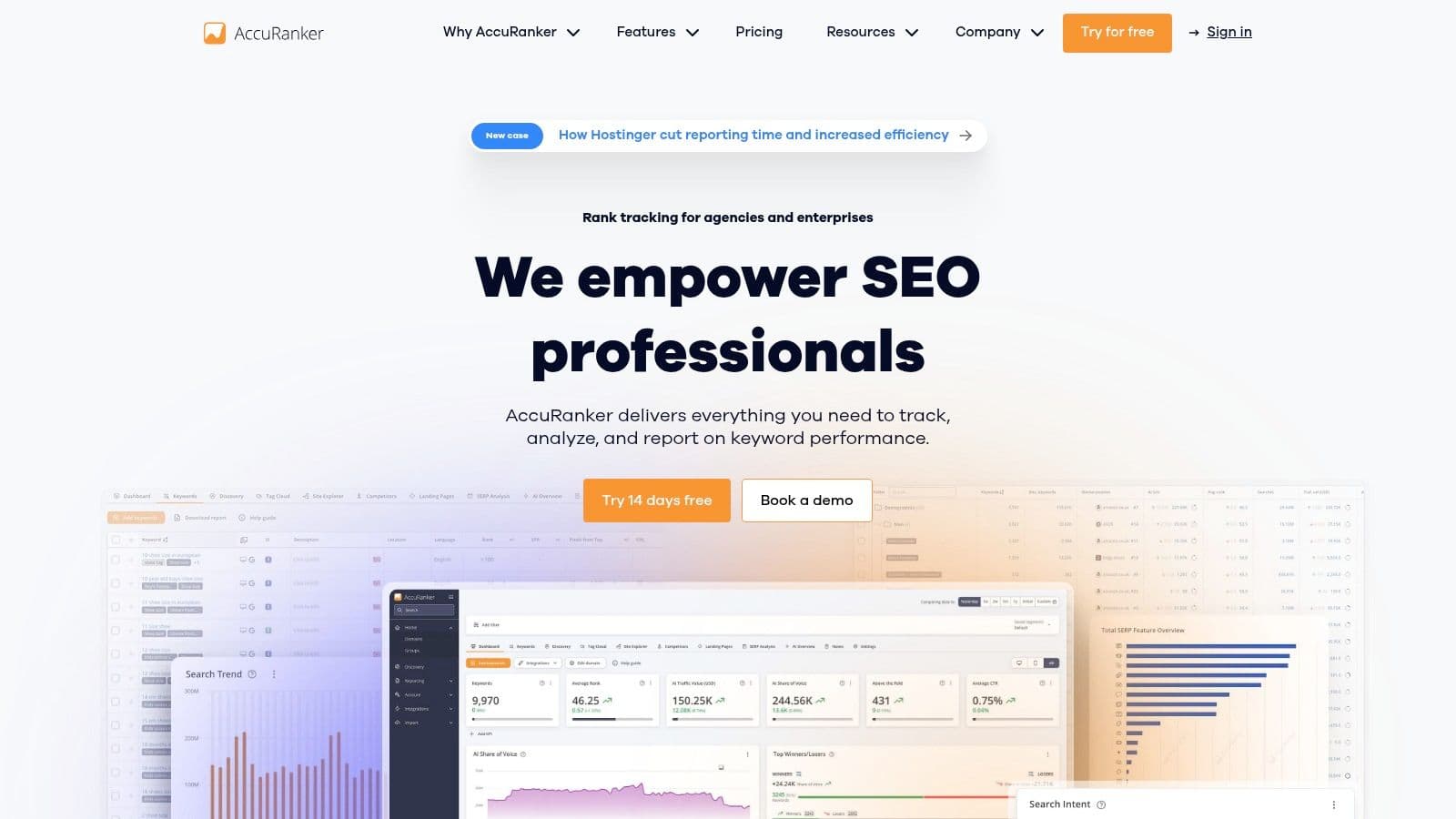
AccuRanker does one job. Professional starts at $224 a month for 2,000 keywords with daily updates, keyword tagging, Search Console and GA integration and reporting; Expert ($764 a month, 10,000 keywords) adds Looker Studio and an unlimited read API. On top of the daily run, you can refresh a single keyword or update a whole domain every two hours. Paying yearly saves 10%.
- Best for: agencies and in-house teams tracking thousands of keywords who need fast refreshes.
- Watch out for: no keyword research or audit suite around it, and no cheap tier.
Wincher: best simple daily tracker for small teams
Wincher starts at $49 a month for 500 keywords with daily updates on up to 10 websites, with 5 competitors per site. Standard ($89, from 1,000 keywords) adds unlimited websites, multiple users and on-demand updates. There's a 7-day free trial and no free plan.
- Best for: small businesses and freelancers who want clean daily data without a suite.
- Watch out for: on-demand refreshes start on the second tier.
Mangools SERPWatcher: best for beginners
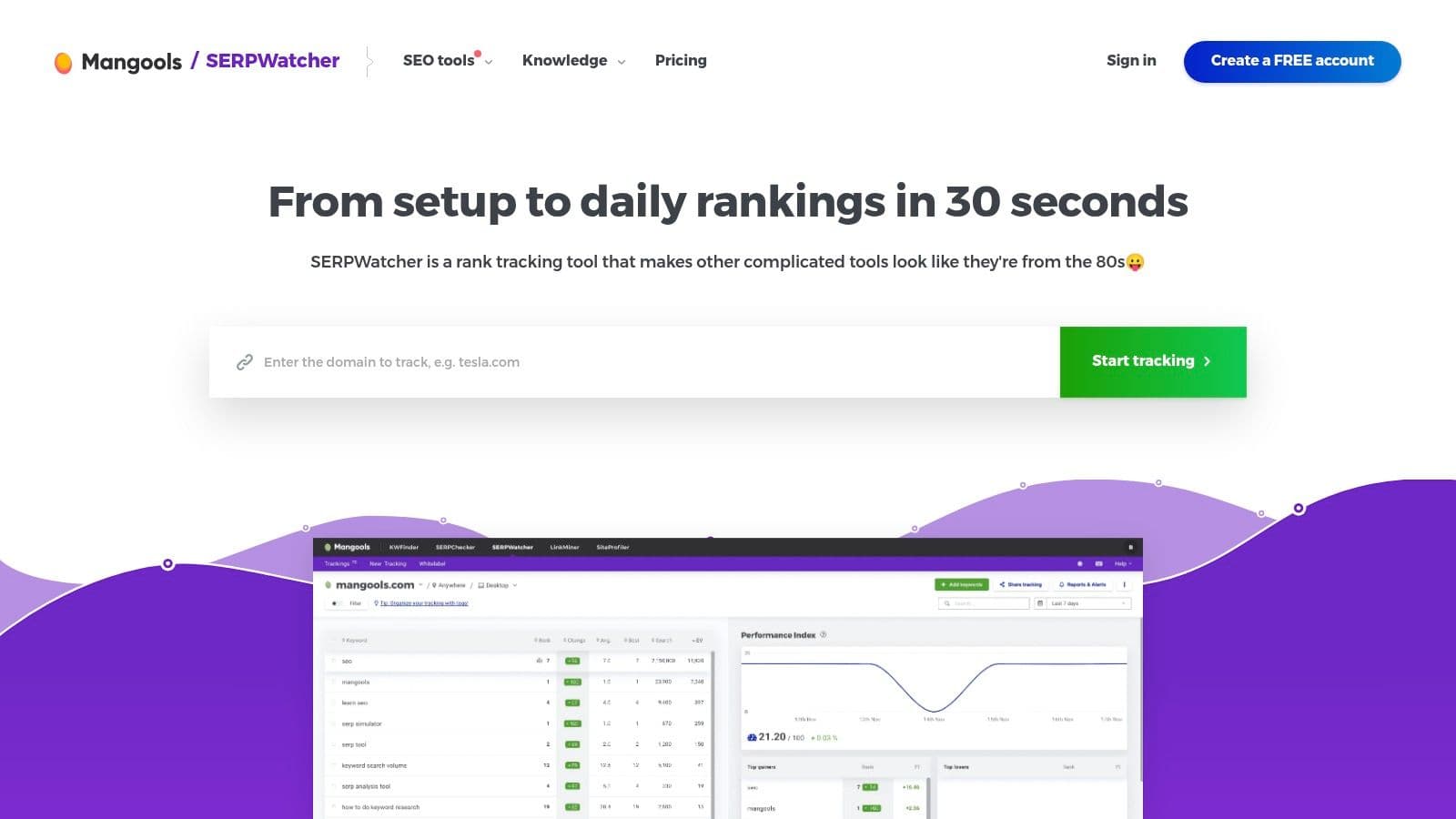
SERPWatcher comes bundled with KWFinder and the other Mangools tools. Mangools Basic costs $37.70 a month billed yearly ($452.40) and tracks 200 keywords, updated weekly; Premium ($52.70) tracks 700 weekly, and only Agency ($97.70, 1,500 keywords) updates daily (Mangools pricing). It's the friendliest interface here and supports city-level locations.
- Best for: bloggers and beginners who also need an easy keyword research tool.
- Watch out for: weekly updates below the Agency plan.
Nightwatch: best for local and multi-engine tracking
Nightwatch bills in euros: Starter is €79 a month billed yearly for 500 keywords tracked daily, 5 websites and 5 competitors per site, across Google, Bing, Yahoo, DuckDuckGo, YouTube and Google Maps. Every plan includes unlimited seats and AI prompt tracking, and the 14-day trial needs no card.
- Best for: local businesses and agencies that need city-level and Maps rankings.
- Watch out for: euro billing and yearly pricing on the headline number.
Advanced Web Ranking: best for agency reporting
Advanced Web Ranking Pro costs $139 a month for 7,000 keywords with unlimited projects and users, local and mobile rankings, SERP feature analysis and AI visibility tracking. Agency ($279, 14,500 keywords) adds hourly on-demand updates, white-label reports, Looker Studio and the API. It has a free trial and a 30-day money-back guarantee.
- Best for: agencies reporting on many clients and locations.
- Watch out for: the API and white-label reporting start on Agency.
Serpstat: best budget all-in-one
Serpstat Individual costs $50 a month billed yearly and includes 10,000 keyword position checks a month (about 330 keywords checked daily) alongside keyword research, backlinks and audits. Higher tiers (from $100 a month) raise the pool and add the API. 7-day free trial.
- Best for: freelancers who want one cheap suite with daily rankings.
- Watch out for: position checks are a monthly pool, so daily tracking of many keywords burns through it fast.
Nozzle: best for full-SERP data and BigQuery
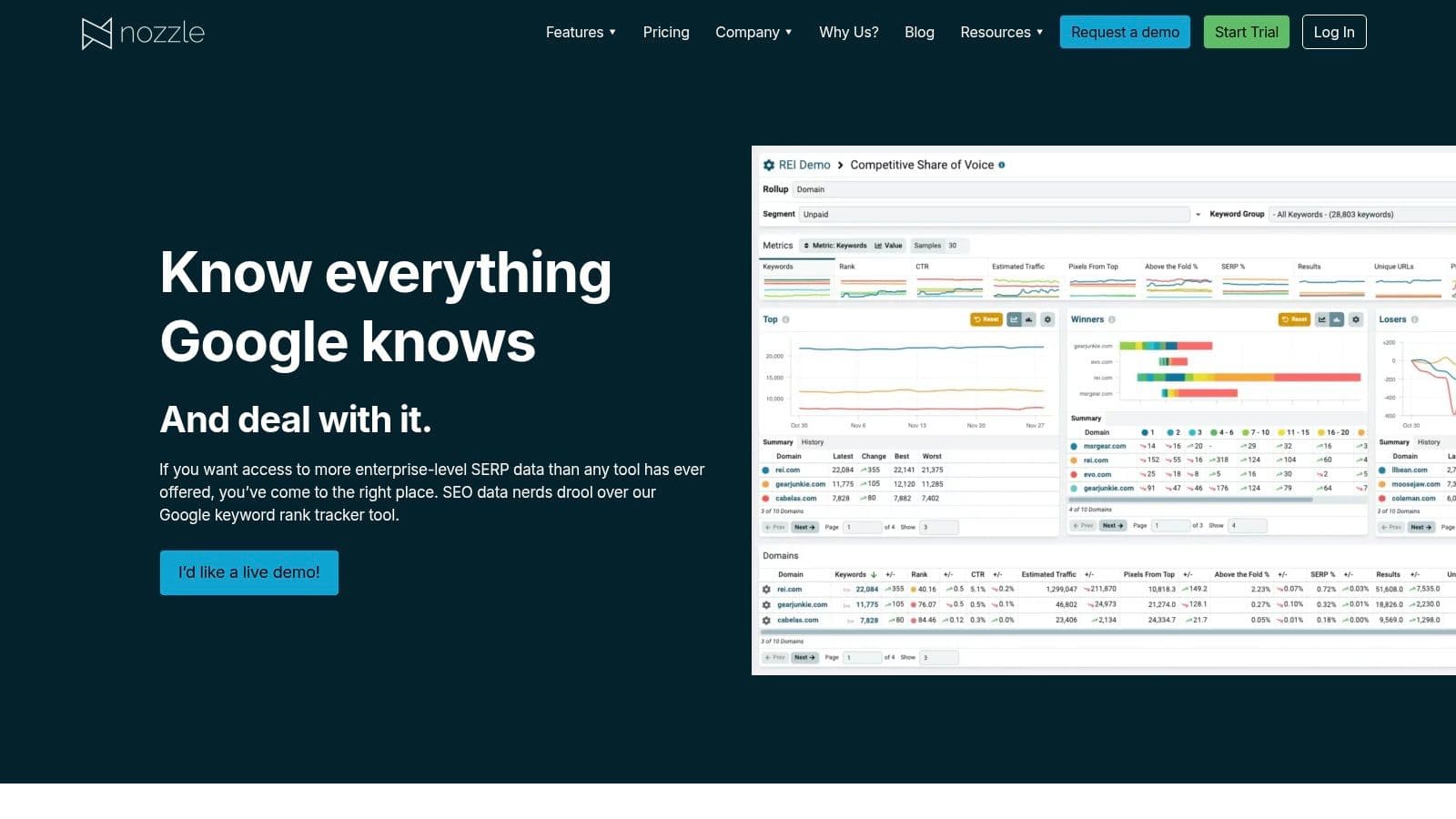
Nozzle prices by SERPs pulled per month rather than by keyword, and captures the top five pages (50 to 60 results) with every SERP feature. API access, BigQuery export, unlimited users and unlimited competitors are included on every plan, and the 14-day trial needs no card. It suits data teams that want raw SERPs in a warehouse, not a dashboard.
Moz Pro also includes a rank tracker: Moz Pro Standard costs $99 a month ($79 billed yearly) with 300 tracked keywords, and a $49 Starter plan covers a single site. If price is your main filter, our list of cheaper Semrush alternatives and Ahrefs alternatives goes further.
Which keyword ranking tool should you choose?
Answer four questions and the picker suggests a starting point.
4-question decision helper
Which keyword rank checker fits you?
Question 1 of 4
Whose rankings do you need?
Beyond the picker, check these five things before you pay:
- Update frequency. Daily matters during launches, migrations and competitive pushes. Weekly is fine for steady content sites (Ahrefs and Mangools Basic are weekly).
- Depth. How many results does the tool check per keyword? Top 20 is enough to monitor page one and two; top 100 matters for new sites climbing from far back. Since September 2025, top-100 checks cost vendors ten page requests, so many charge more for them.
- Location and device. Local businesses need city or ZIP-level tracking and Google Maps positions. Track mobile and desktop separately.
- SERP features and AI answers. Several trackers now report AI Overviews and AI-assistant citations alongside blue links. If AI visibility matters to you, Outrank's AI visibility tracking covers ChatGPT, Perplexity, Gemini, Copilot and Google's AI features.
- Cost per keyword at your real list size. A $49 plan for 500 keywords and a $129 plan for 2,000 cost about the same per keyword.
Rank checker vs Search Console: why the numbers differ
A rank checker and Search Console answer different questions, so they rarely agree.
| Rank checker (SE Ranking, AccuRanker...) | Google Search Console | |
|---|---|---|
| What it measures | Your position in one simulated search (one location, device, language) | Average topmost position across every real search that showed your site |
| Keywords | The list you choose, including ones you don't rank for yet | Every query you appeared for (1,000 rows in the UI, more via the API) |
| Competitors | Yes | No, only sites you verify |
| Clicks and impressions | Estimated, if at all | Real |
| Freshness | Daily or on demand | About 2 to 3 days behind, plus a preliminary 24-hour view |
| Cost | $5 to $250+ a month | Free |
Google says it plainly: you might not see your site when you repeat a query yourself, because "Search results are specific to the time, place, device, and recent history of the person searching." That's also why a page can show position 4 in a tracker and 9.3 in Search Console at the same time. Neither is wrong.
One more trap: when Google stopped supporting the &num=100 parameter on September 10–13, 2025, Search Console impressions from scrapers disappeared. In Outrank's zero-click study of 1,503 sites, median impressions fell 33% within days and average position "improved" from 29 to 13, with no real ranking change. If your history crosses that date, compare clicks, not average position.
If you want Search Console data without the 1,000-row cap, pull it with the free API: our Search Console API guide has copy-paste Apps Script and Python code.
Keyword ranking analysis: what to do with the data
Tracking is only useful if it changes what you do next week. A simple analysis loop:
- Find striking-distance keywords. Queries at positions 5 to 20 with real impressions are the cheapest wins: Google already finds the page relevant.
- Fix high-impression, low-CTR results. A page that ranks but doesn't get clicked usually needs a better title and description. See how to write meta titles.
- Check which URL ranks. Two of your pages trading places for one query is a sign of keyword cannibalization.
- Report trends, not single days. Use weekly or monthly views and group keywords by topic or funnel stage. Our SEO keyword ranking report template shows exactly what to put in it.
Where Outrank fits (and where it doesn't)
Outrank is not a rank tracker, and you shouldn't buy it as one. It's an SEO content platform: it connects to your Search Console, flags articles that underperform so you can schedule rewrites, and researches, writes and publishes one SEO article a day to your CMS, with backlinks from its exchange. The usual workflow is a tracker (or Search Console) to see where you stand, and Outrank to publish the pages that close the gaps. Across 2,119 sites in our AI SEO agent study, the median site reached 2.0× its pre-Outrank Google clicks by month 7.
FAQ
What is a keyword rank checker?
A keyword rank checker is a tool that shows where a website appears in search results for a specific keyword, in a specific location and on a specific device. Free checkers answer one query at a time; rank trackers check a saved list on a schedule and chart the history. Google Search Console is different: it reports your average position across all real searches rather than one simulated check.
What is the best free keyword rank checker?
For your own site, Google Search Console: it's free, shows every query you rank for with real clicks and impressions, and keeps 16 months of data. For checking any domain, including competitors, Ahrefs' free Keyword Rank Checker is the quickest option. If you need to track a large list for free, SEO PowerSuite's Rank Tracker desktop app tracks unlimited keywords on its free version.
How much does a keyword rank tracker cost?
As of October 2026, dedicated trackers start around $5 to $50 a month for a few hundred keywords (SERPRobot $4.99 per bot, Wincher $49 for 500). All-in-one suites with daily tracking cost $129 to $140 a month at entry level (SE Ranking, Semrush), and enterprise trackers like AccuRanker start at $224 a month for 2,000 keywords.
Are rank checkers accurate?
They're accurate for the exact search they simulate: one keyword, one location, one device, at one moment. They differ from what you see in your browser (which is personalized) and from Search Console (which averages every real search). For trends and competitor comparisons they work well; for your own traffic, trust Search Console.
How often should I check keyword rankings?
Weekly is enough for most sites, ideally using Search Console's weekly view to smooth out weekday swings. Check daily during a launch, a site migration, a big content push, or right after a Google core update. Reacting to daily moves of one or two positions wastes time.
Can I check keyword rankings for a competitor's website?
Yes, but not in Search Console, which only covers sites you verify. Use a free one-off checker like Ahrefs' Keyword Rank Checker, or add the competitor's domain to a paid tracker such as SE Ranking, Wincher or AccuRanker to follow their positions daily.