Semrush and Google Analytics don't compete, because they measure different things. Google Analytics 4 (GA4) is a free analytics tool that records what real visitors do on your own website: where they came from, which pages they read, and whether they bought or signed up. Semrush is a paid SEO and competitive research suite that estimates search data for any website: keywords, rankings, backlinks, competitors' traffic and Google Ads.
If you can only have one, install GA4 and Google Search Console first: they're free, and they're your ground truth. Add Semrush when you need to find keywords to target and see what competitors do. This page compares the three side by side, shows how far Semrush's estimates drift from first-party data, lists what each costs as of October 2026, and explains how to connect them.
Key takeaways
- GA4 measures your own site through a tracking tag; Semrush estimates any site from its own keyword, ranking and clickstream databases.
- GA4 and Search Console are free. Semrush has a free plan capped at 10 reports a day; paid plans start around $140 a month as of October 2026.
- In a 2025 test on 32 client sites, Semrush's organic traffic estimate was within 10% of Search Console for only two; it overestimated 15 and underestimated 15.
- Connecting GA4 and Search Console to Semrush adds your first-party data next to Semrush's estimates. It doesn't replace them.
- Use GA4 for "what happened on my site", Search Console for "how Google shows my site", and Semrush for "what's possible and what competitors do".
Semrush vs Google Analytics: the core difference
Google Analytics is a web analytics tool: a tag on your pages sends events (page views, clicks, purchases) to Google, and GA4 reports on your visitors only. Semrush is a third-party SEO platform: it collects search results, crawls the web for links and models traffic from rankings and clickstream data, so it can show figures for domains you don't own.
That's the whole debate in two sentences. GA4 data is measured but private to you. Semrush data is public-facing but estimated. Google Search Console sits in between: it's Google's own record of how your pages appear in search, free, and also limited to sites you've verified.
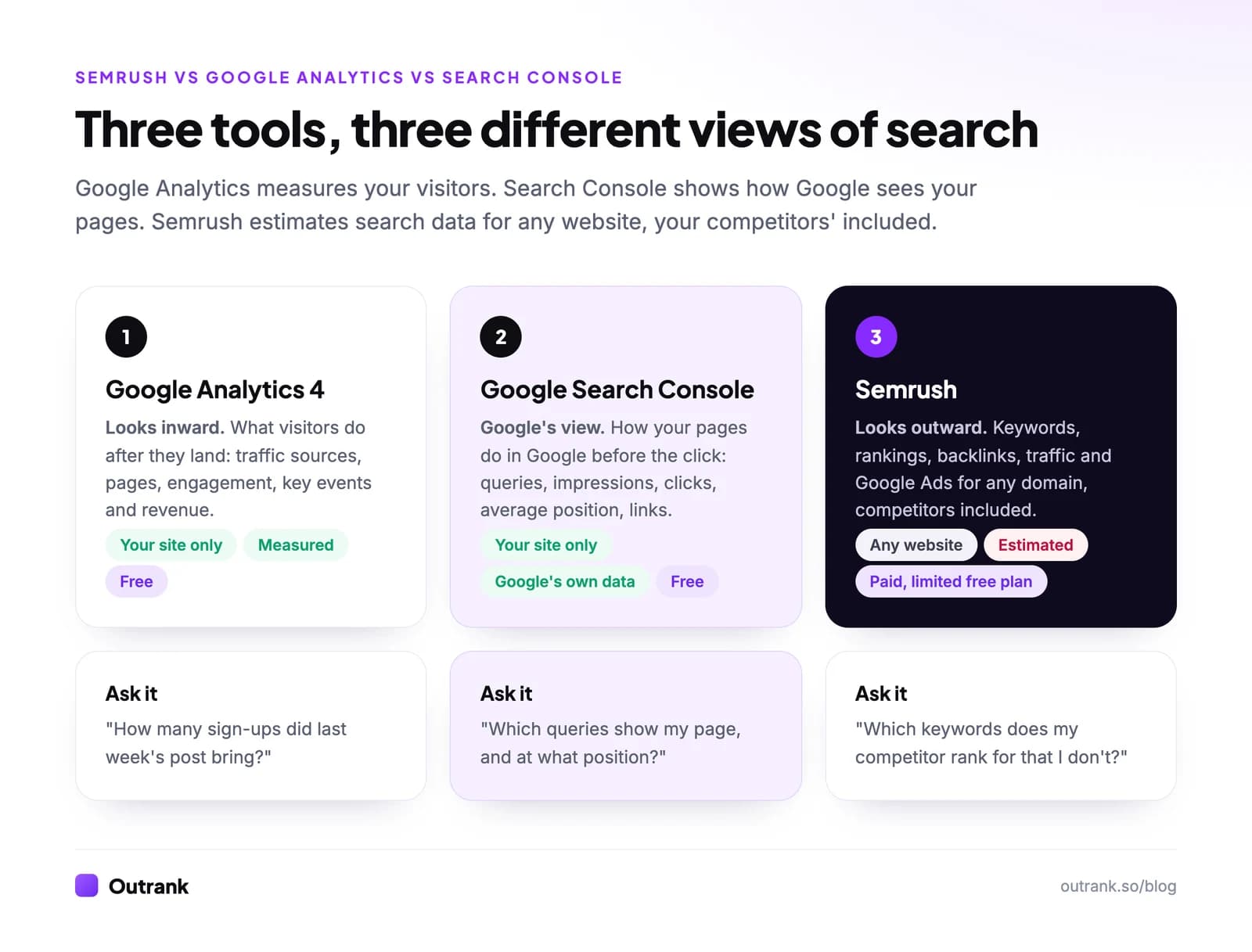
Google Analytics vs Search Console vs Semrush
| Question | Google Analytics 4 | Google Search Console | Semrush |
|---|---|---|---|
| Price | Free (360 edition is paid) | Free | Free plan (10 reports a day); paid from about $140/month |
| Whose data | Your site only | Your verified sites only | Any domain |
| Data type | Measured from your tag | Google's own search data | Estimates from Semrush databases |
| Visitor behavior and conversions | Yes: engagement, key events, revenue | No | No |
| Google queries and positions | Only when linked to Search Console | Yes: clicks, impressions, CTR, average position | Estimated, plus daily tracking of keywords you choose |
| Keyword ideas you don't rank for yet | No | No | Yes: volume, difficulty, intent |
| Competitors' traffic and keywords | No | No | Yes (estimated) |
| Backlinks | Only links that send clicks (referrals) | Sample of links Google found | Full link index for any domain |
| Competitors' Google Ads | No | No | Yes: keywords, ad copy, history |
| Best for | Measuring results | Search visibility and indexing | Research and planning |
Click a column header to sort.
Which tool answers which question
The fastest way to stop comparing them is to look at the questions you actually ask in a week:
| Your question | Open this | Where |
|---|---|---|
| How many visitors did my new post get last week? | GA4 | Reports → Engagement → Pages and screens |
| Which channel brings the most sign-ups? | GA4 | Reports → Acquisition → Traffic acquisition, with key events |
| Which Google searches show my pages, and at what position? | Search Console | Performance → Search results |
| Which keywords could I rank for next? | Semrush | Keyword Magic Tool, filtered by keyword difficulty |
| What does a competitor rank for that I don't? | Semrush | Keyword Gap |
| Who links to a competitor? | Semrush | Backlink Analytics |
| What ads do competitors run on Google? | Semrush | Advertising Research |
| Did a Google update shake my niche this week? | Semrush Sensor + Search Console | Sensor score, then your own clicks |
Still unsure where to start? Three questions:
3-question decision helper
Semrush, Google Analytics or Search Console: which do you need first?
Question 1 of 3
What do you most want to know right now?
How accurate is Semrush compared with Google Analytics?
Semrush is accurate enough for direction and comparison, and unreliable as an exact count. Its traffic numbers are modeled: Semrush sees which keywords a site ranks for, applies search volumes and expected click-through rates, and adds clickstream data. Your GA4 numbers are counted from your own tag.
The best recent public test is from UK agency Varn (January 2025). It compared Semrush's organic traffic estimates with Google Search Console data for 32 client sites:
- Semrush overestimated 15 sites and underestimated 15.
- Overestimates averaged about 152% above the real figure; underestimates were about half the real figure.
- Semrush landed within 10% of Search Console on only two of the datasets.
So use Semrush to answer "is competitor A bigger than competitor B?" and "is their traffic trending up?", not "how many visits did they get in March?". We go further into the methodology in how accurate is Semrush.
GA4 isn't perfectly complete either. Visitors who decline cookies, use ad blockers or land on a page without your tag don't show up, and Google itself says Search Console and Analytics numbers won't match because they measure different things. GA4 is a measurement of the visits it can see; it's still far closer to your reality than any third-party estimate.
Google Search Console vs Semrush
This is the comparison most people actually mean when they ask about "Semrush vs Google". Search Console is Google's own report on your site in search: clicks, impressions, click-through rate and average position, per query and per page, for up to 16 months. It's free and it's the closest thing to a ground truth for Google organic search.
Semrush covers what Search Console can't:
- Any domain. Search Console only shows sites you've verified; Semrush shows competitors.
- Keywords you don't rank for yet. Search Console only reports queries where you already appear. Semrush's keyword database lets you plan the pages you haven't written.
- Daily rank tracking for a chosen keyword list, by location and device, instead of an average position blended across every search.
- Backlinks. Search Console's Links report is a sample of links Google found to your site; Semrush has its own link index for any domain.
The practical split: Search Console to measure your search performance, Semrush to research everyone else's.
Can you connect Google Analytics to Semrush?
Yes, in two useful ways.
Organic Traffic Insights. Inside a Semrush project, you connect your Google account and pick your GA4 property and Search Console property. Semrush then combines the three sources in one dashboard: GA4 supplies post-click data (engaged sessions, engagement rate, conversions) and the "(not provided)" keywords GA4 can't show, Search Console supplies impressions and positions, and Semrush adds keywords from its own database for the same landing pages. Per Semrush's knowledge base, the number of pages you can analyze depends on your plan (10 without an SEO Toolkit subscription, up to 50 on Business).
Looker Studio (now Data Studio). Google's free reporting tool has native GA4 and Search Console connectors. Semrush's own connectors (Domain Analytics, Position Tracking and Site Audit) need a Guru or Business tier of the SEO Toolkit. With both, you can put measured traffic and Semrush rankings on one dashboard; our guide to creating SEO reports shows what to put on it.
Semrush and Google Ads
For paid search, the same inward/outward split applies.
- Semrush Advertising Research shows which keywords a competitor bids on, where their ads appear, their ad copy and ad history going back to 2012, and estimated traffic and cost. Good for planning a campaign before you spend.
- GA4 linked to Google Ads (Admin → Product links → Google Ads links) shows what your own ad clicks do after they land: engagement, key events and revenue by campaign. Good for deciding where the next dollar goes.
Semrush Sensor: is Google moving today?
Semrush Sensor tracks day-to-day changes in Google's results and scores volatility from 0 to 10: 0–2 is low, 2–5 normal, 5–8 high and 8–10 very high. A spike tells you something changed across the results; it doesn't tell you whether your site was affected. Check your own Search Console clicks and positions for the same days before you react.
What about Moz?
Moz Pro is in the same category as Semrush: a paid suite of third-party estimates (keyword research, a link index, its own Domain Authority score) for any domain. So "Moz vs Google Analytics" follows the same logic as this page, and choosing between Moz and Semrush is a question of data and price, not of measurement. If you're comparing their authority scores, read our breakdown of Moz DA vs Ahrefs DR.
Cost: free vs paid (October 2026)
| Tool | Price | Notes |
|---|---|---|
| Google Analytics 4 | $0 | The enterprise edition, GA4 360, is reported to start at $50,000 a year. |
| Google Search Console | $0 | Free for any site you can verify. |
| Semrush Free | $0 | 1 demo project and 10 reports a day across the main tools, per Semrush's pricing page. |
| Semrush paid plans | From about $140/month | The pricing page we checked from Europe in October 2026 listed an SEO plan at €134/month billed monthly, plus Starter (€190) and Pro+ (€286) bundles. US guides list the classic Pro plan at $139.95/month. Semrush offers a 7-day free trial. |
Semrush is worth paying for when keyword and competitor research is a weekly job: agencies, content teams, anyone running paid search against known competitors. If you mostly need a list of keywords you can win, there are cheaper Semrush alternatives that do that part well.
If the bottleneck isn't research but turning keywords into published pages, that's what Outrank automates. Its $99/month plan includes unlimited keyword research with live search volume and difficulty, then writes and publishes one SEO article a day to your CMS. It isn't a competitive research suite (no ad research, no traffic estimates for other domains), and it doesn't replace GA4: GA4 is how you check the pages are working.
A simple workflow that uses all three
- 1
Find the keyword in Semrush
Use the Keyword Magic Tool with a keyword difficulty filter, or Keyword Gap against two competitors, and pick a topic you can realistically rank for. - 2
Publish the page
One page per search intent. Link to it from related pages on your site. - 3
Watch Search Console for the first signals
In Performance → Search results, filter by the page. Impressions usually appear before clicks; average position tells you how far you are from page one. - 4
Measure what visitors do in GA4
Open Reports → Engagement → Landing page, filter to organic search, and check engagement rate and key events for the new page. - 5
Track and reinforce in Semrush
Add the keyword to Position Tracking, then look for link opportunities in Backlink Analytics if the page stalls on page two. - 6
Tag the links you control
Add UTM parameters to newsletter, partner and social links so GA4 attributes those visits to the right campaign instead of lumping them into referral or direct.
FAQ
Can Semrush replace Google Analytics?
No. Semrush estimates search data for any website, but it can't see what visitors do on your pages, which pages convert, or how much revenue a channel brings. Google Analytics measures that from your own tracking tag, and it's free, so every site should run it even if it also pays for Semrush.
Does Semrush use Google Analytics data?
Only if you connect it. Semrush's keyword, ranking, traffic and backlink data come from its own databases. When you connect GA4 and Search Console to a Semrush project, tools like Organic Traffic Insights show your first-party data next to Semrush's figures for your own site.
How accurate is Semrush?
Semrush is good for trends and relative comparisons, not exact counts. In Varn's January 2025 test of 32 client sites, Semrush's organic traffic estimate was within 10% of Search Console for only two; it overestimated 15 sites and underestimated 15. Treat its traffic numbers as directional.
Is Google Analytics or Semrush better for SEO?
They do different SEO jobs. Google Analytics (with Search Console) measures the results of your SEO: organic visits, engagement and conversions on your own pages. Semrush helps plan SEO: keyword research, competitor gaps, rank tracking and backlinks. Start with the free Google tools and add Semrush when research becomes a bottleneck.
What is the difference between Google Search Console and Semrush?
Search Console is Google's own free report on your verified site: real clicks, impressions, click-through rate and average position by query and page. Semrush is a paid third-party tool that estimates rankings, traffic and backlinks for any domain, including competitors, and suggests keywords you don't rank for yet.
True or false: connecting Google Analytics 4 and Google Search Console to Semrush replaces Semrush's own data with first-party data?
False. Connecting GA4 and Search Console adds your first-party data alongside Semrush's own data, for example in Organic Traffic Insights, which combines all three sources in one dashboard. Semrush's databases and its estimates for other domains don't change.
Can I use Semrush with Google Data Studio (Looker Studio)?
Yes. Semrush offers Looker Studio connectors for Domain Analytics, Position Tracking and Site Audit data, available with a Guru or Business tier of the SEO Toolkit according to Semrush's knowledge base. GA4 and Search Console connect to Data Studio for free, so you can combine measured traffic and Semrush rankings in one report.
Is Semrush free?
Partly. Semrush has a free plan with one demo project and 10 reports a day across its main tools, plus a 7-day free trial of paid plans. Full keyword lists, competitor analysis and project tools need a paid plan, which started at about $140 a month as of October 2026.