

A keyword gap analysis compares the keywords your site ranks for with those of 3–5 competitors, to find the ones they rank for and you don't (missing keywords) and the ones where they outrank you (weak keywords). You run it in a tool like Ahrefs' Competitive Analysis or Semrush's Keyword Gap, filter out brand names and irrelevant terms, then turn each real gap into a new page or an improvement to a page you already have.
The report is the easy part. The value is in the filtering and the decisions afterwards. This guide covers how to choose competitors, the exact steps in Ahrefs, Semrush and free tools, how to break down the opportunities, and how to run the same analysis for AI citations.
Key takeaways
- A keyword gap is a search term competitors rank for that you don't, or rank lower for. Missing gaps need a new page; weak gaps need a better page.
- Compare against 3–5 search competitors, meaning the sites that rank for your keywords. They aren't always your business rivals.
- Ahrefs' own gap workflow filters for at least two competitors in the top 10, a minimum volume of 20 and a KD of 30 or less.
- Exclude competitor brand names first. A non-branded keyword gap is the only one worth acting on.
- Google visibility and AI citations move together. In Outrank's study of 200 sites, Google impressions were the strongest predictor of AI citations (Spearman 0.80).
What is a keyword gap?
A keyword gap is a search query where one or more competitors rank in Google and your site doesn't, or ranks well below them. A keyword gap analysis is the process of listing those queries for a set of competitors and deciding which ones to go after.
Tools sort every keyword into zones. Semrush's Keyword Gap uses the most common names:
- Shared: "keywords, where every site entered has a ranking."
- Missing: keywords where all of your competitors rank but your site doesn't.
- Weak: "keywords where you have a ranking but it is lower than all of your competitors' rankings."
- Strong: "keywords where you are ranking higher than all of your competitors."
- Untapped: "keywords in which you don't have a ranking but one of your competitors does."
- Unique: "keywords where you have a ranking but none of your competitors do."
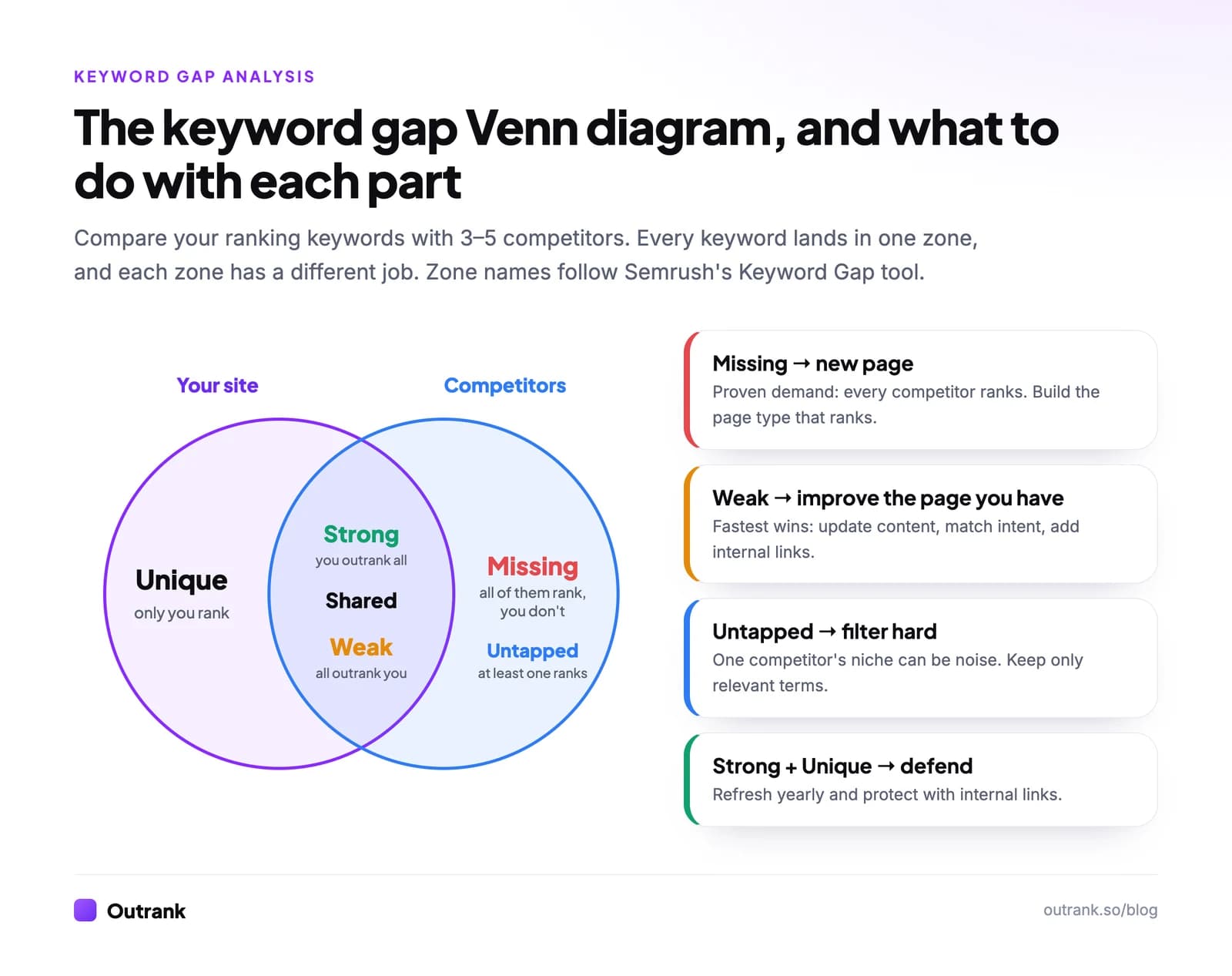
Similarweb's Keyword Gap uses traffic share instead of rankings and names its lists Core keywords, Wins, Opportunities and Losses. The logic is the same: Opportunities are where competitors get traffic and you don't, Losses are where you get less.
Keyword gap vs content gap vs competitor keyword analysis
These terms overlap, so here is the difference in one line each:
- Keyword gap analysis compares keyword lists between domains. It answers "which searches are we missing?"
- Content gap analysis looks at topics, formats and depth your pages lack. Our content gap analysis template covers it.
- Competitor keyword analysis studies one competitor's whole keyword profile, including what you already share. See our guide to competitor keyword analysis.
Step 1: Pick 3–5 search competitors
Your search competitors are the sites that rank for the keywords you want, which is not the same list as the companies you lose deals to. A project management app competes in search with other apps, but also with software review sites, productivity blogs and template galleries.
Pick 3–5 of them:
- Two or three direct rivals that sell what you sell and rank for your core terms.
- One or two content sites that win the informational searches in your niche.
- Sites of a similar size to yours. A gap against Wikipedia or a Fortune 500 brand is mostly keywords you can't win yet.
To find them, search 10 of your most important keywords and note which domains keep appearing, or run your domain through Outrank's free SEO Competitor Finder. It ranks competing domains by how many keywords they share with you and has a "Similar size" setting that hides sites with more than ten times your traffic.
Step 2: Run the gap report
Every major SEO suite has a gap tool. Here is how they compare:
Keyword gap tools compared (October 2026)
| Semrush | Keyword Gap | Up to 5 | Shared, Missing, Weak, Strong, Untapped, Unique; organic, paid or Shopping keywords | ✕ |
| Ahrefs | Competitive Analysis (keywords mode) | Ahrefs' guide uses 1–3 | Keyword opportunities you don't rank for, filtered by how many competitors rank | ✕ |
| Similarweb | Keyword Gap | Multiple | Core, Wins, Opportunities, Losses by traffic share | ✕ |
| Outrank competitor analysis | Head-to-head comparison | 1 | Topics and keyword gaps with a playbook; no login | ✓ |
| Outrank SEO Competitor Finder | Competitor discovery | n/a | Competing domains ranked by shared keywords | ✓ |
| Google Search Console | Performance report | 0 (your site only) | Your weak keywords: queries where you rank 11–30 | ✓ |
Click a column header to sort.
How to do a keyword gap analysis in Ahrefs
Ahrefs' current gap workflow runs in Competitive Analysis. Following Ahrefs' own guide (updated February 2025):
- 1
Open Competitive Analysis in keywords mode
Enter your domain in the first field and your competitors below it. Ahrefs suggests competitors if you leave the fields empty. - 2
Show keyword opportunities
Click Show keyword opportunities to list keywords your competitors rank for and you don't. - 3
Turn on "main positions only"
This removes rankings inside image packs, sitelinks and carousels, which inflate the list. - 4
Filter the list
Exclude competitor brand names (with misspellings), require at least two competitors in the top 10, set a minimum volume of 20 and a maximum KD of 30 for quick wins. - 5
Export
Export to CSV and continue with the prioritization below.
How to do a keyword gap analysis in Semrush
Open Keyword Gap in Semrush's SEO toolkit, enter your domain as "You" and add competitors. Semrush describes it as "a side-by-side comparison between keyword profiles of up to five competitors". You can choose organic, paid or PLA (Shopping) keywords for each domain, which makes it the best option if you also want to see what competitors bid on.
Start with the Missing and Weak tabs. Then use the filters Semrush documents: position range (for example 11–20), intent, keyword difficulty, volume and keyword include/exclude for brand terms.
A free keyword gap analysis
Without a paid tool, combine three free sources:
- Find competitors with the SEO Competitor Finder.
- Compare head to head with Outrank's free SEO competitor analysis: enter a competitor's domain and yours to see where they win and where you can outrank them, with no login.
- Find your weak keywords in Search Console: go to Performance → Search results, filter Position to greater than 10, and sort by impressions. Every query on page two is a keyword where someone else outranks you. Our guide to checking keyword rankings shows the filters.
Step 3: Filter the noise
A raw gap report can list tens of thousands of keywords. Most of them don't deserve a page. Cut in this order:
- Brand terms. Remove every competitor brand name, product name and misspelling. What's left is your non-branded keyword gap, the only part you can realistically win. "Notion templates" in a Notion gap report is not an opportunity.
- Off-topic keywords. Content sites rank for everything. Exclude topics you don't cover or sell.
- Keywords only one competitor ranks for. Requiring two or more competitors in the top 10 keeps keywords with proven demand across your niche.
- Volume and difficulty. Set a floor (Ahrefs uses 20 searches a month) and a KD ceiling that fits your site. Our guide to keyword difficulty explains what each score means.
- Wrong intent. If the results are product pages and you planned a blog post (or the reverse), skip it or change the page type.
Step 4: Keyword opportunities breakdown
Each zone of the report calls for a different action:
| Gap type | What it tells you | Action | Effort |
|---|---|---|---|
| Weak (you rank, but below all competitors) | You have a page; it is losing | Update the page: match intent, add missing subtopics, refresh dates and data, add internal links | Low |
| Missing (all competitors rank, you don't) | Proven demand across your niche | Create a new page of the type that ranks | Medium |
| Untapped (at least one competitor ranks) | Possible demand, often noise | Keep only relevant, winnable terms; batch them into clusters | Medium |
| Shared but page two | You're in the race | Improve the page and point internal links at it from related posts | Low |
| Strong and Unique | You're winning | Refresh yearly; watch for new competitors | Low |
Start with Weak keywords. Updating a page Google already ranks usually moves faster than publishing a new one. Then take Missing keywords in clusters: several missing keywords often share the same results and belong on one page. Group them with keyword clustering before you write, or you will create pages that compete with each other.
To decide between the keywords that survive, score them on business value, intent fit and winnability with the method in how to pick keywords.
Step 5: Turn gaps into pages
For every keyword (or cluster) you keep, write down: the primary keyword, the page type that ranks, the URL you'll create or update, and two or three top-ranking pages to beat. That is a content brief in four lines; our content brief template has the full version.
Then publish in order of effort: page updates first, new pages for Missing clusters next. Recheck the gap report a month or two later. Missing keywords should move into Weak or Shared as Google picks up the new pages.
Citation gaps: the same analysis for AI answers
A citation gap is the AI search version of a keyword gap: prompts where ChatGPT, Perplexity, Gemini or Google's AI Overviews cite your competitors and not you. To analyze citation gaps against competitors:
- List 20–50 prompts your customers would ask, built from your best keywords ("best invoicing app for freelancers", "how to send a late payment reminder").
- Run them in each AI assistant and record which domains are cited or recommended. Repeat monthly; answers change.
- Compare citation counts per competitor, like a keyword gap report: prompts where all competitors are cited and you aren't are your "missing" citations.
- Check which of your pages already get cited. Bing Webmaster Tools now reports this; see our guide to the Bing AI performance report.
Closing keyword gaps helps here too. In Outrank's study of AI citations across 200 sites, Google impressions were the strongest predictor of how often a site gets cited (Spearman 0.80), and sites with DR 30+ got 29× the citations of sites under DR 10. Outrank's AI visibility tracking tracks these mentions for you across ChatGPT, Perplexity, Gemini, Copilot, AI Overviews and AI Mode.
How often to run a keyword gap analysis
Quarterly is enough for most sites. Run it monthly if you publish several pages a week or your niche moves fast, and right after a competitor launches a new section. Between full runs, Search Console's page-two queries give you a free, always-current list of weak keywords.
If you want the whole loop handled, Outrank analyzes your niche and competitors, builds a 30-day keyword plan and publishes one article a day to your CMS, with backlinks from its exchange to help new pages rank.
FAQ
What is keyword gap analysis?
Keyword gap analysis is the process of comparing your site's ranking keywords with those of 3–5 competitors to find searches they rank for and you don't, or where they outrank you. The result is a list of content opportunities with proven demand. Most SEO tools group them as missing, weak, untapped, shared, strong and unique keywords.
How do I do a keyword gap analysis in Ahrefs?
Open Competitive Analysis in keywords mode, enter your domain and your competitors, and click "Show keyword opportunities". Turn on "main positions only", exclude competitor brand names, require at least two competitors in the top 10, and set limits for volume and keyword difficulty. Export the list and prioritize it.
What is the best keyword gap tool?
Semrush's Keyword Gap has the clearest categories and compares up to five competitors across organic, paid and Shopping keywords. Ahrefs' Competitive Analysis has strong filters for how many competitors rank. For a free check, Outrank's SEO competitor analysis compares your site with one competitor without a login.
What is a non-branded keyword gap?
A non-branded keyword gap is the gap report after you remove every competitor's brand names, product names and misspellings. Branded keywords (like a competitor's login or pricing page) are searches you can't realistically win. The non-branded list is where the real opportunities are.
Can I do a keyword gap analysis for free?
Yes. Use Outrank's free SEO Competitor Finder to identify competitors and its SEO competitor analysis to compare your site with one of them. Then use Google Search Console's Performance report, filtered to positions above 10, to find the keywords where others outrank you.
How do I find a keyword gap without a tool?
Search your 10–20 most important keywords in a private window and note which competitor pages rank where you don't. Then check those competitors' blogs and category pages for topics you haven't covered. It is slower than a tool, but it shows you the actual pages you need to beat.