

Topical authority is the degree to which search engines treat a site as a reliable, go-to source on a specific subject. You earn it by covering that subject in depth with interlinked pages, staying focused on it, and getting cited by other sites in the same field. It isn't a score you can look up in any tool. Google has confirmed a "topic authority" system for news, its own content guidelines ask whether a site has a primary purpose or focus, and the documents leaked in 2024 describe site-level attributes that measure how closely pages stick to a site's core topic.
Below: what topical authority is and isn't, what Google has actually said, what Outrank's data from hundreds of sites shows about depth and visibility, a worked topical map, and a calculator for measuring your coverage and topic share.
Key takeaways
- Topical authority is a site's standing as a go-to source on one subject, built by covering it in depth, staying focused, and being cited by peers.
- Google confirmed a topic authority system for news in May 2023. Its signals: how notable a source is for a topic or place, how often its original reporting is cited, and its reputation.
- Depth correlates with visibility. Among 200 Outrank sites, 67% of those with fewer than 50 Google-visible pages had zero AI citations; none of the 110 sites with 400+ visible pages had zero.
- Pace matters. Sites publishing 30+ articles a month reached a median 2.27× their pre-Outrank Google clicks, versus 1.07× for sites publishing fewer than 5 (Outrank results, October 2026).
- Volume is not authority. Google says publishing on many topics hoping some rank, or a page for every query variation, works against you.
What topical authority is, and what it isn't
Topical authority describes how much a search engine trusts a site on a subject, as opposed to trusting it in general. A site that covers home espresso from equipment to troubleshooting, with pages that link to each other and links from other coffee sites, is a stronger candidate for an espresso query than a bigger site that published one espresso article among thousands of unrelated ones.
It gets confused with three neighbors:
| Concept | What it measures | Who defines it | Can you look it up? |
|---|---|---|---|
| Topical authority | Trust on one subject | An SEO concept, partly confirmed by Google | No |
| Domain Authority / Domain Rating | Strength of a site's backlink profile, on a 0–100 scale | Moz / Ahrefs | Yes, in those tools |
| E-E-A-T | Experience, expertise, authoritativeness and trust of content and creators | Google's quality rater guidelines | No |
| Semantic SEO | How clearly a single page communicates its meaning | An SEO practice | No |
The short version: semantic SEO works at the page level, topical authority at the site level, and DR or DA only at the link level. A DR 80 news site can lose a niche query to a DR 25 specialist. Our guide to Domain Rating vs Domain Authority explains what those link scores do and don't capture.
What Google has actually confirmed
Plenty of topical authority advice is folklore. Here is the evidence, from strongest to weakest.
Confirmed for news. In May 2023 Google described a topic authority system that helps decide which expert sources to show for news queries in specialized areas such as health, politics and finance. Its prominent signals are how notable a publication is for a topic or location, how often its original reporting is cited by other publishers, and its reputation (history of quality reporting, awards, recommendations from professional bodies). That system is specific to news, but the signals map neatly onto any niche: be known for the subject, be cited for it, keep a clean record.
Written into Google's content guidelines. Google's guide to creating helpful, reliable, people-first content asks site owners "Does your site have a primary purpose or focus?" and whether the content shows first-hand expertise and depth of knowledge. Its list of warning signs includes producing lots of content on many different topics in the hope that some of it performs, and entering a niche without real expertise just for the traffic.
Described in the 2024 documentation leak. Internal API documentation that leaked in May 2024 lists site-level attributes called siteFocusScore and siteRadius. In Mike King's analysis, siteFocusScore captures how much a site sticks to a single topic, and siteRadius how far a page strays from it, based on embeddings of the site and its pages. The leak shows the attributes exist, not how much they weigh, and Google cautioned against drawing conclusions from out-of-context documents.
Contradicted: authority by volume. Google's guide to optimizing for generative AI search says that a high quantity of pages doesn't make a site higher quality or more relevant, and that creating separate content for every variation of a query primarily to manipulate rankings violates its scaled content abuse policy. Depth means covering distinct subtopics well, not publishing near-duplicates.
What our data shows about depth and visibility
Outrank publishes articles for thousands of sites and many connect Google Search Console, so we can see how coverage relates to results. Two findings are relevant here. Both are correlations: sites that publish more have often been around longer and hold more links.
Median AI citations per site, by number of Google-visible pages
0
5
13.5
57
121.5
Under 50 pages
15 sites, 67% never cited
50–149
33 sites
150–399
42 sites
400–999
44 sites, none at zero
1,000+
66 sites, none at zero
Sites with fewer than 50 pages visible in Google were mostly invisible to AI assistants too. Every site with 400 or more visible pages was cited at least once. And at the same level of Google visibility, sites with 100+ Outrank articles earned up to 3.4× the citations of sites with fewer (study). Breadth of coverage within a niche looks like an input AI assistants reward, not just Google. Most of what they cite is blog content, too: in our benchmark of what four AI assistants cite, it made up 74% of the 2,671 sources ChatGPT, Perplexity, Gemini and Claude cited across 96 questions.
The second finding is about pace. On Outrank's open results page, sites are compared with their own pre-Outrank baseline:
Median Google clicks vs the 28 days before joining, by articles published per month
Under 5 a month
50% of sites grew
1.07×
5–14 a month
70% grew
1.38×
15–29 a month
73% grew
1.92×
30+ a month
84% grew
2.27×
Consistent publishing inside one niche is how coverage accumulates. That's the practical meaning of topical authority: by the time you've answered most of the questions in your field, Google and AI assistants have many reasons to show you and few reasons to show the generalist.
How to build topical authority in five steps
1. Pick a core topic narrow enough to finish
"Coffee" is a category. "Home espresso" is a topic a small site can cover completely in a year. A good core topic has a few hundred distinct questions, a clear audience, and a natural link to what you sell. If you can't imagine ever "finishing" the topic, it's too broad for now. Start narrow and widen later into adjacent topics (home espresso → specialty beans → coffee gear for cafés).
2. Build a topical map
A topical map is the list of every subtopic your site should cover for the core topic, grouped into clusters, with one planned page per search intent. Sources, in order of usefulness:
- Your Search Console queries (Performance → Search results → Queries), including the ones you rank badly for.
- People Also Ask and related searches for your core terms.
- Competitor sitemaps and top pages: what do the specialists in your niche cover that you don't? Our content gap analysis template structures this.
- A keyword tool for volume and difficulty, then keyword clustering to merge variants that share an intent.
Here is what a finished map looks like for home espresso:
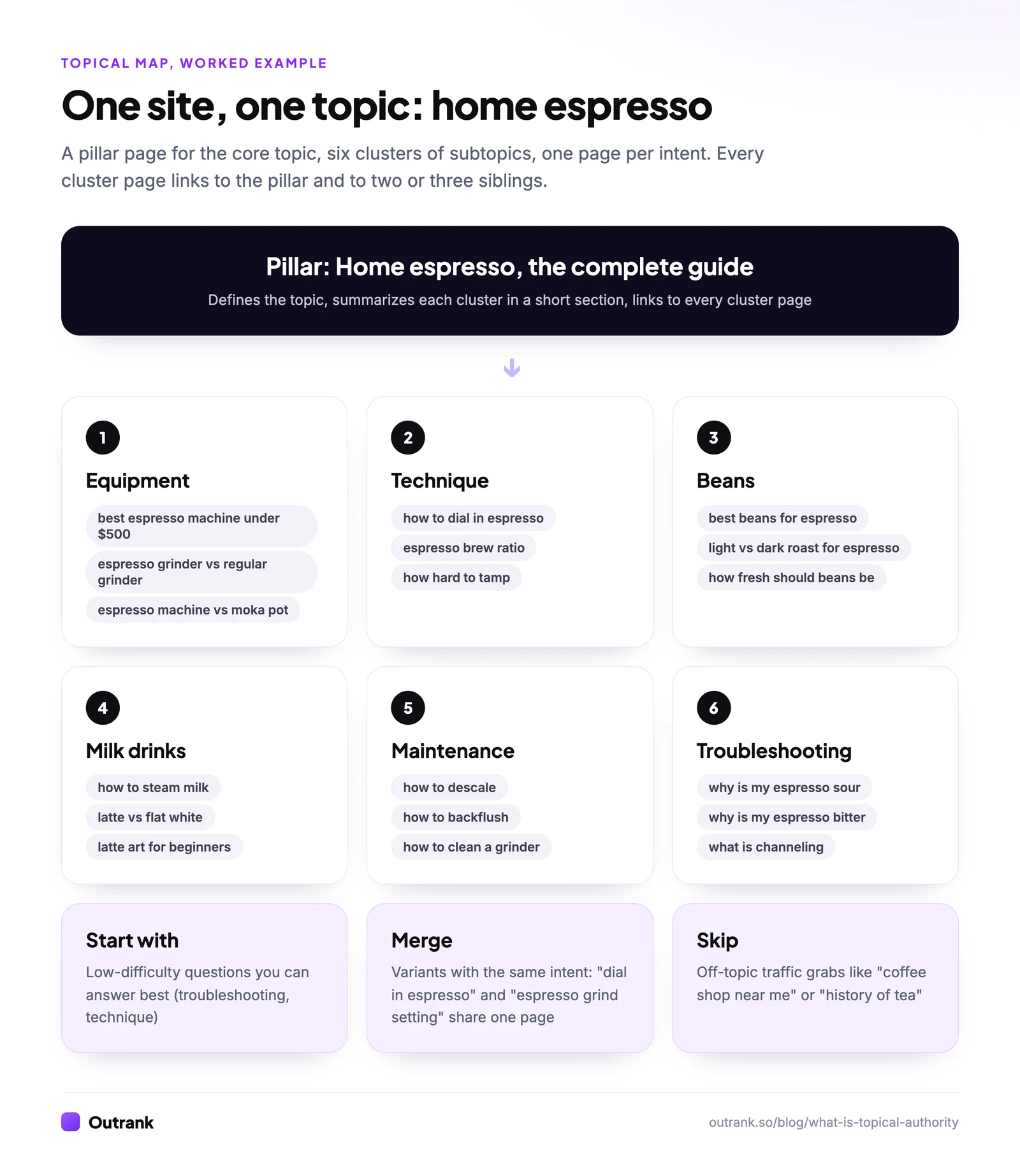
The six clusters are equipment (best espresso machine under $500, espresso grinder vs regular grinder, espresso machine vs moka pot), technique (dialing in, brew ratio, tamping), beans (best beans for espresso, light vs dark roast, freshness), milk drinks (steaming milk, latte vs flat white, latte art), maintenance (descaling, backflushing, cleaning a grinder) and troubleshooting (sour shots, bitter shots, channeling). A real map for this niche would be several times larger; eighteen pages are enough to show the shape.
3. Write one page per intent, easiest wins first
Order matters. New sites rank faster for specific, low-competition questions than for head terms, and each ranking page adds evidence that you know the subject. Of the 183,540 articles Outrank generated with a known keyword difficulty in the 90 days to October 2026, 63% targeted keywords with difficulty under 20, and the median search volume was 170 a month (Outrank platform data). The long tail is where a focused site wins first. Our guide to finding low-competition keywords shows how to spot them.
Write the pillar page early but keep it short at first: a definition, a summary of each cluster, and links. It grows as the clusters fill in. Pillar page examples show how established sites structure theirs.
4. Interlink deliberately
Internal links are how a topical map becomes visible to a crawler. Three rules cover most of it:
- Every cluster page links to the pillar, and the pillar links to every cluster page.
- Each page links to two or three siblings in the same cluster, with anchors that describe the destination ("how to dial in espresso", not "read more").
- No orphan pages. Every new page gets at least two internal links pointing at it on the day it goes live.
Why internal links matter for SEO goes deeper, and how to find internal links to a page helps you audit the ones you have.
5. Earn links and mentions from your own niche
Google's news system counts how often other publishers cite your work; links from sites in your field are the general-web equivalent. In uSERP's 2026 survey, 58.6% of senior SEOs named the topical relevance of the linking page as the single most important factor when judging a backlink (uSERP). A link from an espresso blog inside an article about grinders does more for an espresso site than a link from a general directory.
That's the logic behind Outrank's backlink exchange: links are placed inside relevant, in-niche articles on other Outrank sites, never in footers or link lists, with a guarantee of 15 verified backlinks a month. Whatever method you use, judge each link by how close the linking page is to your topic.
How to measure topical authority
No tool reports topical authority directly, so measure its effects. Three numbers do the job.
Coverage: the share of your topical map with a published page. Simple, and the one you control.
Ranking coverage: the share of your map where your page ranks in Google's top 10. Check it in Search Console by filtering each page's queries, or with a rank tracker.
Topic share: the share of all available search traffic for your topic that lands on your site. SEO consultant Kevin Indig calls this topic share and frames it like market share (Clearscope summary). To approximate it, add up your monthly clicks from topic queries in Search Console (Performance → Search results → Query filter → Custom (regex), for example espresso|crema|portafilter|tamp) and divide by the total monthly search volume of your topical map's keywords from a keyword tool.
Interactive calculator
Topical map coverage and topic share
Topic share (approximate)
2%
- Map coverage
- 31.3%
- Ranking coverage (top 10)
- 10%
- Months to cover the rest of the map
- 6.9
Read the three together. High coverage with low ranking coverage means the pages exist but don't convince Google yet: improve them and add links. High ranking coverage with low topic share means you rank, but low (positions 6 to 10 earn few clicks) or on the small subtopics. Low coverage means you simply haven't written enough of the map yet, which is the most common case and the easiest to fix.
How long does topical authority take to build?
It depends on your niche and starting point, but our data gives a realistic shape. Across 2,119 sites that publish with Outrank, median Google clicks were up 7% in the first 28 days, 27% after 84 days, and 2.0× by month seven (Outrank study): three slow months, then it compounds. A quarter of sites had fewer clicks than before, so it isn't automatic. Expect the first quarter to show impressions and long-tail rankings before clicks move.
Common topical authority mistakes
- Starting too broad. A site about "marketing" competes with everyone. A site about "email marketing for Shopify stores" can finish its map.
- One page per keyword variation. Pages for "espresso ratio", "espresso brew ratio" and "espresso dose to yield" compete with each other. Merge them.
- Drifting off topic for traffic. Viral off-topic posts dilute focus (the siteRadius idea) and attract visitors who never convert.
- Orphan pages. A page no other page links to is barely part of your topical map from a crawler's point of view.
- Never updating. Coverage decays as products, prices and advice change. Refresh the pages that lose clicks first.
FAQ
What is topical authority in SEO?
Topical authority is how much search engines trust a website as a source on a specific subject, as opposed to trusting it in general. Sites build it by covering a subject in depth with interlinked pages, staying focused on that subject, and earning links and mentions from other sites in the same field. It isn't a published metric, so you measure it through coverage, rankings and topic share.
How do you build topical authority?
Pick a core topic narrow enough to cover completely, build a topical map of every subtopic grouped into clusters, and publish one page per search intent, starting with low-competition questions. Link every cluster page to a pillar page and to related pages, keep publishing consistently, and earn links from sites in your niche.
Is topical authority a Google ranking factor?
Google has confirmed a topic authority system for news results, and its helpful content guidance asks whether a site has a primary purpose or focus. The 2024 leaked documents also describe site-level topic focus attributes. Google hasn't confirmed a general "topical authority score", so treat it as a strong pattern supported by evidence rather than a single documented factor.
What is the difference between topical authority and domain authority?
Domain Authority (Moz) and Domain Rating (Ahrefs) are third-party scores of a site's overall backlink strength. Topical authority is a site's trust on one specific subject, built through content depth, focus and relevant citations. A small specialist site can have low domain authority and still outrank a large general site on its niche topic.
How many articles do you need for topical authority?
There's no fixed number: it depends on how many distinct questions your topic has. Build a topical map and aim to cover it. In Outrank's study of 200 sites, those with fewer than 50 Google-visible pages were mostly never cited by AI assistants, while every site with 400 or more visible pages was cited, which suggests small sites benefit most from adding depth.
How long does it take to build topical authority?
Usually several months. Across 2,119 sites publishing with Outrank, median Google clicks rose 7% in the first 28 days, 27% after 84 days and reached 2.0× by month seven. Narrow niches with little competition move faster; broad, competitive topics take longer.