


A content gap analysis template is a spreadsheet that lists the searches and topics your audience cares about, shows who ranks for each (you and two to four competitors), labels the type of gap and scores each one so you know what to write or fix first. The useful version doesn't stop at "keywords they rank for and we don't". It also catches pages where you rank on page two, formats you're missing, funnel stages you skip and answers AI assistants give without citing you.
Below: the template to copy, the seven gap types with how to spot each, a calculator for what a gap is worth, and a real gap analysis from this blog's own Search Console with what we changed.
Key takeaways
- A content gap is any search your audience makes where a competitor's page serves them better than yours, or where you have no page at all.
- Missing keywords are only one of seven gap types. Depth, freshness and format gaps on pages you already have are usually faster to close.
- Filter for winnable gaps. The keywords Outrank targets have a median difficulty of 14 and a median of 170 searches a month, and 81% have a difficulty under 30.
- Format gaps are worth real traffic. Across 3,332 sites, free tools and calculators earned 2.11× the click-through rate of the same site's articles at positions 4–10.
- Score every gap on demand, relevance, business value and effort, then work the list top down.
What is a content gap analysis?
A content gap analysis is a comparison between the content your audience looks for and the content you have, usually measured against the sites that rank for the same searches. The output is a prioritised list of pages to create, update or merge.
It overlaps with a keyword gap analysis, which only compares keyword lists between domains. A content gap analysis starts from that list and adds the questions a keyword tool can't answer: is our page too thin, too old, the wrong format, or aimed at the wrong stage of the buying journey? It also differs from a content audit, which grades the pages you already have. The audit looks inward; the gap analysis looks at the market.
The content gap analysis template
Paste this header row into cell A1 of a Google Sheet or Excel workbook, then split it into columns (Data → Split text to columns in Sheets, Data → Text to Columns in Excel).
Topic / query,Monthly searches,Keyword difficulty,Intent,Funnel stage,Competitor A position,Competitor B position,Competitor C position,Our URL,Our position,Gap type,Relevance (1-3),Business value (1-3),Effort (1-3),Priority score,Action,Target URL,Brief link,Owner,DuePut this formula in Priority score (column O) and fill it down:
=ROUND(SQRT(B2) * L2 * M2 / N2, 0)The square root on search volume stops a single 20,000-search head term from burying fifty specific queries your buyers actually type. Relevance and business value multiply, so a high-volume query that's off-topic for you still scores low. Effort divides: updating an existing page is a 1, a new article a 2, a new tool or a cluster of pages a 3.
Here's the template filled in with real rows from this blog's Search Console (90 days to October 2026). The competitor columns are left out because the point here is our own position.
| Query | Impressions (90 days) | Our position | Gap type | Action |
|---|---|---|---|---|
| content briefs | 641 | 31.3 | Depth | Update content brief examples with a definition up top |
| seo content brief example | 581 | 20.4 | Format | Replace the list of other companies' briefs with six filled-in briefs |
| content brief template seo | 381 | 23.5 | Format | Add a copy-and-paste brief template with SEO fields |
| website content audit template | 120 | 40.4 | Format | Add a real template (header row, rubric, example rows) |
| what is a content brief | 142 | 8.5 | Depth | Answer it in one sentence in the first paragraph |
| content audit spreadsheet | 33 | 8.8 | Format | Add a paste-ready CSV version of the template |
Every one of those pages ranked for its query and still earned almost no clicks. None of them was a missing keyword. They were format and depth gaps: searchers wanted a template or an example, and the page gave them an essay. That pattern is common on blogs that have published for a while, and it's why the template has a Gap type column rather than a simple yes/no.
The 7 types of content gaps
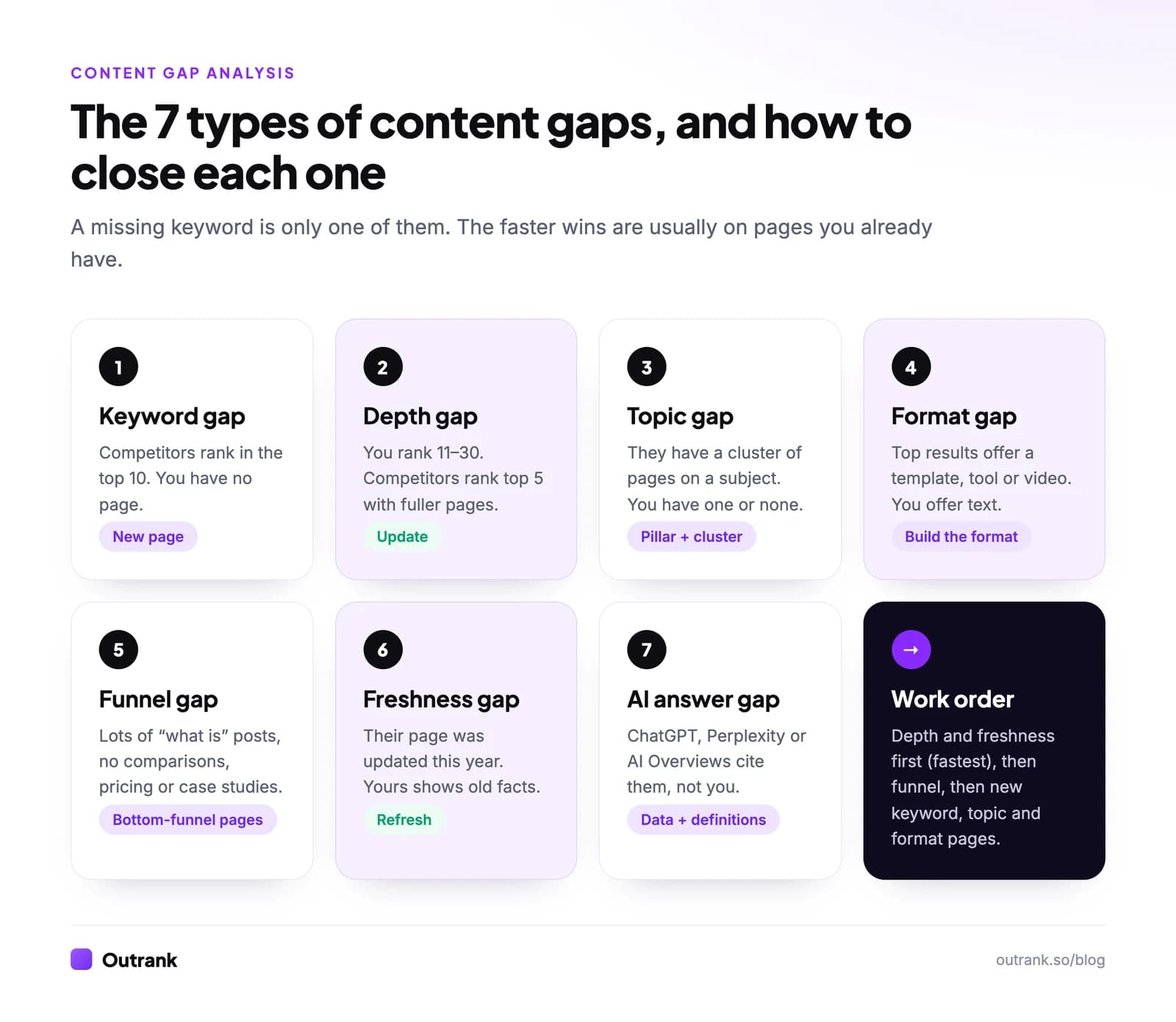
| Gap type | How to spot it | Usual fix |
|---|---|---|
| Keyword gap | Competitors rank in the top 10, you have no page | New page |
| Depth gap | You rank 11–30, competitors rank top 5 with more complete pages | Update: answer earlier, add the sub-topics they cover |
| Topic gap | Competitors have a cluster of pages on a subject, you have one or none | A pillar page plus supporting articles |
| Format gap | The top results offer a template, tool, calculator or video; you offer text | Build the format the searcher expects |
| Funnel gap | You have plenty of "what is" posts but no comparisons, alternatives, pricing or case studies | Bottom-of-funnel pages |
| Freshness gap | Competitors updated this year; your page shows old prices, screenshots or years | Refresh facts and examples, then update the date honestly |
| AI answer gap | ChatGPT, Perplexity or AI Overviews cite competitors for your topics, not you | Clear definitions, original data, more pages Google already shows, mentions on other sites |
Work them roughly in this order: depth and freshness gaps first, because the page already exists and Google already shows it; then funnel gaps, because they sit closest to revenue; then new keyword, topic and format pages. A few notes on the less obvious ones.
Depth gaps hide in Search Console. In Performance → Search results, filter position to "greater than 10" and sort by impressions. Every query with high impressions and a position between 11 and 30 is a page Google already considers relevant but not good enough.
Format gaps are often the biggest wins. Outrank's study of 6.2 million pages compared each format with the same site's other articles at the same positions:
Click-through rate vs the same site's blog articles, positions 4–10
Free tools & calculators
74% of 328 sites
2.11×
Comparisons & alternatives
43% of 539 sites
0.88×
How-to articles
37% of 607 sites
0.8×
"Best X" listicles
37% of 577 sites
0.69×
"What is" definitions
23% of 326 sites
0.52×
If competitors answer a query with a calculator or a downloadable template and you answer it with 2,000 words, that's a format gap no amount of rewriting will close.
Freshness gaps matter for AI answers too. Ahrefs found that of ChatGPT's 1,000 most-cited pages with a detectable date, 89.7% had been updated in 2025. To see which AI assistants mention competitors instead of you, track your topics with AI visibility.
How to fill in the template
- Pick two to four competitors that rank, not just the ones you sell against. Search five of your most important queries and note the domains that keep appearing. Publishers, review sites and forums often beat direct rivals. Outrank's free competitor finder does this from your domain.
- Pull their keywords. Ahrefs' Content Gap shows "the keywords your competitors rank for, but you don't" across several competitors at once; filtering for keywords that every competitor ranks for gives the cleanest list. Semrush's Keyword Gap does the same job. Without a paid tool, open each competitor's
/sitemap.xml, paste the URLs into a sheet and group them by the words in the slugs: you'll see their topic coverage in ten minutes. - Pull your own data. Export queries and pages from Search Console for the last 3 months. This is where depth gaps show up, and it stops you from creating a page that competes with one you already have (see keyword cannibalization).
- Look at the results page for your top 20 rows. Note the format of the top 5 results and whether an AI Overview appears. That fills in the gap type.
- Score relevance, business value and effort, let the formula rank the list, and assign an action and an owner to the top rows.
- Group what's left into clusters before you brief anything. Five gap keywords that one page can cover are one article, not five. Our guide to keyword clustering covers how.
Which gaps are actually winnable?
Most sites can't close a gap on a keyword with difficulty 60 any time soon. The keywords Outrank picks for its customers show where the winnable long tail sits:
14
median keyword difficulty of keywords Outrank targets
63% are under 20 and 81% are under 30
170
median monthly searches per target keyword
96.7% are under 1,000 searches a month
200,871
articles behind these numbers
For 4,348 websites in the 90 days to October 2026
Source: Outrank platform data, 90 days to October 2026. A practical first filter for a young site: difficulty under 30, at least some search volume, and no competitor brand names. Then sort by priority score. For more on picking those, see finding low-competition keywords.
What is a gap worth?
Before you commit a quarter to closing gaps, put a rough number on it. Enter how many gap keywords you plan to cover and where you can realistically rank.
Interactive calculator
How much traffic would closing your content gaps bring?
Estimated visits per month
175
- Blended click-through rate
- 2.1%
- Estimated visits per year
- 2.1K
The calculator makes one thing obvious: position matters far more than the number of keywords. Fifty gaps at position 8 bring less traffic than ten at position 2, which is why depth gaps on pages you already have usually come first.
From gap list to published pages
A gap list is only useful once each row turns into a brief. For every row marked "new page" or "update", write a brief with the target query, the gap type and what the competitor page does better; our content brief template has the fields. Then schedule the work in a website content plan.
If the list is long, this is where automation pays off. Outrank picks long-tail keywords a site can rank for, writes the articles and publishes them daily, which closes keyword and topic gaps at a pace a small team can't match. The depth, format and funnel gaps on your most important pages still deserve your own attention.
FAQ
What is a content gap analysis?
A content gap analysis compares the searches and topics your audience cares about with the content you have, usually against two to four competitors that rank for the same searches. It produces a prioritised list of pages to create, update or merge.
What is the difference between a content gap analysis and a keyword gap analysis?
A keyword gap analysis lists keywords competitors rank for and you don't. A content gap analysis starts from that list but also flags pages that are too thin, too old, the wrong format or missing a funnel stage, so it covers pages you already have as well as missing ones.
How do I do a content gap analysis for free?
Use Google Search Console for your own queries and positions, search your main queries to see who ranks and in what format, and read competitors' XML sitemaps to see which topics they cover. A spreadsheet with the template above is enough to score and prioritise the result.
How many competitors should I include?
Two to four. Pick sites that rank for your target searches, which may be publishers or review sites rather than direct rivals. Keywords that several competitors all rank for are the strongest signal, and more than four competitors mostly adds noise.
How often should I run a content gap analysis?
Once or twice a year for a full analysis, and a quick check of Search Console for depth gaps every quarter. Run one sooner if you launch a product, enter a new market or see a competitor start publishing heavily on your topics.