

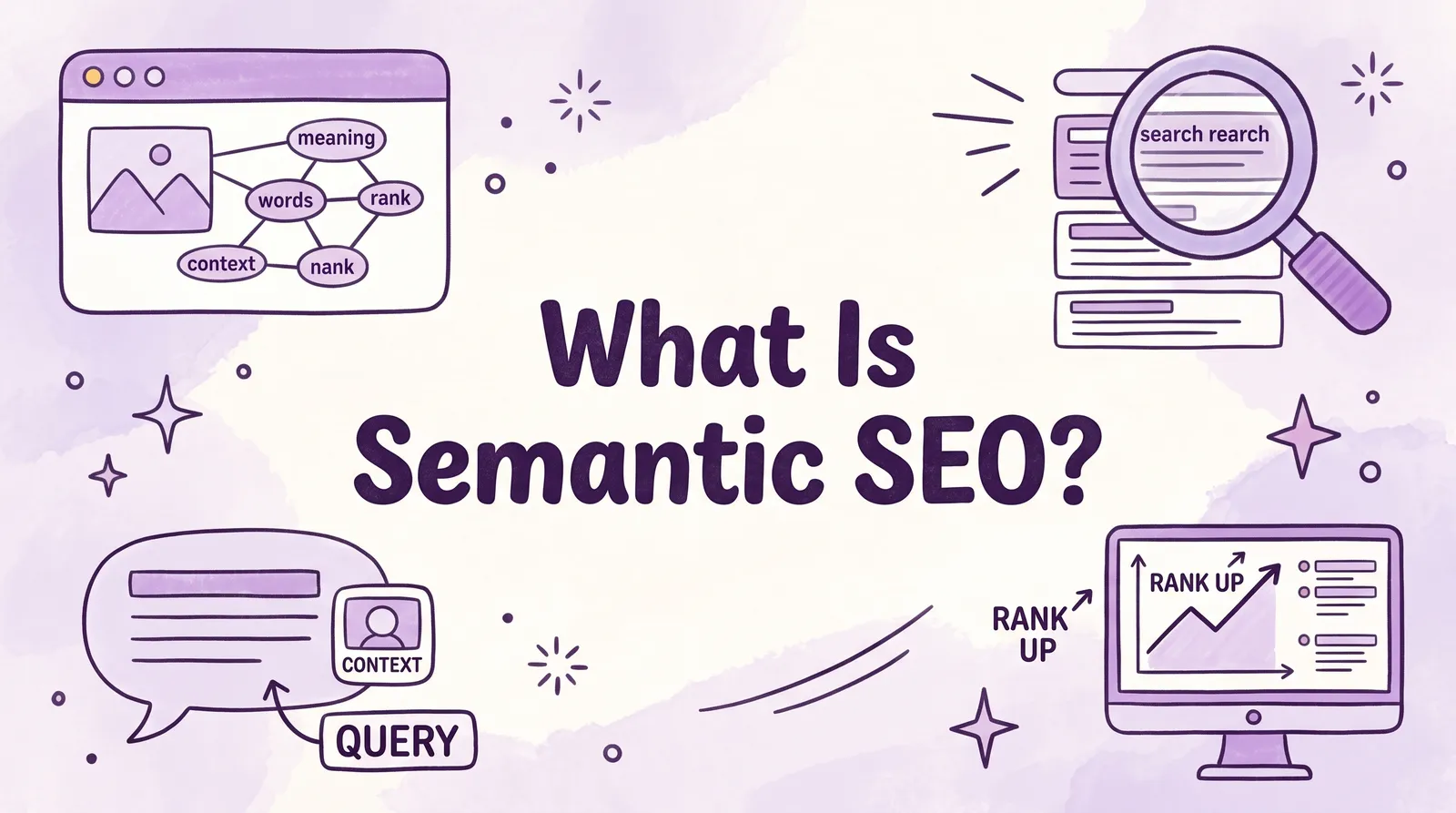
Semantic SEO is the practice of optimizing a page for what a search means rather than the exact words typed. In practice that means four things: make the main entity (the "thing" the page is about) unmistakable, match the intent behind the query, cover the subtopics and follow-up questions a searcher expects, and connect related pages with internal links and accurate structured data. It works because Google stopped matching strings of text years ago. Since the Knowledge Graph (2012) and language models like BERT (2019), it matches concepts.
Below: a one-sentence definition you can quote, how search moved from strings to things, the four parts of semantic SEO with a worked example, what structured data still does in 2026, and a 14-point checklist you can run on any page.
Key takeaways
- Semantic SEO is optimizing content for meaning (entities, intent and topic coverage) instead of exact-match keywords.
- Google's Knowledge Graph launched in 2012 with 500 million entities and 3.5 billion facts. By 2020 it held over 500 billion facts about 5 billion entities.
- One page per intent, not per keyword variation: Google says creating separate pages for every query variation to manipulate rankings violates its scaled content abuse policy.
- Structured data is not required to appear in Google's AI features, and FAQ rich results stopped showing on May 7, 2026. Use markup to describe what is visible, not as a ranking lever.
- Definitions alone are weak pages: across 3,332 sites, 'what is' pages earned 0.52× the click-through rate of the same site's other articles (Outrank, October 2026).
What semantic SEO means
Semantic SEO is the practice of making it easy for search engines and AI systems to understand what a page is about, which real-world things it discusses, and which question it answers, so it can rank for every query with that meaning and not just the phrase you targeted.
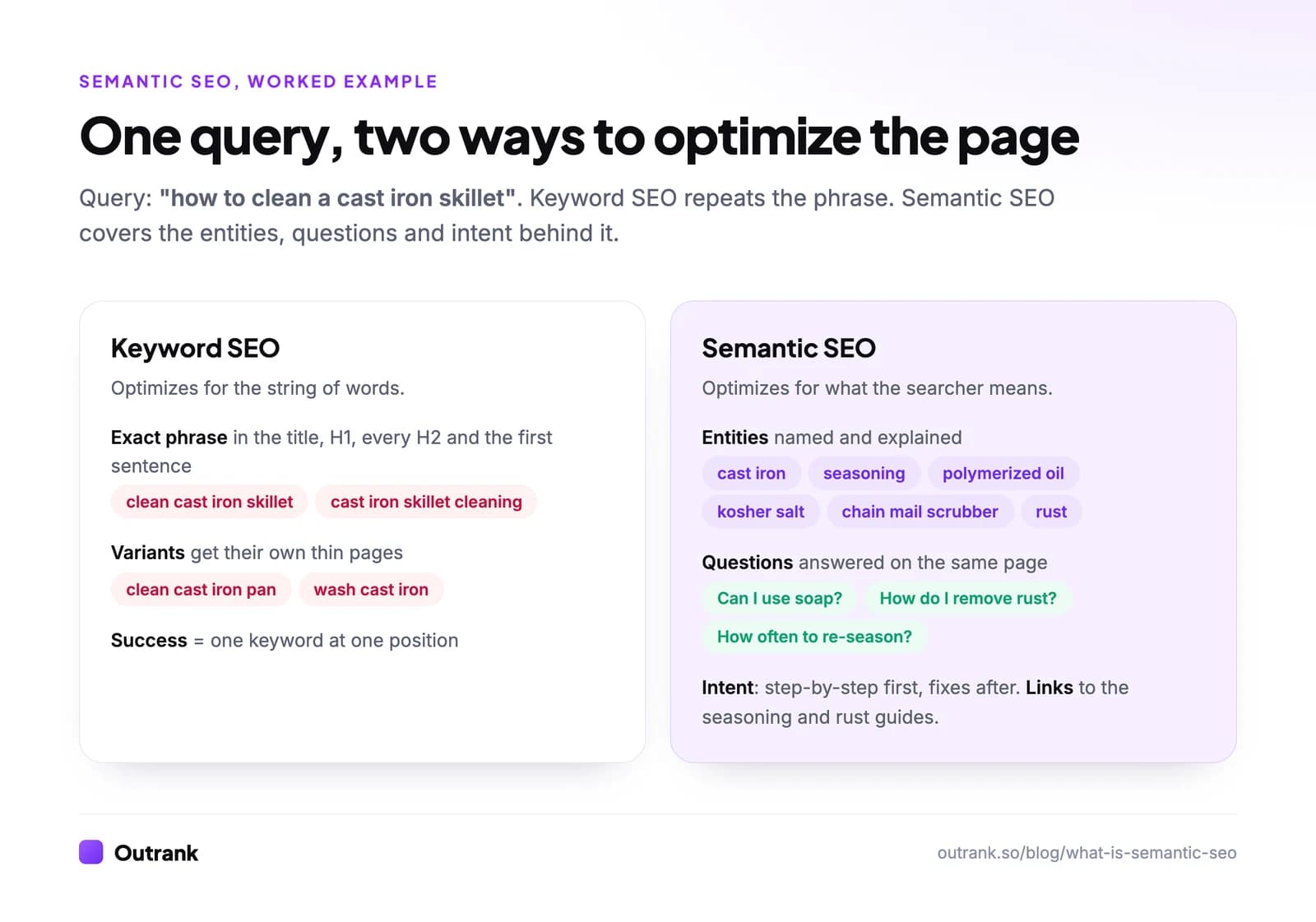
"Semantic" refers to meaning. Keyword SEO asks "does the page contain the phrase?" Semantic SEO asks "does the page satisfy what someone typing any version of this phrase wants?" Here is how the two approaches differ in practice:
| Keyword SEO | Semantic SEO | |
|---|---|---|
| Unit you optimize | A keyword string | A topic: an entity plus an intent |
| Pages | One per keyword variation | One per distinct intent, covering all its variations |
| How you find subtopics | Keyword tool suggestions | Entities, related questions, People Also Ask, the pages that rank |
| What success looks like | One keyword at one position | A page ranking for dozens or hundreds of related queries |
| Typical failure | Thin, repetitive pages that compete with each other | Over-long pages that bury the answer |
Neither is wrong on its own. You still research keywords; semantic SEO changes what you do with them. Grouping them by meaning is the job of keyword clustering, and doing that well across a whole site is how you build topical authority.
How search moved from strings to things
Semantic SEO exists because search engines changed how they read pages. The milestones below come from Google's own announcements.
- 1
2011, Schema.org
Google, Microsoft, Yahoo and Yandex launch a shared vocabulary for describing things on web pages (schema.org). Markup can now say "this is a recipe, this is its author". - 2
- 3
2015 to 2019, language models in ranking
RankBrain (2015) relates words to concepts, neural matching (2018) connects the concepts in queries and pages, and BERT (2019) reads how word order and small words change meaning (Google). - 4
Passage ranking
Google can score an individual section of a long page for a query (ranking systems guide), so a well-structured page can rank for questions answered deep inside it. - 5
AI Overviews and AI Mode
Google's AI features use "query fan-out", running related sub-queries to gather sources. Google's own example turns "how to fix a lawn that's full of weeds" into searches like "best herbicides for lawns" and "how to prevent weeds in lawn" (Google).
The pattern across all five: each step made exact wording matter less and meaning matter more. A page that answers the sub-questions a searcher (or a fan-out query) will ask is now more useful than one that repeats the head phrase.
The four parts of semantic SEO
1. Entities: make the "thing" unmistakable
An entity is a uniquely identifiable thing: a person, company, product, place or concept. "Jaguar" is ambiguous. "Jaguar F-Pace" is not. Search engines resolve which entity you mean from context, so give them context:
- Name the main entity precisely in the title, the first paragraph and at least one heading. "Cast iron skillet", not "your pan".
- Define it in one sentence near the top ("X is…"). This is also the sentence AI answers are most likely to quote.
- Cover its key attributes. For a product: what it's made of, sizes, price range, care. For a concept: what it is, how it works, examples, what it's often confused with.
- Mention the related entities an expert would. A page about cleaning cast iron that never mentions seasoning reads like it was written by someone who has never owned one.
- Link out to authoritative sources for facts, and to your own deeper pages for related entities.
To see which entities your page and your competitors actually cover, run an entity extraction script. Our guide to using Python for NLP and semantic SEO has a tested 25-line version.
2. Intent: one page per job
Search intent is the goal behind a query: learn, compare, buy, or reach a specific site. Two keywords with different intents need different pages even if they share words ("cast iron skillet" is mostly shopping; "how to clean a cast iron skillet" is a how-to). Two keywords with the same intent belong on one page even if they share no words.
The fastest intent check is the results page itself. Search the query in a private window and note the format of the top five: guides, product pages, comparison lists, videos, forum threads. Match the dominant format, then do it better.
Don't create a separate page for each phrasing. Google's guide to optimizing for generative AI search says that creating content for every variation of a query, including fan-out queries, primarily to manipulate rankings violates its scaled content abuse policy, and that a higher quantity of pages doesn't make a site more relevant.
3. Topic coverage: answer the next question too
A page covers its topic when a searcher doesn't need to go back to Google for the obvious follow-up. Sources for those follow-ups, in order of usefulness:
- Your own Search Console queries for the page (Performance → Search results, filter by page, open the Queries tab). They show the phrasings Google already associates with you. Search Console Insights also groups similar queries into Query groups, launched in October 2025.
- People Also Ask and related searches on the results page.
- The top-ranking pages: which subtopics do most of them cover that you don't?
- Customer questions: sales calls, support tickets, reviews.
Go past the definition. In Outrank's study of 6.2 million pages across 3,332 sites, "what is" definition pages earned 0.52× the click-through rate of the same site's other articles at positions 4 to 10. A one-line definition is exactly what AI Overviews answer without a click. Examples, steps, comparisons and decisions are what people still click for.
4. Relationships: internal links and structured data
Search engines also learn what a page means from what it connects to.
Internal links tell Google which of your pages are related and what each one is about, through the anchor text. Link from the broad page to the specific ones and back, with descriptive anchors ("how to season cast iron", not "click here"). Our guide on why internal links matter for SEO covers the mechanics.
Structured data (schema markup) describes the page in a machine-readable format, usually JSON-LD, which Google recommends because it's easiest to maintain (Google). For semantic SEO it does two jobs: it makes you eligible for rich results such as product prices, review stars, recipes and events, and it states facts about entities, like which organization publishes the page and which profiles belong to it (Organization with sameAs).
Keep expectations current. Google's AI optimization guide says structured data isn't required to appear in generative AI search and there's no special markup for it. Several rich result types have been retired since 2023, and FAQ rich results stopped appearing in Google Search on May 7, 2026 (Google's documentation changelog). Mark up what is visible on the page, keep it accurate, and don't expect markup alone to move rankings. The details, including which markup still produces rich results, are in our guide to SEO rich text and rich results.
Semantic SEO in AI search
AI Overviews, AI Mode, ChatGPT and Perplexity all retrieve pages and then quote passages from them. Semantic SEO helps here for a plain reason: a page with a clear entity, a direct one-sentence answer and well-labeled sections is easy to retrieve for many phrasings and easy to quote. They also pick the format that fits the intent: when we checked what ChatGPT, Perplexity, Gemini and Claude actually cite across 96 questions, 73% of the sources for "best X" questions were listicles and 75% of those for "X vs Y" questions were comparison articles.
What our data adds:
- Visibility in Google predicts AI citations. Across 200 Outrank sites, Google impressions were the strongest predictor of how often a site was cited by AI assistants (Spearman correlation 0.80), and 67% of sites with fewer than 50 Google-visible pages had zero AI citations (Outrank study). You don't need a separate "AI SEO" playbook to get started; you need pages Google understands and shows.
- Machine-written queries are already in your data. 79% of 111 sites studied received queries written by AI systems fanning out searches, and 95–98% of those never earned a click (query fan-out study). Read your query list with that in mind before you build pages around odd, prompt-like queries.
For the content side of this, see why questions are replacing keywords in AI search. To see where your brand is cited, Outrank's AI visibility tracking covers ChatGPT, Perplexity, Gemini, Copilot, AI Overviews and AI Mode.
Semantic SEO checklist
Run it on one page at a time. Your ticks are saved in your browser.
Interactive checklist
Semantic SEO checklist for a single page
0/14
Entities
0/4Intent
0/3Topic coverage
0/3Relationships
0/4Your progress is saved in this browser, so you can come back to it later.
How to measure semantic SEO
Keyword rankings undercount semantic SEO, because the point is ranking for queries you never targeted. Track these instead:
- Queries per page. In Search Console, filter the Performance report by page and count the queries in the Queries tab. If a page grows from, say, 40 to 300 queries, Google is understanding it more broadly, even if its "main" keyword didn't move.
- Clicks from non-exact queries. Filter out your target phrase (Query → Queries not containing). Growth there is semantic reach.
- Impressions in AI features. Search Console's generative AI performance report shows how often your URLs appeared in AI Overviews and AI Mode, by page, country and date. Google rolled it out to all sites by August 31, 2026 (Google).
- Citations in AI assistants outside Google, tracked with a tool such as Outrank's AI visibility tracker.
If you want this structure on every article without building it by hand, Outrank writes and publishes articles with an H2/H3 outline, an FAQ, internal links to your existing pages and external sources, then publishes them to your CMS daily. It doesn't replace the judgment calls in the checklist above, but it removes most of the typing.
FAQ
What is semantic SEO in simple words?
Semantic SEO is writing and structuring a page so search engines understand what it means, not just which words it contains. You make the main topic clear, answer the real question behind the search, cover the related questions people ask next, and link to related pages. The result is a page that can rank for many different phrasings of the same need.
What is the difference between semantic SEO and keyword SEO?
Keyword SEO optimizes a page for a specific phrase, often by repeating it and creating separate pages for variations. Semantic SEO optimizes for a topic and an intent: one page answers every variation of the same need and covers the entities and subtopics around it. Keyword research is still the starting point; semantic SEO changes how you group and use the keywords.
What are entities in SEO?
An entity is a uniquely identifiable thing, such as a person, company, product, place or concept, that search engines can store in a knowledge base like Google's Knowledge Graph. Naming entities precisely, explaining them and mentioning the related entities an expert would cover helps search engines understand what your page is about.
Does schema markup help semantic SEO?
Yes, within limits. Structured data describes your content and organization in a machine-readable way and makes pages eligible for rich results such as product prices, review stars and recipes. Google says it isn't required to appear in AI features, and several rich result types, including FAQ rich results in May 2026, have been retired, so treat markup as accurate labeling rather than a ranking lever.
Is semantic SEO still relevant with AI search?
More than before. AI Overviews, AI Mode and assistants like ChatGPT retrieve pages for many related sub-queries and quote clear passages. Pages with a clear entity, direct answers and well-labeled sections are easier to retrieve and quote, and in Outrank's study of 200 sites, Google visibility was the strongest predictor of AI citations.
How do I start with semantic SEO?
Pick one important page. Check that its format matches the search results, put a one-sentence answer at the top, compare its entities and subtopics with the top three ranking pages, answer the questions in its Search Console queries, and link it to and from related pages. Then repeat for the next page and track queries per page in Search Console.