Page ranking is the position a web page holds in a search engine's results for a specific query: #1 is the first organic result, #11 is usually the top of page two. A page doesn't have one ranking. It has a different position for every query it appears for, and that position shifts with the searcher's location, language and device.
Page ranking is not the same as PageRank, Google's original link-based algorithm, which is one input into those positions and hasn't been visible to the public since 2016. Below: how search engines decide page rankings, how PageRank works in plain words, and how to check your own pages' rankings for free.
Key takeaways
- Page ranking = a page's position in search results for one query. The same page can be #2 for one query and #48 for another.
- PageRank is Google's link-analysis algorithm from 1998. Google still lists it among its ranking systems, but the public 0–10 score was switched off in April 2016.
- The most accurate free page ranking report is Google Search Console's Performance report, which shows the average topmost position for every query a page appears for.
- Position matters a lot: the #1 organic result averages a 27.6% click-through rate and the top three take 54.4% of clicks (Backlinko, 12M queries).
- Median average position jumped from 29 to 13 in September 2025 with no real ranking change, because Google dropped the 100-results parameter rank trackers relied on (Outrank study of 415 sites).
Page ranking, PageRank and domain authority: not the same thing
These terms get mixed up constantly, including by SEO tools. The difference matters because you can see and act on some of them and not others.
| Term | What it measures | Who calculates it | Can you see it? |
|---|---|---|---|
| Page ranking (search position) | Where one page appears for one query | Google, Bing and other search engines | Yes, in Search Console and Bing Webmaster Tools |
| PageRank | How important a page is, based on the links pointing to it | Google, internally | No, the public toolbar score was removed in 2016 |
| Domain Rating / Domain Authority | A tool's estimate of a whole site's link strength, 0–100 | Ahrefs (DR), Moz (DA), Semrush (AS) | Yes, in each tool. Google doesn't use them |
| Page ranking report | A list of queries and positions over time | You, from Search Console or a rank tracker | Yes |
So when someone asks "what is the page rank of my website", they usually mean one of two things: where the site's pages show up in Google (search position), or how strong its backlink profile is (DR or DA). Neither is Google's internal PageRank. Our guide to Domain Rating vs Domain Authority covers the second.
How search engines rank web pages
Search engine page ranking happens in three stages, according to Google's documentation:
- Crawling: a bot (Googlebot, Bingbot) finds your page through links or a sitemap and downloads it.
- Indexing: the engine reads the page, works out what it's about, and decides whether to store it.
- Ranking: for each search, it picks the indexed pages that best answer the query and puts them in order.
The ranking step uses what Google calls "hundreds of factors". Google publishes a list of its ranking systems, and they fall into a few groups:
- Relevance: does the page answer what this query means? Language systems such as BERT, RankBrain and neural matching compare meaning, not just matching words.
- Quality and helpfulness: is the content original, accurate, written by someone who knows the subject? Since March 2024 this is part of Google's core ranking.
- Links: which pages link to this one, and how important are they? This is where PageRank lives.
- Usability: does the page work on a phone, load fast, and avoid intrusive pop-ups?
- Context: the searcher's country, city, language and device change the results.
If a page isn't indexed, it has no ranking at all. That's the first thing to check when a page "isn't ranking" (see how to fix crawled but not indexed). For the step-by-step process of improving positions, read our guide on how to rank on Google.
What PageRank is and how it works
PageRank is an algorithm that scores a page's importance by the number and importance of the pages linking to it. Larry Page and Sergey Brin developed it at Stanford in 1996 and described it in their 1998 paper, and it became the foundation of Google. The patent (US 6,285,999, granted in 2001) was assigned to Stanford, which received 1.8 million Google shares for the license and sold them in 2005 for $336 million (Wikipedia). The PageRank patents expired in 2019.
The idea in one sentence: a link is a vote, and votes from important pages count more. The original formula adds one detail that still shapes how SEOs think about links.
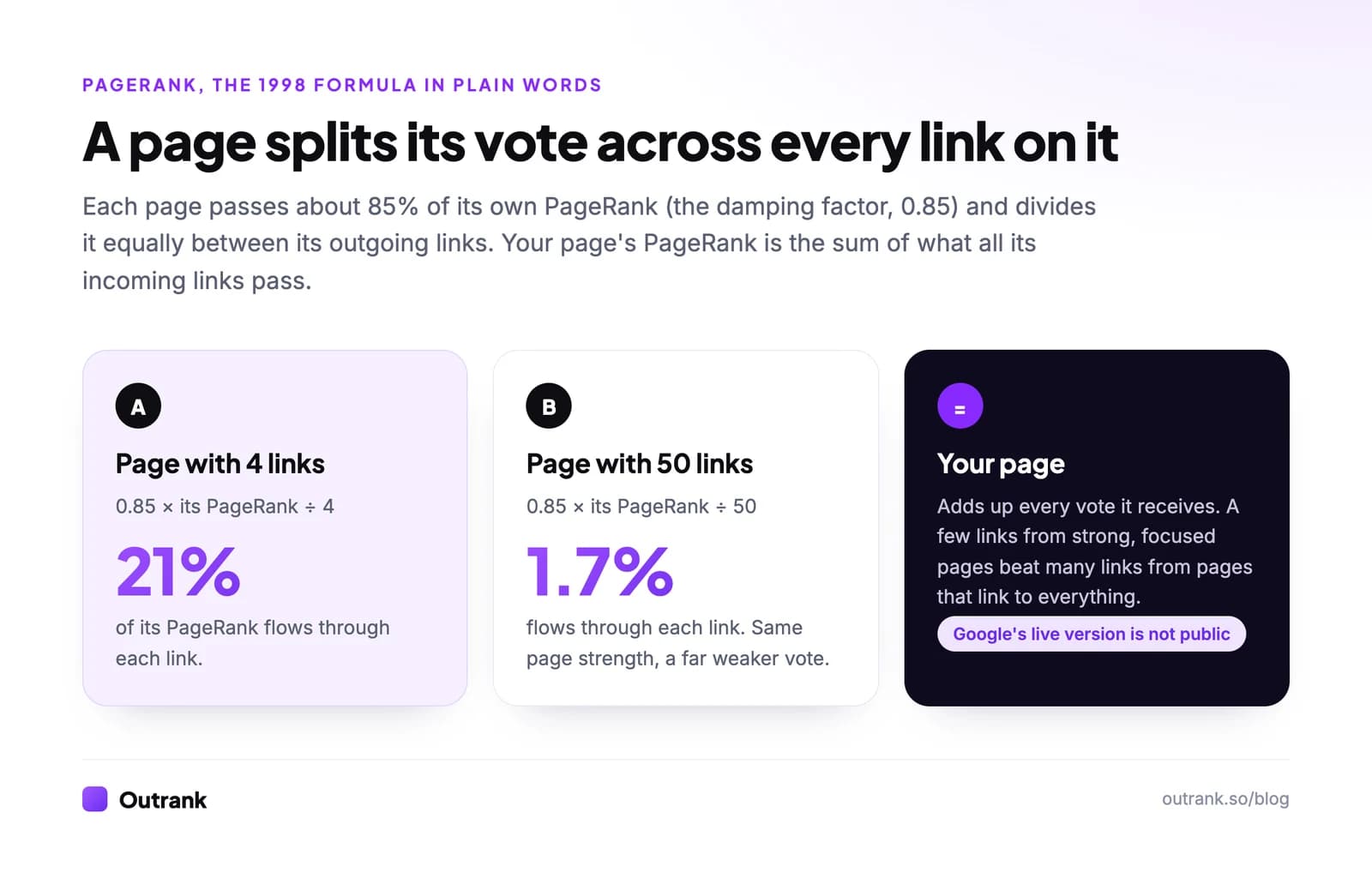
Each page passes on most of its own PageRank (the damping factor, usually set at 0.85) and divides it equally among the links on the page. A strong page with four links sends about 21% of its PageRank through each one. The same page with 50 links sends about 1.7% through each. Your page's PageRank is the sum of everything its incoming links pass to it.
Three practical consequences:
- One link from a strong, focused page can beat dozens from weak ones. That's why links from a relevant article are worth more than a site-wide footer link or a directory with 400 links on the page.
- Internal links pass PageRank too. Linking from your strongest pages to the ones you want to rank moves authority where you need it (why internal links matter).
- Link schemes stopped working. After people built networks of fake sites to manufacture votes, Google launched Penguin in 2012 to devalue manipulative links. Today its SpamBrain system does that job.
Is PageRank still used?
Yes. "Link analysis systems and PageRank" is still on Google's ranking systems list, described as one of the ways Google works out what pages are about and which might be most helpful. What disappeared is the public score: Google last updated the Toolbar PageRank in 2013 and turned off the display on April 15, 2016. Any site that still sells you a "PageRank 0–10" number is showing a third-party estimate.
How to check a web page's ranking
The best method depends on whether you need your real Google data or want to watch competitors too.
Ways to check page ranking
| Google Search Console | ✓ | ✓ | ✕ | Average position for every query each of your pages appears for, over 16 months |
| Bing Webmaster Tools | ✓ | ✓ | ✕ | The same report for Bing, plus backlink data |
| Manual search in a private window | ✓ | ✕ | ✓ | Quick spot checks. Results still vary by location and device |
| Ahrefs Webmaster Tools | ✓ | ✕ | ✕ | Keywords and positions for sites you verify, estimated from Ahrefs' own data |
| Paid rank trackers (Semrush, Ahrefs, SE Ranking and others) | ✕ | ✕ | ✓ | Daily positions for a fixed keyword list, by city or device, next to competitors |
Click a column header to sort.
Check your page ranking in Google Search Console
- Open Search Console and choose your property.
- Go to Performance → Search results and tick Average position at the top.
- Click + Add filter → Page and paste the URL you want to check.
- Open the Queries tab. Each row shows a query, its clicks, impressions and that page's average position.
Search Console reports the topmost position your page held each time it was shown, averaged over the date range (Google's definition). An AI Overview counts as a single position, so a link inside it shares that position. Because it's an average across countries, devices and days, "position 7.4" can mean #3 in one city and #14 in another.
How to read a page ranking report
- Positions 1 to 3 get most of the clicks. Backlinko's CTR study of 12 million queries found the #1 organic result averages a 27.6% click-through rate and is 10 times more likely to be clicked than #10.
- Positions 4 to 10 are on page one but often below ads, AI Overviews and other features. Better titles and a stronger answer can move them.
- Positions 11 to 20 are "striking distance": Google already sees the page as relevant. These are usually the fastest wins.
- Positions 21+ with impressions often mean the page is relevant to part of the query but not the main intent.
One caution for trend reports: in September 2025 Google stopped supporting the &num=100 parameter that rank trackers used to load 100 results at once. In Outrank's study of 415 sites, median impressions dropped 33% within days and average position moved from 29 to 13, with no real change in rankings. Compare periods after mid-September 2025 with each other.
For building a full report with dates, keyword groups and competitors, see how to build an SEO keyword ranking report and our comparison of the best keyword rank checking tools.
How to improve a page's ranking
Page ranking moves when the page becomes the better answer, so work through these in order:
- Confirm it's indexed with URL Inspection in Search Console.
- Match the intent of the current top results: guide, list, tool or product page.
- Answer the query in the first two sentences, then add what other results don't have (your data, screenshots, examples).
- Link to it from your strongest related pages.
- Earn links from relevant sites. Following the PageRank logic, one link from a focused article in your niche beats a pile of directory listings. Outrank's backlink exchange places links inside relevant articles on other sites in its network, never in footers or link lists.
- Re-check the Queries tab after four to eight weeks and improve the page for the queries in positions 8 to 20.
If you'd rather run the whole process yourself, our do-it-yourself SEO guide turns this into a weekly plan.
FAQ
What is page ranking in SEO?
Page ranking in SEO is the position a web page appears in organic search results for a given query. A page has a separate ranking for every query it shows up for, and SEO is the work of moving those positions up for the queries that bring customers. Search Console shows these positions as "average position".
What is the page rank of a website?
A website doesn't have a single page rank. Each page ranks separately for each query. When people say "page rank of a website" they usually mean either its Google positions (visible in Search Console) or a third-party authority score such as Ahrefs Domain Rating or Moz Domain Authority, which estimate link strength on a 0–100 scale.
Is Google PageRank still used?
Yes. Google still lists "link analysis systems and PageRank" among its ranking systems. What ended is the public 0–10 Toolbar PageRank score, last updated in 2013 and switched off in April 2016, so nobody outside Google can see a page's real PageRank.
How do I check my web page ranking for free?
Use Google Search Console: go to Performance → Search results, add a Page filter with your URL, turn on Average position, and open the Queries tab. Bing Webmaster Tools offers the same for Bing. A search in a private browser window works for a quick check, but your location still affects what you see.
What is a good page ranking?
Position 1 to 3 is the goal for queries that matter, because the top three results take about half of all clicks. Positions 4 to 10 still get traffic, and 11 to 20 is a good sign that a page can reach page one with improvements. An average position above 50 usually means the page is only loosely relevant to that query.
Why does my page ranking change every day?
Google updates its index and ranking systems constantly, competitors publish and update pages, and results are personalized by location and device. Small daily moves of a few positions are normal. Look at trends over 28 days or more, and check Google's Search Status Dashboard when you see a sudden sitewide drop, since it lists confirmed updates.