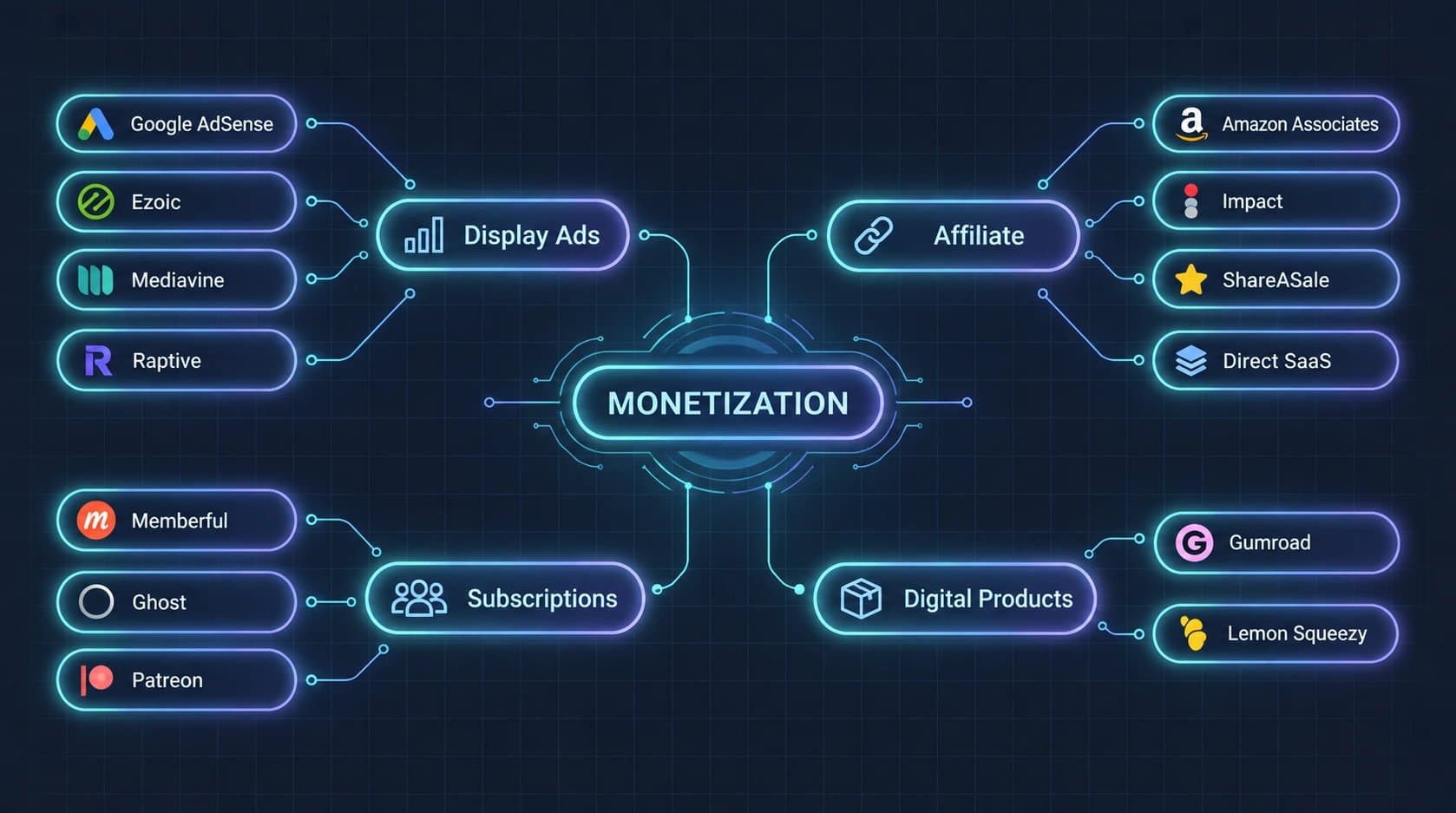
A website monetization platform is a service that turns your traffic into money: an ad network that fills your pages with ads (Google AdSense, Mediavine, Raptive), an affiliate network that pays commission on sales you refer (Amazon Associates, Awin, Impact), a membership tool that charges readers (Substack, Ghost, Memberful) or a checkout that sells your own files (Gumroad, Lemon Squeezy). The best one for a publisher is the best one you qualify for today: AdSense and affiliate links need no traffic, Journey by Mediavine opens at 1,000 sessions a month from Tier 1 countries, Raptive at 25,000 pageviews, and full Mediavine at $5,000 in yearly ad revenue.
Below: all 15 platforms in one sortable table, with entry rules and fees checked against each vendor's own pages in October 2026, then what each type pays and which combinations work.
Key takeaways
- No traffic minimum: Google AdSense, Amazon Associates, Substack, Patreon, Gumroad and Lemon Squeezy all accept a brand-new site.
- Mediavine dropped its 50,000-session rule. Full Mediavine now asks for $5,000 in annual ad revenue; Journey by Mediavine needs 1,000 sessions from Tier 1 countries in 30 days.
- Raptive now accepts sites from 25,000 monthly pageviews, if most traffic comes from the US, Canada, UK, Australia or New Zealand.
- Ezoic went the other way: new sites need 250,000 monthly active users since February 19, 2026.
- Ad network choice moves RPM a lot. In a 2025 survey of 187 bloggers, average ad RPM was $2.34 on AdSense, $11.15 on Journey, $31.55 on Mediavine and $34.86 on Raptive.
All 15 platforms at a glance
Entry rules and fees come from each platform's requirements or pricing page, read in October 2026. A dash means the platform doesn't publish that number.
Website monetization platforms compared (October 2026)
| Google AdSense | Display ads | Original content, age 18+, policy compliance. No traffic minimum | You get 80% after the advertiser platform's fee (about 68% on Google Ads demand) | Brand-new sites |
| Journey by Mediavine | Display ads | 1,000 sessions from Tier 1 countries in 30 days; Grow plugin running 30+ days | — | Small sites with US/UK/CA/AU readers |
| Mediavine | Display ads | $5,000 in annual ad revenue, clean human traffic | 75% for new sites earning under $100k a year, rising to 90% | Established content sites |
| Raptive | Display ads | 25,000 monthly pageviews, most traffic from US/CA/UK/AU/NZ | — | Lifestyle, food, finance and home sites |
| Ezoic | Display ads | 250,000 monthly active users (Incubator takes 20 smaller sites a month) | — | Very large or international sites |
| Amazon Associates | Affiliate | Open to new sites; must show the Amazon Associate disclosure | 0% to 10% by category, 4% for most categories | Product reviews and gear guides |
| Awin (now includes ShareASale) | Affiliate network | Apply to each brand | Set by each brand | Retail and DTC brands |
| Impact.com | Affiliate network | Apply to each brand | Set by each brand | SaaS and subscription brands |
| Direct SaaS programs | Affiliate | Apply to each company | Often recurring; Outrank pays 30% recurring | B2B and software audiences |
| Substack | Paid newsletter | None | Keeps 10% of subscriptions, plus Stripe fees | Writers selling a newsletter |
| Ghost(Pro) | Membership CMS | Publisher plan, $29/month billed yearly | 0% of subscriptions, plus Stripe fees | Publishers who want their own site and list |
| Memberful | Memberships | $49/month | 4.9% of transactions, plus Stripe fees | Adding paid tiers to WordPress or another CMS |
| Patreon | Memberships | None | 10% of income, plus processing and payout fees | Creators with a community |
| Gumroad | Digital products | None | 10% + $0.50 per direct sale, 30% via its Discover marketplace | Ebooks, templates and courses |
| Lemon Squeezy | Digital products | None | 5% + 50¢ per transaction; acts as merchant of record | Software and subscriptions |
Click a column header to sort.
Which platform fits your traffic right now
Start from your numbers in Google Analytics, not from the platform you'd like to be on. Most rejections happen because a publisher applies to a network they don't qualify for yet.
- Under 1,000 monthly visitors: AdSense plus affiliate links in your best buying-intent posts. Start an email list now; it's the asset every later model uses.
- 1,000+ sessions from the US, UK, Canada or Australia: apply to Journey by Mediavine. Install the Grow plugin early, since it has to run for 30 days before Journey measures you.
- 25,000+ pageviews with mostly Tier 1 readers: apply to Raptive.
- On track for $5,000 a year in ad revenue: apply to full Mediavine. If you're not sure where you stand, our Mediavine requirements guide walks through the math.
- A loyal audience at any size: add a paid tier (Substack, Ghost, Memberful) or a digital product (Gumroad, Lemon Squeezy). Neither needs a traffic threshold.
Display ad networks: who qualifies and what they pay
An ad network is a middleman that sells the ad space on your pages to advertisers and pays you per thousand impressions. If the term is new, start with what an ad network is. The networks differ mainly in who they let in and how much demand they bring.
Average ad RPM by network (bloggers' own reports)
Raptive
$34.86
Mediavine
$31.55
Journey by Mediavine
$11.15
Ezoic
$11.08
SHE Media
$8.03
Monumetric
$6.77
Google AdSense
$2.34
Google AdSense is the default first network because it has no traffic floor. Google asks for original content that follows its policies and an account holder aged 18 or over. Publishers receive 80% of the revenue after the advertiser platform takes its fee, which Google says works out to about 68% when advertisers buy through Google Ads. The catch is the RPM: low enough that AdSense is a placeholder, not a business model. If you're weighing upgrades, see our list of AdSense alternatives matched to traffic tier.
Journey by Mediavine is the on-ramp most older guides miss. It needs 1,000 sessions from Tier 1 countries (the US, Canada, the UK and Australia) within 30 days, plus Mediavine's Grow plugin running for at least 30 days. Journey is self-supported, with no revenue minimum.
Mediavine no longer publishes a session floor. Its requirements page asks for at least $5,000 in annual ad revenue, clean human traffic and original content. For sites launched after January 1, 2026, Mediavine's revenue share starts at 75% for publishers earning under $100,000 a year and steps up to 90% above $500,000.
Raptive (formerly AdThrive) lowered its bar to 25,000 monthly pageviews, provided most of your traffic comes from the US, Canada, the UK, Australia or New Zealand and your content is 100% original. Its creator levels are set by annual ad revenue, starting with Insider for sites under $250,000.
Ezoic went the opposite way. Since February 19, 2026, new sites need 250,000 monthly active users, verified through Google Analytics. Smaller sites can apply to its Incubator, which accepts 20 publishers a month. Our Ezoic vs AdSense comparison covers who it still suits.
Two practical notes. Premium networks generally want to be your only programmatic display partner, so read the contract before you stack them. And if you publish video, the managed networks bundle their own video players, which is usually the simplest answer to "which video monetization partner should a media site use".
Affiliate platforms: no traffic floor, but intent matters
Affiliate marketing pays you a commission when a reader buys through your link. There's no traffic minimum. There is a conversion floor: informational posts send almost no buyers, while reviews, comparisons and "best X for Y" pages do.
Amazon Associates is the easiest to join. Commission rates on its US fee schedule run from 0% (gift cards, for example) to 10% (luxury beauty), with 1% on grocery and 4% for all other categories. Amazon also requires you to state "As an Amazon Associate I earn from qualifying purchases" on your site.
Awin and Impact.com are networks where you apply to each brand's program separately and the brand sets the commission. ShareASale no longer takes sign-ups on its own: it now routes publishers and brands to Awin, which has owned it since 2017.
Direct SaaS programs often pay recurring commission, which is where small, targeted sites earn the most per reader. Outrank's own affiliate program, for example, pays 30% of every payment for as long as the customer stays, with a 60-day cookie.
Whichever network you use, disclose it next to the link. The FTC's endorsement guide says "affiliate link" alone is not enough and a hyperlinked "disclosure" page doesn't count. Mark the links rel="sponsored" for Google.
Subscription and membership platforms
Memberships charge readers directly. The prerequisite isn't traffic volume, it's readers who'd miss you if you stopped.
- Substack is free to publish on and keeps 10% of paid subscriptions, plus Stripe's processing fees.
- Ghost(Pro) takes 0% of subscription revenue. Paid memberships start on the Publisher plan at $29 a month billed yearly. You own the site, the domain and the list. Our Substack vs blog comparison covers that trade-off.
- Memberful adds paid tiers to an existing site for $49 a month plus a 4.9% transaction fee.
- Patreon charges 10% of what you earn, plus processing, currency conversion and payout fees. It suits creators whose value is community and access more than articles.
Digital product platforms
Selling your own product has the best margin per reader, because there's no middleman taking an ad or affiliate cut. In the same blogger survey, sites whose main income was digital products reported an average RPM of $283.64, against $33.80 for sites living on ads.
- Gumroad charges no monthly fee: 10% + $0.50 per sale through your own links, 30% when a buyer finds you through its Discover marketplace. Since January 2025 it handles sales tax for you.
- Lemon Squeezy charges 5% + 50¢ per transaction and acts as merchant of record, so it collects and remits VAT and sales tax. It handles subscriptions and software license keys, which makes it the better fit for anything recurring.
The best low-setup platform for a new publisher
If you want to earn something without a heavy build, the shortest path is three free pieces: AdSense Auto ads (one code snippet, Google places the ads), one affiliate program that fits your niche, and a newsletter signup form. Everything else can wait until the traffic is there. Running WordPress? Our guide to monetizing a WordPress blog lists the plugin for each of these.
If you don't have a site yet, Outrank Blogs gives you a hosted blog on your own domain or subfolder, free up to 10,000 visits a month, with newsletter forms, analytics and call-to-action blocks built in. Affiliate links and email capture work on the free plan; custom scripts such as ad code need the paid plan. Outrank never adds its own ads to your blog.
Run the numbers before you apply
Each model has a simple formula. Use your own figures, since averages hide huge swings by niche and audience country.
- Display ads: monthly pageviews × RPM ÷ 1,000. At 30,000 pageviews and the survey's $31.55 Mediavine average, that's about $950 a month. At AdSense's $2.34, it's about $70.
- Affiliate: visitors to buying-intent pages × conversion rate × commission per sale. Only count the pages where people are deciding what to buy.
- Subscriptions: free subscribers × paid conversion rate × price. Track your own conversion rate from the first month rather than borrowing someone else's.
For a fuller model with every revenue type, the what is website monetization guide has a traffic value calculator.
Combining platforms
Most earning sites run two or three models at once. The survey above found that bloggers with five or more revenue streams averaged an RPM of $62.47, about double the $29.79 of single-stream bloggers.
Combinations that work:
- Display ads + affiliate links. Ads monetize every visit; affiliate links earn more on the commercial pages.
- Affiliate + your own product. Recommend tools for problems you don't solve, sell the thing you know best.
- Newsletter + sponsorships. A focused list sells sponsor slots. Our guide to selling ad space on your website covers pricing and media kits.
For the order a blogger should add each stream, and what each pays, see how to make money with a blog.
Combinations that fight each other: a paywall plus heavy ads on the free tier (the paid offer looks cheap), and two programmatic ad networks on the same pages (most contracts forbid it).
Traffic is the real gate
Every platform above assumes visitors who keep coming without paid ads. Ad networks need sessions, affiliate programs need buyers arriving from search, memberships need readers who found you somewhere. For most content sites, that means organic search.
That's the part Outrank automates: it finds keywords your site can rank for, writes and publishes an SEO article a day to your CMS or free Outrank blog, and builds backlinks through its exchange. Across the sites on our results page, the median site reached 2.04× its pre-Outrank Google clicks after seven months. It's observational data, not a promise, and the first three months are slow for everyone.
FAQ
What is the best monetization platform for publishers?
The best platform is the highest-paying one you qualify for. With Tier 1 traffic, that's Raptive from 25,000 monthly pageviews or Mediavine once you can show $5,000 in yearly ad revenue; below that, Journey by Mediavine from 1,000 Tier 1 sessions, and AdSense for everyone else. Add affiliate programs and a newsletter on top, because ads alone rarely pay the most per reader.
What is a website monetization platform?
A website monetization platform is a service that converts your site's traffic into revenue. The four types are ad networks (paid per impression), affiliate networks (paid per sale), membership tools (readers pay you) and digital product checkouts (you sell your own files or software). Most profitable sites use more than one.
Which monetization platform needs no traffic minimum?
Google AdSense, Amazon Associates, Substack, Patreon, Gumroad and Lemon Squeezy all accept new sites. Ghost(Pro) and Memberful have no traffic rule either, but charge a monthly plan fee. Approval still depends on original content and following each platform's policies.
How much traffic do you need for Mediavine or Raptive?
Mediavine no longer uses a session count for its main program: it asks for $5,000 in annual ad revenue. Its Journey program needs 1,000 sessions from Tier 1 countries in 30 days. Raptive needs 25,000 monthly pageviews, with most traffic from the US, Canada, the UK, Australia or New Zealand.
Can you use multiple website monetization platforms at the same time?
Yes. Ad networks, affiliate programs, memberships and product sales stack without conflict, and bloggers with five or more revenue streams report about double the RPM of single-stream bloggers. The exception is display ads: premium networks expect to be your only programmatic ad partner, so don't run two on the same pages.
Which website monetization platform pays the most?
Per reader, selling your own digital products pays the most: bloggers reporting digital products as their main income averaged an RPM of $283.64 in Productive Blogging's 2025 survey. Among ad networks, Raptive ($34.86) and Mediavine ($31.55) averaged roughly 13 to 15 times AdSense ($2.34) in the same survey.