You can sell ad space on your website three ways: join an ad network that fills your slots automatically (Google AdSense has no traffic minimum), sell placements directly to advertisers through an "Advertise" page and a media kit, or list your site on a marketplace that brings buyers to you. Most sites start with a network for baseline revenue, then add direct deals once they have a clearly defined audience, because direct sales keep the full price and fit sponsorships a network can't sell.
This guide walks through each route, how to find advertisers for your website, what to charge, the paperwork, and a checklist you can work through today.
Key takeaways
- Start with an ad network. AdSense has no minimum, Journey by Mediavine takes 1,000 monthly tier-1 sessions and Raptive 25,000 monthly pageviews.
- Direct deals pay the full price to you, but you do the selling, contracts and reporting.
- The best advertiser leads are brands already buying ads on your keywords or sponsoring sites like yours. The Google Ads Transparency Center and Meta Ad Library show who they are.
- Price direct placements from impressions × CPM, and start above what your ad network earns you per 1,000 pageviews.
- Label every paid placement as an ad and mark paid links rel="sponsored" to stay within FTC and Google rules.
The three ways to sell ad space
| Ad network | Direct sales | Marketplace | |
|---|---|---|---|
| How it works | Network code fills your slots via auctions | You sell placements to brands yourself | A platform lists your inventory and handles buyers |
| Who sets the price | The auction | You | You, or the platform's rate card |
| Your share | AdSense pays 80% after the advertiser platform's fee; Raptive 75% | 100% (minus payment fees) | The platform takes a commission |
| Effort | Install once | Ongoing selling and admin | Low to medium |
| Traffic needed | None for AdSense; thresholds for premium networks | Enough to interest a sponsor in your niche | Varies by platform |
| Examples | AdSense, Journey, Raptive, Mediavine | Banners, newsletter slots, sponsored posts, takeovers | BuySellAds, Paved (newsletters), Outrank marketplace (sponsored articles) |
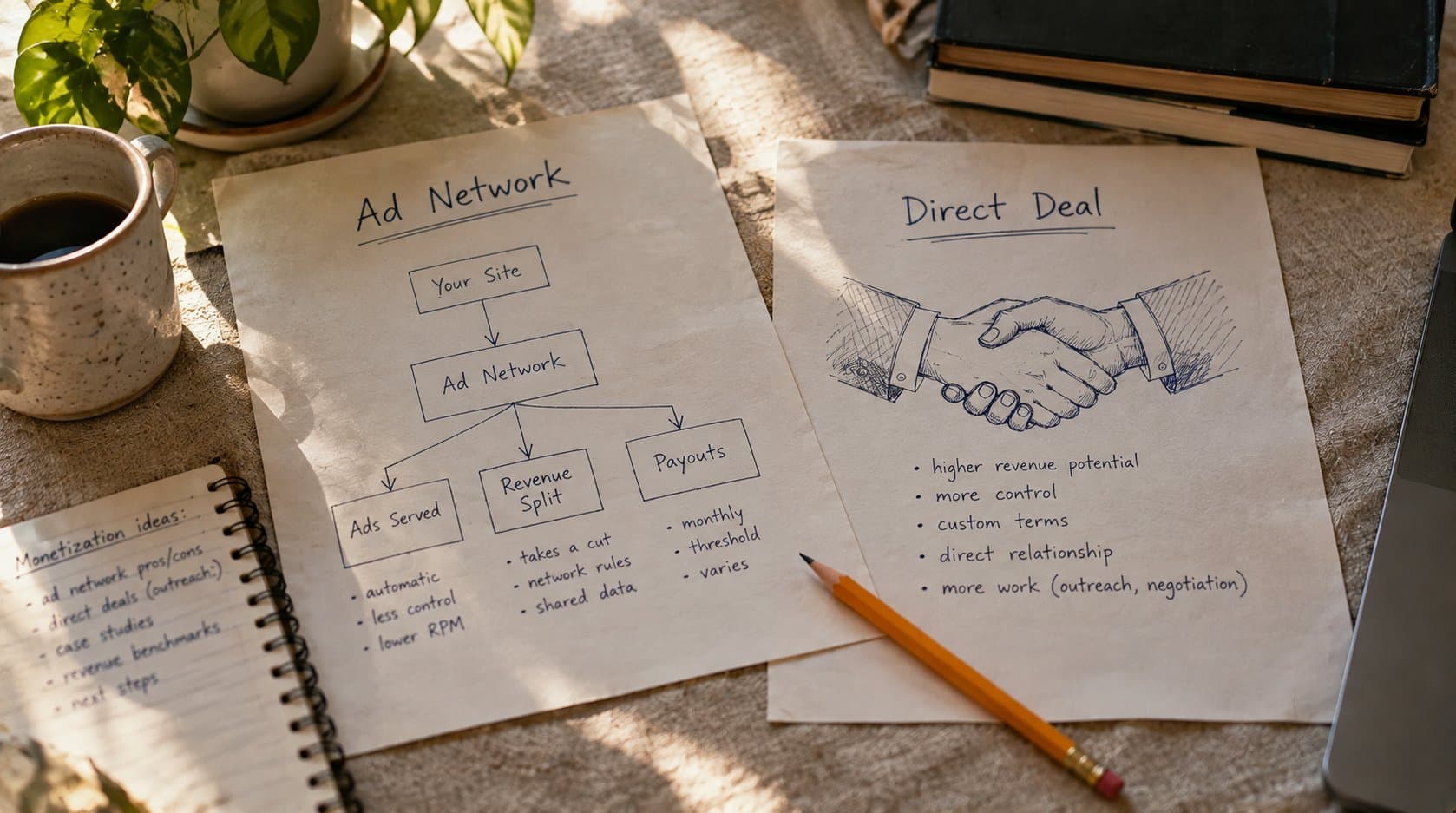
Running both is normal: direct deals take your best placements, and the network fills everything you haven't sold.
Step 1: Know what you're selling
Before you pitch anyone, write down your inventory:
- Traffic: monthly pageviews and users, from Google Analytics or your analytics tool, plus the top 20 pages by traffic.
- Audience: country split, device split, and what readers come for. Search Console (Performance → Queries) shows the exact problems people search to reach you, which is the most persuasive audience data you have.
- Placements: where an ad can go without wrecking the page. The usual units are a 728×90 leaderboard, a 300×250 rectangle in the sidebar or between paragraphs, a mobile 320×100 banner, a sponsored newsletter slot and sponsored articles.
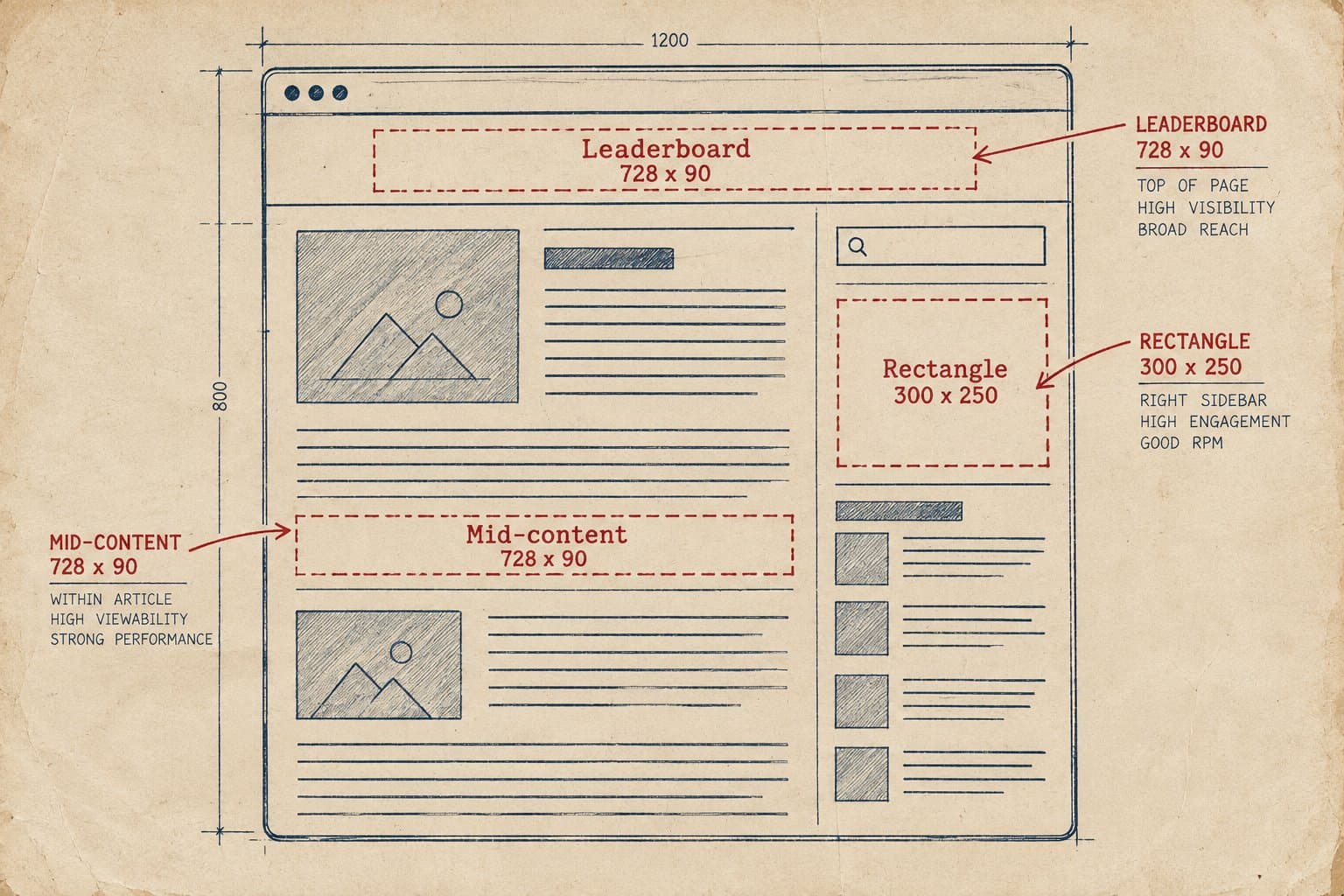
Keep the ad load sane. The Coalition for Better Ads treats mobile pages where ads take up more than 30% of the content height as a poor experience, and heavy ad stacks slow pages down. More units rarely means more revenue if readers leave.
Step 2: Turn on an ad network for baseline revenue
A network monetizes every page from day one while you build direct sales. Pick by where your traffic is today:
- Any size: Google AdSense, no traffic minimum.
- 1,000+ monthly sessions from the US, UK, Canada or Australia: Journey by Mediavine.
- 25,000+ monthly pageviews: Raptive, which cut its minimum from 100,000 in October 2025.
- $5,000+ a year in ad revenue: full Mediavine.
Our banner ad network guide compares their RPMs and includes a revenue calculator; if the terms are new to you, start with what an ad network is.
Step 3: Build an "Advertise" page and a media kit
Advertisers who find you need a way in. An Advertise page linked from your footer should list your monthly traffic, audience profile, placements on offer, starting prices or "rates on request", and a contact form or email.
The media kit is the one- or two-page PDF you send when someone asks "what do you offer?" Include:
- Monthly pageviews, users and newsletter subscribers (with dates).
- Audience: top countries, devices, and job roles or interests if your niche has them.
- Engagement: newsletter click rates, pages per session, top topics.
- Placements with sizes, positions and prices.
- Results from past sponsors (clicks, sign-ups), if you have any.
- Contact details and payment terms.

Step 4: Set your prices
Direct banner placements are usually priced per 1,000 impressions (CPM) or as a flat monthly fee:
Monthly price = (monthly impressions of the slot ÷ 1,000) × CPM
A sidebar slot shown 80,000 times a month at a $15 CPM is $1,200 a month. To pick the CPM, start from what your ad network already pays you per 1,000 pageviews (your RPM) and charge more for direct deals: the advertiser gets a fixed, exclusive, brand-safe placement, and you do the work the network used to do.
Sponsored articles and newsletter slots are priced differently, by authority and audience. For context, guest posts on marketplaces averaged $332 at DR 1–30 and $555 at DR 31–70 in Adsy's 2026 analysis of 52,671 sites, and newsletter sponsorships on Paved ranged from about $1.22 to $18.47 per 1,000 subscribers by category. Our blog advertising rates guide has the full benchmarks and a rate card calculator.
Two rules: sell the audience, not the headcount (20,000 readers who are all HR managers are worth more to an HR software brand than 200,000 general visitors), and don't anchor low. It's easier to discount than to raise a price you've already quoted.
Step 5: Find advertisers for your website
Look at who already buys ads for your topics. Search the Google Ads Transparency Center and the Meta Ad Library for your main keywords and competitors. Brands running ads on your topics have a budget for your audience.
Check who sponsors similar sites and newsletters. Read the sponsor slots in the five biggest newsletters and blogs in your niche. A brand sponsoring three of them is a warm prospect for the fourth.
Start with brands you already send traffic to. Affiliate partners and tools you recommend know your audience converts; ask their marketing team about a sponsorship.
Pitch short. Three or four sentences: who reads your site, one number that proves it, the placement you suggest and its price, and a link to your media kit. Reach the marketing or partnerships lead on LinkedIn or by email, and follow up once.
List on marketplaces for passive demand. BuySellAds and its Carbon network sell placements on tech and design sites, Paved sells newsletter sponsorships, and Outrank's marketplace sells sponsored articles (more below).
Step 6: Handle the paperwork
- Insertion order (IO): a one-page agreement listing the placement, dates, impressions or flat fee, creative specs, price and payment terms. Larger advertisers send their own.
- Payment: invoice up front for small deals; Net 30 is common for larger ones.
- Disclosure: label paid placements as ads or sponsored. The FTC's endorsement guides apply to sponsored content in the US, and Google's link spam policy asks for paid links to carry
rel="sponsored"orrel="nofollow". - ads.txt: list every network and reseller authorized to sell your inventory in
yoursite.com/ads.txt(IAB Tech Lab standard). Many buyers won't bid on inventory without it. - Reporting: tag the advertiser's links with UTM parameters and send impressions, clicks and click rate at the end of the campaign. A clear report is what earns the renewal.
Interactive checklist
Sell-ready checklist for your website
0/15
Foundations
0/4Packaging
0/4Selling
0/3Delivery
0/4Your progress is saved in this browser, so you can come back to it later.
Selling sponsored articles through a marketplace
Sponsored articles are often the most valuable thing a content site sells, and the most time-consuming to sell directly: briefs, drafts, revisions and invoices for each deal. A marketplace removes most of that.
On Outrank's publisher marketplace, advertisers pay to place one link inside a full article that Outrank writes for your blog, in your voice, on a topic checked against your own Search Console queries so it doesn't compete with your posts. You earn $1 per Domain Rating point per article (a DR 40 site earns $40), paid to your bank through Stripe after the link has been live for 14 days. To qualify, a site needs DR 30+ and at least 100 monthly organic clicks over three months of Search Console history; you choose up to three articles a day.
Be clear-eyed about the trade-off: selling links is never risk-free under Google's spam policies, and Outrank's own FAQ says so. The marketplace limits that exposure with one link per article, volume caps and topic checks, but it's your call whether sponsored articles fit your site.
Newsletter, video and OTT ad space
Newsletter slots are a separate product from your site inventory. Price and sell them separately, report unique clicks rather than opens, and bundle them with site placements at a modest discount.

Video, VOD and OTT ad space needs a video player or streaming app that can request ads, typically through an ad server and a video SSP using the VAST standard, or through a distribution deal with a FAST platform that sells the ads and shares revenue. That's a bigger project than selling banners; most website owners sell video sponsorships directly, as host-read or integrated segments.
Common mistakes
- Too many units. Ad density past the Better Ads thresholds costs readers and page speed.
- Pricing by traffic alone. A narrow, valuable audience beats a big general one.
- No way in. Without an Advertise page, inbound demand never reaches you.
- Unlabeled sponsorships. Undisclosed ads and unmarked paid links risk FTC trouble and Google penalties.
- Ignoring the traffic engine. Every price in this guide multiplies by your pageviews.
Traffic is what you're really selling
Ad networks pay per impression, direct advertisers pay for reach, and marketplaces price on authority. All three grow with organic traffic. Outrank grows it by finding keywords your site can win, publishing a long SEO article every day to your CMS, and building backlinks through its exchange. Across sites on our results page, the median site reached 2.04× its pre-Outrank Google clicks after seven months, and our Scalelist case study shows a B2B site going from DR 16 to DR 45 in 12 months, which moves a site from Adsy's DR 1–30 guest post price band into the DR 31–70 band.
For the bigger picture of what your site can earn, read what website monetization is and how to make money with a blog.
FAQ
How do I sell ad space on my website?
Join an ad network such as Google AdSense to monetize every page automatically, then add direct sales: publish an Advertise page and media kit, pitch brands that already advertise on your topics, and agree each deal in an insertion order. Marketplaces such as BuySellAds or Paved can bring buyers to you.
How do I find advertisers for my website?
Search your main keywords in the Google Ads Transparency Center and Meta Ad Library to see which brands already pay to reach your audience. Check who sponsors similar blogs and newsletters, approach brands you already recommend or earn affiliate commissions from, and list your inventory on marketplaces.
How much traffic do I need to sell ad space?
None for Google AdSense. Journey by Mediavine needs 1,000 monthly sessions from the US, UK, Canada or Australia, and Raptive 25,000 monthly pageviews. Direct sponsors care more about who your readers are than how many: a small site with a precise professional audience can sell placements before it qualifies for premium networks.
How much should I charge for ad space on my website?
Multiply the slot's monthly impressions (in thousands) by your CPM. Start your direct CPM above the RPM your ad network already pays you, since a direct placement is fixed and exclusive. For example, 80,000 monthly impressions at a $15 CPM is $1,200 a month.
Can I sell OTT or VOD ad space?
Yes, if you own a streaming app, player or channel. Video ad space is sold through an ad server and video SSPs using the VAST standard, through a FAST platform that sells ads in your channel and shares the revenue, or directly as sponsorships.
Do I need to label ads on my website?
Yes. In the US, the FTC expects paid placements and sponsored content to be clearly disclosed, and Google asks for paid links to use rel="sponsored" or rel="nofollow". Clear labels also protect your readers' trust, which is what advertisers are paying for.