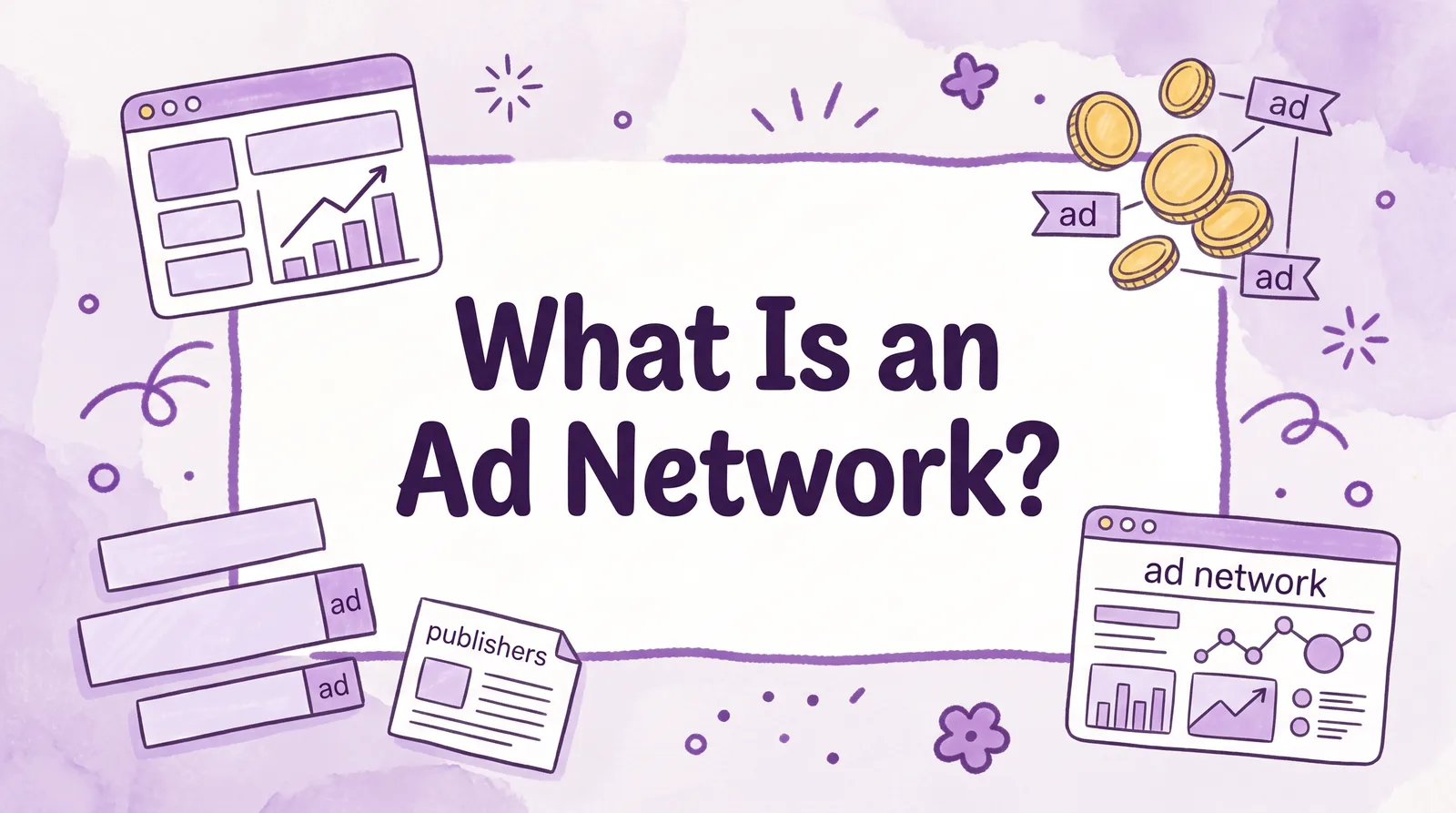
An ad network is a company that collects advertising space from many publishers (websites, apps, newsletters, streaming channels) and sells it to many advertisers through one platform. Publishers get paid without selling ads themselves; advertisers reach thousands of sites with one buy; the network keeps a cut of every transaction. Google AdSense, Mediavine, Raptive, Taboola and Google AdMob are all ad networks.
This guide explains how ad networks work, how they differ from ad exchanges, SSPs and DSPs, the main types with real examples, and how to pick one whether you sell ad space or buy it.
Key takeaways
- An ad network is a middleman that bundles ad space from many publishers and resells it to advertisers, keeping a share of the spend.
- Publishers keep 80% of AdSense display revenue after the advertiser platform's fee (about 68% when ads are bought through Google Ads); Raptive pays creators 75%.
- A network is not an exchange. The network packages and sells inventory; the exchange is the auction marketplace where networks, SSPs and DSPs trade it.
- The main types are display, native, video and CTV, mobile in-app, contextual, newsletter and retail media networks.
- For publishers, the network sets your rate per 1,000 pageviews; your traffic sets the total.
Ad network definition
An ad network is an intermediary between the supply side (publishers with ad space) and the demand side (advertisers with budgets). It aggregates unsold impressions from its member sites, segments them by audience, topic, format or country, and sells them to advertisers, usually through automated auctions.
Before networks, a brand that wanted to reach 500 websites had to negotiate with 500 sales teams. The network collapses that into a single contract, a single dashboard and a single invoice on each side.

How an ad network works, step by step
For a publisher using a display network, every page view runs through the same loop:
- You install the network's code. Usually a JavaScript tag or a WordPress plugin, plus an
ads.txtfile that lists who is authorized to sell your inventory. - A reader loads your page and the tag requests an ad for each slot, passing context: page topic, device, the reader's country.
- The network finds a buyer. It matches the request against its advertisers' targeting and, in most modern setups, runs a real-time auction that also includes outside bidders.
- The winning ad renders in a fraction of a second, before the reader notices.
- The advertiser is charged per impression (CPM), per click (CPC) or per action (CPA), and the network credits your share.
- You get paid on the network's schedule. AdSense issues payments between the 21st and 26th of the month once your balance reaches the threshold; Raptive pays Net 45; Mediavine and Journey pay Net 65.

How ad networks make money
The network keeps the difference between what advertisers pay and what it passes to publishers. Some publish their split:
- Google AdSense: publishers receive 80% of display revenue after the advertiser platform takes its fee, or about 68% when the advertiser buys through Google Ads.
- Raptive: 75% to creators, 25% to Raptive.
- Journey by Mediavine: 70% to publishers, rising as sites move up Mediavine's tiers.
Many networks don't publish a fixed share at all. When you compare them, compare RPM (your revenue per 1,000 pageviews) instead, because it captures share, fill rate and ad count in one number.
Ad network vs ad exchange vs SSP vs DSP
These terms get used interchangeably. They name different jobs in the same supply chain:
| Player | What it does | Who uses it | Examples |
|---|---|---|---|
| Ad network | Packages inventory from many publishers and sells it to advertisers | Small and mid-size publishers; advertisers wanting simple reach | Google AdSense, Mediavine, Raptive, Taboola, AdMob |
| Ad exchange | Runs the real-time auction where inventory is bought and sold impression by impression | Networks, SSPs and DSPs (not usually small sites directly) | Google Ad Exchange, Magnite, PubMatic, Index Exchange |
| SSP (supply-side platform) | Lets a publisher offer inventory to many exchanges and buyers at once and set price floors | Larger publishers and managed networks | Magnite, PubMatic, OpenX |
| DSP (demand-side platform) | Lets an advertiser bid on inventory across many exchanges with its own targeting | Advertisers and agencies | The Trade Desk, Google Display & Video 360, Amazon DSP |
| Ad server | Decides which ad shows in each slot and counts impressions | Publishers and advertisers | Google Ad Manager |
The lines blur: most SSPs run their own exchange, and Google operates a network, an exchange, a DSP and an ad server. The useful distinction for a publisher is this: a network is something you join and it handles everything; an exchange or SSP is plumbing you (or a managed network) connect to for more control and more bidders.

Types of ad networks
By ad format
- Display (banner) networks fill standard image and responsive slots. Google AdSense is the largest; we break down the banner-specific options in our banner ad network guide.
- Native networks show ads styled like content, such as "recommended for you" article grids. Taboola and Teads (Outbrain renamed itself Teads in 2025 after buying it) lead this category.
- Video and CTV networks sell pre-roll, mid-roll and outstream video, plus ad breaks on streaming TV and free ad-supported channels.
- Mobile in-app networks monetize apps and games: Google AdMob, AppLovin and Unity Ads (which merged with ironSource).
- Contextual networks match ads to the words on the page rather than the reader's history. Media.net is the best-known example.
- Newsletter networks place sponsorships in emails. The beehiiv Ad Network pays per unique open or verified click; Paved runs a newsletter ad marketplace.
- Retail media networks sell ads on store websites and apps, such as Amazon Ads and Walmart Connect (our guide to digital ad space compares every format by spend). IAB counts this "commerce media" at $63.4 billion of US ad revenue in 2025.

By access and quality
- Premium (managed) networks vet every site and handle optimization for you: Mediavine, Raptive. Higher requirements, higher RPMs.
- Open (self-serve) networks accept most sites that follow their policies: AdSense, Adsterra, PropellerAds. Easy to join, lower average yield.
- Vertical networks focus on one audience. Carbon Ads, for example, sells placements on 350+ developer and design sites.
By who they serve
"Ad networks for publishers" and "ad networks for advertisers" are usually the same companies seen from opposite sides. AdSense is the publisher side of Google's network; Google Ads Display campaigns are the advertiser side of the same inventory.
Examples of ad networks (October 2026)
Entry rules come from each network's own pages in October 2026; they change often, so check before you apply.
Ad networks compared by type and entry requirement
| Google AdSense | Display | New and small publishers | No traffic minimum; policy review | ✓ |
| Journey by Mediavine | Display (managed) | Growing blogs with tier-1 readers | 1,000 sessions in 30 days from the US, UK, Canada or Australia | ✓ |
| Raptive | Display (managed) | Lifestyle, food, travel and creator sites | 25,000 monthly pageviews | ✕ |
| Mediavine | Display (managed) | Established content sites | $5,000 a year in ad revenue | ✕ |
| Ezoic | Display (AI-optimized) | Large sites | 250,000 monthly users for new sites since Feb 2026 | ✕ |
| Media.net | Contextual | English content with US/UK/CA readers | No published minimum; site review | ✓ |
| Adsterra | Display and pop formats | Global traffic and hard-to-approve niches | No traffic minimum | ✓ |
| Taboola | Native | News and large publishers | Site review | ✕ |
| Teads | Native and outstream video | Premium publishers | Site review | ✕ |
| Carbon Ads | Native (niche) | Developer and design audiences | Audience fit review | ✕ |
| beehiiv Ad Network | Newsletter | Newsletters hosted on beehiiv | Publish on beehiiv; plan eligibility set by beehiiv | — |
| Google AdMob | Mobile in-app | App and game developers | App store listing; policy review | ✓ |
Click a column header to sort.
How to choose an ad network
If you're a publisher
- Check eligibility first. Most rejections come from traffic or country thresholds, not content. Under 1,000 tier-1 sessions a month, AdSense is your realistic option; the banner ad network guide maps each tier.
- Compare RPM, not revenue share. A 90% share of a low bid pays less than 75% of a high one. Bloggers in Productive Blogging's 2025 survey reported average RPMs from $2.34 on AdSense to $34.86 on Raptive. Ask for RPM ranges in your niche, or test for 30 days.
- Read the payment terms. Threshold, schedule (Net 30, 45, 65) and payment methods matter for cash flow.
- Check control and speed. Can you cap ad density, block categories and keep pages fast? Heavy ad loads cost you readers and rankings.
- Plan the upgrade path. Journey is built to feed into Mediavine; Raptive starts at 25,000 pageviews. Know your next threshold.
For ranked shortlists, see AdSense alternatives and the best ad networks for bloggers.

If you're an advertiser
- Decide the format first: display for reach and remarketing, native for content promotion, video and CTV for brand, newsletters for a defined niche.
- Choose self-serve or managed. Google Ads Display campaigns and Adsterra launch in an afternoon; DSPs and premium networks usually need a sales conversation and higher budgets.
- Demand placement transparency: a site list or placement report, viewability data and authorized sellers in each site's ads.txt.
- Test small and compare cost per result, not CPM. Our guide to buying ad space includes a calculator for exactly that.
Ad networks or direct sales?
Networks are convenient, but they are not the only way to earn from your audience. Once you have a defined niche and steady traffic, selling placements directly often pays more per impression, because you keep the full price and can sell sponsorships networks can't. Most established sites run both: direct deals first, network ads to fill the rest. Our guide on how to sell ad space on your website covers the direct route, and blog advertising rates shows what to charge.
Where Outrank fits
Every ad network pays per impression, and impressions come from traffic. If your earnings have plateaued, the usual constraint is the number of pages you have ranking, not the ad code.
Outrank grows that number for you: it finds keywords your site can realistically rank for (the median keyword it targets has a difficulty of 14 out of 100), writes a long SEO article every day and publishes it to WordPress, Webflow, Shopify and other platforms. The median site using it reached 2.04× its pre-Outrank Google clicks after seven months, which is the kind of growth that moves a site from AdSense into Journey or Raptive territory.
FAQ
What is an ad network in simple terms?
An ad network is a company that sits between websites that have ad space and advertisers who want to fill it. Publishers give the network their ad slots, advertisers pay to appear in them, and the network matches the two, delivers the ads and takes a percentage of the money.
What is the difference between an ad network and an ad exchange?
An ad network packages inventory from its member publishers and sells it to advertisers, often with managed optimization. An ad exchange is the real-time auction marketplace where networks, SSPs and DSPs buy and sell impressions one by one. Small publishers join networks; exchanges are usually reached through an SSP or a managed network.
What are the best ad networks for publishers?
For small sites, Google AdSense has no traffic minimum. Journey by Mediavine accepts sites with 1,000 monthly sessions from the US, UK, Canada or Australia, Raptive starts at 25,000 monthly pageviews and full Mediavine at $5,000 a year in ad revenue. Bloggers in Productive Blogging's 2025 survey reported RPMs of $34.86 on Raptive and $31.55 on Mediavine versus $2.34 on AdSense.
What are the best ad networks for advertisers?
Google Ads Display campaigns give self-serve access to the Google Display Network. DSPs such as The Trade Desk, Display & Video 360 and Amazon DSP buy across many exchanges with audience targeting. Taboola and Teads are the main native networks, and niche networks such as Carbon Ads reach specific professional audiences.
How do ad networks pay publishers?
Most pay monthly in arrears once you pass a payment threshold. AdSense issues payments between the 21st and 26th of the month, Raptive pays Net 45 and Mediavine and Journey pay Net 65, meaning 65 days after the month ends. Bank transfer is the usual method.
Is an ad network the same as an affiliate network?
No. An ad network pays you for showing ads, mostly per impression or click, whatever the reader does next. An affiliate program such as Amazon Associates, or a network such as CJ or Impact, pays a commission only when a reader you referred buys or signs up. Many sites use both.