

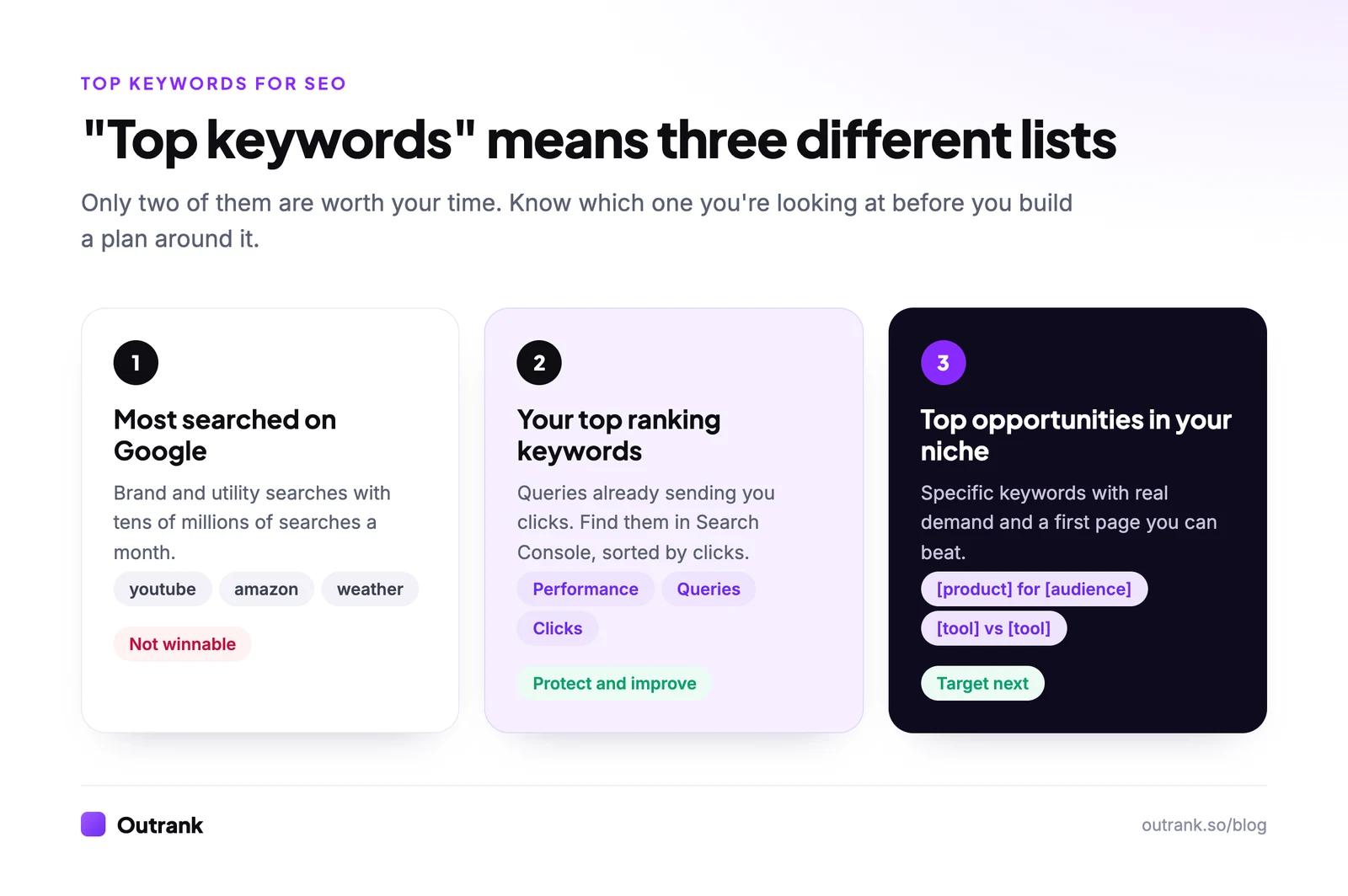
The top keywords for SEO are not the most searched words on Google. Those are brand and utility searches like "youtube", "amazon" and "chatgpt", each searched tens of millions of times a month in the US, and nobody but those brands can rank for them. Your top keywords are two other lists: the queries already driving traffic to your site (in Search Console under Performance → Search results → Queries, sorted by clicks) and the specific keywords in your niche with real demand and a first page you can beat.
This guide shows how to find both, with example keyword lists by type and intent you can adapt, and data on which kinds of queries actually turn impressions into clicks.
Key takeaways
- The most searched US keywords (youtube, amazon, chatgpt, gmail) are navigational brand searches. They are useful as trivia, not as targets.
- Your top ranking keywords are in Search Console. Sort Queries by clicks for what drives traffic, by impressions for what you almost rank for.
- Good SEO keywords match one intent (informational, commercial, transactional, navigational or local), and each intent needs its own page.
- In Outrank's study of 1.2 million queries, 5–6 word queries had the best click-through rate (8.39%), ahead of 1–2 word queries (5.25%).
- The median keyword Outrank targets for its customers has 170 searches a month and a difficulty of 14. Winnable beats popular.
The most searched keywords on Google
These are the top 10 Google searches in the US, by Ahrefs' estimate of monthly search volume:
Top 10 Google searches in the US
youtube
85.9M
amazon
85.8M
chatgpt
68.6M
gmail
57.4M
wordle
48.4M
facebook
41.6M
weather
40.2M
google
36.0M
chat gpt
31.8M
translate
29.7M
Eight of the ten are navigational: the searcher wants one specific site. The other two ("weather", "translate") are answered by Google itself, right on the results page. None of them is a keyword a business can win, and the same is true for the top 100.
Google's yearly Year in Search lists are different again: they rank the searches that spiked most compared with the previous year, not the most searched terms. They're useful for spotting topics, not for picking SEO targets.
How to find your top ranking keywords
The keywords that matter most are the ones already sending you visitors. Google Search Console shows them, for free.
- 1
Open the Performance report
In Search Console, go to Performance → Search results. Set the date range to the last 3 months. - 2
Open the Queries tab and sort by Clicks
These are your top keywords driving traffic. Tick Average position to see where each one ranks. - 3
Re-sort by Impressions
Queries with many impressions and few clicks are usually ranking on page 1's bottom half or page 2. These are your best next wins. - 4
Split branded and non-branded
Use the branded queries filter (rolled out from November 2025) to see which keywords bring new people rather than those already searching your name. - 5
See which page ranks for each query
Click a query, then the Pages tab. Two pages swapping places for the same query is a sign of keyword cannibalization.
Two newer Search Console features help on larger sites. Query groups in Search Console Insights (October 2025) cluster near-identical queries, misspellings and translations into one row, so you see topics instead of hundreds of variations; Google only shows them for properties with a large number of queries. And if you also use Google Analytics, linking the two adds a Google Organic Search Queries report to Analytics, since Analytics alone doesn't show search keywords.
Remember that Search Console shows impressions for queries where you appear, not total searches. For market demand, use a volume tool; our guide on how to check keyword search volume compares the free options.
How to find a competitor's top keywords
Your competitors' top keywords show where demand is proven in your niche. Search Console can't show them, so you need a third-party database:
- Ahrefs Site Explorer → Organic keywords or Semrush → Organic Research list the keywords a domain ranks for, sorted by estimated traffic. Both are paid, with limited free access (Semrush's free plan allows 10 lookups a day).
- Outrank's free SEO Competitor Finder lists the sites that share the most ranking keywords with your domain, with their estimated traffic, and can hide sites more than 10 times your size. That's the right list to analyze: your real search competitors are often not your business competitors.
- A keyword gap compares their keywords with yours and shows what they rank for that you don't. The method is in our keyword gap analysis guide.
Filter their list hard. A competitor's top keyword by traffic is often their brand name or a head term they've owned for years. The useful rows are specific keywords where they rank with a mediocre page.
SEO keyword examples by type and intent
An SEO keyword is any word or phrase you want a page to rank for. The type tells you how hard it is, and the intent tells you what page to build. Here's how the main types look for one business, an online coffee roaster:
| Keyword type | Example | What the searcher wants |
|---|---|---|
| Head (short-tail) | coffee beans | Broad and mixed; owned by big retailers |
| Long-tail | low acid coffee beans for a sensitive stomach | A specific need; far easier to rank for |
| Informational | how to brew pour over coffee | To learn something |
| Commercial investigation | best coffee subscription for espresso | To compare options before buying |
| Transactional | buy single origin Ethiopian coffee beans | To buy now |
| Navigational (branded) | [your brand] coffee subscription | To reach your site |
| Local | coffee roaster in Portland | To visit or buy nearby |
| Question | how long do roasted coffee beans stay fresh | A direct answer |
| Comparison | light vs dark roast caffeine | To choose between two options |
Each row needs a different page. A "best coffee subscription" query wants a comparison, "buy single origin Ethiopian coffee beans" wants a product page, and "how long do roasted coffee beans stay fresh" wants a short, direct answer. Matching the page type to the intent matters more than how many times the keyword appears. For the difference between head and long-tail terms in depth, see short-tail vs long-tail keywords.
Which keywords actually get clicks
Popular and profitable are different things. Outrank's query fan-out study looked at 1.2 million queries from 111 sites' Search Console data. Short queries get most of the impressions, but mid-length queries convert those impressions into clicks better:
Click-through rate by query length
Hover or tap the chart for exact values.
Five- and six-word queries had an 8.39% CTR, against 5.25% for one- and two-word queries. Very long queries (10+ words) did worse, partly because many are machine-generated prompts that rarely click. The sweet spot for most sites is specific, human-sounding keywords of three to six words: the kind of long-tail phrases covered in our long-tail keyword research guide.
That's also what Outrank targets when it picks keywords for customer sites. Across 189,369 articles in the last 90 days, the median keyword had 170 monthly searches and a difficulty of 14 out of 100.
SEO related keywords: a starter list for agencies and consultants
If you sell SEO services, "SEO keywords" means keywords about SEO. The head terms ("seo", "seo services", "seo agency") are dominated by Google's own documentation, Wikipedia and agencies with thousands of backlinks. The winnable ones are specific:
- Service + industry: seo services for dentists, seo for law firms, seo for plumbers, seo agency for saas startups, white label seo for web designers
- Service + location: local seo services in [city], seo consultant [city], google maps optimization [city]
- Pricing and value: how much does seo cost per month, seo pricing for small business, seo retainer vs project pricing, is seo worth it for a small business
- How-to: how to do seo for a new website, seo checklist for wordpress, how to rank on google maps, how to get backlinks without outreach
- Tools: best seo tools for small business, free seo audit tool, ahrefs alternatives, rank tracker with daily updates
- Concepts: what is keyword difficulty, what is topical authority, what is a good domain rating
Treat these as patterns to check, not guaranteed wins: run each through a free tool like Outrank's keyword research tool for volume and difficulty, then look at the live results. For dozens more patterns across other industries, see our low competition keywords list by niche.
How to use your top keywords
Finding the keywords is half the job. To turn them into rankings:
- Give each page one primary keyword. Put it in the title tag, the H1, the URL and the first paragraph. Use close variations in subheadings.
- Don't target the same keyword with two pages. They split signals and swap positions. Merge or differentiate them; see what is keyword cannibalization.
- Update before you create. Queries where you rank 4–15 respond fastest to a better section, a sharper title and two or three internal links from related posts.
- Track monthly, not daily. Compare the last 28 days with the previous 28 in Search Console. Our guide on how to track Google rankings for free shows the setup.
If you'd rather not build the list by hand, Outrank's Organic Growth plan analyzes your niche and competitors, picks keywords your site can realistically rank for, and writes and publishes an article for one of them every day.
FAQ
What are the top keywords for SEO?
The top keywords for SEO are the ones that bring qualified visitors to your site: queries you already rank for (found in Search Console) and specific keywords in your niche with real demand and beatable competition. The most searched keywords on Google, like "youtube" or "amazon", are brand searches nobody else can rank for.
How do I find the top ranking keywords for my website?
Open Google Search Console, go to Performance → Search results, and open the Queries tab. Sort by clicks to see the keywords driving traffic and by impressions to see the ones you nearly rank for. Click any query, then Pages, to see which URL ranks for it.
What are the most searched keywords on Google?
In the US, the most searched keywords are youtube, amazon, chatgpt, gmail, wordle, facebook, weather and google, each with tens of millions of monthly searches according to Ahrefs (September 2026). Almost all are navigational searches for a specific site.
What is an example of an SEO keyword?
"Low acid coffee beans for a sensitive stomach" is a good example for a coffee roaster: specific, clearly commercial, and far easier to rank for than "coffee beans". SEO keywords can be informational ("how to brew pour over coffee"), commercial ("best coffee subscription"), transactional, navigational or local.
How do I find which keywords drive traffic to my site?
Search Console's Queries report sorted by clicks shows exactly which Google searches bring visitors. Google Analytics doesn't show search keywords on its own, but linking it to Search Console adds a Google Organic Search Queries report inside Analytics.
How many keywords should I target per page?
One primary keyword per page, plus the close variations and questions that share the same intent. A well-built page typically ranks for many related queries at once. Our guide on how many keywords to use for SEO covers it in detail.