

Short-tail keywords are broad searches of one to three words with high search volume, like "running shoes" or "crm". Long-tail keywords are specific searches with low individual volume, like "running shoes for plantar fasciitis" or "crm for insurance agents". Short-tail terms promise more traffic but come with heavy competition and mixed intent. Long-tail terms are easier to rank for and tell you exactly what the searcher wants.
The defining trait is search volume, not word count. Ahrefs defines long-tail keywords as queries that get few searches per month, and keywords under 10 monthly searches make up almost 93% of its U.S. database. This guide gives you clear definitions, real examples pulled from Google Autocomplete, Outrank data on which keywords sites actually target, and a quick picker for your own page.
Key takeaways
- Short-tail = broad and high-volume ("crm"). Long-tail = specific and low-volume ("crm for insurance agents"). Volume defines the tail, not the number of words.
- Keywords with fewer than 10 monthly searches make up almost 93% of Ahrefs' U.S. keyword database.
- Of 189,369 keywords Outrank targeted in the last 90 days, the median had 170 monthly searches and 96.7% had under 1,000.
- In 1.2 million Search Console queries, 5–6 word queries had the best click-through rate (8.39%), ahead of 1–2 word queries (5.25%). Queries of 10+ words fell to 3–4%.
- New or low-authority sites should win long-tail pages first, then link them to one pillar page that targets the short-tail term.
What is a short-tail keyword?
A short-tail keyword (also called a head term) is a broad search query, usually one to three words long, with high search volume and several possible intents. "Running shoes", "standing desk", "cold brew" and "crm" are all short-tail keywords.
Three things define them:
- Big volume, big competition. Brands, marketplaces and publishers with strong backlink profiles fight for these terms, so the first page is hard to crack without authority.
- Mixed intent. Google Autocomplete for "cold brew" (U.S., October 2026) suggests "cold brew recipe", "cold brew coffee maker", "cold brew vs iced coffee", "cold brew ratio" and "cold brew tea". That is a recipe, a product, a comparison, a measurement and a different drink, all behind the same two words.
- Best served by broad pages. Homepages, category pages and pillar guides are the natural targets, because they can cover every intent at once.
What is a long-tail keyword?
A long-tail keyword is a specific search query with low individual search volume, usually a narrower version of a broader topic. The name comes from the shape of the demand curve: a few head terms get enormous volume, followed by a very long "tail" of millions of rare searches. That tail keeps growing. Google said in its 2019 BERT announcement that 15% of the queries it sees every day are new, and John Mueller said in 2025 that the share is still hovering around 15% despite AI search.
Word count is a proxy, not the definition. Most long-tail queries are longer because every extra word narrows the audience, but a two-word niche product name can be long-tail, and a longer phrase can still be a popular head term. Check the volume in your keyword tool before you label anything.
You will also see two related terms:
- Long-tail query is the same thing seen from the searcher's side: the exact specific phrase someone typed, as it appears in your Search Console Queries report.
- Long-tail focus keyword is the one long-tail phrase a page is built around (the "focus keyphrase" in Yoast or Rank Math). For most blog posts, the focus keyword should be long-tail.
Ahrefs splits the long tail into two useful types. Supporting long-tail keywords are less popular variations of a bigger query ("cold brew ratio grams" is a variant of "cold brew ratio"), so they belong on the same page. Topical long-tail keywords are their own topic ("why is my cold brew sour" is a troubleshooting question), so they deserve their own article or at least their own section.
Short-tail vs long-tail keywords: side-by-side comparison
| Short-tail keywords | Long-tail keywords | |
|---|---|---|
| Example | "standing desk" | "standing desk for tall person" |
| Typical length | 1–3 words | 3+ words (but volume decides) |
| Searches per keyword | High | Low, often under 100 a month |
| Competition | High, dominated by strong domains | Lower, smaller sites can rank |
| Intent | Mixed and vague | One clear need |
| Best page type | Homepage, category, pillar guide | Blog post, product page, FAQ answer |
| Time to rank | Often a year or more, with strong links | Often weeks to a few months on a healthy site |
| Main value | Visibility on your core topic | Qualified visitors and topical depth |
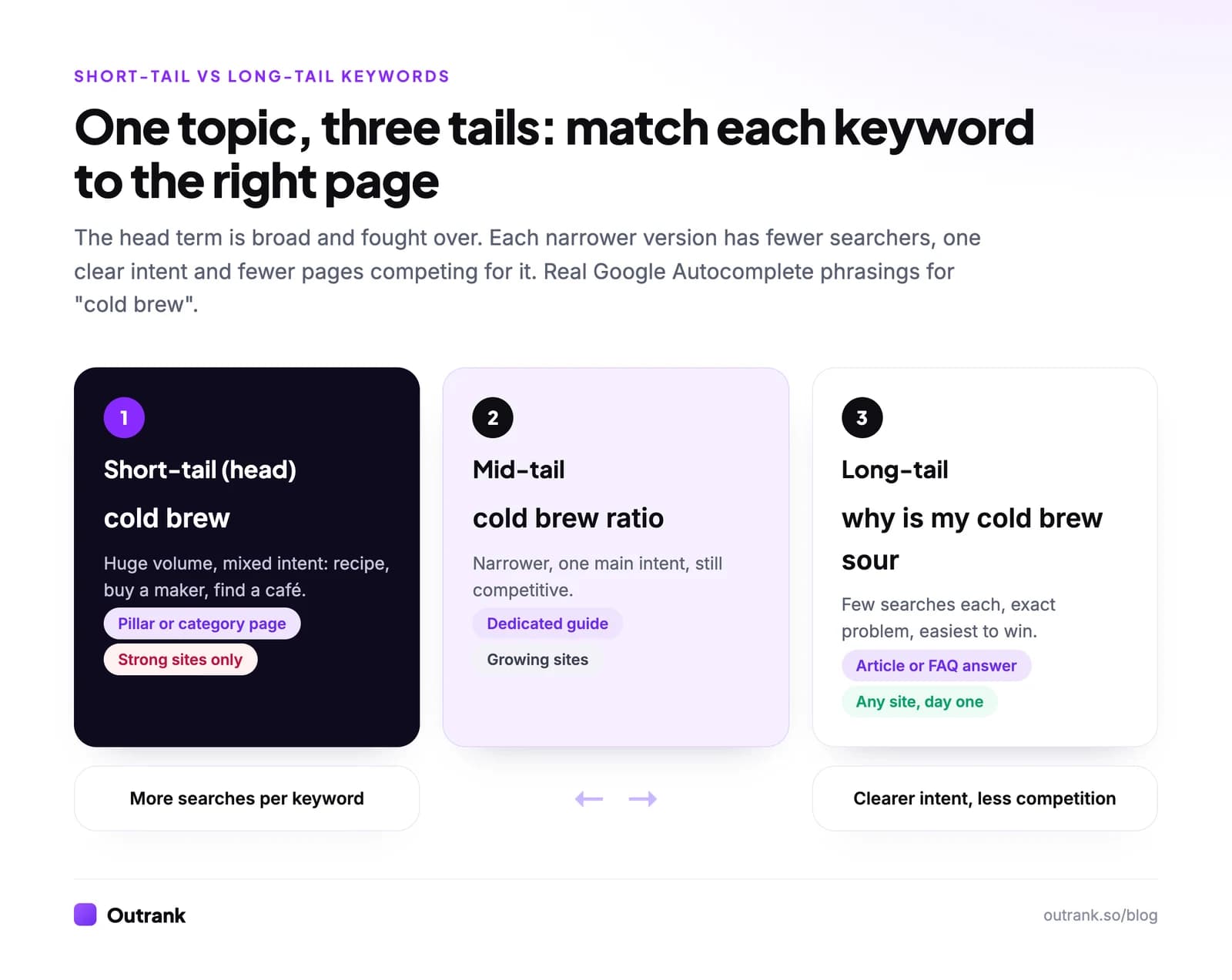
The picture above is the whole strategy in one line: the further down the tail, the fewer people search each phrase, but the more precisely your page can answer them.
Real examples of short-tail and long-tail keywords
Every long-tail example below is a real Google Autocomplete suggestion for the U.S. in English, collected on October 19, 2026. Autocomplete only shows phrases people actually search, so these are proven queries, not brainstormed guesses.
| Industry | Short-tail keyword | Long-tail keywords |
|---|---|---|
| Running gear | running shoes | running shoes for plantar fasciitis, running shoes for flat feet men |
| B2B software | crm | crm for insurance agents, crm for contractors |
| Project tools | project management software | project management software for interior designers, project management software for engineering firms |
| Local services | emergency plumber | emergency plumber cost per hour, emergency plumber near me open now |
| Coffee | cold brew | why is my cold brew sour, how much cold brew concentrate equals a shot of espresso |
| Office furniture | standing desk | standing desk for tall person, standing desk vs standing desk converter |
| SEO | keyword research | keyword research for amazon kdp, keyword research for beginners |
Notice the patterns: an audience ("for insurance agents"), a problem ("for plantar fasciitis"), a comparison ("vs standing desk converter"), a cost question ("cost per hour") or a "why/how" question. These modifiers are how you create long-tail keywords on purpose.
Why most SEO wins happen in the long tail
Three data points explain why experienced SEOs build sites from the tail up.
Most keywords are long-tail. Almost 93% of the keywords in Ahrefs' U.S. database get fewer than 10 searches a month. The head is tiny; the tail is nearly everything.
Sites that grow target the tail. Outrank researches and writes articles for thousands of sites every day. Here is what those keywords look like:
170
median monthly searches per targeted keyword
189,369 keywords, Outrank platform data (90 days to October 2026)
96.7%
of targeted keywords had under 1,000 searches a month
14
median keyword difficulty (0–100)
63% of targets were under KD 20
Specific queries get clicked. Outrank's query fan-out study classified 1.2 million Search Console queries from 111 sites by length. Click-through rate climbs from short queries to 5–6 word queries, then drops for very long ones:
Click-through rate by query length
Hover or tap the chart for exact values.
The drop after nine words matters. Many very long queries in Search Console are written by machines: AI assistants that "fan out" one prompt into many searches, and other automated tools. The same study found 95–98% of these machine-shaped queries never get a click, against 74% for normal human queries. This page is a live example: its biggest query over the last 90 days is a 10-word question about schema markup and long-tail keywords, with 1,234 impressions and no clicks.
The lesson: target the specific, human long tail (roughly three to eight words with a clear need), and don't rebuild your content plan around every strange 15-word question that shows up in your reports.
Which should you target: short-tail or long-tail?
Your choice depends on your site's authority and the page you're working on.
- New site, or Domain Rating under about 20: go long-tail. You can rank for specific queries within weeks or months, while head terms may take years. Read what keyword difficulty means and keep most targets low.
- Growing site: build pillar-and-cluster sets. One pillar page aims at the short-tail term, and ten or more long-tail articles link to it.
- Online store: category pages target short-tail and mid-tail terms ("standing desks", "standing desk converter"); blog posts and buying guides take the long tail ("standing desk for tall person").
- Local business: service pages target "service + city"; FAQs and blog posts answer questions like "emergency plumber cost per hour".
- Established brand: defend your head terms, and use the long tail to cover every question your buyers ask before they convert.
Answer three questions for the page you're planning:
3-question decision helper
Should this page target a short-tail or long-tail keyword?
Question 1 of 3
How strong is your site today?
How short-tail and long-tail keywords work together
The two types are layers of the same plan. A pillar page targets the head term; long-tail articles answer the specific questions; internal links connect them in both directions.
Using the cold brew example, a coffee site could build:
- Pillar: "Cold brew: the complete guide" (targets "cold brew").
- Cluster articles: "Cold brew ratio for every batch size", "Why is my cold brew sour (and how to fix it)", "Cold brew vs iced coffee", "How to make cold brew in a French press".
- Supporting variants inside each article: "cold brew ratio grams" and "cold brew ratio in cups" become sections of the ratio article, not separate pages.
Two rules keep this clean. Give each search intent exactly one page, or your pages will compete with each other (keyword cannibalization). And link every cluster article to the pillar with a descriptive anchor, so Google sees the depth of your topical authority.
How to write SEO-friendly content with long-tail keywords
- 1
Pick one long-tail focus keyword per page
The phrase with the clearest intent and a difficulty your site can beat. Put its close variants on the same page. - 2
Use it where it counts
Title tag, H1, URL slug and the first sentence. After that, write naturally; there is no density target. - 3
Answer in the first two or three sentences
Specific queries deserve a direct answer. This is also the passage Google's AI Overviews and chat assistants are most likely to quote. - 4
Turn related questions into H2s and an FAQ
Pull them from People Also Ask, Autocomplete and your own Search Console queries. - 5
Link to the pillar and to sibling articles
Descriptive anchors such as "cold brew ratio guide", never "click here". - 6
Revisit after 4–8 weeks
Check which new queries the page earns impressions for in Search Console, and add sections that answer them.
The full writing workflow, with modifier formulas and cluster planning, is in our guide to creating long-tail keywords. If you'd rather not run this loop by hand, Outrank does it daily: it researches keywords with live volume and difficulty, writes the article with headings, FAQ and internal links, and publishes it to your CMS.
FAQ
What is a short-tail keyword in SEO?
A short-tail keyword is a broad, high-volume search term of one to three words, such as "running shoes" or "crm". It attracts a lot of searches but mixes many intents and faces heavy competition from strong domains. Short-tail keywords are best targeted with homepages, category pages and pillar guides.
What is a long-tail keyword in SEO?
A long-tail keyword is a specific search query with low individual search volume, such as "running shoes for plantar fasciitis". Because the searcher's need is clear, the page can answer it precisely, and fewer sites compete for it. Together, long-tail queries make up the large majority of all keywords.
How many words is a long-tail keyword?
There is no fixed number. Most long-tail keywords have three or more words because extra words narrow the audience, but Ahrefs defines the long tail by low search volume, not length. A short niche phrase with few searches is long-tail; a long phrase with lots of searches is not.
Are long-tail keywords better than short-tail keywords?
For new and small sites, yes: long-tail keywords are easier to rank for and bring visitors with a clear need. Short-tail keywords still matter for pillar and category pages once your site has authority. The strongest strategy uses both, with long-tail articles linking to a short-tail pillar.
Does using schema markup improve website structure for long-tail keywords?
No. Schema markup does not change your site structure or directly boost rankings for long-tail keywords. Google says structured data helps it understand a page and can make it eligible for rich results, and FAQ rich results are now shown mainly for government and health sites. Site structure comes from your URLs, navigation and internal links between pillar and cluster pages.
How can I adapt my link building strategy for local SEO with long-tail keywords?
Point local links at the specific service-plus-location pages that target your long-tail terms, not only at your homepage. Earn them from relevant local sources: suppliers, trade associations, local news, sponsorships and chambers of commerce. Use natural, varied anchor text, and support each service page with blog posts that answer local questions like "emergency plumber cost per hour".
Can I use A/B testing to optimize content for long-tail keyword performance?
Yes, with limits. Single long-tail pages get too little traffic for a classic split test, so test changes across a group of similar pages (for example, a new title format on 20 articles) and compare their Search Console clicks and CTR with an untouched group. Follow Google's A/B testing guidance: use rel=canonical or 302 redirects for variant URLs and never show Googlebot a different page than users.
What should I include in a technical SEO audit checklist for long-tail targeting?
Focus on whether your deep pages get crawled and indexed: check Search Console's Pages report for "Crawled - currently not indexed", make sure every long-tail article is in your XML sitemap and gets internal links from its pillar, and fix duplicate or cannibalizing pages. Then check canonicals, page speed and mobile rendering. Our technical SEO audit checklist covers each step.