SEO for electricians means getting your business into Google's map results and top organic listings when someone nearby searches for electrical work, whether that's "electrician near me" at 9 p.m. or "EV charger installation cost" on a Sunday afternoon. Three things move rankings most: a Google Business Profile with the right category and service area, a separate page for every job you want more of (panel upgrades, EV chargers, generators, rewiring), and a steady flow of recent reviews. Troubleshooting articles and local links then make the results compound.
Below is how to do each one, based on Google's own guidelines and on what well-run electrical companies already publish, plus a checklist you can work through with your office manager.
Key takeaways
- Electrician searches come in three kinds (emergencies, planned upgrades and commercial work) and each one needs a different page.
- Use "Electrician" as your primary Google Business Profile category, hide your home address if customers don't visit you, and keep the service area within about 2 hours' drive, as Google's guidelines ask.
- Give every high-value job its own page (EV charger installation, panel upgrade, standby generator, rewiring). One "Services" page can't rank for all of them.
- 47% of consumers won't use a business with fewer than 20 reviews, and 74% only care about reviews from the last three months (BrightLocal, 2026).
- Put your license number on your website. In California it's required in all advertising, websites included, with a civil penalty of $100 to $1,000 for a first offense.
How people search for an electrician
Electrical searches split into three groups, and they behave very differently.
- Something is wrong right now. "Electrician near me", "emergency electrician", "half my house has no power", "breaker keeps tripping". The searcher is on a phone, often stressed, and calls one of the first businesses in the map results. Your Google Business Profile, your reviews and a fast mobile page with the phone number at the top decide this one.
- A planned upgrade. "EV charger installation", "200 amp panel upgrade cost", "whole house generator installer", "knob and tube wiring replacement". These are your highest-value jobs. The homeowner compares two or three companies over several days, and a detailed page for that exact job wins.
- Commercial work. "Commercial electrician", "electrical contractor for tenant improvements", "LED retrofit for warehouse". Property managers, general contractors and facility teams want to see capability, licensing, insurance and past projects before they call.
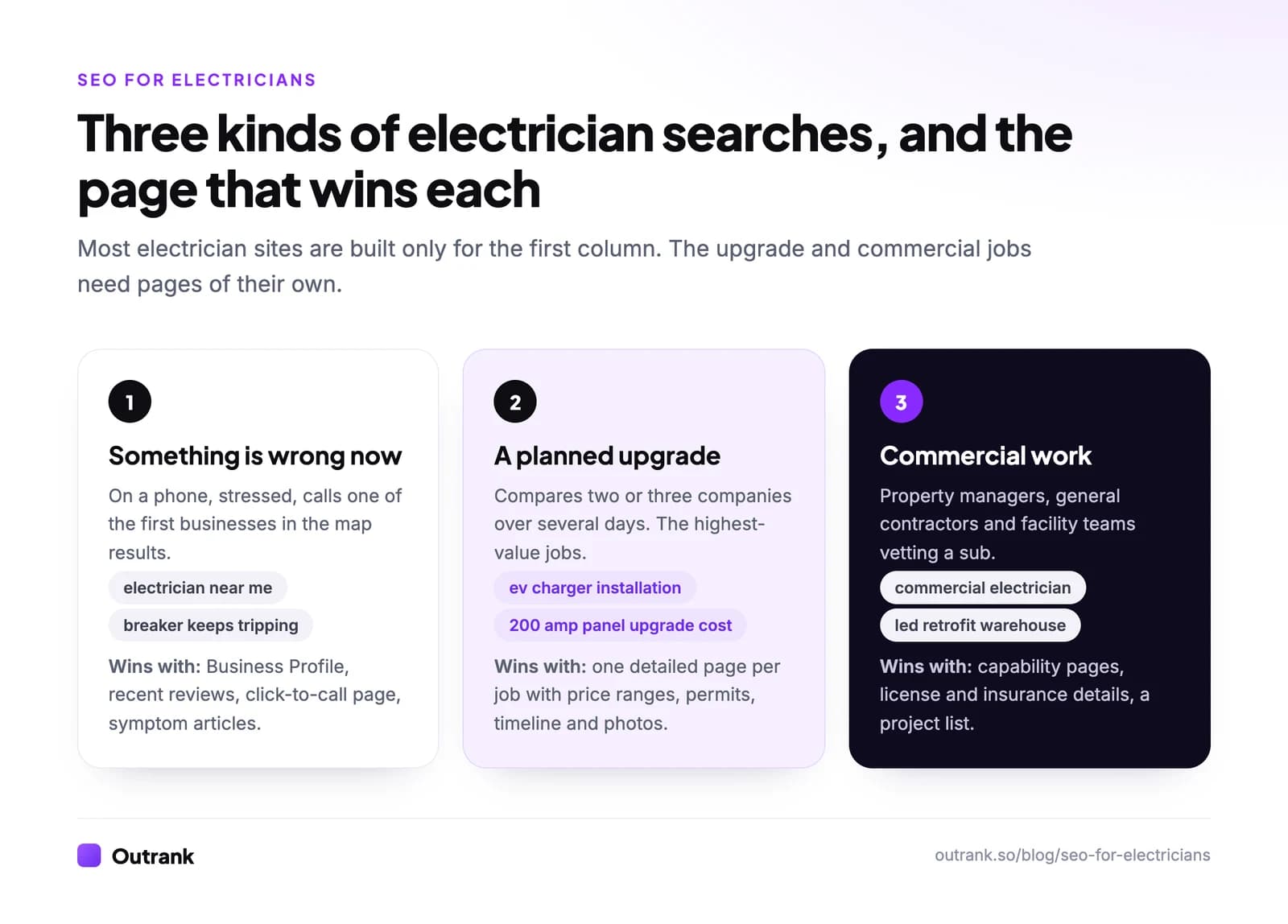
Most electrician websites are built for the first group only: a homepage, a phone number and a list of services. That's why they rank for their own name and little else.
Benefits of SEO for electricians
SEO is one of three ways to show up when someone searches for an electrician on Google. Here's how it compares with the two paid options:
| Channel | How you pay | How fast it works | What happens when you stop |
|---|---|---|---|
| Local Services Ads | Per lead (call or message) | Days to weeks, after Google's screening | Leads stop |
| Google Ads (search) | Per click | Same day | Clicks stop |
| SEO (map results and organic) | Time and content, no fee per call | Months | Rankings fade slowly |
The case for SEO comes down to three benefits:
- Calls you don't pay for one by one. Once you rank in the map results and organic listings, every call from them is free at the margin. Paid channels charge you for every lead, including the tire-kickers.
- The expensive jobs come through research. Panel upgrades, generators and EV chargers are planned purchases. People read before they call, and the company whose page answered their questions usually gets the first call.
- It compounds. A good EV charger page keeps bringing calls for years. An ad stops the minute the budget runs out.
The honest downside is speed. Across Outrank customer sites (all industries, not only electricians), the median site had 7% more Google clicks after the first 28 days, 27% more after 84 days and twice as many by month 7. Three slow months, then it compounds. If you need calls this week, run Local Services Ads while SEO builds.
Step 1: Set up your Google Business Profile like an electrician
Your Business Profile is what appears in the map results, so it gets the first week. Google's guidelines for representing your business set the rules:
- Name. Use your real business name only. "Smith Electric" is fine; "Smith Electric | 24/7 Emergency Electrician Dallas" breaks the rules and can get the profile suspended.
- Primary category. "Electrician". Add secondary categories only if they describe what the business is, not services it has. Real options in Google's list include "Electrical installation service", "Lighting contractor" and "Electric vehicle charging station contractor". Google asks you to use as few categories as possible.
- Address. If customers don't come to your shop, you're a service-area business: hide the address. Google's own example is a plumber running the business from home. If you have a staffed office, you can show it and set a service area too.
- Service area. List the cities or ZIP codes you actually cover. Google says the overall area shouldn't extend farther than about 2 hours of driving time from where you're based.
- Hours. Only mark yourself open 24 hours if someone really answers at 3 a.m. Set special hours for holidays.
- Services and photos. Add every service with a one-line description, and upload real photos: panel swaps, EV charger installs, your branded van, your team. Stock photos tell customers nothing.
- Phone number. Google requires a number under your direct control. If you use a call-tracking number, use one you own and keep your main line as an additional number.
Google says local results are based mainly on relevance, distance and prominence, and you control the first and the last. A complete profile covers relevance. Reviews and links cover prominence.
Step 2: Build one page for every job you want more of
A single "Services" page that lists fifteen things can't rank for any of them. The electrical companies that rank across many searches give each job its own page. Mr. Electric, for example, has separate pages for EV charger installation, knob-and-tube wiring replacement, hot tub circuits, pool circuits and tankless water heater circuits, with commercial services in their own section.
Start with the jobs that earn you the most:
| Page | Searches it should answer | What the page needs |
|---|---|---|
| EV charger installation | "ev charger installation near me", "level 2 charger install cost" | Chargers you install, panel capacity check, permit, timeline, price range |
| Panel upgrade | "200 amp panel upgrade cost", "replace fuse box" | Signs a panel needs replacing, utility coordination, permit, price range |
| Standby generator | "whole house generator installer" | Brands you're certified for, sizing, gas line work, maintenance plan |
| Rewiring | "knob and tube wiring replacement", "rewire old house cost" | Insurance issues, phases of the job, how wall repairs are handled |
| Lighting | "recessed lighting installation", "landscape lighting installer" | Photos of finished rooms, fixture options, price per fixture |
| Emergency service | "24 hour electrician [city]" | Real response times, after-hours fee policy, phone at the top |
| Commercial | "commercial electrician [city]" | License classes, insurance limits, project list, contact for bids |
A service page that converts follows the same order every time:
- 1
H1 with the job and the place
For example: EV Charger Installation in Sacramento. The first paragraph says what you install, where, and how fast you can book. - 2
Who needs it and the warning signs
For a panel upgrade, list the signs (breakers tripping when the dryer runs, a 100-amp panel and a new EV, an old fuse box), in the customer's words. - 3
What the job involves
Site visit, load calculation, permit, utility coordination, installation, inspection. Homeowners want to know who handles the permit and how long the power is off. - 4
Price range
Give a range from your own recent jobs and what moves it up or down. Most competitors won't, which is exactly why this section earns calls. - 5
Proof
Photos from real jobs, a short project example, reviews that mention this service, your license number. - 6
Questions and the next step
The questions your office hears most, answered in two or three sentences each, then a booking form and a tap-to-call number.
City pages. Make one only when you have something specific to say about that town: the local permit office, the age of the housing stock, the utility's rebate program, jobs you've done there. Google's spam policies name "multiple domain names or pages targeted at specific regions or cities that funnel users to one page" as doorway abuse. Twenty copies of the same page with the city name swapped help nobody.
One more reason to be specific: national networks such as Qmerit compete for EV charger searches across the US and Canada. Local detail (your county's permit process, your utility's program, photos from your own installs) is what a national page can't copy.
Step 3: Answer the troubleshooting searches, safely
Homeowners search their symptoms before they search for an electrician: "why does my breaker keep tripping", "outlet stopped working", "lights flickering in whole house", "burning smell from outlet". A page that answers the question honestly and tells the reader when to stop and call puts your phone number in front of people at the exact moment they need it.
Mr. Electric's article Why are the lights flickering in my house is a good model. It walks through causes from a loose bulb to voltage fluctuations, says which ones a homeowner can safely check, and says plainly to call an electrician when the cause could start a fire.
Electrical safety is what Google calls a "Your Money or Your Life" topic. Google's guidance on helpful, reliable content says its systems give even more weight to strong experience, expertise and trust on topics that affect people's safety. In practice:
- Name the licensed electrician who wrote or reviewed each article, with their license type.
- Give safe checks only (reset the GFCI, unplug the space heater, check whether the neighbors lost power too).
- Never publish step-by-step instructions for work that needs a license or a permit.
- End every article with what the homeowner should do next and how to reach you.
These questions are long-tail searches: low volume each, low competition, lots of them. That's the kind of keyword Outrank targets by default (in the last 90 days, the median keyword behind an Outrank article had 170 monthly searches and a difficulty of 14 out of 100). If you'd rather not write two articles a week yourself, Outrank can research and draft them daily; have your lead electrician review the safety advice before anything goes live.
Step 4: Show customers you're licensed and insured
Homeowners can't judge your wiring, so they judge your proof. Put it where both customers and Google can read it:
- License number in the site footer and on the About page, with a link to your state's license lookup.
- Insurance: say what you carry and that you'll send a certificate on request.
- Who does the work: the master electrician's name, photo and years in the trade.
- Certifications: manufacturer programs you belong to (generator brands, EV charger brands), plus trade associations.
Some states make the license number mandatory. California's Contractors State License Board advertising guidelines require it in all forms of advertising, including any website that solicits business, with a civil penalty of $100 to $1,000 for a first offense. The same guidelines forbid advertising outside your classification (only a C-10 Electrical license holder can advertise electrical work) and forbid mentioning that you're bonded. Check your own state board's rules before you redesign anything.
If you run Local Services Ads, Google screens your business registration and licenses before awarding the Google Verified badge, and electricians are an eligible category in the US.
Step 5: Get reviews every week, not once a year
Reviews are the part of local SEO customers see first, and they go stale. BrightLocal's Local Consumer Review Survey 2026 (1,002 US adults) found:
How consumers use reviews before choosing a local business
Read online reviews for local businesses
97%
Expect the owner to respond to reviews
89%
Only care about reviews from the last 3 months
74%
Put off by templated or generic replies
50%
Won't use a business with fewer than 20 reviews
47%
The routine that works for electricians is simple: the tech finishes the job, and the office (or your field-service software) texts the customer a direct link to your Google review form the same day. Ask every customer, not only the happy ones.
Stay inside Google's review policy. It bans incentives (discounts, gift cards), selectively asking happy customers, and asking reviewers to include specific content. That last rule catches a lot of electricians: "please mention the EV charger and Sacramento in your review" is not allowed. Let customers write what they want.
Reply to every review within a few days, and make each reply specific to the job ("Glad the new panel solved the tripping breakers, Maria"). Half of consumers are put off by generic replies.
Step 6: Earn local links and listings
Links from other websites are part of what Google means by prominence. Electricians have more natural link sources than most trades:
- Manufacturer directories. If you're a certified installer, make sure your listing is live and links to your site, for example on Generac's dealer locator for standby generators.
- The companies you work with. General contractors, builders, solar installers and property managers you sub for often have a partners page. Ask.
- Trade and local associations. Your IEC or NECA chapter, the local home builders association, the chamber of commerce.
- Local sponsorships. Youth sports, school events and charity runs usually link to sponsors.
- Listings. Apple Business Connect, Bing Places, Yelp, Nextdoor, the BBB and Angi, with the same name, address and phone as your Business Profile. Apple Maps matters more than it used to: BrightLocal found 27% of consumers used it for reviews in 2026, up from 14% a year earlier.
If you'd rather not chase links one email at a time, Outrank's backlink exchange for local service businesses places links inside relevant articles on other sites in the network. Our guide to how to build backlinks covers the manual methods.
Electrician SEO checklist
Tick each item as you go; your progress is saved in this browser.
Interactive checklist
Electrician SEO checklist
0/24
Google Business Profile
0/6Website pages
0/5Trust and proof
0/3Content
0/2Reviews
0/3Links and listings
0/3Tracking
0/2Your progress is saved in this browser, so you can come back to it later.
How to measure electrician SEO
Rankings are a means. Booked jobs are the result. Track three things every month:
- Business Profile performance: calls, website clicks and direction requests from the profile.
- Google Search Console: which searches bring visitors to which pages. Watch for service pages (EV charger, panel upgrade) moving from page two to page one.
- Lead source per booked job: ask "how did you find us?" and record it in your field-service software. Without it you can't tell whether the panel upgrade page paid for itself.
For tracking positions in more detail, see our guide to tracking your Google rankings for free. If you're also working on the broader basics, our SEO for small business guide covers the rest, and the contractors, HVAC and plumbers guides cover how those trades' customers search.
FAQ
Is SEO worth it for electricians?
Yes, if you can wait a few months for results. Map and organic rankings bring calls with no fee per lead, and the pages that rank for planned jobs (panel upgrades, EV chargers, generators) keep bringing them for years. Pair SEO with Local Services Ads if you need calls right away.
How much does SEO cost for an electrician?
Doing it yourself costs time: a few hours to set up your Business Profile and a few hours a week for pages, reviews and articles. In Ahrefs' survey of 439 SEO professionals, the most common monthly retainer was $501 to $1,000, and the most common hourly rate for local SEO services was $75 to $100. Software like Outrank, which writes and publishes articles and builds backlinks, starts at $99 a month.
How long does SEO take for electricians?
Business Profile fixes can show up in the map results within weeks. New service pages and articles usually take three to six months to rank well. In Outrank's data across all industries, the median site gained 27% more clicks after 84 days and doubled its clicks by month 7.
What keywords should electricians target?
Start with your service and your area ("electrician [city]", "emergency electrician [city]"), then the high-value jobs ("EV charger installation", "200 amp panel upgrade cost", "whole house generator installer"), then the symptoms customers search ("breaker keeps tripping", "outlet not working"). Our guide on how to pick keywords explains how to check volume and difficulty.
Should electricians use Local Services Ads or SEO?
Both, for different jobs. Local Services Ads charge per lead and appear above everything else, which is ideal for emergency calls. SEO costs nothing per call once you rank and brings in the research-heavy upgrade jobs that ads often miss.
Does an electrician need a blog?
Not a blog for its own sake, but troubleshooting articles help. Each one answers a question homeowners search before calling (flickering lights, tripping breakers, dead outlets) and ends with your phone number, as long as a licensed electrician reviews the safety advice.