



SEO for contractors is the work of getting your company found on Google while homeowners research a big project: a kitchen remodel, an addition, a new roof, a custom home. Unlike a plumber's emergency call, these jobs are planned for weeks or months, so your website does most of the selling before anyone fills in a quote form. The contractors who win publish what homeowners are actually searching for: honest cost guides for their area, project pages organized by town, a clear explanation of their process, and proof that they're licensed, insured and well reviewed.
This guide covers each of those pages with real contractor examples, plus a calculator to work out what one more Google lead a month is worth to you.
Key takeaways
- Contractors sell planned, high-ticket projects, so the website does more of the selling than the map results do.
- Publish real price ranges. Mosby Building Arts' St. Louis kitchen guide says semi-custom remodels usually start around $65,000 and custom ones around $150,000.
- Organize finished projects by town and project type. Pages with real projects, photos and budgets are the local pages Google wants; city-swapped templates are not.
- Calculators win clicks: in Outrank's study of 6.2 million pages, free tools and calculators earned 2.11× the click-through rate of the same site's articles at positions 4 to 10.
- In Outrank's data, 82% of 118 home and garden sites grew their Google clicks after they started publishing, from a median 282 to 1,104 clicks per 28 days.
How homeowners hire a contractor
A homeowner planning a remodel goes through four stages, and each one has its own searches:
| Stage | What they search | The page that wins it |
|---|---|---|
| Inspiration | "small kitchen remodel ideas", "modern farmhouse addition" | Project pages and galleries with your own photos |
| Cost | "kitchen remodel cost [city]", "how much does a new roof cost" | A cost guide with ranges from your own jobs |
| Vetting | "[your company] reviews", license lookups, "best remodelers [city]" | Reviews, license and insurance details, process and warranty pages |
| Contact | "kitchen remodeler near me", "general contractor [city]" | Your Business Profile and a service page with a clear consultation request |
Most contractor websites only cover the last stage. The first three are where homeowners form a shortlist, often before they've contacted anyone.
Reviews weigh heavily on big purchases. BrightLocal's Local Consumer Review Survey 2026 found that 27% of US consumers have spent more than $1,000 after reading reviews, and 13% more than $5,000. After reading positive reviews, 54% go on to check the business's website, which is where your cost guides and project pages take over.
What SEO is worth to a contractor
Before deciding how much time or money to put into SEO, put a number on a lead. Adjust the inputs to match your business:
Interactive calculator
What are Google leads worth to your contracting business?
Gross profit per month from Google leads
$18,000
- Projects won per month from Google
- 1.5
- Gross profit per year
- $216,000
- Break-even cost per quote request
- $3,000
The last line is the useful one. If a quote request is worth thousands of dollars in gross profit to you, a few hours a week on cost guides and project pages is cheap, and so is any tool that does the writing for you.
Cost guides: the page most contractors won't publish
"How much does it cost" is one of the first things homeowners search, and most contractors refuse to answer it. That leaves the searches to national lead sites and marketplaces, which can't know your local prices.
Mosby Building Arts, a design-build remodeler in St. Louis, shows how to do it. Its kitchen remodel cost guide splits projects into three tiers (cosmetic updates, "pull and replace" semi-custom remodels that usually start around $65,000, and custom remodels that usually start around $150,000), then explains what moves the price: countertop material (laminate vs. quartz can add $1,000 to $6,000), cabinetry, layout changes and electrical upgrades. It has a matching bathroom guide and an article on the cost of moving versus remodeling.
A cost guide that earns calls:
- 1
Name the project and the place
"Kitchen remodel cost in [City] (2026)". Update the year only when you update the numbers. - 2
Give tiers, not a single number
Two to four project levels with a starting price or range for each, based on your own completed jobs. - 3
Explain what moves the price
Materials, structural changes, permits, the age of the house, access. Use real examples from jobs you've done. - 4
Say how long it takes
Design, permits, construction, inspections. Homeowners plan their lives around this. - 5
Cover financing
If you offer it, explain how it works. If you don't, say so. - 6
Show examples and the next step
Link two or three project pages in each tier, then offer a consultation.
Cost guides are also a natural home for a simple estimate calculator. In Outrank's study of 6.2 million pages, free tools and calculators earned 2.11× the click-through rate of the same site's articles at positions 4 to 10. A "kitchen remodel cost estimator" built on your real tiers is both useful and hard for a competitor to copy.
Project pages, organized by town
Your finished jobs are your best SEO asset, and most contractors waste them in a photo gallery with no words. Turn each finished project into its own page:
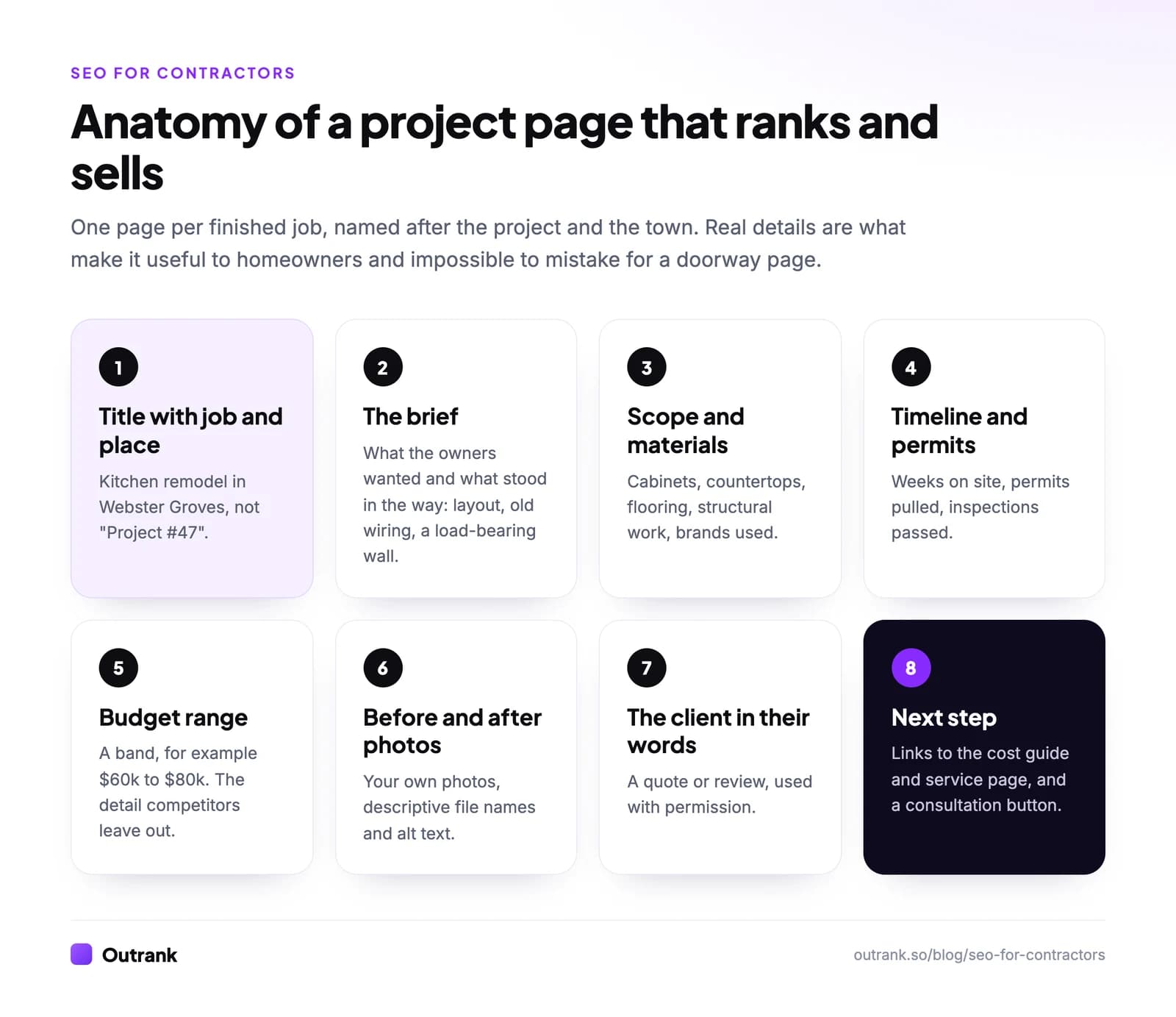
Then organize those pages by town and by project type. Normandy Remodeling, which has worked in Chicago and its suburbs since 1979, lets visitors enter a ZIP code or city to see a map of nearby projects, and links community pages with project photos and comments from neighbors.
This is the right way to build town pages. Google's spam policies call "pages targeted at specific regions or cities that funnel users to one page" doorway abuse. A town page listing five real projects you finished there, with photos and budgets, is the opposite: it's the most useful page a homeowner in that town could find.
Two practical tips:
- Photos: use your own, and give each a descriptive file name and alt text ("walnut-kitchen-island-webster-groves.jpg"). Our guide to naming images for SEO covers the details.
- Permission: ask clients before publishing their street, photos of their home or their names. Neighborhood or town is usually enough.
Your Google Business Profile still matters
Planned projects lean on the website, but "remodeler near me" and "roofing contractor [city]" searches still show the map results first. Set your Business Profile up properly:
- Category. Pick the most specific one that describes what you are: "General contractor", "Remodeler", "Kitchen remodeler", "Bathroom remodeler", "Roofing contractor", "Custom home builder", "Deck builder" or "Concrete contractor". Google asks for as few categories as possible, chosen by what the business is.
- Address or service area. If you have a staffed office or showroom, show it. If you work from home, hide the address and set a service area within about 2 hours' drive.
- Name. Your real business name, with no added keywords or cities.
- Photos. Finished projects, work in progress, your crew and your trucks. Add new ones as jobs finish.
If you run Local Services Ads, general contractors, roofers, and kitchen and bathroom remodelers are eligible categories in the US, with Google screening your business and licenses before the Google Verified badge.
Proof: license, insurance, warranty and process
A homeowner handing over a large deposit wants evidence. Put it on the site, in text Google can read:
- License number in the footer and on the About page, with a link to the state lookup. In California, the Contractors State License Board's advertising guidelines require it in all advertising, websites included (a civil penalty of $100 to $1,000 for a first offense), forbid advertising work outside your license classification, and forbid saying you're bonded. Only "A" and "B" license holders can advertise as general contractors.
- Insurance: what you carry, and that you'll provide certificates.
- Warranty: a page that explains it plainly. Case Architects & Remodelers gives its 5-year workmanship warranty its own page within a step-by-step process section.
- Process: design, pricing, permits, build, walkthrough. A page that explains how a project runs answers the "what am I getting into" question that stops many homeowners.
- Certifications: manufacturer programs you belong to (roofing, windows, cabinetry) and trade associations, with links to your listings.
Reviews across a long project
Remodeling and building clients can leave detailed reviews, because they've spent months with you. Ask at two moments: at the final walkthrough, and again at the first warranty check-up when they've lived with the result.
Send a direct link to your Google review form, and keep your Houzz, BBB and Angi profiles current too; homeowners check several sites for a big job. Stay inside Google's review policy: no incentives, no asking only happy clients, and no asking reviewers to include specific content. Reply to every review with something specific to the project.
Content that brings research traffic
Beyond cost guides and project pages, the questions homeowners ask during planning make good articles: "how long does a kitchen remodel take", "do I need a permit to finish my basement in [county]", "addition or move", "what to do with the kids during a remodel". Each one is a long-tail search with modest volume and little competition, and each puts your company in front of someone months before they ask for quotes.
That's the work Outrank automates: it finds the keywords your site can rank for, writes the articles with internal links to your service pages, and publishes them to WordPress, Webflow or whatever you use, every day. You keep the parts only you can do (cost tiers, project pages, photos). Outrank's study of 2,119 sites found 82% of 118 home and garden sites grew their Google clicks after starting, from a median 282 to 1,104 clicks per 28 days. That's Outrank customer data for the median site, not a promise, and growth usually takes a few months to show.
What to measure
Contractor SEO has a long feedback loop, so track it properly:
- Quote requests by source, every month, with a "how did you find us?" question on the form and on the phone.
- Close rate and revenue by source, looked at quarterly, since a lead from March may sign in June.
- Search Console: impressions and clicks for cost guides and project pages. Pages stuck on page two usually need more specific numbers or photos.
The trade-specific guides cover how other contractors' customers search: electricians, plumbers, HVAC companies and landscapers. For the basics, see SEO for small business.
FAQ
What is SEO for contractors?
SEO for contractors is the work of making a construction, remodeling or roofing company appear on Google when homeowners in its area research and hire for projects. It covers the Google Business Profile, service pages, cost guides, project pages, reviews, local links and articles that answer planning questions.
Should contractors publish prices on their website?
Yes, as ranges or tiers based on your own jobs. Cost searches are among the first homeowners make, and a contractor who answers them earns trust and better-qualified leads. Explain what moves the price so nobody treats the range as a quote.
How long does SEO take for a contractor?
Expect three to six months before new pages rank well, and longer in competitive cities. Outrank's data across all industries shows the median site with 27% more Google clicks after 84 days and twice as many by month 7. Because contractor sales cycles are long, revenue from SEO lags rankings by a few more months.
How much does SEO cost for contractors?
Doing it yourself costs time, mainly for cost guides, project pages and review requests. Agencies usually charge a monthly retainer, and software that writes and publishes content, such as Outrank, starts at $99 a month. Use the calculator above to set a budget from what a lead is worth to you.
Do contractors need a blog?
They need answers to planning questions, and a blog is the usual place for them. Articles like "how long does a bathroom remodel take" or "do I need a permit for a deck in [county]" bring homeowners to your site early and link them to your cost guides and project pages.
What's the best Google Business Profile category for a contractor?
The most specific one that describes your business: "General contractor" if you run whole projects, or "Kitchen remodeler", "Roofing contractor", "Custom home builder" and so on if you specialize. Google asks for as few categories as possible.