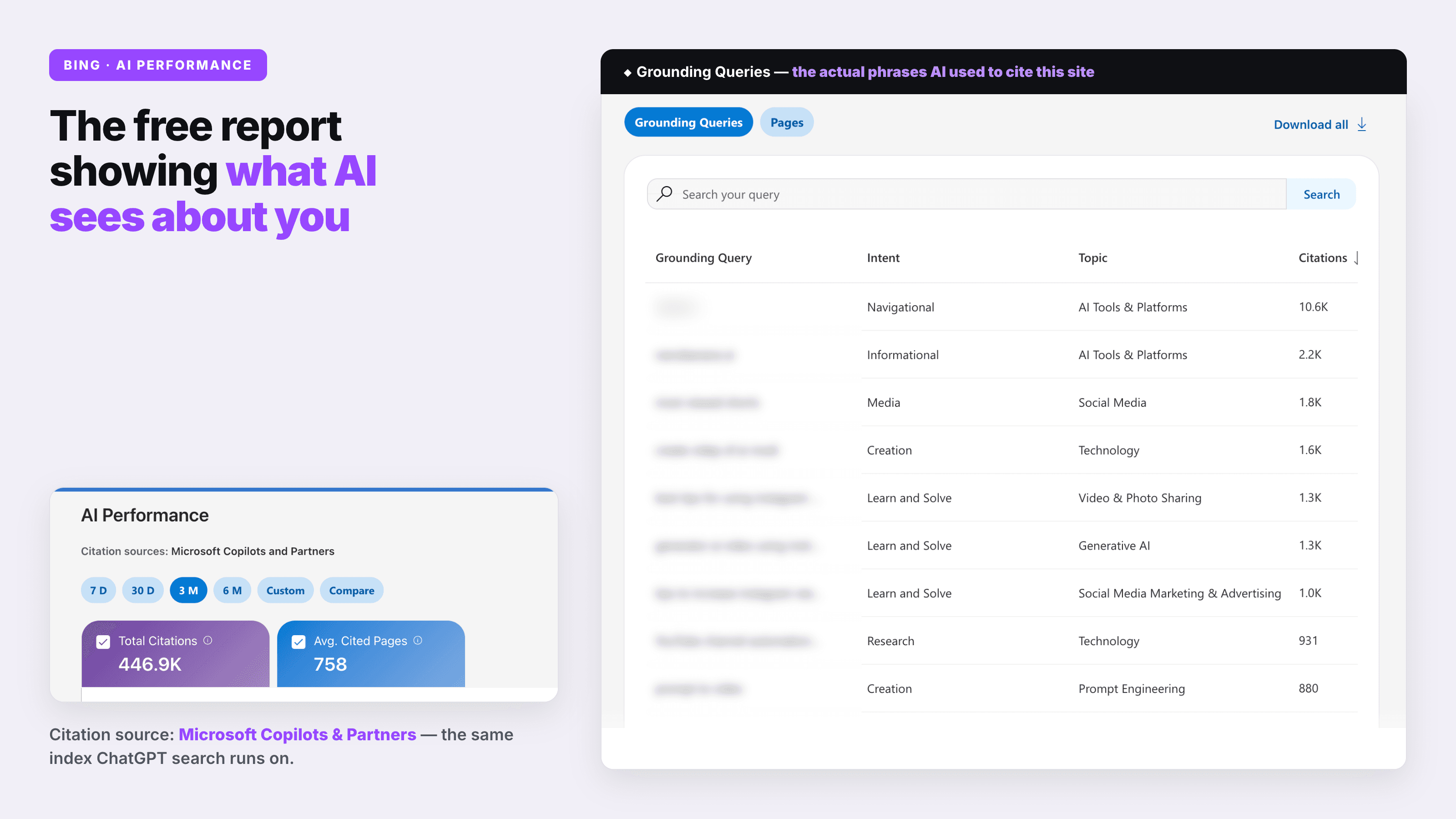
Bing's AI Performance report is a free dashboard in Bing Webmaster Tools that shows how often your pages are cited as sources in Microsoft Copilot, Bing's AI-generated summaries and select partner AI experiences, plus the grounding queries: the phrases the AI searched to find your content. Microsoft launched it in public preview on February 10, 2026 and added Intents, Topics, Citation Share and Compare on June 16, 2026. Google's equivalent in Search Console shows impressions, not queries, so as of October 2026 this is the only free first-party report we know of that shows the words behind AI citations.
Almost nobody opens it. Here's where to find it, what each metric means, and a simple loop for turning grounding queries into pages AI quotes more often.
Key takeaways
- The AI Performance report is free in Bing Webmaster Tools and covers Microsoft Copilot, Bing's AI summaries and select partner experiences. ChatGPT isn't in it.
- Grounding queries are the phrases the AI used to retrieve the content it cited. Microsoft says they're a sample of citation activity, not the full list.
- Since June 16, 2026 each grounding query gets an intent label and a topic, and Citation Share shows what percentage of all citations for a query went to your site.
- Copilot produced 18.8% of the AI citations in Outrank's study of 200 sites, second only to Perplexity (41.6%) and well ahead of ChatGPT (4.8%).
- The fix that works: take a query you're cited for, put a plain answer under a heading that matches it on the cited page, push the update with IndexNow, and compare 30 days later.
What the AI Performance report shows
| Metric | What it tells you |
|---|---|
| Total citations | How many times your pages were shown as sources in AI answers during the period. It says nothing about where in the answer you appeared. |
| Average cited pages | The average number of unique pages from your site cited per day. |
| Grounding queries | The key phrases the AI used when retrieving content it went on to cite. A sample of total citation activity. |
| Page-level citation activity | Citation counts for each URL on your site. |
| Visibility trends | Citations over time, so you can spot a rise or a drop. |
| Intents (added June 2026) | Each grounding query labelled as Informational, Commercial, Navigational, Learn and Solve, Research, Creation, Local and more. |
| Topics (added June 2026) | Related grounding queries grouped into broader themes. |
| Citation Share (added June 2026) | For one grounding query, your share of all the citations shown across every site. It doesn't name competitors. |
| Compare (added June 2026) | Overlays a previous period, for example the last 30 days against the 30 before. |
What it doesn't show: clicks, traffic, your position inside the answer, or which competitors were cited alongside you. Microsoft is explicit that citation counts don't indicate ranking, authority or importance.
How to open the report
- 1
Add your site to Bing Webmaster Tools
Sign in at Bing Webmaster Tools with a Microsoft account. The fastest way in is importing your sites from Google Search Console, which takes a couple of clicks. - 2
Open AI Performance
Choose AI Performance in the navigation and pick a period (7 days, 30 days, 3 months, 6 months or custom). Compare overlays an earlier period. - 3
Read the Grounding Queries tab
Sort by citations. Check the Intent and Topic columns to see which kinds of questions pull your pages in. - 4
Switch to the Pages tab
See which URLs get cited most. It's often not the page you'd pick. - 5
Export
Use Download all to pull everything into a spreadsheet you can work through.
What grounding queries usually reveal
When we first opened the report for our own sites, three things stood out, and they're worth checking on yours:
- AI cites you for questions you never wrote for. The queries are often broader or stranger than your keyword list.
- It reaches for the "wrong" page. An old blog post can earn more citations than the product page that should answer the question.
- Your homepage isn't its favourite source about you. Deeper pages that answer one question clearly tend to win.
The useful part is the gap. You optimize one page for a topic, and AI quotes a different one. The report shows you exactly which.
Turn grounding queries into better pages
The loop is simple and repeatable, and the queries double as a content plan built on real questions rather than keywords (why your content plan should be questions, not keywords). For the page fixes themselves, Microsoft's launch post recommends clear headings, tables and FAQ sections, claims backed by evidence, and content kept fresh.
Interactive checklist
Grounding query fix loop
0/7
Your progress is saved in this browser, so you can come back to it later.
Grounding queries are also the best free view of how AI rephrases a buyer's question (ChatGPT does the same before it searches, as why ChatGPT skips your site shows). The same question asked five ways can surface different brands, which we test in change one word, lose your spot in AI rankings.
How it compares with other ways to track AI citations
| Source | Price | AI surfaces covered | Query data | Main metric |
|---|---|---|---|---|
| Bing Webmaster Tools AI Performance | Free | Microsoft Copilot, Bing AI summaries, select partners | Grounding queries (a sample) | Citations per query and per page |
| Search Console generative AI reports | Free | Google AI Overviews, AI Mode, Discover AI features | None | Impressions per page, country and device |
| Manual prompt testing | Free | Any assistant you test | Only the prompts you run | Share of answers that mention you |
| Paid AI visibility trackers | Paid | Usually ChatGPT, Perplexity, Gemini, Copilot and Google's AI features | Only the prompts you track | Mentions and citations over time |
Google's version arrived on June 3, 2026 and reached all sites worldwide by August 31, 2026. It's useful for seeing which pages appear in AI Overviews and AI Mode, but it doesn't list queries. For the "which words did the AI use" question, Bing is still the only free first-party source.
Why Copilot citations are worth your time
It's easy to dismiss Bing. The data says otherwise.
Share of all AI citations, by assistant
Perplexity
154 of 200 sites
41.6%
Microsoft Copilot
134 of 200 sites
18.8%
Google AI Mode
118 of 200 sites
12.6%
Gemini
106 of 200 sites
11.9%
Google AI Overviews
109 of 200 sites
10.3%
ChatGPT
114 of 200 sites
4.8%
One caveat on ChatGPT: it isn't in Bing's report. OpenAI crawls the web with its own search bot, OAI-SearchBot, for ChatGPT search, so treat Bing data as a signal for how assistants read your site, not a mirror of what ChatGPT says. To see what ChatGPT draws on when someone asks about you, read what ChatGPT reads when someone asks if you're any good. To check a single question yourself, our free AI citation checker runs it on ChatGPT, Perplexity, Gemini and Claude and lists every source each one cites.
Then comes the real work: a clear answer for every query you're cited for, plus every query you should be cited for, kept current. That's what Outrank does. It finds the questions buyers ask, writes answer-first articles with plain headings, tables and FAQs, and publishes one a day to your CMS. Before you write anything, make sure the answer is readable by machines at all: how AI reads your website has a 30-second check.
FAQ
What is the AI Performance report in Bing Webmaster Tools?
It's a free report that shows how often your site is cited as a source in AI answers from Microsoft Copilot, Bing's AI summaries and select partners. It lists total citations, cited pages, the grounding queries behind citations and, since June 2026, intent, topic and citation share for each query.
What are grounding queries?
Grounding queries are the key phrases an AI system used to retrieve web content it then cited in an answer. They show how the AI rephrased the user's question into a search. Bing shows a sample of them, not the complete list.
Does Bing AI Performance include ChatGPT data?
No. The report covers Microsoft Copilot, AI-generated summaries in Bing and select partner experiences, and Microsoft doesn't list ChatGPT among them. ChatGPT search relies on OpenAI's own crawler, OAI-SearchBot, so check ChatGPT separately with manual prompts or a tracker.
Is the Bing AI Performance report free?
Yes. It's part of Bing Webmaster Tools, which is free. You need a Microsoft account and a verified site, and you can verify by importing your sites from Google Search Console.
Does Google Search Console show AI Overviews data?
Yes. Google launched Search Generative AI performance reports on June 3, 2026 and rolled them out to all sites by August 31, 2026. They show impressions in AI Overviews, AI Mode and Discover's AI features by page, country, device and date, but not the queries behind them.