

To rank on page one, you need roughly as many relevant referring domains pointing at your page as the comparable pages in positions 4 to 10 already have. To push into the top three, you need about as many as positions 1 to 3. For a lightly contested long-tail keyword that can be zero to five; for a competitive commercial term it can be 50 to 100 or more.
Two details matter more than the number itself. Count referring domains (unique sites linking to you), not total backlinks, and count them for the ranking page, not your whole domain. The calculator below turns the current top 10 for your keyword into a target and a timeline, and the rest of this guide shows what the research and Outrank's own data say about links and rankings.
Key takeaways
- There is no universal number. Your target is the median referring domains of comparable pages ranking for your keyword: positions 4 to 10 for page one, 1 to 3 for the top three.
- Referring domains beat raw backlink counts: across 1 million keywords, referring domains correlated 0.255 with rankings vs 0.131 for Domain Rating (Ahrefs, 2025).
- The #1 result has on average 3.8× more backlinks than positions 2 to 10 (Backlinko, 11.8M results).
- In Outrank's data, sites receiving 30+ backlinks a month grew Google clicks a median 2.18×, against 1.59× for sites receiving under 5.
- Links carry into AI answers: sites with 150+ verified backlinks got 16× the AI citations of sites with fewer than 10 (Outrank study of 200 sites).
How many backlinks do you need? The short answer
The number of backlinks you need is set by the search results you want to enter, not by a rule. Google uses links to discover pages and as one signal among many when ranking them, and its ranking systems work at both page and site level. So the same page can need three links for one keyword and eighty for another.
Generic quotas ("50 links for low competition, 100 for high") come from nowhere. What works is measuring the gap to the pages you're trying to displace:
- Entry target: the median page-level referring domains of comparable results in positions 4 to 10. Reaching it gives you a realistic shot at page one.
- Breakout target: the median of positions 1 to 3. Worth chasing only once you're on page one and the content clearly matches intent.
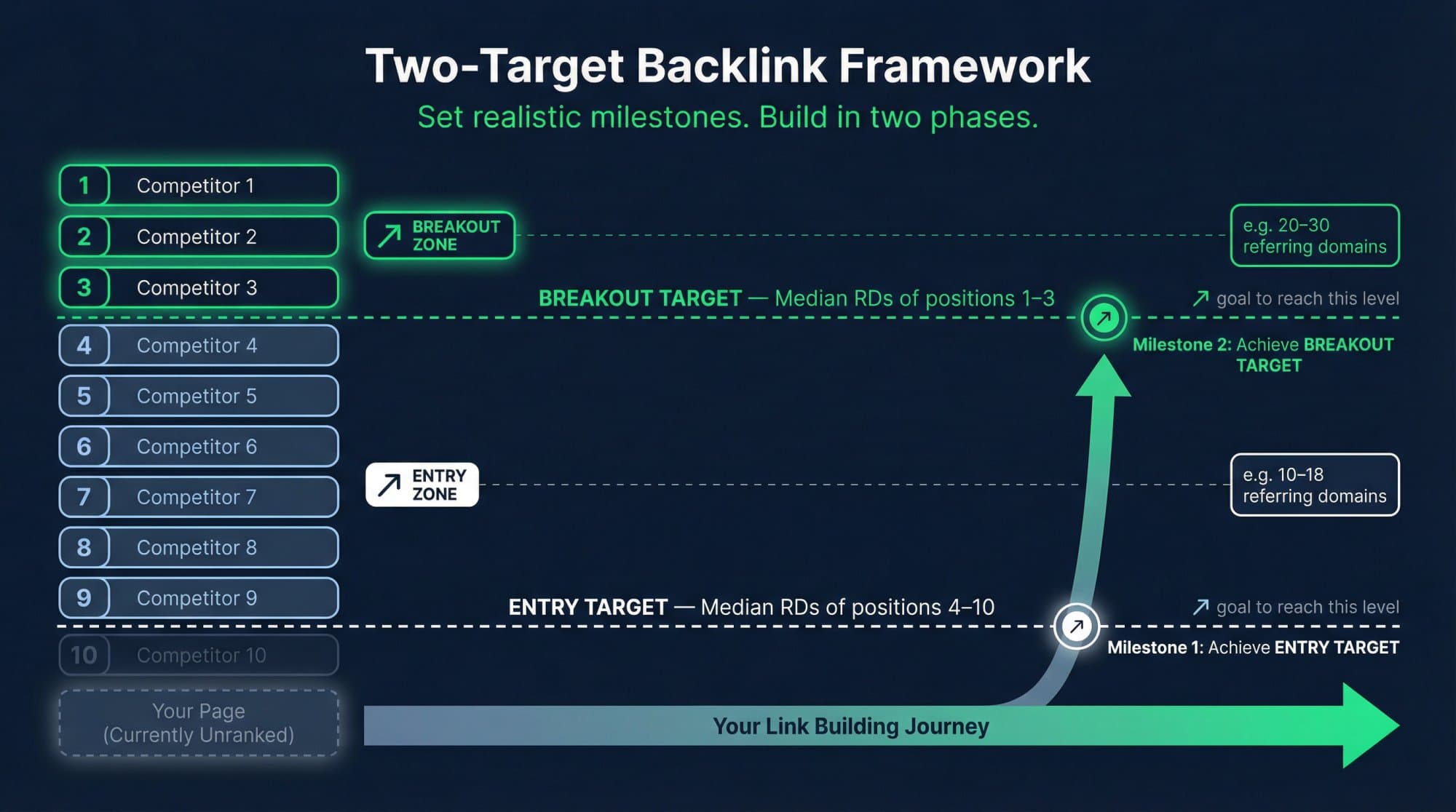
Why referring domains and not backlinks: ten links from one site are still one site vouching for you. Ten links from ten different sites are ten separate endorsements. Every major SEO tool reports both, and the referring domain count is the one to plan with.
Calculate how many backlinks your page needs
Pull the top 10 for your keyword in Ahrefs, Semrush or Moz, note each result's page-level referring domains, and drop the outliers that win for reasons you can't copy (giant brands, homepages when you're ranking an article, Reddit, YouTube, government and university sites). Then fill in the medians.
Interactive calculator
How many referring domains does your page need?
New referring domains to reach the page-one target
12
- New referring domains to reach the top-three target
- 27
- Months to the page-one target at your pace
- 3
- Months to the top-three target at your pace
- 6
Then adjust by judgement:
- Adjust up when your page is thinner than the competition, the query is local or high-volume (links correlate more strongly there), or the links you can get are weaker than theirs.
- Adjust down when your site already has topical authority in the area, your page clearly answers the query better, or competitors' totals are padded with junk links.
- Reassess after the first batch. Build five or ten good referring domains, wait a few weeks, and check whether the page moved. If it didn't, the bottleneck may be intent, content quality or internal links, not backlinks.
Examples: low, mid and high competition
These are hypothetical search results that show the logic, not quotas.
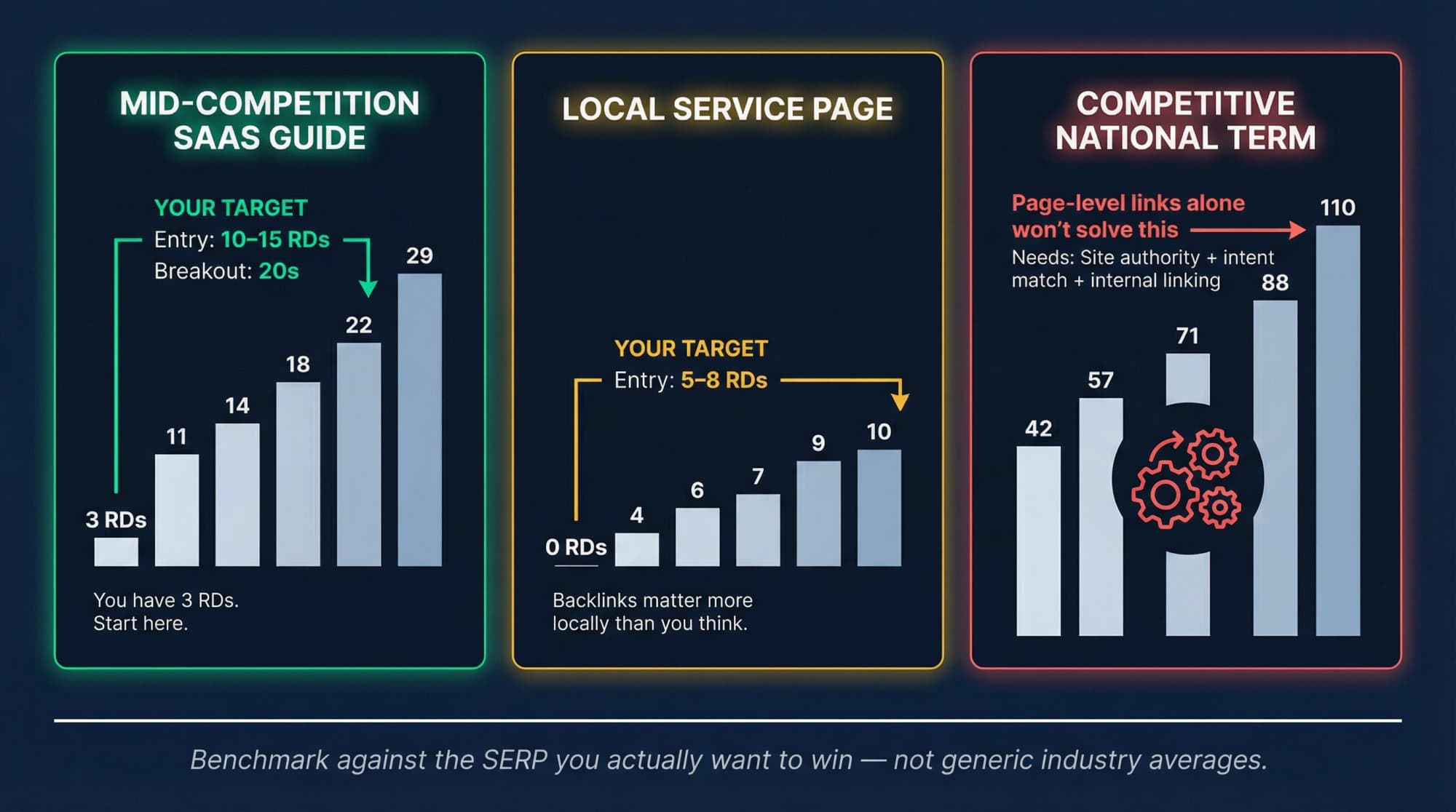
Mid-competition SaaS guide. After removing a big-brand homepage and a Reddit thread, the comparable page-one results have 11, 14, 18, 22 and 29 referring domains. Your page has 3. The entry target is the mid-to-high teens, the breakout target the twenties. A first campaign of 10 to 15 new relevant referring domains is a fair test.
Local service page. Comparable organic results have 4, 6, 7, 9 and 10 referring domains; you have none. Links matter more here than people assume: Google says local prominence draws on links and reviews, and Ahrefs measured a 0.33 correlation between referring domains and rankings for local queries, higher than average. Five to eight local or industry referring domains, plus reviews and a complete Business Profile, is a realistic first milestone.
Competitive national commercial term. Comparable results have 42, 57, 71, 88 and 110 referring domains. Page-level links alone won't close that on a young domain. You need broader site authority, brand mentions and a page that matches intent better, or a longer-tail keyword to win first.
How many backlinks should a website have?
There's no good total for a website, because a site doesn't rank; its pages do. What a "good" number of backlinks looks like is relative to the sites you compete with, and the useful comparison is referring domains to your key pages versus theirs.
Site-wide links still matter, because they lift every page. In Outrank's AI citation study of 200 sites, the median Domain Rating rose with the number of verified backlinks: DR 6 for sites with fewer than 10, DR 11 at 10 to 49, DR 26 at 50 to 149, and DR 30 at 150 or more. Our Domain Rating vs Domain Authority guide explains what those scores do and don't measure.
A useful floor: almost every page that earns search traffic has at least some links. Ahrefs' search traffic study found 96.55% of pages in its index get zero Google traffic, and only about 1 in 6,671 pages with no referring domains gets more than 1,000 monthly visits. Semrush found 92.3% of new domains that held top-100 rankings for 13 straight months had at least one backlink.
How many backlinks per month?
There's no safe or required monthly number. Google doesn't publish a quota, and the right pace is whatever closes your gap with links that would exist without you asking for a ranking boost. Two data points help calibrate:
- Ahrefs' backlink growth study found most #1-ranking pages gain followed links from new referring domains at 5% to 14.5% a month.
- In Outrank's results data, sites that received more backlinks a month grew more, with the clearest gap at 30+ a month.
Median growth in Google clicks, by backlinks received per month
Under 5 a month
65% of these sites grew
1.59×
5 to 14 a month
78% of these sites grew
1.66×
15 to 29 a month
69% of these sites grew
1.54×
30+ a month
80% of these sites grew
2.18×
Notice the middle of the chart: 15 to 29 links a month did no better than 5 to 14. Link count alone doesn't explain growth; relevance, the pages being linked and the content behind them do much of the work. For reference, the median site connected to Outrank's exchange receives 28 verified in-article backlinks a month, from sites with a median DR of 26.
How to check how many backlinks you have
Every tool counts differently, because each crawls a different slice of the web. Use more than one and compare trends, not exact totals.
- 1
Google Search Console (free, your own site)
Open Links in the left menu. Top linking sites shows referring domains, Top linked pages shows which pages earn links. Google says the report is a sample, not a comprehensive list, may include links that were removed, and doesn't show whether a link is nofollow. - 2
Bing Webmaster Tools (free)
The Backlinks report lists referring domains and linking pages for your verified site, and lets you compare against other domains. - 3
A third-party backlink checker (any site)
To see how many backlinks a site has, including a competitor's, paste the domain or URL into Ahrefs' free Backlink Checker, Semrush or Moz Link Explorer. Note referring domains for the exact ranking URL, not just the domain total. - 4
Check that important links are still live
Links disappear over time. Our free backlink monitor checks whether each link still exists, is followed and sits on an indexable page.
For tracking which links actually send visitors, see how to find backlinks in Google Analytics.
What the research says about backlinks and rankings
Links still correlate with rankings, more weakly than they used to, and referring domains remain the best link metric to plan with.
| Metric (Ahrefs, top 1M US keywords, 2025) | Correlation with ranking |
|---|---|
| Referring domains | 0.255 |
| Followed referring domains | 0.250 |
| Backlinks | 0.248 |
| Followed backlinks | 0.242 |
| Domain Rating | 0.131 |
Source: Ahrefs, January 2025. The same study found links correlate more strongly on high-volume, local and informational queries, and slightly less than in its 2019 study of comparable keywords (0.22 to 0.24 vs up to 0.29).
Two more benchmarks: Backlinko's analysis of 11.8 million results found the #1 page has on average 3.8× more backlinks than positions 2 to 10, and that about 95% of pages had no backlinks at all.
None of this means links are the only lever. Google's own ranking systems guide lists many systems that weigh content and usefulness. That is why a strong, focused page often needs fewer links than a weak one.
When fewer backlinks are enough, and when more won't help
You usually need fewer links when your site already has topical authority, your page is the best format for the query, your internal links route authority to it, the keyword is long-tail, or the page contains something cite-worthy (original data, a calculator, a template).
More links usually won't help when the page is the wrong type for the search results, the content is thin or outdated, it misses search intent, two of your pages compete for the same keyword, or competitors win on brand trust and product depth. A technical SEO audit surfaces those problems faster than another round of outreach.
How many high-quality backlinks do you need for AI answers?
Links help beyond Google's blue links. In Outrank's study of 200 customer sites, AI citations (ChatGPT, Perplexity, Gemini, Copilot, AI Overviews and AI Mode, counted by Ahrefs) climbed steeply with verified backlinks:
Median AI citations per site, by verified backlinks
6
15
68.5
98
Under 10 links
50 sites · median DR 6
10–49
43 sites · median DR 11
50–149
56 sites · median DR 26
150+
51 sites · median DR 30
The strongest predictor of AI citations in that study was Google impressions (Spearman 0.80), and links fed into it: verified backlinks correlated with DR, DR with impressions. Outside Google, SE Ranking found sites with over 32,000 referring domains were 3.5× more likely to be cited by ChatGPT than sites with up to 200. You don't need 32,000; you need steady, relevant links to pages that already rank. Outrank's AI visibility tracking shows where you're cited today.
Can you rank fast with backlinks?
Only when links were the missing piece. A page sitting at positions 8 to 20 with good content can move within weeks of earning a handful of strong referring domains. A new domain trying to enter a competitive results page usually takes months, whatever you spend. Offers of "high PageRank backlinks" for a quick jump don't help: Google stopped showing PageRank publicly in 2016, and paid links that pass ranking credit break its link spam policy. If you do pay for placements, our guide to the best places to buy backlinks covers the risks and how to vet sellers, and how to build backlinks covers the 12 tactics that don't need a budget.
FAQ
How many backlinks do I need to rank on page 1?
About as many relevant referring domains as the comparable pages already ranking in positions 4 to 10 for your keyword. Look up their page-level referring domains in Ahrefs, Semrush or Moz, take the median, and subtract what your page has. For low-competition long-tail keywords that can be a handful; for competitive terms it can be dozens.
How many backlinks is good for a new website?
There is no fixed number, but a new site should aim for steady, relevant referring domains to the pages it wants to rank, rather than a total. In Outrank's study of 200 sites, those with 50 to 149 verified backlinks had a median DR of 26, against DR 6 for sites with fewer than 10. Relevance and placement matter more than reaching a round number.
How many backlinks should I build per month?
Google publishes no safe monthly number. Ahrefs found most #1-ranking pages gain links from new referring domains at 5% to 14.5% a month, and among Outrank customers, sites receiving 30 or more backlinks a month grew Google clicks a median 2.18× from their baseline. A steady flow of relevant links matters more than hitting a monthly quota.
How do I check how many backlinks I have?
In Google Search Console, open Links and read Top linking sites (referring domains) and Top linked pages. Google says this report is a sample, so cross-check with Bing Webmaster Tools or a backlink checker such as Ahrefs, Semrush or Moz. Expect each tool to show a different total.
Is it better to have more backlinks or more referring domains?
More referring domains. Ten links from ten different sites carry more weight than ten links from one site, and Ahrefs' 2025 study found referring domains correlated slightly better with rankings than total backlinks. Plan and report in referring domains to the ranking page.
Can you rank without backlinks?
Yes, for low-competition queries, especially on a site that already has topical authority and good internal linking. Once the pages competing for a keyword have earned links, a page with none rarely holds a top position. Ahrefs found only about 1 in 6,671 pages with no referring domains gets more than 1,000 monthly search visits.