

The best place to buy backlinks is a service that puts your link inside a real article, on a site that already gets Google traffic in your niche, and then checks that the link stays live. In October 2026 that means a curated placement service or a managed outreach vendor, at roughly $100 to $400 per link. Open catalogues sell links from $1, and at that price you inherit every risk the seller didn't screen out.
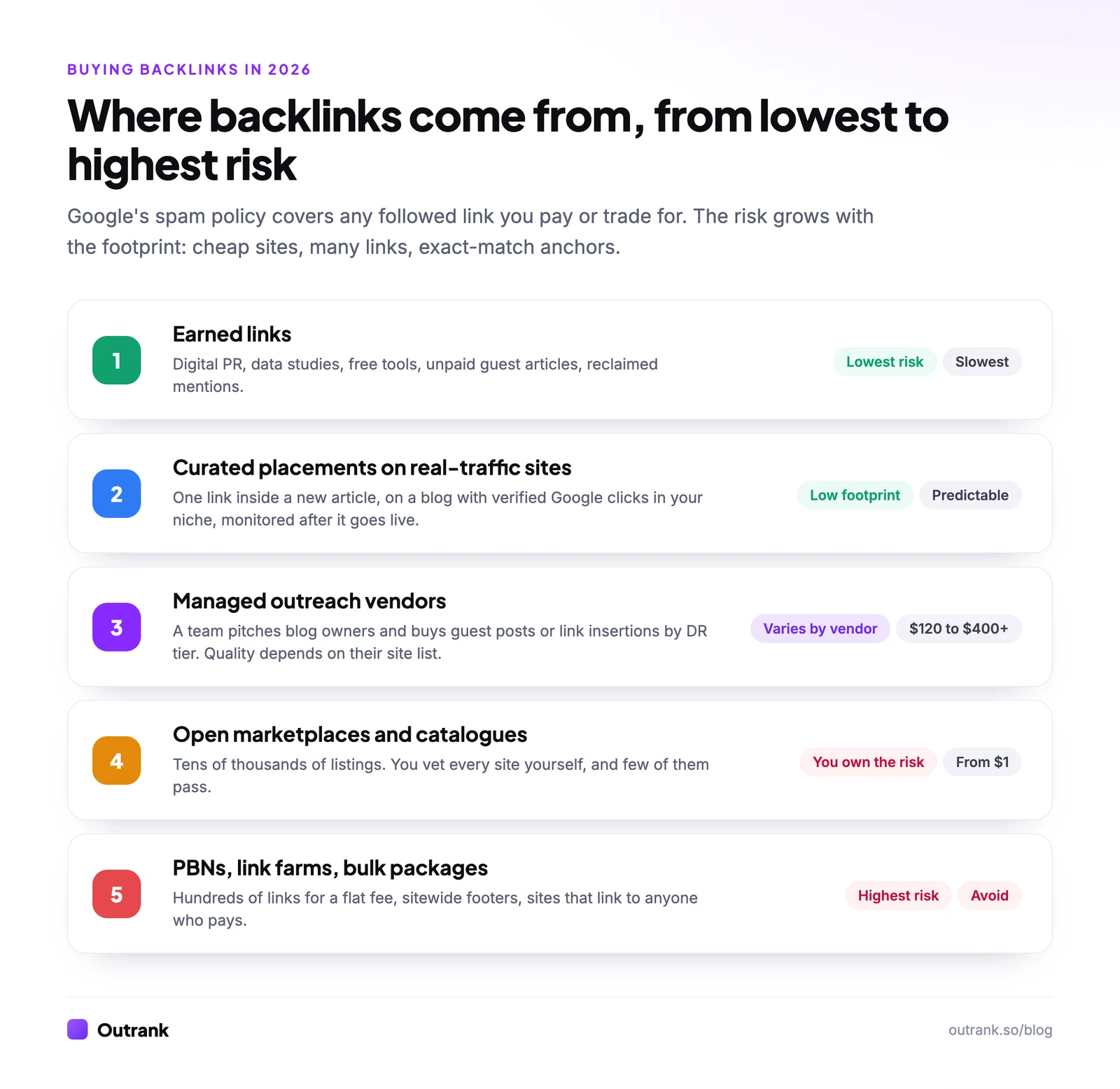
One rule frames everything below. Google's spam policies class "buying or selling links for ranking purposes" as link spam, unless the paid link carries rel="sponsored" or rel="nofollow". No paid followed link is risk-free, so the real question is which kind of placement carries the smallest footprint.
This guide compares 10 places to buy backlinks, with prices checked on each vendor's site, and gives you a checklist to vet any seller before you pay.
Key takeaways
- Google treats paid links that pass ranking credit as link spam. Its SpamBrain system can detect "sites buying links" and neutralize the credit they pass.
- Average 2026 prices: $225 for a link insertion and $459 for a guest post, across 52,671 sites (Adsy). Vetted guest posts at DR 30+ start around $120 to $200.
- Only 1.37% of sites selling guest posts on marketplaces qualify as high quality or top tier (BuzzStream, 257,267 sites). Most of any catalogue is not worth buying.
- Pay for Google traffic and topical relevance, not Domain Rating. A DR 50 site with no traffic is a worse buy than a DR 25 blog that ranks in your niche.
- Buy from sellers who monitor links: 66.5% of links pointing to 2 million sites rotted within nine years (Ahrefs).
Can you buy backlinks? What Google's link spam policy says
Link spam, in Google's words, is creating links "primarily for the purpose of manipulating search rankings." Its spam policies list the first example plainly: buying or selling links for ranking purposes, which includes exchanging money, goods or services for links, or for posts that contain them. Excessive link exchanges ("link to me and I'll link to you") are on the same list.
Paying for a link is not a problem in itself. Google says such links are fine "as long as they are qualified" with rel="sponsored" or rel="nofollow", which tells it not to pass ranking credit. That is how Google wants sponsored links marked. It also means a properly labelled paid link does little for your rankings, which is why most buyers want followed links.
What happens when Google spots a paid followed link:
- The link stops counting. Since the December 2022 link spam update, SpamBrain "can now detect both sites buying links, and sites used for the purpose of passing outgoing links." Rankings shift as that credit is lost. You get no notice; you simply paid for nothing.
- A manual action. For larger patterns, a reviewer can apply an "Unnatural links to your site" action, visible in Search Console under Security & Manual Actions → Manual actions. That one hurts the whole site until you clean up and file a reconsideration request.
Buying is common anyway: 91.89% of SEO professionals believe their competitors buy backlinks, according to an Editorial.Link survey of 518 SEOs. The risk scales with footprint. A few in-content links on relevant, well-read blogs look like ordinary editorial links. Hundreds of exact-match anchors from sites that link to anyone who pays look like what they are.
The 10 best places to buy backlinks, compared
Prices below come from each vendor's own site in October 2026. Vendors change them often, so treat them as a starting point and check before you order.
Where to buy backlinks in 2026
| Outrank Backlinks | Curated placements | $899/mo plan (1,400 credits); a DR 30 link costs 120 credits | Matched for you: DR 30+, 100+ Google clicks a month, Search Console verified | Rechecked every 2 days for 90 days; credits returned if lost |
| FATJOE | Managed outreach | $72 (DR 10+), $120 (DR 30+) | By DR and traffic tier | Lifetime link guarantee and money-back guarantee |
| Loganix | Managed guest posts | $200 (DR 30+), $400 authority links | You approve the site list before outreach | Rejected placements replaced at no cost |
| The HOTH | Managed outreach | $150 (DR 20+), $200 (DR 30+) | By DA or DR tier | Broken links fixed or replaced for 6 months |
| Rhino Rank | Link insertions and guest posts | $60 curated link, $75 guest post | Existing articles that already rank | Not stated on the homepage |
| Authority Builders | Managed link building | On request | Hand-picked sites with organic traffic | Not stated on the homepage |
| Rixot | AI-matched marketplace | $1 per link and up | AI matching from 50,000+ listed domains | Charged only once the link is published |
| Collaborator | Open marketplace | Listings from about $40 | You choose from a catalogue of about 45,000 sites | Free 3-month guarantee against deletion and de-indexing |
| Adsy | Open marketplace | Set per site | You choose from 150,000+ platforms | Link presence monitored |
| WhitePress | Open marketplace | Set per site | You choose from 148,000+ sites | 36-month guarantee with daily monitoring |
Click a column header to sort.
The three types behave very differently:
- Curated placement services pick the site for you against fixed quality rules and write the article. You give up control over the exact domain in exchange for screening you don't have to do.
- Managed outreach vendors email site owners on your behalf and charge by DR tier. You pay a markup for the outreach and writing, and quality depends on how well they maintain their list.
- Open marketplaces are catalogues of publishers with a price tag on each site. They are the cheapest per link and the most work, because you vet every site yourself.
Outrank Backlinks: placements on blogs with real Google traffic
Outrank Backlinks places one link to the page you choose inside a brand-new article on a third-party blog, with a 250 to 350 word section about your business. There is no catalogue to trawl. Every day it looks for blogs in your subject and language that pass its bar (DR 30 or higher, at least 100 organic Google clicks a month, Search Console connected with three or more months of history) and places you on the best one your credits allow.
Pricing as of October 2026: the Scale plan is $899 a month for 1,400 credits, and a placement costs the host's DR times 4 credits. A DR 30 blog costs 120 credits and a DR 60 blog 240, which works out to roughly $77 and $154 of plan value per link. Links are rechecked every 2 days for 90 days; if one disappears and the publisher doesn't restore it within 7 days, the credits come back and the page is placed elsewhere.
What it won't do: let you pick a specific domain, or promise a number of links. In a narrow niche some days have no match, and credits roll over. It also doesn't claim the links are penalty-proof; nobody outside Google can.
FATJOE: blogger outreach priced by DR
FATJOE is a long-running white-label vendor, popular with agencies. Its blogger outreach is priced by tier: $72 at DR 10+, $96 at DR 20+, $120 at DR 30+ (its most popular tier, 100 to 10,000 monthly visits), up to $456 at DR 60+. Writing is included, and it lists a lifetime link guarantee and a money-back guarantee. Good for agencies that need predictable per-link pricing and reports they can rebrand.
Loganix: guest posts you approve first
Loganix sells guest posts from $200 (DR or DA 30+, 100 to 500+ monthly visits) and "Authority Links" from $400 (average DR 40+, at least 1,000 monthly organic visits, niche-specific sites). You approve the site selections, turnaround is about three weeks from approval, and rejected placements are replaced with an equal or better site. Worth the premium if you want to see the list before money changes hands.
The HOTH: managed link outreach
The HOTH's Link Outreach runs $150 at DA or DR 20+, $200 at 30+, $314 at 40+ and $375 at 50+, with articles from 500 to 2,000 words and a turnaround of about 30 days. Broken links are fixed or replaced for six months. It is a reasonable middle ground for small businesses that want one vendor for links, press releases and content.
Rhino Rank: links inside articles that already rank
Rhino Rank is best known for "curated links": your link added to existing articles that already rank, from $60. Guest posts start at $75 (750+ words) and listicle placements at $135. Link insertions into ranking pages are efficient, but check each host page yourself: an old article stuffed with new commercial links is exactly the pattern spam systems look for.
Authority Builders: managed campaigns on request
Authority Builders sells guest posts, link insertions and managed campaigns with no public price list; you book a call. It pitches its sites on real organic traffic. Fine for teams with a budget who want a hands-off campaign, harder to compare on price.
Rixot: AI-matched links from $1
Rixot is an AI backlink marketplace: you give it a target page and keyword, and it matches you with donor sites, writes the placement and orders it through a dashboard, an API or an AI agent. It lists 50,000+ domains, prices "from $1 / link" (with a promotion pricing every domain at $10 at the time of writing), and charges only once a link is published. Cheap and fast. At that price, judge every donor site on its own traffic and relevance before you trust it.
Collaborator, Adsy and WhitePress: open marketplaces
These three are catalogues of publishers who accept paid articles:
- Collaborator shows about 45,000 sites, with sample listings from around $40, and includes a free three-month guarantee against deletion and de-indexing (a one-year guarantee costs extra).
- Adsy lists 150,000+ platforms you can filter by metrics, and monitors link presence after publication. Its own 2026 study of 52,671 sites is the source of the $459 average guest post price below.
- WhitePress covers 148,000+ websites and offers a 36-month guarantee with daily monitoring, which is long for this market.
Open marketplaces give you the most control and the lowest prices. They also hand you the hardest job: BuzzStream's analysis of 257,267 marketplace sites found only 1.37% qualified as high quality or top tier. Use the vetting checklist below on every single site.
What backlinks cost in 2026
Most of a link's price comes from the host site's authority and traffic. Adsy found that each additional 10 points of DR raises the price by about 32%, and that the average guest post rose 7.5% in a year, from $427 to $459.
Average price of one backlink in 2026, by type
Link insertion in an existing article
Adsy
$225
Guest post bought directly from the site
BuzzStream
$295
Guest post
Adsy
$459
Guest post bought through a vendor
BuzzStream
$461
What SEOs consider acceptable for one high-quality link
Editorial.Link
$509
High-quality guest post through a vendor
BuzzStream
$3,130
A useful sanity check: if a seller's price is a fraction of these averages, the site is probably either very weak or selling to everyone. Neither is a link you want. For a full view of what links cost and how many you need, see our guide to how many backlinks you need to rank and the sourced numbers on our link building statistics page.
"High authority", "PageRank" and "premium" backlinks: what you are actually buying
Sellers use a handful of labels that sound precise and aren't.
PageRank backlinks. Google still uses PageRank internally, but it stopped showing it publicly when it removed Toolbar PageRank in 2016. Nobody outside Google can see a page's PageRank today, so a "PR 6 link" is a number the seller made up or carried over from a decade ago.
High authority backlinks. "Authority" usually means Ahrefs Domain Rating or Moz Domain Authority, which are third-party estimates built from link counts, not Google metrics. Both can be inflated by link schemes. Our Domain Rating vs Domain Authority guide explains how each is calculated and why a high score alone proves little.
Relevant backlinks. This is the label that matters. In uSERP's 2026 survey, 58.6% of senior SEOs said the topical relevance of the linking page is the single most important factor when judging a backlink. A link from a page about your topic, read by your audience, is the one Google is most likely to treat as a genuine recommendation.
Organic backlinks. A bought link is not organic by definition. When a seller says "organic", ask whether they mean a link in the body of an article on a site with organic Google traffic. That is a reasonable thing to pay for.
Premium backlinks. Usually a price tier, not a quality standard. Judge the site, not the label.
How to vet a backlink seller before you pay
Run every site through these checks, whichever service you use. The ones you can't verify are the ones that cost you money later.
Interactive checklist
Backlink seller vetting checklist
0/12
The host site
0/5The placement
0/4The seller
0/3Your progress is saved in this browser, so you can come back to it later.
Link monitoring matters more than it sounds: Ahrefs' link rot study found 66.5% of links pointing to a sample of 2 million websites had disappeared within nine years. A seller who doesn't check and replace lost links is selling you a depreciating asset with no warranty.
Red flags that should end the conversation: bulk packages of hundreds of links for a flat fee, private blog networks (PBNs, sites built only to sell links), sitewide or footer links, "guaranteed DA 50" for $20, and any seller who won't show you a single example placement.
Safer alternatives to buying links
If the policy risk bothers you, or your budget doesn't stretch to $200 a link, these routes get you similar links with less exposure:
- A backlink exchange with strict rules. Outrank's exchange places links to your site inside new, in-niche articles that other Outrank businesses publish, and you host relevant links in yours in return. It is included in the Organic Growth plan ($99 a month, with 30 articles) and comes with a guarantee of 15 verified backlinks a month or the plan runs free. Be clear-eyed: an exchange is still a way of getting links you didn't earn editorially, and Google's policy names excessive link swaps. The rules exist to avoid that pattern: links only go inside article bodies, at most two or three per article, a site that just linked to you can't receive a link back for 14 days, the same site links to you at most once every 30 days, and exact-match anchors are rejected.
- Digital PR. In the Editorial.Link survey, 48.6% of SEO professionals named digital PR the most effective link building tactic. Original data, surveys and expert commentary earn links from news sites you could never buy.
- Reclaiming links you already earned. Brands get mentioned without a link all the time, and old links break. Link reclamation turns both into backlinks with one email each.
- Content people cite. Statistics pages, free tools and original research collect links for years. Our step-by-step guide to building backlinks covers how to make and promote them.
148,877
backlinks verified live through Outrank's exchange in 90 days
Placed in articles on 1,960 sites, July to October 2026
28
verified backlinks a month for the median connected site
1,026 sites measured, 30 days to September 29, 2026
DR 26
median Domain Rating of the sites placing those links
Last 5,000 verified links
Source: Outrank platform data (90 days to October 2026) and the /guarantee exchange audit.
How many links should you buy?
Fewer than sellers suggest, and spread out. A sudden spike of links to a young site is a pattern; a steady trickle of relevant placements is not. Start with the gap to the pages already ranking for your target keyword: compare their referring domains with yours in Ahrefs or Semrush, then close part of that gap each month. In Outrank's results data, sites receiving 30 or more backlinks a month grew Google clicks a median 2.18× from their pre-Outrank baseline, against 1.59× for sites receiving under 5 (an observational median across Outrank customers, not a controlled test).
If you're new to links altogether, read what backlinks are and which ones help first, and use our guide to checking which backlinks you have to track what each purchase actually delivers.
FAQ
Is it illegal to buy backlinks?
No. Buying a backlink is not against any law, but it breaks Google's spam policies if the link passes ranking credit. Google allows paid links marked with rel="sponsored" or rel="nofollow". Unmarked paid links risk being ignored by Google's algorithms or, at scale, a manual action.
What is the best site to buy backlinks?
The best site to buy backlinks is one that places your link inside a relevant article on a blog with real Google traffic, shows you the site or its selection rules, and monitors the link after it goes live. Curated services like Outrank Backlinks and managed vendors like Loganix, FATJOE and The HOTH meet that bar at roughly $100 to $400 a link. Open marketplaces are cheaper but require you to vet every site.
How much should I pay for a backlink?
Expect around $225 for a link insertion and $459 for a guest post on average in 2026, according to Adsy's study of 52,671 sites. Vetted placements at DR 30+ start around $120 to $200 with managed vendors. Links from genuinely high-quality sites through a vendor average $3,130 (BuzzStream), so anything sold for a few dollars is almost certainly low quality.
Can buying backlinks get my site penalized?
Yes, it can. Google's SpamBrain detects sites that buy links and neutralizes the credit those links pass, and large patterns can trigger an "Unnatural links to your site" manual action in Search Console. The risk grows with volume, exact-match anchors and low-quality host sites.
Do PageRank backlinks still exist?
Google still uses PageRank internally, but it removed the public Toolbar PageRank score in 2016. No one outside Google can see a page's PageRank today, so links sold as "PR 5" or "high PageRank" are labelled with a number the seller can't verify. Judge the host site's traffic and relevance instead.
Are high DR backlinks worth buying?
Only when the high-DR site also has real Google traffic and covers your topic. Domain Rating is a third-party estimate based on links, and it can be inflated. A DR 25 blog that ranks for keywords in your niche usually passes more value than a DR 60 site that ranks for nothing.
What is Rixot?
Rixot is an AI backlink marketplace that matches a target page and keyword with donor sites from a list of 50,000+ domains, writes the placement and orders it. It advertises prices from $1 per link and charges only once a link is published. As with any open marketplace, check each donor site's traffic and relevance before trusting the link.