

An AI SEO content generator is software that turns a keyword, or just your website URL, into an article built to rank. It picks the keyword, studies the pages already on page one, writes to that brief, adds the title tag, meta description, headings, internal links and images, and in the better tools publishes the post to your CMS. ChatGPT can write the words. A generator also does the research and the plumbing around them.
That difference decides what you pay and what you get. This guide covers the six steps a serious generator runs, what Google says about AI content in 2026, what these tools really cost per article, and how eight of them compare.
Key takeaways
- An AI SEO content generator does six jobs (keyword selection, SERP brief, draft, on-page SEO, publishing and, rarely, link building). A chatbot covers one of them.
- Google does not demote content for being AI-written. Its spam policy targets "scaled content abuse", meaning many pages made mainly to manipulate rankings, however they were produced.
- Winnable keywords are small. Across 200,871 articles Outrank wrote in 90 days, the median target keyword had a difficulty of 14 and 170 searches a month.
- Expect slow, then compounding results. Across 2,119 sites on Outrank, median Google clicks were up 7% after 28 days, 27% after 84 days and 2.0× by month 7.
- The software is the cheap part. Budget for the human review time, which is what keeps AI articles accurate.
What is an AI SEO content generator?
An AI SEO content generator is a tool that produces search-optimized content from search data instead of a blank prompt. Its input is a keyword with a known search volume and difficulty, plus an analysis of what already ranks for it. Its output is content shaped to compete for that query.
Three kinds of tools are sold under the name, and they solve different problems:
| Type | You give it | You get back | Examples |
|---|---|---|---|
| SEO text generator | A keyword, page or product | Short copy: title tags, meta descriptions, product descriptions, FAQ answers | Rank Math AI, Yoast SEO Premium, ChatGPT with a good prompt |
| AI article writer | A keyword or a list of keywords | A full draft optimized against the SERP; you edit and publish it | Surfer, Frase, Koala, Byword |
| Autopilot platform | Your website URL | A keyword plan, articles published to your CMS on a schedule, internal links, sometimes backlinks | Outrank, SEObot, Arvow |
If you searched for an "SEO text generator", the first type saves you minutes per page. If you want organic traffic from a blog nobody on your team has time to write, you need the second or third type. The rest of this guide is about those.
How an AI SEO content generator works, step by step
Every credible generator runs the same pipeline. The tools differ in how many of the steps they automate and how well.
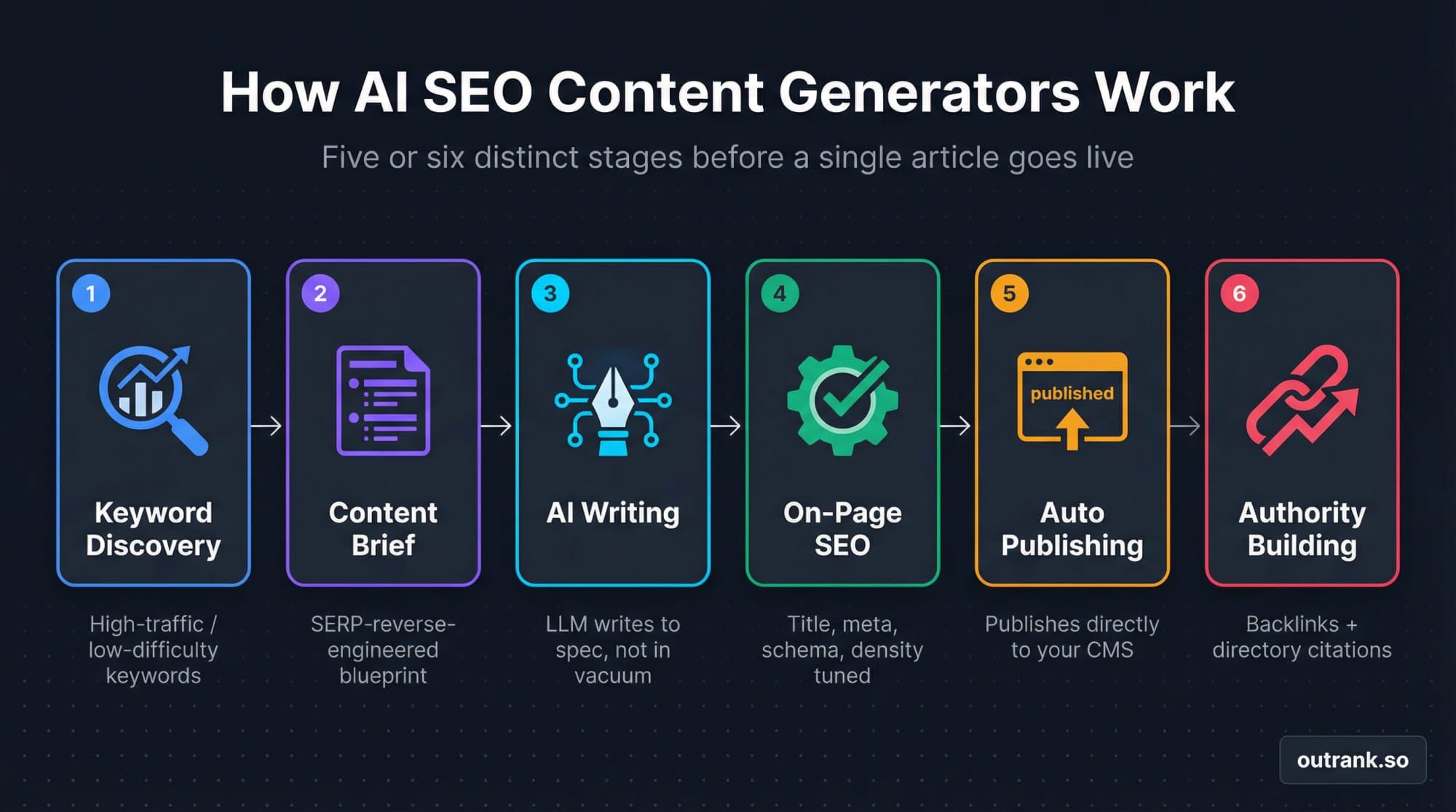
1. It picks keywords you can actually rank for
Good generators start from difficulty, not volume. A young site with few backlinks is unlikely to rank for a keyword with a difficulty of 60, however well the article is written. Keyword difficulty is the filter that matters most at this step.
Here is what "winnable" looks like at scale. These are the keywords Outrank chose for its customers' articles over the last 90 days:
Keyword difficulty of the keywords an AI SEO generator targets
KD 0–9
32.4%
KD 10–19
30.8%
KD 20–29
17.5%
KD 30–39
9.4%
KD 40–49
4.7%
KD 50–69
4.1%
KD 70+
1.1%
Volume follows the same pattern: the median target keyword had 170 searches a month, and 96.7% of articles targeted keywords with fewer than 1,000 monthly searches. That is the long tail, and it is where automated content wins, because big sites rarely bother with it.
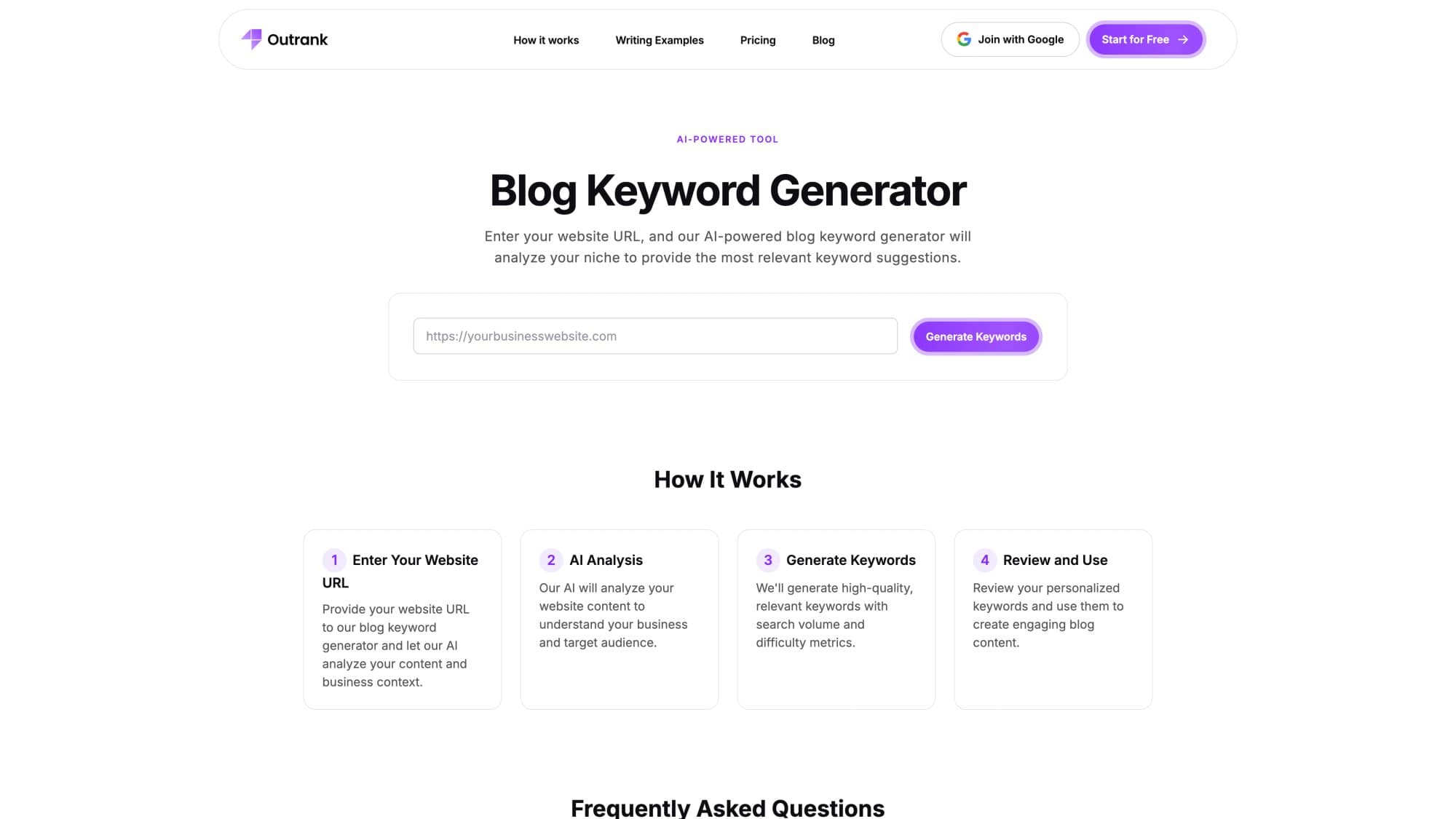
You can try this step for free with Outrank's blog keyword generator: paste your URL and it suggests keywords with search volume and difficulty for your niche.
2. It builds a brief from the current results
Next, the tool reads the pages ranking for the keyword: the headings they share, the questions they answer, the entities they mention and how long they run. That becomes the brief, the spec the article is written against. The useful briefs also flag what the top results miss, because that gap is your reason to exist on page one. You can do the same for AI answers: our free tool shows which pages ChatGPT, Perplexity, Gemini and Claude cite for a question and whether each one is a listicle, a blog article or a comparison. If you write briefs by hand today, these content brief examples show the same structure.
3. It writes to the brief
A large language model drafts the article with the brief, the target keyword, related terms and your brand settings in its context. It is not writing in a vacuum, but it is still predicting likely words, not looking up facts. Google's own guidance on generative AI content (updated October 2026) says it plainly: models can hallucinate, so fact-check everything, including titles, structured data and image alt text.
4. It applies on-page SEO
After the draft comes the technical layer: a title tag that fits in the results, a meta description, one H1, a clean H2/H3 hierarchy, internal links to your related pages, external links to sources, image alt text and an FAQ block. None of it is magic, but sloppy on-page signals are a common reason decent AI drafts never rank. Our guide to writing meta titles covers the part searchers see first.
Ignore any tool that brags about "keyword density calibration". Density is not a target worth chasing; covering the topic completely matters far more.
5. It publishes to your CMS
Publishing friction kills more content programs than bad writing does. Drafts pile up in Google Docs, nobody formats them, and the cadence dies in week three. Autopilot generators connect directly to your site. Outrank publishes to WordPress, Webflow, Shopify, Wix, Framer, Notion, Ghost, Next.js and any stack through a webhook, and can save articles as drafts if you want to review first (see all integrations).
It shows in the data. In Outrank's AI SEO agent study, 76.8% of sites that auto-published grew their Google clicks, against 62.5% of sites that did not. That is a correlation, not proof, but the direction is what you would expect: content that ships beats content that waits.
6. It builds authority, the step most tools skip
Content without links stalls on anything competitive. Most generators stop at publishing and leave link building to you. Outrank runs a backlink exchange: your site earns links placed inside relevant new articles on other Outrank sites (never footers or link lists), with no exact-match anchors and a guarantee of 15 verified backlinks a month. The median connected site gets 28. Details on the backlinks page.
AI SEO content generator vs ChatGPT
A general chatbot is a writing engine. A generator is a writing engine plus search data, SEO rules and a publishing pipeline.

| Step | ChatGPT, Claude or Gemini | AI SEO content generator |
|---|---|---|
| Keyword choice | You bring it | Picked from volume and difficulty data |
| SERP analysis | Only if you paste competitors in | Built into the brief |
| On-page SEO | Only what you prompt for | Title, meta, headings, links, FAQ by default |
| Publishing | Copy, paste, format, upload | Pushed to your CMS on a schedule |
| Links | None | Rare; Outrank's exchange is one example |
| Cost | Free, or about $20 a month for paid tiers | About $19 to $299 a month for the tools compared below |
ChatGPT is enough if you publish two to four posts a month, already know your keywords and enjoy editing. A generator earns its fee when you want a daily cadence, have no keyword list, or have no one to format and upload posts.
Does AI-generated SEO content rank on Google?
Yes, when it is useful. Google's spam policies do not mention AI as a problem in itself. They target "scaled content abuse": generating many pages mainly to manipulate rankings without helping users, whether by AI, scraping or hand. Its generative AI guidance adds the practical rule: AI can help with research and structure, but pages that add no value can fall under that policy.
Independent data backs this up, with a caveat:
- Ahrefs found that 86.5% of pages ranking in Google's top 20 contain at least some AI-generated content.
- Semrush's 2026 study found blog pages ranking #1 had an 80.5% probability of being human-written, against 10% for AI-generated pages. AI-assisted content ranks; unedited AI content rarely takes the very top spot.
- In Outrank's study of AI SEO agents, 75.4% of sites gained clicks after starting and 50.7% at least doubled. 24.4% had fewer clicks, so it is not automatic.
Median Google clicks before and after joining Outrank
Hover or tap the chart for exact values.
The best AI SEO content generators compared
Prices below were checked on each vendor's pricing page in October 2026. "Publishes for you" means the tool pushes finished articles to your CMS without copy and paste.
AI SEO content generators compared (October 2026)
| SEOwriting.ai | $19/mo | 50 articles a month | — | ✓ | ✕ |
| Koala AI | $25/mo | 45,000 words a month | ✓ | ✓ | ✕ |
| Frase | $49/mo | 10 articles a month, AI visibility tracking | ✓ | ✓ | ✕ |
| SEObot | $49/mo | Entry autopilot plan (article count not listed) | ✓ | ✓ | — |
| Surfer | €59 | 120 documents a month (AI or manual) | ✓ | — | ✕ |
| Arvow | $69/mo | 1,000 credits for 1 website | ✓ | ✓ | ✕ |
| Outrank | $99/mo | 30 articles a month, images, internal links, backlinks | ✓ | ✓ | ✓ |
| Byword | $99/mo | 25 articles a month | ✕ | — | ✕ |
Click a column header to sort.
A few notes the table can't hold. Frase can auto-publish once you enable it for a content type and also runs a "Content Guard" that patches older pages. Koala publishes to WordPress, Shopify, Webflow and Ghost. Arvow's backlink features start on its $169 Business plan. SEObot advertises AI backlink building but doesn't document how the links are placed.
Where Outrank has a detailed head-to-head, it's linked: Outrank vs Surfer, vs Frase, vs Koala, vs Byword, vs SEObot and vs Jasper.
What does an AI SEO content generator cost?
Subscription prices are easy to compare. The real comparison is against what an article costs you today. The Orbit Media survey of 1,042 bloggers puts the average blog post at 3 hours 20 minutes of writing time, and the US Bureau of Labor Statistics puts the median pay for writers at $36.98 an hour (May 2025). Change both to match your situation.
Interactive calculator
Writing in-house vs an autopilot generator
Monthly difference
$3,231
- In-house writing cost per month
- $3,885
- Outrank plan for that volume
- $99
- Plan plus your review time
- $654
- Hours you get back per month
- 90
Volume matters too. On Outrank's results page, sites publishing 30 or more articles a month reached a median 2.27× their pre-Outrank clicks, against 1.07× for sites publishing fewer than five. Busier sites may differ in other ways, so treat it as a pattern, not a promise.
How to choose an AI SEO content generator
Run a real test before you commit: give each tool the same three keywords from your niche and compare the drafts side by side. Tick off what each one does.
Interactive checklist
AI SEO content generator evaluation checklist
0/14
Research
0/3Writing
0/4SEO and publishing
0/4After publishing
0/3Your progress is saved in this browser, so you can come back to it later.
How to get started in the first 90 days
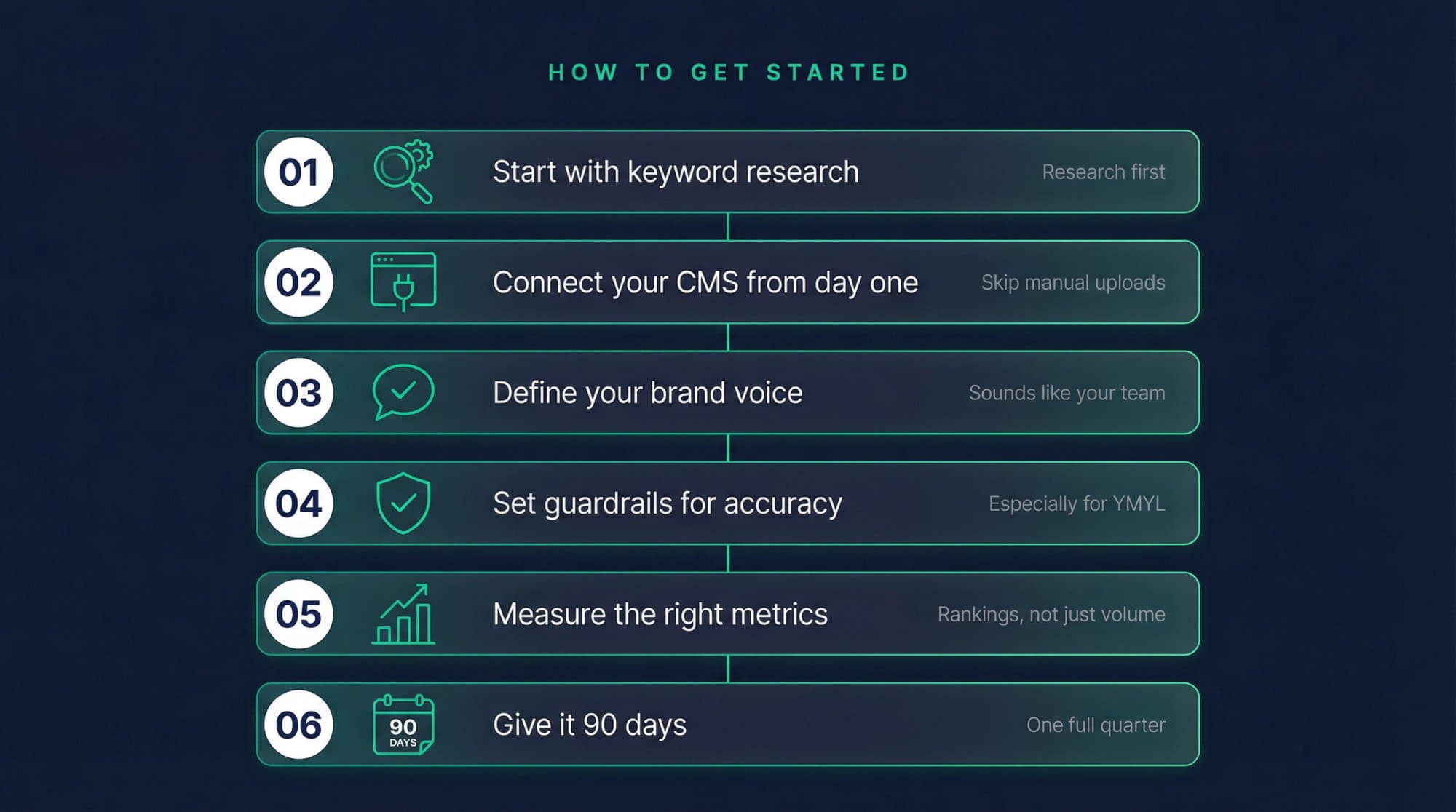
- 1
Start with keywords, not articles
Pull the keywords you can win before generating anything. If you have Search Console data, add the queries where you already sit on page two. The keyword research tutorial covers the method. - 2
Connect your CMS on day one
Manual uploading is where cadence dies. Connect WordPress, Webflow, Shopify or your stack, and decide whether articles go live directly or as drafts. - 3
Define your brand voice and your no-go list
Give the tool your audience, tone, products and any claims it must never make. This is the difference between "generic AI blog" and content that sounds like your team. - 4
Set accuracy guardrails
For health, finance, legal or anything else where a wrong fact can hurt a reader, review every article before it goes live. Outrank's Human Curated Service ($1,399/month) adds editors who fact-check and polish each piece. - 5
Measure impressions first, then clicks
In Search Console, watch impressions and pages indexed in month one, positions in month two, and clicks from month three. Clicks lag; the Outrank results page shows the typical curve. - 6
Give it a full quarter
In Outrank's data, median clicks were up 27% after 84 days and doubled around month 7. A 30-day test tells you almost nothing about SEO.
If you would rather hand the whole thing to a team, Outrank Agency is the done-for-you version: specialists plan, review and publish the content for you.
FAQ
What is the best AI SEO content generator?
It depends on how much of the work you want done. For a hands-off pipeline (keywords, daily articles, publishing and backlinks), Outrank is built for that at $99 a month. For writers who want to optimize every draft themselves, Surfer or Frase fit better. For cheap articles from your own keyword list, Koala or SEOwriting.ai are good value.
Is there a free AI SEO content generator?
Not a complete one. You can get partway for free: ChatGPT, Claude and Gemini have free tiers for drafting, Google Search Console gives you real keyword data from your own site, and Outrank's free SEO tools, including the blog keyword generator, cover the research step. Full keyword-to-published-article automation is a paid product everywhere.
What is an SEO text generator?
An SEO text generator writes short, search-optimized copy such as title tags, meta descriptions, product descriptions and FAQ answers from a keyword or a page. It saves time per page but does not plan content or publish anything. Plugins like Rank Math AI and Yoast SEO Premium include one inside WordPress.
Can Google detect AI-generated content?
Google does not need to: it ranks pages on usefulness, not on how they were made. Its spam policies target scaled content created mainly to manipulate rankings, by any method, and its October 2026 guidance asks publishers to fact-check AI output. Detection tools exist, but none is reliable enough to matter for rankings.
How many articles can an AI SEO content generator produce?
As many as you pay for. Outrank publishes 30 articles a month (one a day) on its base plan, with add-ons for 60 or 90. Credit-based tools like Koala or Byword let you generate hundreds in bulk. The limit that matters is how many good, accurate articles your site and your review process can absorb.
What is an AI SEO content strategy generator?
It is the planning half of the job: a tool that turns your site and niche into a list of keywords, topics and a publishing calendar. Autopilot platforms like Outrank include it (a 30-day plan with one keyword per day), while most AI writers expect you to bring the keywords yourself.
Do I lose my articles if I stop paying?
No, with any reputable tool. Articles published to your CMS live on your site and stay there after you cancel; you simply stop getting new ones.