The primary goal of a search engine is to give each person the most relevant, helpful results for their search, in the best order, as fast as possible. Google's own rater guidelines open with the plain version: "Search engines exist to help people find what they are looking for." Everything else a search engine does (crawling, indexing, ranking, even selling ads) is a means to that end, because an engine that stops being useful stops being used.
That's the textbook answer. The more useful part is how a search engine checks that it actually hit that goal, because the same yardstick decides whether your pages rank. This page covers both, plus a quick test that rates a page the way Google's quality raters do.
Key takeaways
- The primary goal of a search engine is to return the most relevant, helpful results for a query, in the most helpful order, fast.
- Ads are how most search engines make money, not their goal. Results that stop helping people would cost them the users the ads depend on.
- Google measures success with about 16,000 human raters and hundreds of thousands of experiments a year (719,326 search quality tests in 2023 alone).
- Raters score each result on a five-point Needs Met scale, from Fails to Meet to Fully Meets.
- The goal is drifting from sending you to the best page toward answering on the results page. Across 415 sites, Google impressions doubled while clicks rose 22% (Oct 2025 to Aug 2026).
The Short Answer (for Quizzes and Exams)
If you need one line for a class, a certification practice test or a quiz, use this:
The primary goal of a search engine is to provide users with the most relevant and useful results for their search queries.
The usual wrong answers on multiple-choice versions, and why they're wrong:
| Tempting answer | Why it's not the primary goal |
|---|---|
| To show ads and make money | That's the business model. It only works if the results are good enough that people keep searching. |
| To index every page on the web | Indexing is a step toward the goal, and Google deliberately skips pages it judges unhelpful or spammy. |
| To rank the most popular websites first | Popularity (links, mentions) is one signal of quality, not the goal itself. |
| To help websites get traffic | Traffic is a side effect. Search engines optimize for the searcher, not the site. |
A search engine is software that finds, organizes and ranks web pages (and increasingly writes answers) in response to a query. Its primary goal is user satisfaction: the searcher finds what they needed.
How a Search Engine Pursues That Goal
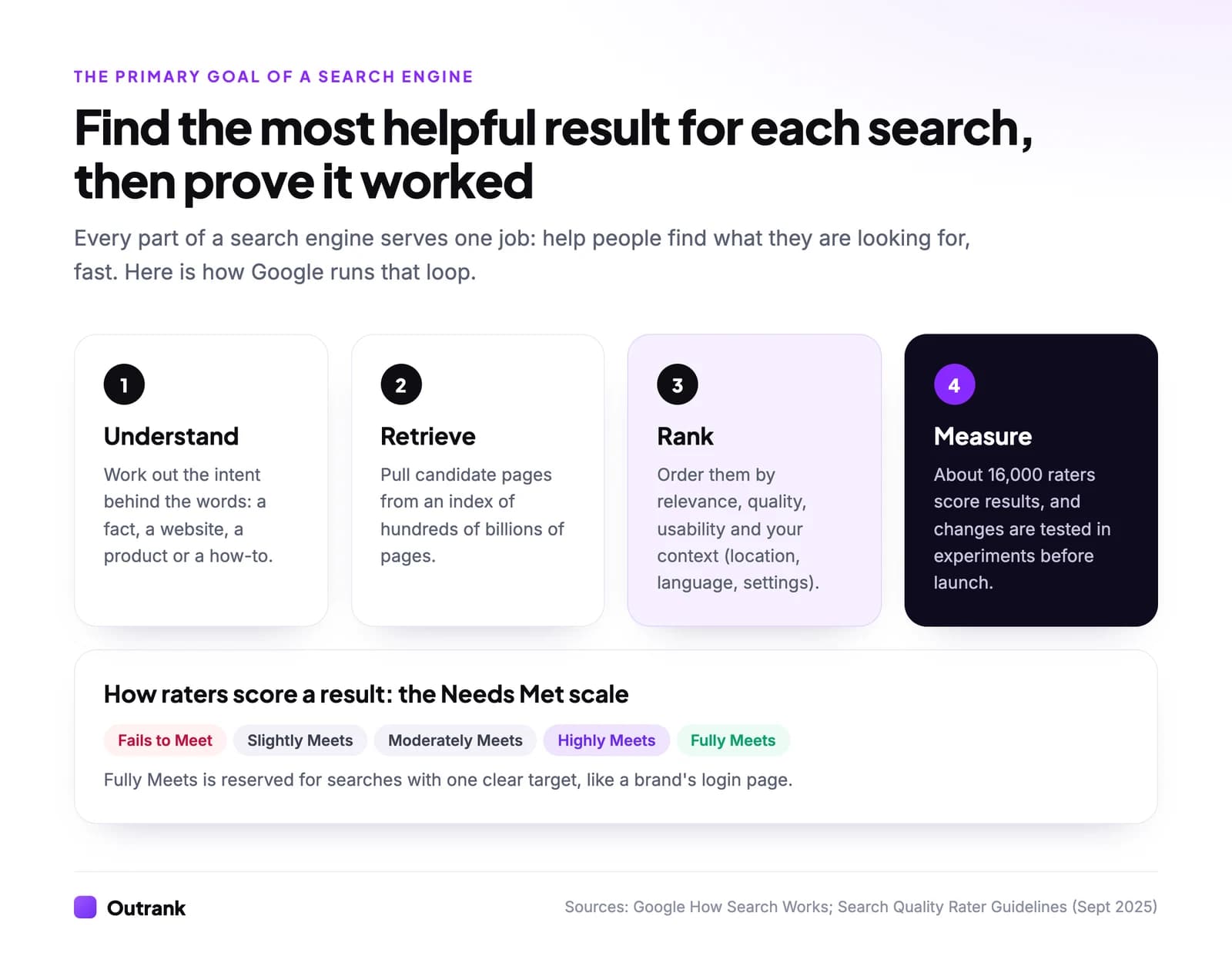
Every search runs through the same four-stage loop. Each stage exists to serve the primary goal.
- 1
Understand the query
The engine works out the intent behind the words. Google says it first has to establish the meaning of your query before it can return relevant results: [bat] could be an animal or a piece of sports equipment. This is where semantic SEO comes from. - 2
Retrieve candidates from the index
Crawlers follow links and render pages like a browser. Google's index holds hundreds of billions of pages, well over 100,000,000 gigabytes. - 3
Rank them
Google's ranking systems aim to put the most relevant, useful results on the first page in a fraction of a second, using the meaning of the query, the relevance and quality of pages, usability, and your context (location, language, settings). - 4
Measure and improve
Human raters and live experiments check whether the results actually helped. Changes that improve them ship; the rest don't.
Step four is the one most explanations skip, and it's the clearest evidence of what the goal really is.
How Google Checks Whether It Hit the Goal
A goal you don't measure is a slogan. Google measures this one at a scale few companies match. Its How Search Works site lists the testing it ran in 2023:
719,326
search quality tests with external raters
Google, 2023
124,942
side-by-side experiments
Raters compare two sets of results and pick the better one
16,871
live traffic experiments
A change is switched on for a small share of real users first
4,781
launches that made it into Search
Out of more than 700,000 experiments
The people doing the rating are about 16,000 external Search Quality Raters around the world, according to Google's rater program overview. Two details matter:
- Ratings don't move individual pages. Google's guidelines state that no single rating can directly change where a page ranks. Ratings measure how well the system works and give engineers examples of helpful and unhelpful results.
- Raters judge two things. Page Quality (is this a trustworthy page from a source with real experience and expertise?) and Needs Met (how well does this result satisfy what the searcher wanted?).
Needs Met is the primary goal turned into a score.
The Needs Met Scale: The Goal as a Score
Raters place every result on one scale, defined in Google's Search Quality Rater Guidelines (September 2025 edition):
| Rating | What it means |
|---|---|
| Fully Meets | Only for searches with one clear target (a specific website, a specific page) when the result is that target. |
| Highly Meets | Very helpful for a dominant or common meaning of the query. Most searchers would be satisfied. |
| Moderately Meets | Helpful, but many searchers would want to look at other results too. |
| Slightly Meets | Less helpful for a common meaning, or helpful only for an unlikely meaning. |
| Fails to Meet | Off-topic, wrong, outdated, or aimed at an interpretation almost nobody means. |
Raters also consider whether a result fits the query, is up to date, is accurate and trustworthy for information searches, and satisfies the user. That last word is the whole point: a result that makes people go back and search again has failed, however well it's "optimized".
Rate your own page like a quality rater
Pick one page and the main query you want it to rank for, then answer honestly:
4-question decision helper
What Needs Met rating would your page get?
Question 1 of 4
How well does your page match what most people mean by the query?
The Goals That Compete With It
A search engine has one primary goal and several others pulling at it. Being honest about them explains most of what frustrates people about search.
| Goal | What it looks like | Tension with the primary goal |
|---|---|---|
| Relevance (primary) | The best answer for this person, now | None: this is the goal the others are measured against |
| Revenue | Ads at the top of results, labeled "Sponsored" | Every ad slot pushes an organic result down |
| Safety | Filtering spam, malware and scams | Mostly aligned: Google says SpamBrain kept more than 99% of visits from Search spam-free in 2022 |
| Speed and retention | Answers on the results page: AI Overviews, AI Mode, featured snippets | Faster for the searcher, fewer clicks for the sites that supplied the answer |
Ads are the obvious tension. Search ads are Alphabet's largest source of revenue, which is why critics argue Google's goal is really advertising. The counter-argument is structural: ads only pay because billions of people trust the organic results enough to keep searching. Engines with other business models make the trade-off differently: Kagi charges a subscription and shows no ads, and DuckDuckGo shows ads that aren't based on a profile of you. Our comparison of search engines other than Google covers how each one balances it.
The fourth goal is the one changing fastest.
The Goal Is Shifting: From the Best Page to the Answer
For most of the web's history, "the most helpful result" meant "the best page to click". Increasingly, it means "the answer, right here". Google now answers many questions directly on the results page with AI Overviews and AI Mode, and the effect shows up in site owners' data.
Outrank's zero-click study tracked 415 sites' Search Console data month by month. After Google's September 2025 change to how results are counted settled, impressions kept climbing while clicks barely moved:
Google impressions doubled, clicks didn't
Hover or tap the chart for exact values. Click a legend item to hide it.
Median impressions grew 2.18× while clicks grew 22%, so the median click-through rate fell 40%. From the search engine's side, that can count as success: more questions answered without the searcher having to leave. From a publisher's side, it means being the source of the answer matters as much as ranking. Our query fan-out research found the same pattern for question-style queries, which earned 58% fewer clicks than other queries at the same top-three position.
What This Means If You Publish Content
If the primary goal is satisfying the searcher, the strategy writes itself: be the result that ends the search. Google's guide to helpful, people-first content turns that into self-assessment questions. Here they are as a checklist you can run on any page:
Interactive checklist
Does this page serve the search engine's goal?
0/10
Does it satisfy the searcher?
0/4Can it be trusted?
0/3Was it made for people first?
0/3Your progress is saved in this browser, so you can come back to it later.
Two practical consequences:
- Pick queries you can fully answer. A focused page that Highly Meets a specific query beats a generic page that Moderately Meets a broad one. That's why long-tail keywords work: Outrank's platform data shows the median keyword it targets for customers has a difficulty of 14 and about 170 monthly searches, small enough that one genuinely complete page can be the best result.
- Write for the answer layer too. Put a one-sentence definition or answer near the top of each section, the kind an AI Overview can quote, and back it with specifics. Our guides on how AI reads your website and planning content around questions, not keywords go deeper.
The flip side is what search engines remove to protect the goal: spam, cloaking, scraped pages and malware. Our guide to what kind of websites search engines blacklist covers where that line sits.
FAQ
What is the primary goal of a search engine?
To give users the most relevant, useful results for their search query, in the most helpful order and as fast as possible. Google's rater guidelines say search engines exist to help people find what they are looking for, and every other function, from crawling to ranking, serves that goal.
What is the main purpose of a search engine?
The main purpose is to help people find information, websites, products or answers on the web without knowing exactly where they are. A search engine does that by crawling pages, storing them in an index, and ranking the best matches for each query.
What are the three main functions of a search engine?
Crawling (discovering pages by following links), indexing (analyzing and storing pages so they can be retrieved) and ranking (ordering the indexed pages by how well they answer a query). Modern engines add a fourth step: measuring whether the results satisfied people and adjusting their systems.
How do search engines make money if their goal is relevance?
Mostly through ads shown next to the results, paid per click or per impression. The model only works while people trust the organic results, which is why relevance stays the primary goal. Some engines, such as Kagi, charge a subscription instead.
What is the difference between the goal of a search engine and the goal of SEO?
A search engine's goal is to satisfy the searcher. SEO's goal is to make a specific site's pages rank and get visited. The two line up when SEO means making the page that best answers the query; they clash when SEO tries to manipulate rankings, which is what spam policies are written to stop.
How does Google know if a search result is helpful?
It combines signals from its ranking systems with human evaluation. About 16,000 external quality raters score sample results on the Needs Met and Page Quality scales, and Google runs live experiments and side-by-side tests before launching changes: more than 700,000 experiments in 2023.