

Social bookmarking in SEO is the practice of saving and sharing links to your web pages on public bookmarking and community sites, like Reddit, Pinterest or Hacker News, so people (and search engines) can find them. It used to be a cheap way to build backlinks. In 2026 it isn't: links on these platforms are mostly user-generated and pass little or no ranking credit, and Google's own spam policies list "low-quality directory or bookmark site links" as link spam.
What still works is the original idea behind it: putting genuinely useful pages in front of communities that save, discuss and share them. That earns referral traffic, brand mentions and, increasingly, citations in AI answers. This guide explains the difference, which sites still matter, and how to do it without wasting time or risking your site.
Key takeaways
- Social bookmarking means saving links publicly on sites where others can browse, tag, vote on and discuss them.
- As a backlink tactic it's over: Google lists "low-quality directory or bookmark site links" as link spam, and mass bookmark submissions earn nothing at best.
- As a distribution tactic it still works, mainly on Reddit, Pinterest and niche communities, where the payoff is traffic and mentions, not link equity.
- Reddit takes 46.4% of social media citations in AI answers (OtterlyAI, 100M+ citations), and 80% of the Reddit posts AI cites have fewer than 20 upvotes (Semrush).
- Delicious, StumbleUpon and Pocket have all closed. Any "top 500 social bookmarking sites" list in 2026 is mostly dead sites and spam.
What is social bookmarking?
Social bookmarking is saving a web page's link to a public, online collection instead of your browser, usually with a title, a short description and tags. Other people can browse those collections by topic, follow curators, vote links up or down and comment on them. The "social" part is that discovery happens through other people's saves and votes rather than a search box.
A social bookmarking site is any platform built around that behavior. The classic examples were Delicious, Digg and StumbleUpon. Today the closest equivalents are Reddit (links plus voting and discussion), Pinterest (visual bookmarks called pins), Hacker News (a voted link board for tech), Flipboard (curated magazines of articles) and personal bookmarking tools with public profiles like Pinboard, Raindrop.io and Diigo.
In SEO, "social bookmarking" usually refers to one specific off-page tactic: submitting your own URLs to these sites to earn backlinks, get pages crawled faster and drive traffic. Only the last of those three still holds up.
A short history: why the SEO tactic died
Social bookmarking peaked in the late 2000s. Delicious, launched in 2003, claimed more than 5.3 million users and 180 million bookmarked URLs by the end of 2008. Digg, launched in 2004, could send a site so much traffic that it crashed. SEOs noticed, and the tactic turned into mass submission: hundreds of sites, the same link, the same keyword, often automated.
Search engines responded. Google introduced rel="nofollow" in 2005 so links in user-generated content wouldn't pass ranking credit, and later added ugc and sponsored. Bookmarking sites filled with spam, and most of the classic ones closed: Delicious was bought by Pinboard and went read-only in 2017, StumbleUpon shut down in June 2018, and Mozilla closed Pocket on July 8, 2025. Digg, bought back by its founders in 2025, closed its open beta in March 2026 citing bots and returned in May 2026 as an AI news aggregator.
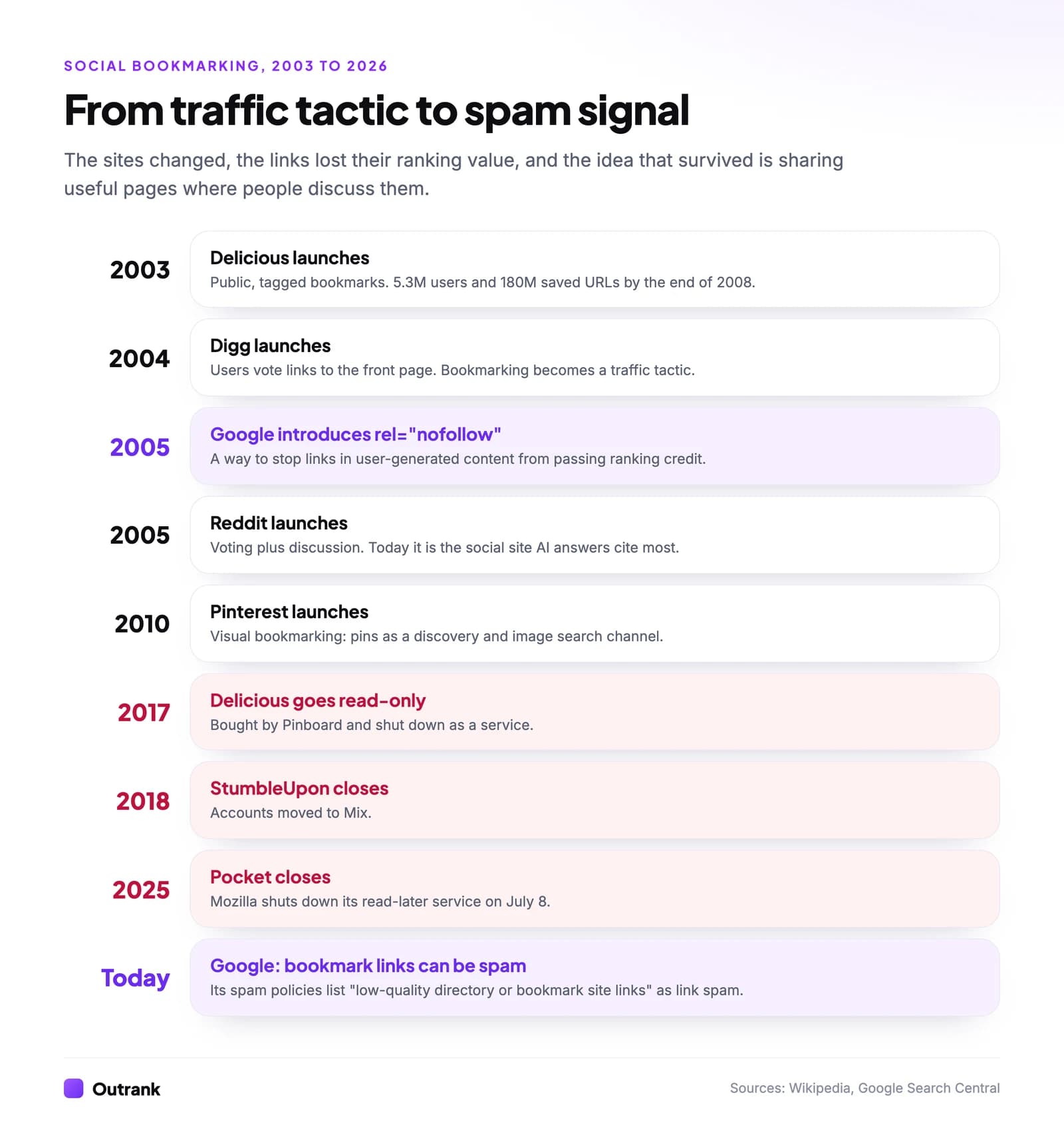
Today, Google's spam policies name the old playbook directly. Their list of link spam includes "low-quality directory or bookmark site links", "using automated programs or services to create links to your site", and "forum comments with optimized links in the post or signature".
Does social bookmarking still help SEO in 2026?
Partly. Here is each benefit people still claim, and what holds up:
| Claimed benefit | Still true? | Why |
|---|---|---|
| Backlinks that boost rankings | Mostly no | Links in user-submitted content are typically marked nofollow or ugc, which Google treats as hints rather than votes. Bulk bookmark links are named as link spam. |
| Faster indexing of new pages | Marginal | A shared link can help Google discover a URL, but a sitemap and Search Console's URL Inspection tool do this directly and reliably. |
| Referral traffic | Yes, if the community wants the page | A useful answer in the right subreddit or a popular pin can send visitors for months. |
| Brand mentions and AI citations | Yes, and growing | AI answers lean heavily on Reddit discussions (see below). Being mentioned there shapes what assistants say about your category. |
| Image search and visual discovery | Yes, in visual niches | Pinterest works as a visual search engine for recipes, decor, fashion, DIY and products. |
| "Social signals" as a ranking factor | No evidence | Google has never documented likes, saves or upvotes as a ranking signal. The traffic and links they lead to are what matter. |
The AI angle is the biggest change. In OtterlyAI's analysis of more than 100 million AI citations across ChatGPT, Perplexity, Gemini, Copilot and Google's AI features, Reddit took 46.4% of all social media citations. And the threads that get cited aren't the viral ones: Semrush found that 80% of the Reddit posts cited by AI search had fewer than 20 upvotes. Our guide to which social platforms AI search engines cite has the full breakdown.
Social bookmarking sites that still matter in 2026
Forget the lists of 300 "high-DA bookmarking sites". Most are dead, abandoned or exist only to sell links. These are the platforms worth your time, and what each one is actually good for:
| Platform | What it is | Best for | What to expect |
|---|---|---|---|
| Communities (subreddits) where links are voted on and discussed | Answering questions in your niche, B2B and B2C | Traffic and AI citations; strict rules on self-promotion | |
| Visual bookmarks (pins) organized on boards | Recipes, decor, fashion, DIY, products | Long-lived traffic from pins and image search | |
| Hacker News | Voted link board for tech and startup readers | Original technical writing, launches, research | Big traffic spikes when a post reaches the front page |
| Curated magazines of articles | News, culture, lifestyle and trade publishers | Steady readership for publishers who curate actively | |
| Niche communities | Forums, Slack and Discord groups, industry newsletters' link roundups | Specialist B2B and hobby topics | Small, highly qualified audiences |
| Pinboard, Raindrop.io, Diigo | Personal bookmarking tools with public collections | Research and saving sources | Almost no SEO value; useful for your own workflow |
A note on Hacker News: when we checked in October 2026, links in front-page story titles carried no nofollow attribute. That doesn't make it a link-building venue. Its guidelines say "please don't use HN primarily for promotion", and the community buries anything that reads like marketing.
How to use social bookmarking the right way
Treat it as distribution for your best pages, not as link building. This checklist is the process we'd follow:
Interactive checklist
Social bookmarking checklist for 2026
0/13
Pick the right places
0/3Share only what deserves it
0/4Stay out of trouble
0/3Measure what matters
0/3Your progress is saved in this browser, so you can come back to it later.
Two habits make the biggest difference. First, contribute before you share: answer questions with no link at all for a while, so your account has a history people trust. Second, match the format to the platform. A long, data-heavy guide can do well on Hacker News or in a specialist subreddit; the same page needs a strong vertical image and a clear title to get saved on Pinterest.
Social bookmarking mistakes that can hurt your site
- Buying "social bookmarking backlinks" packages. Gigs that promise hundreds of bookmark links deliver exactly what Google's spam policies describe. At best they're ignored; at worst they contribute to a manual action.
- Automated submission tools. Same problem, plus banned accounts on every platform you actually care about.
- Drive-by links. Dropping a link and leaving gets posts removed and accounts banned on Reddit and most forums.
- Using bookmarking as your only off-page strategy. It can support a content strategy, but it doesn't replace links from relevant, real websites.
If someone else built spammy bookmark links to your site, you usually don't need to act: Google says it can work out which links to trust on its own and that most sites will never need the disavow tool.
What to do instead if you wanted backlinks
If the reason you looked up social bookmarking was links, spend that time on tactics that still earn them:
- Get mentioned and linked on relevant sites people read, especially "best of" lists in your category. Our backlinks guide shows what makes a link valuable, with Search Console data on how links relate to growth.
- Reclaim mentions and broken links. People who already wrote about you are the easiest yes; see link reclamation.
- Publish something worth citing, like original data or a free tool, then share it in the communities above. That's where social bookmarking and link building meet: the share brings readers, and some readers are writers who link.
- Follow a step-by-step plan. How to build backlinks covers every method, and online stores should read ecommerce link building.
If you'd rather not do outreach at all, Outrank's backlink exchange places links to your site inside relevant articles on other sites in your niche, never in footers or link lists, and guarantees 15 verified backlinks a month or your plan runs free until you get them.
FAQ
What is social bookmarking in SEO?
Social bookmarking in SEO is sharing links to your pages on public bookmarking and community sites like Reddit, Pinterest or Hacker News, so people and search engines can discover them. It was once used mainly to build backlinks; today its value is referral traffic, brand mentions and AI citations rather than ranking credit.
Is social bookmarking still effective for SEO in 2026?
Not as a backlink tactic. Links on these platforms are mostly user-generated and pass little ranking credit, and Google's spam policies list low-quality bookmark site links as link spam. It is still effective for distribution: a genuinely useful page shared in the right community can bring steady traffic and mentions that AI assistants pick up.
Are social bookmarking backlinks dofollow?
Mostly not. Large platforms typically mark links in user-submitted content as nofollow or ugc, which Google treats as hints rather than endorsements. Even where a link is followed, bulk bookmark links are exactly what Google's link spam policy describes, so they shouldn't be part of a link building plan.
What are examples of social bookmarking sites?
The classic examples were Delicious, Digg and StumbleUpon, which have closed or changed completely. Today's equivalents are Reddit, Pinterest, Hacker News and Flipboard, plus personal bookmarking tools with public collections like Pinboard, Raindrop.io and Diigo.
Is social bookmarking part of off-page SEO?
Yes, it's traditionally classed as an off-page SEO tactic because it happens on other websites. In practice it now belongs with content distribution and community marketing: it helps people find your best pages, while links from relevant websites do the heavier lifting for rankings.
Can social bookmarking hurt your SEO?
Bulk or automated bookmarking can. Google's spam policies list low-quality bookmark site links and automated link creation as link spam, which is usually ignored but can contribute to a manual action. Sharing your pages manually, in communities where they're genuinely useful, carries no such risk.