Ecommerce link building is getting other websites to link to an online store's category, product and content pages, so those pages rank higher on Google and get named in AI answers. The catch is that almost nobody links to a product page for free. The links that work for stores come attached to something editors and shoppers already want: a pick in a gift guide or a "best of" roundup, a stockist listing, a review, a supplier showcase or a data story. You point those links at category and content pages, then pass the authority to products with internal links.
Below: the nine tactics that earn links to stores, ranked by what they're worth, where each link should point, what links cost when you pay, the gifted-product and paid-link rules that trip stores up, and what Outrank's Search Console data shows for stores that build links steadily.
Key takeaways
- Gift guides and "best of" roundups are the biggest source of editorial links for online stores, and they double as AI visibility: 50% of ChatGPT's citations are listicles (Evertune, April 2026).
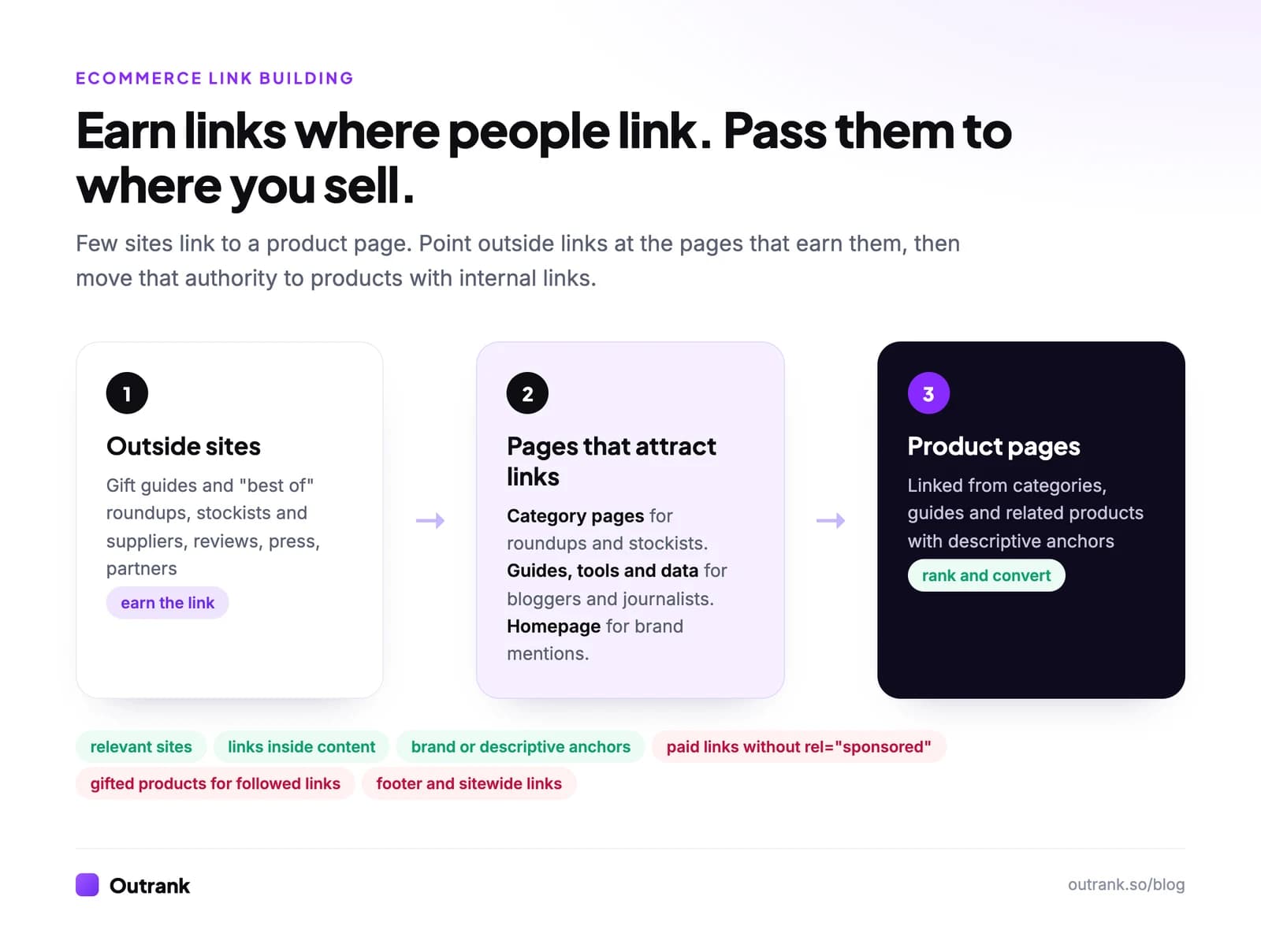
- Point most links at category pages, not products. Categories target the broader searches with the most buyers; products inherit authority through internal links.
- Links given for free products, payment or affiliate deals must carry rel="sponsored" or rel="nofollow" under Google's spam policies. They still sell; they just don't pass ranking credit.
- Paid links cost real money: $295 for a guest post bought directly, $461 through a vendor (BuzzStream) and $225 for a link insertion (Adsy), on average in 2026.
- In Outrank's data, 82% of 153 Shopify stores grew their Google clicks, from a median 895 to 1,993 per 28 days, and sites receiving 30+ backlinks a month grew the most.
Why link building is harder for online stores
A backlink is a link from another site to yours, and Google still uses links to discover pages and judge which ones deserve to rank. Online stores face three problems that blogs and SaaS sites don't:
- Product pages give writers nothing to cite. A writer links to a source, a tool or a story. A product page with a price and a "Buy" button is none of those, so it rarely earns a link on its own.
- The most natural links are often the ones Google discounts. Bloggers who get free products, affiliates and influencers all link to stores, but Google's spam policies list "sending a free product in return for a write-up with a link" as link spam unless the link is marked
nofolloworsponsored. - Store URLs churn. Products sell out, get discontinued or move collections. Every removed URL that had backlinks throws away the value of those links unless you redirect it.
So ecommerce link building is less about volume and more about earning the right links and routing their value to the pages that make money.
Where should ecommerce backlinks point?
Category (collection) pages are where most store rankings happen: "linen bedding", "trail running shoes", "vegan protein powder". They target the broader searches with the most buyers, so most of your outside links should land there. Product pages then rank on the strength of internal links from those categories, from buying guides and from related products.
| Page type | Links it naturally earns | Use it for |
|---|---|---|
| Homepage | Brand mentions, press, partner and stockist pages | Overall authority; brand searches |
| Category or collection page | Roundups, gift guides, stockist links, reviews of a range | Your main commercial keywords |
| Product page | Reviews and gift-guide picks of that exact product | Specific product and model searches |
| Buying guides, size guides, calculators | Bloggers, forums, journalists citing a resource | Informational searches; passing authority to categories |
| Data and research pages | Journalists and industry blogs | Digital PR and AI citations |
When a writer offers to link, ask for the most relevant category page unless the coverage is about one specific product. Then make sure that category links to its best products with descriptive anchors, and that your guides link to both.
9 ecommerce link building tactics that work in 2026
Ranked roughly by value for a typical online store. The first four are the ones to start with.
1. Get into gift guides and "best of" roundups
Editors and bloggers publish gift guides every season, and each pick links to a store. "Best [product]" roundups do the same year round, and they are exactly what shoppers and AI assistants read before buying: Evertune found that 50% of ChatGPT's citations are listicles, and 58% of those are ranked lists (April 2026, 40,000+ cited URLs).
How to do it:
- Work to the editorial calendar. Holiday gift guides are planned from late summer; Mother's Day and Father's Day guides from early spring. Pitch two to four months ahead.
- Find last year's guides with searches like
"gift guide" "candles" 2025orintitle:"best" "running belts", and note the writer. - Pitch one product, not a catalog. One great photo, the price, and one sentence on why it fits their readers beats a press kit.
If the writer asks for a free sample, that's fine, but expect the link to be marked sponsored (see the rules below). The sales and the AI mention still count.
2. Turn stockists, suppliers and partners into links
Retailers who carry your products often have "brands we carry" or "where to buy" pages. Suppliers showcase the brands that use their materials. Complementary brands run collaborations and announce them. These links are relevant, permanent and easy to ask for because the relationship already exists.
Make a list of every company you buy from, sell through or partner with, check whether their site has a brands, partners or customer showcase page, and send a short note with your logo, a one-line description and the URL you'd like them to use. Wholesale-friendly categories (home goods, beauty, food, handmade gifts, fashion, pet products) tend to have the most stockist pages.
3. Reclaim mentions and broken links
Once a store has customers, people write about it: bloggers, forum threads, local news, roundups that named you without linking. Search "your brand" -site:yourstore.com, then ask authors who mention you without a link to add one. It's the easiest yes you'll get, because they already chose to write about you.
Two variations worth a monthly check: old buying guides that link to a competitor's discontinued product (offer your equivalent), and backlinks to your own retired product URLs (redirect them). Our guide to link reclamation covers both step by step.
4. Get reviewed, and accept that those links are sponsored
Product reviews from bloggers, YouTubers and niche sites send buyers and create the brand searches that help every page of your store. Under Google's rules, a link given in exchange for a free product must be qualified with rel="sponsored" or rel="nofollow", so it passes little ranking credit. Do it anyway, for the sales and the mentions, but don't count these toward your SEO link targets and never ask a reviewer to remove the attribute.
5. Publish a data story journalists can cite
Stores sit on data journalists want: what sells where, seasonal spikes, price changes, the most-returned sizes, survey results from your customers. One well-framed finding from your own numbers (which product spikes in which week, which size sells out first, what changed since last year) can earn links from news sites and industry blogs that no product page ever would. In Editorial.Link's survey of 518 SEO professionals, 48.6% named digital PR the most effective link building tactic.
Put the data on a dedicated page with a clear chart, a short method and a downloadable image, and pitch it to writers who cover your category.
6. Build resources that earn links on their own
Buying guides, size and fit guides, care instructions, comparison charts and calculators (a paint coverage calculator for a decor store, a dog food portion calculator for a pet store) give bloggers and forums something to cite. Length helps when it adds substance: Backlinko's study of 912 million blog posts found that content over 3,000 words earns 77.2% more referring domains than content under 1,000 words.
Keep these resources on your store's domain and link them to the relevant categories, so the links they earn flow to the pages that sell. Our guide to ecommerce keyword research shows how to find the questions worth answering.
7. List the store where shoppers already look
Review platforms, local business listings, brand directories for your niche, marketplace profiles and your social profiles. These links are low value on their own, but they're quick, they confirm your brand to search engines and AI assistants, and some send buyers. Skip bulk directory packages: Google's spam policies name "low-quality directory or bookmark site links" as link spam.
8. Write for the sites your buyers read
Guest articles still work on blogs with a real audience in your niche: a skincare brand writing about routine order for a beauty blog, a bike shop writing a maintenance guide for a cycling site. Write for their readers, link to a guide or category where it helps, and avoid keyword-stuffed anchors, which Google lists as a link spam signal in guest posts.
9. Use a content network that places links in relevant articles
The time-consuming part of link building is finding relevant sites and getting a "yes". Networks like Outrank's backlink exchange automate it: your link is placed inside new, relevant articles that other Outrank sites in your niche publish, and you host relevant links in yours. The rules are what keep it on the right side of the line: links only go in the body of in-niche articles (never footers or link lists), at most two or three per article, no exact-match anchors, no link back within 14 days, the same site links to you at most once every 30 days, and adult and gambling sites are excluded. Every link is verified on the live page.
The median connected site receives 28 verified backlinks a month, from sites with a median Domain Rating of 26. Outrank guarantees 15 verified backlinks a month or your plan runs free until you get them. No one outside Google can promise how it will treat a given link, which is why the relevance rules above matter more than the count.
How much does ecommerce link building cost?
Earned links cost time, not money. When stores pay, these are the 2026 market averages:
| Method | Average cost | Source |
|---|---|---|
| Guest post bought directly from a site | $295 | BuzzStream |
| Guest post bought through a vendor | $461 | BuzzStream |
| Link insertion in an existing article | $225 | Adsy |
| Price SEOs consider acceptable for one high-quality link | $508.95 | Editorial.Link |
| Outrank Organic Growth plan (30 articles plus the backlink exchange) | $99/month, 15 verified backlinks a month guaranteed | Outrank pricing |
Paid placements that pass ranking credit are a policy risk: Google's spam policies treat buying links for ranking purposes as link spam unless they're marked sponsored or nofollow. Our guide to the best place to buy backlinks covers the trade-offs in detail.
To size a campaign, look at how many referring domains the top three results have for each category you want to rank, compare with yours, and plug the gap in here:
Interactive calculator
How many links does your store need, and what would they cost?
Monthly budget at market prices
$1,844
- Links needed in total
- 75
- Links per month
- 6.25
- Total budget
- $22,125
For a deeper method on setting the target, see how many backlinks you need to rank.
Links that get online stores in trouble
Google's link spam list reads like a list of common ecommerce shortcuts. Avoid:
- Free products or discounts in exchange for followed links. Fine for reviews and sales; the link must be
sponsoredornofollow. - Affiliate and influencer links without a qualifier. Same rule: they're paid placements.
- Requiring a link in a contract without letting the other site mark it
nofollow, for example as a condition of wholesale terms. - Footer and sitewide links on partner or theme sites, and links in widgets you distribute.
- Bulk directory and bookmark links bought as a package.
- Excessive link swaps with other stores, or partner pages that exist only to cross-link.
- Guest posts and press releases with keyword-stuffed anchors, such as "cheap linen bedding" on every link.
Bad links you didn't build usually don't need any action: Google says it can usually work out which links to trust on its own, and that most sites will never need the disavow tool.
Make every link count: the technical side
- Redirect retired products. When a product is discontinued for good, 301 its URL to the closest replacement or its category, so the backlinks keep working. Link rot is the default: Ahrefs found 66.5% of links to a sample of 2 million sites died within nine years.
- Keep filter URLs out of the way. Faceted navigation (size, color, price filters) can create thousands of near-duplicate URLs. Google's faceted navigation guidance says there's often no good reason to let it crawl filtered URLs, and recommends blocking them in robots.txt or using URL fragments when you don't need them indexed.
- Link from content to categories to products. Every buying guide should link to the categories it discusses, and every category to its best sellers. That's how authority reaches products.
- Add product structured data so Google can show price, availability and reviews in results; it won't make links count more, but it helps the traffic those links bring convert.
How to measure ecommerce link building
- New referring domains per month, from Google Search Console (Links → Top linking sites, exported monthly) or a backlink tool.
- Rankings and clicks for the category pages you targeted, in Search Console's Performance report filtered by page.
- Referral traffic and revenue from linking sites in Google Analytics; our guide to finding backlinks in Google Analytics shows the report.
- AI mentions of your brand for "best [product]" prompts, which roundups influence directly. Outrank's AI visibility tracking monitors ChatGPT, Perplexity, Gemini, Copilot and Google's AI features.
What our data shows for online stores
Outrank's study of 2,119 sites that connected Google Search Console includes 153 Shopify stores. 82% of them grew their Google clicks after they started publishing with Outrank, from a median 895 to 1,993 clicks per 28 days. Across all sites, growth was strongest for those receiving the most backlinks: a median 2.18× their starting clicks for sites receiving 30+ backlinks a month, against 1.59× for those receiving under 5 (results, October 1, 2026). Sites that receive more links also tend to publish more, so read that as articles and links working together, not links alone.
Individual stores show the same pattern. Blushing Ivy, a handcrafted candle brand, reports traffic up 119% and sales up 30% year over year, and snack brand Rip Van went from zero to 5,000 monthly blog visitors (Shopify success stories).
FAQ
How do you build backlinks for an ecommerce site?
Start with links tied to things editors and shoppers already want: gift guides, "best of" roundups, stockist and supplier pages, reviews and unlinked brand mentions. Then add a data story or a useful guide that journalists and bloggers can cite, and point most links at category pages.
Should ecommerce backlinks point to product pages or category pages?
Mostly category pages. They target the broader searches with the most buyers, and products inherit authority through internal links from categories and guides. Link to a product page when the coverage is about that specific product, like a review or a gift-guide pick.
Do links from gifted products help SEO?
Not much for rankings. Google's spam policies require links given in exchange for free products to be marked sponsored or nofollow, so they pass little ranking credit. They are still worth getting for sales, brand searches and AI mentions.
How much does ecommerce link building cost?
Earned links cost time. Paid links averaged $295 for a guest post bought directly, $461 through a vendor and $225 for a link insertion in 2026 (BuzzStream, Adsy). Outrank's $99-a-month plan includes its backlink exchange with 15 verified backlinks a month guaranteed.
Is buying backlinks for an online store safe?
Buying links that pass ranking credit breaks Google's spam policies, and it can lead to lost rankings or a manual action. Paid placements are fine for traffic and sales when they're marked sponsored or nofollow. Relevance, placement inside real content and natural anchors are what separate a useful link from a risky one.
How long does ecommerce link building take to work?
Usually a few weeks to a few months after Google finds the link, depending on how competitive the category is. In Outrank's data the median site took about seven months to reach 2× its starting Google clicks, so steady links over months beat a single burst.