

Digital ad space is any place on a screen where an advertiser can pay to show a message: a sponsored search result, a post in a social feed, a banner on a website, a video ad on a streaming channel, a product listing on a retailer's site, a slot in an email newsletter. It is sold by the platform or publisher that owns the screen, either directly or through automated auctions, and priced per thousand impressions, per click or per result. In the US alone, advertisers spent $294.6 billion on it in 2025, up 13.9% in a year.
This guide covers the types of digital advertising space, who sells each, how it's bought and priced, what changed in 2025–2026, and why the cheapest ad space is often the kind you own.
Key takeaways
- Digital ad space is screen inventory sold to advertisers. US digital ad revenue reached $294.6 billion in 2025 (IAB/PwC).
- Social ($117.7B, up 32.6%) and search ($114.2B, up 11%) are the two largest formats; display banners took $81.6B.
- Ad space is sold four ways. Direct deals and programmatic guaranteed have fixed prices; private marketplaces and open auctions use bidding.
- Most space is priced per 1,000 impressions (CPM) or per click (CPC). Google search ads averaged $5.42 per click in LocaliQ's 2026 benchmarks.
- Search clicks are shrinking where AI answers appear. Seer Interactive measured a 68% drop in paid CTR on informational queries that show an AI Overview (June 2024 to Sept 2025).
What is digital ad space?
Digital ad space (also called online advertising space or digital advertising inventory) is the set of positions on websites, apps, search results, feeds, streams and emails that their owners make available to advertisers. Each time one of those positions is shown to a person, that is an impression, and impressions are what gets bought and sold.
Two kinds of owners sell it:
- Walled gardens: Google, Meta, Amazon, TikTok, LinkedIn and other platforms sell space on their own properties through their own ad tools, using their own first-party data.
- The open web: independent publishers, app developers, newsletters and streaming channels sell space through ad networks, exchanges or direct deals. If you run a website, your pages are open-web ad space; our guide to how to sell ad space on your website covers that side.
Types of digital advertising space
| Type | Where it appears | Main sellers | How it's usually bought | Typical pricing |
|---|---|---|---|---|
| Search | Sponsored results on search pages | Google Ads, Microsoft Advertising | Self-serve keyword auction | CPC |
| Social | Feeds, stories, short video | Meta, TikTok, LinkedIn, Reddit, Pinterest | Self-serve auction | CPM or CPC |
| Display | Banners on websites and apps | Ad networks, DSPs, publishers direct | Programmatic or direct | CPM |
| Video and CTV | Pre-roll, streaming apps, free ad-supported TV (FAST) channels such as Pluto TV and Tubi | YouTube, streaming platforms, video SSPs | DSPs, platform ad managers, direct | CPM or cost per completed view |
| Retail (commerce) media | Sponsored products on store sites and apps | Amazon Ads, Walmart Connect, Instacart | Retailer ad consoles | CPC or CPM |
| Audio and podcast | Streaming audio, podcast episodes | Spotify, podcast networks | Dynamic insertion or host-read deals | CPM or flat fee |
| Newsletters and sponsored content | Email issues, sponsored articles | Independent publishers, marketplaces such as Paved | Direct deal or marketplace | Flat fee or CPM |
Here is how the money split across formats in the US last year. The categories overlap (social video counts in both social and video), so they add up to more than the $294.6 billion total.
US digital ad revenue by format, 2025
Hover or tap the chart for exact values.
Two things stand out. Social overtook search as the largest category, and display banners grew slowest of the major formats. IAB also counts $162.4 billion as bought programmatically, which tells you how much of this space is now traded by machines rather than sales teams.
How digital ad space is bought and sold
Behind every format above, an impression changes hands in one of four ways:
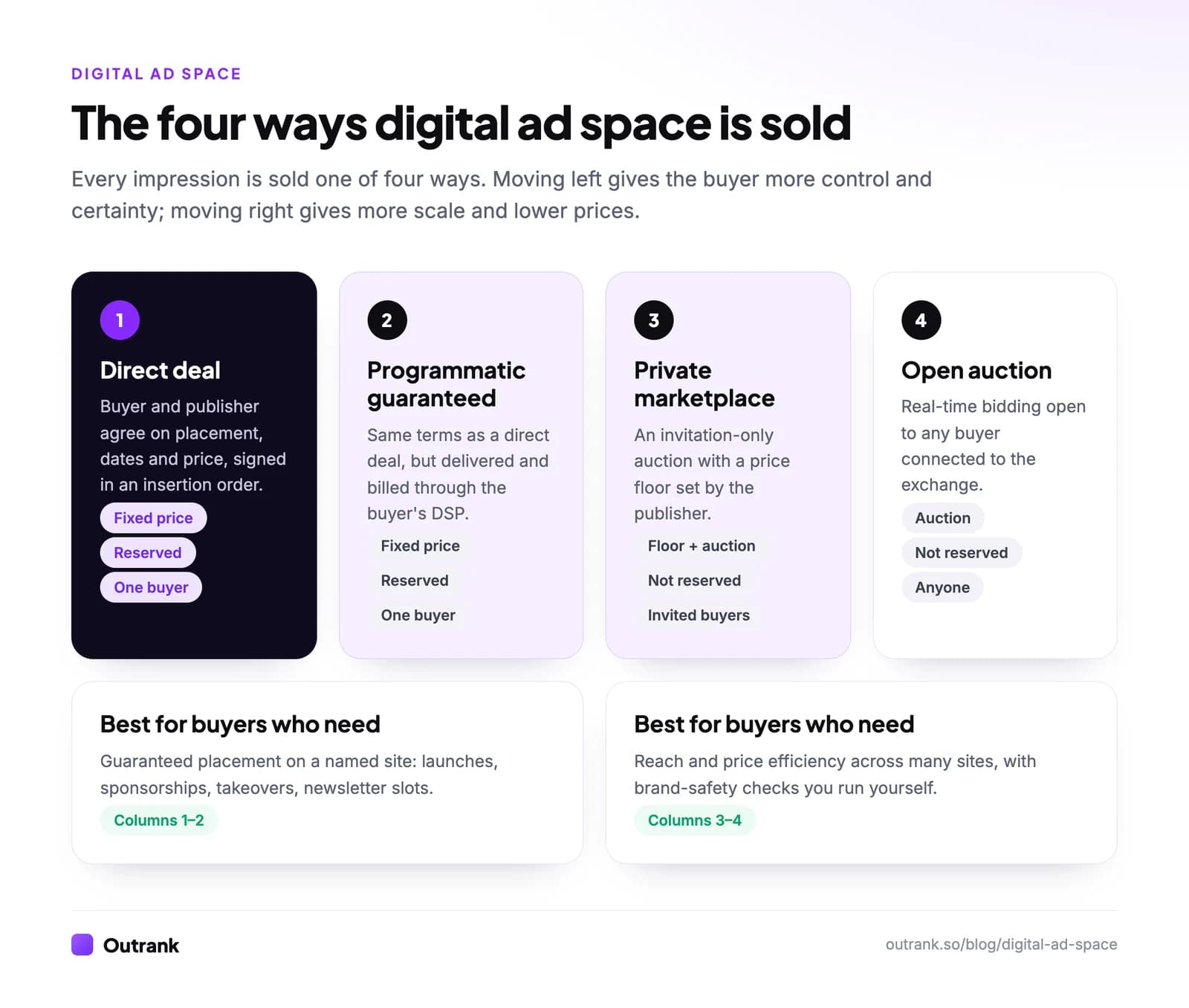
- Direct deal. The buyer and the publisher agree on placement, dates, volume and price, then sign an insertion order (IO). Sponsorships, homepage takeovers and newsletter slots are sold this way.
- Programmatic guaranteed. The same fixed terms, but delivered and billed through the buyer's demand-side platform (DSP) instead of manual trafficking.
- Private marketplace (PMP). An invitation-only auction: the publisher invites selected buyers and sets a price floor. A close cousin, the preferred deal, gives one buyer first look at a fixed price without reserving volume.
- Open auction. Real-time bidding open to any buyer connected to the exchange. Biggest scale, lowest prices, least control over where ads land.
Walled gardens run their own version of the open auction inside tools like Google Ads and Meta Ads Manager, which is why anyone with a credit card can buy their ad space in an afternoon. For a buyer's step-by-step, see our guide to purchasing ad space.
How digital ad space is priced
| Model | You pay for | Common on |
|---|---|---|
| CPM | 1,000 impressions | Display, social, video, CTV |
| vCPM | 1,000 viewable impressions (at least half the ad on screen for one second, two for video, per the Media Rating Council standard) | Display, Google Ads display bidding |
| CPC | One click | Search, retail media, social |
| CPA | One conversion (sale, sign-up, lead) | Affiliate, performance networks |
| CPV / CPCV | One view or one completed view | Video and CTV |
| Flat fee | A placement for a set period or send | Sponsorships, newsletters, sponsored posts |
Prices swing with audience, season and competition, so treat any single number with care. One well-documented benchmark: Google and Microsoft search ads averaged $5.42 per click with a 6.64% click-through rate across industries in LocaliQ's 2026 search advertising benchmarks. For what publishers can charge on the other side of the trade, see blog advertising rates.
What changed in 2025 and 2026
Third-party cookies stayed in Chrome. After years of planned deprecation, Google said in October 2025 that Chrome will keep offering users a choice about third-party cookies and retired most Privacy Sandbox technologies, including Topics and Protected Audience. Safari and Firefox still block third-party cookies by default, and Apple's App Tracking Transparency has required iPhone apps to ask permission before tracking since iOS 14.5 in 2021. Targeting on the open web is patchier than in the 2010s, while the walled gardens keep their logged-in data.
AI answers are eating search clicks, paid included. Seer Interactive tracked 3,119 informational queries and found paid CTR on queries with an AI Overview fell from 19.7% to 6.34% between June 2024 and September 2025, a 68% drop, versus 32% on queries without one (the paid sample was much smaller than the organic one, so read it as a direction). Our own zero-click study of 415 sites shows the organic side: median impressions up 2.18× and CTR down 40% from October 2025 to August 2026.
Spend moved to social and video. Social grew 32.6% and digital video 25.4% in 2025, against 9.8% for display, according to IAB.
Renting attention vs owning it
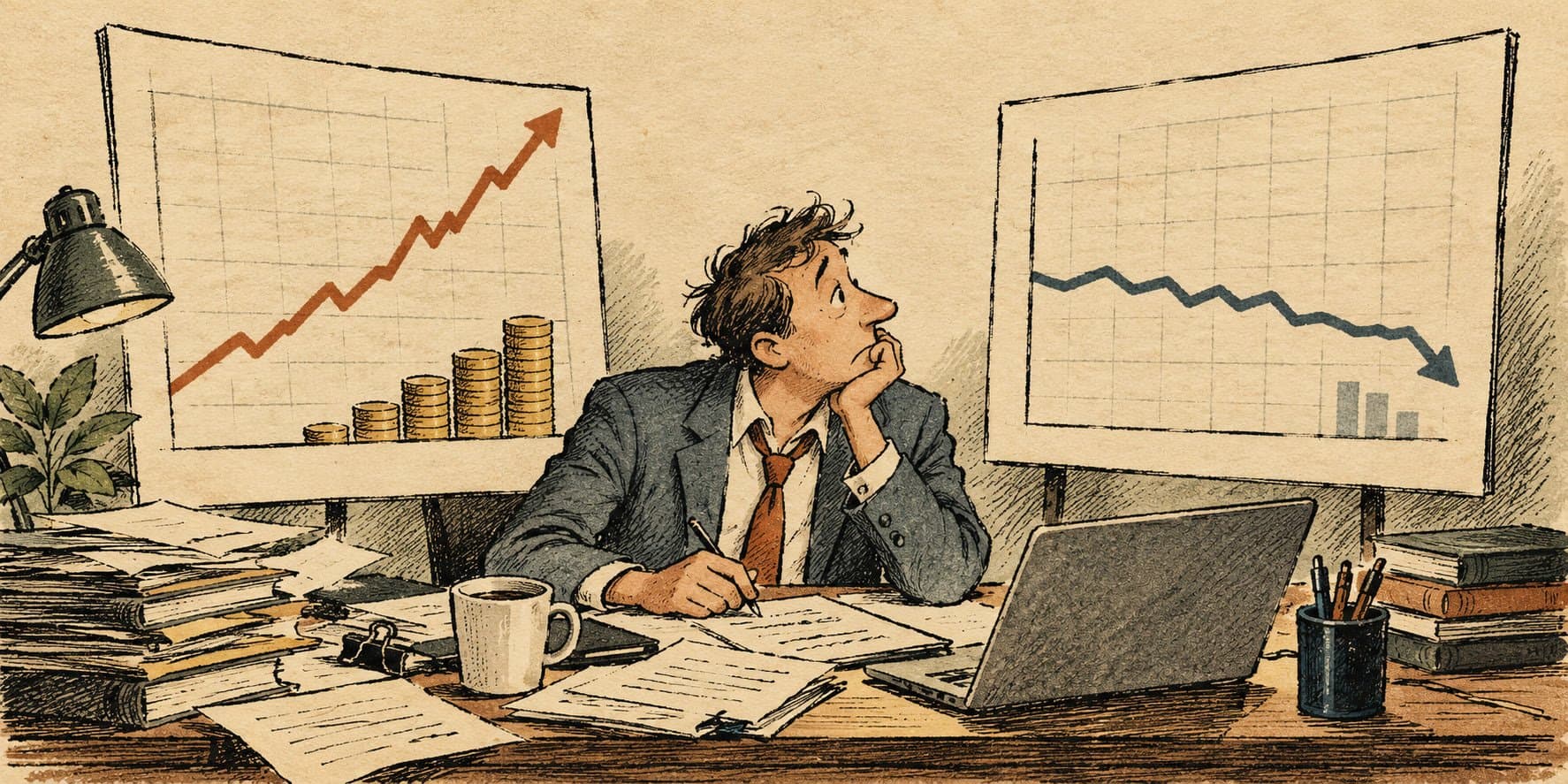
Every type of digital ad space above is rented. The day you stop paying, the impressions stop, and next month's price is set by an auction you don't control.
The alternative is space you own: pages on your own site that rank in Google and get cited by AI assistants for the questions your buyers ask. An article that ranks for a buying-intent query is ad space with no auction and no media bill, and it keeps working after the campaign budget runs out. It is slower: in our study of 2,119 sites, median Google clicks grew 7% in the first 28 days, 27% after 84 days and doubled by month seven.

The practical split for most brands:
- Use paid space for speed: launches, retargeting people who already visited, and high-intent keywords you don't rank for yet.
- Use owned content for compounding: informational and comparison queries, topics your paid data shows convert, and the long tail no one bids on.
Outrank handles the owned side: it finds keywords your site can win, writes and publishes a long SEO article every day to your CMS, and builds backlinks through its exchange, for $99 a month. Our guides to content marketing ROI and automating content marketing show how to measure and run it.
FAQ
What is digital ad space?
Digital ad space is any position on a website, app, search page, social feed, streaming service or email where advertisers can pay to show an ad. Owners sell it directly or through ad networks and auctions, and it is usually priced per 1,000 impressions (CPM) or per click (CPC).
What are the main types of digital advertising space?
The main types are search ads, social media ads, display banners, video and connected TV ads, retail (commerce) media, audio and podcast ads, and newsletter or sponsored content placements. In the US in 2025, social ($117.7 billion) and search ($114.2 billion) were the largest, according to IAB.
How is digital ad space bought?
Through four routes: direct deals with fixed prices, programmatic guaranteed deals delivered through a DSP, private marketplace auctions limited to invited buyers, and open real-time auctions. Platforms such as Google Ads and Meta Ads Manager let anyone buy their space self-serve.
How much does digital ad space cost?
It depends on the format and audience. Search ads averaged $5.42 per click in LocaliQ's 2026 benchmarks, while display, video and social are usually priced per 1,000 impressions and vary widely by targeting and season. Direct sponsorships are quoted as a flat fee per placement or per send.
What is the difference between digital ad space and traditional ad space?
Traditional ad space (print, billboards, broadcast TV, radio) is sold in fixed slots to broad audiences and measured by estimates. Digital ad space can be targeted by keyword, interest, location or device, bought in real time, and measured per impression, click and conversion.