


To create long-tail keywords, take a seed term and add a modifier that narrows it to one specific need: an audience ("crm for insurance agents"), a problem ("why is my cold brew sour"), a comparison ("cold brew vs iced coffee"), a cost ("emergency plumber cost per hour") or a platform ("keyword research for etsy"). Then confirm that real people search that exact phrase, using Google Autocomplete, People Also Ask or your Search Console, before you write a page for it.
You are not inventing demand. You are finding the specific wording people already use and building one great page per intent. This guide gives you 12 modifier formulas with real examples, six ways to brainstorm ideas, and a blueprint for writing content that ranks for them. (To filter and prioritize a big list with volume and difficulty data, use our separate long-tail keyword research process.)
Key takeaways
- Long-tail keyword = seed term + modifier. The modifier (who, why, vs, how much, for what) is what narrows intent.
- Every phrase you target should be confirmed by real search data, such as Autocomplete, People Also Ask or Search Console, not just brainstormed.
- Google says 15% of the searches it sees each day are new, so the long tail never runs out.
- Match the format to the modifier. "How" becomes a how-to guide, "vs" a comparison, "best" a roundup.
- Group close variants on one page and link related pages into a cluster. That is how long-tail pages build topical authority.
What "creating" a long-tail keyword really means
A long-tail keyword is a specific search with low individual volume, usually a narrower version of a broad topic. You can't make people search for something, so "creating" long-tail keywords means combining your topics with the details real searchers add, then checking that the result is something people type.
The supply is effectively endless. Google said in 2019 that 15% of the queries it sees every day are new, and in 2025 John Mueller said the share is still around 15%. Most of those are long-tail.
There is also a payoff for getting specific. In Outrank's analysis of 1.2 million Search Console queries, 5–6 word queries had a click-through rate of 8.39%, against 5.25% for 1–2 word queries. Specific searchers know what they want and click the result that promises it.
The long-tail keyword formula: seed + modifier
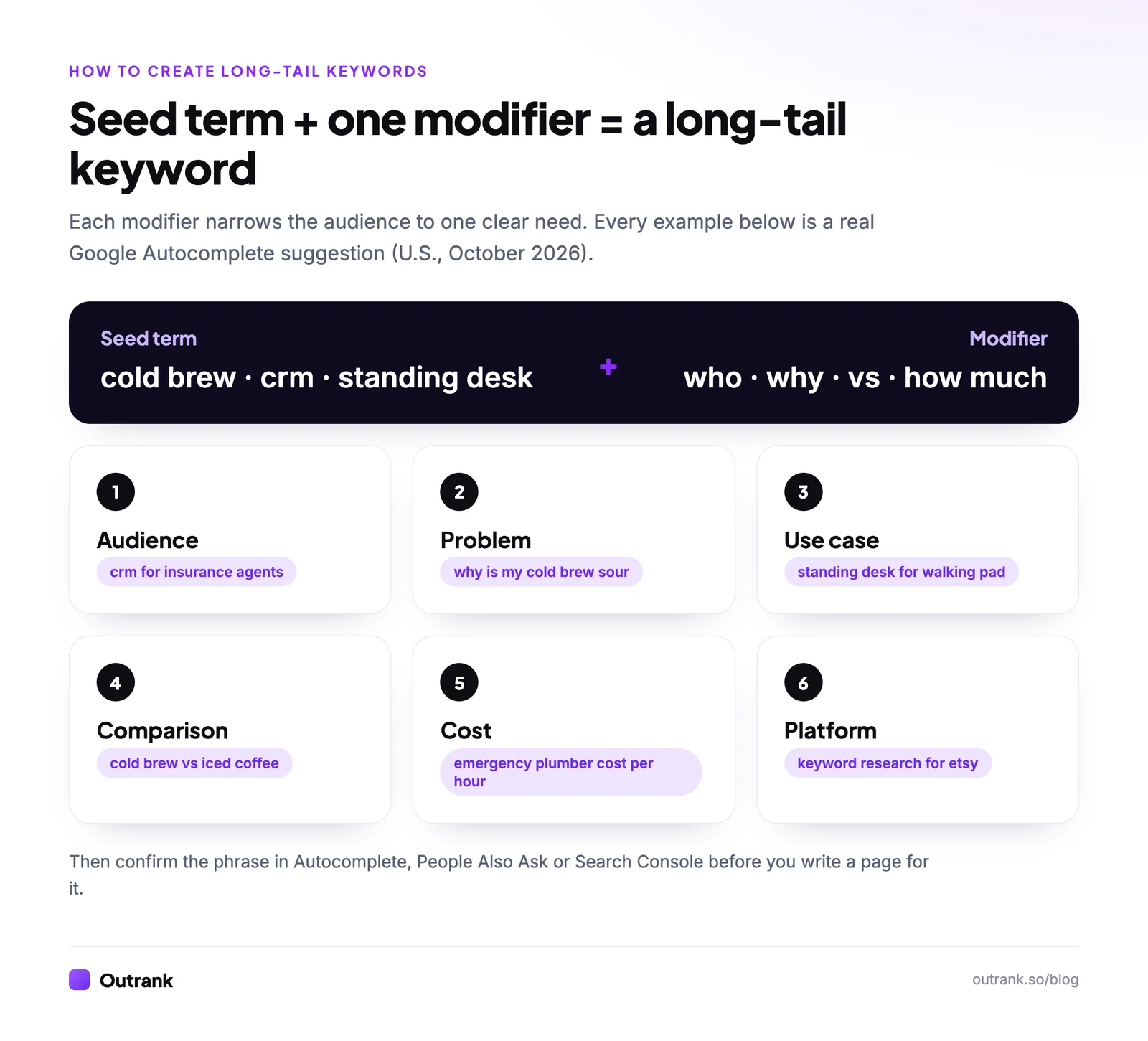
Here are 12 modifier types that reliably produce long-tail keywords. Every example is a real Google Autocomplete suggestion (U.S., English) collected on October 19, 2026.
| # | Modifier type | Formula | Real example |
|---|---|---|---|
| 1 | Audience | [seed] for [who] | crm for insurance agents |
| 2 | Industry | [seed] for [industry] | project management software for engineering firms |
| 3 | Problem or symptom | why is my [seed] [problem] | why is my cold brew sour |
| 4 | Health or fit need | [seed] for [condition] | running shoes for plantar fasciitis |
| 5 | Use case | [seed] for [situation] | standing desk for walking pad |
| 6 | Comparison | [seed] vs [alternative] | cold brew vs iced coffee |
| 7 | How-to | how to [action] [seed] [method] | how to make cold brew in a french press |
| 8 | Quantity | how much [seed] [measure] | how much cold brew concentrate to water |
| 9 | Cost | [seed] cost [unit] | emergency plumber cost per hour |
| 10 | Best + attribute | best [seed] [attribute] | best cold brew maker no plastic |
| 11 | Platform | [seed] for [platform] | keyword research for amazon kdp |
| 12 | Skill level | [seed] for [level] | keyword research for beginners |
Two modifiers deserve a special mention. "Near me" and "open now" signal local, immediate intent (Autocomplete offers "emergency plumber near me open now"), so they belong on location and service pages. "Reddit" (as in "standing desk for tall person reddit") tells you searchers want real, first-hand opinions, so your page needs genuine experience, not a spec sheet.
6 ways to brainstorm long-tail keyword ideas
- Your customers' own words. Read support tickets, sales call notes, live chat logs and product reviews. Copy phrases verbatim. "Does it wobble at full height?" is a long-tail keyword before any tool has heard of it.
- Autocomplete, one modifier at a time. Type your seed, then "for", "vs", "why is my", "how much", "best", and each letter of the alphabet. Write down every suggestion that matches what you sell.
- People Also Ask chains. Search your seed, open a question in the People Also Ask box, and new questions load underneath. Ten clicks usually give you twenty questions.
- Reddit and niche forums. Search
site:reddit.complus your topic in Google, or search inside the subreddit. Thread titles are real questions in real language. - Your Search Console queries. Filter the Performance report for questions and long queries; our research guide has the exact regex. These are long-tail keywords Google already associates with your site.
- An AI assistant, then verification. Ask ChatGPT or Claude for 50 modifiers for your seed by audience, problem and use case. It is a fast idea generator, but it will happily invent phrasing nobody searches, so check every idea against Autocomplete or a keyword tool before you write.
If a keyword tool is part of your workflow, use its question and "matching terms" reports to add search volume. If you are choosing a tool, our Long Tail Pro vs Ahrefs comparison explains what happened to Long Tail Pro, once the go-to long-tail tool.
Check each idea in 60 seconds before you write
Before an idea earns a page, it should pass three quick checks:
- It's real. The phrase (or a close variant) appears in Autocomplete, People Also Ask, a keyword tool or your Search Console.
- The intent is clear. Google it. If the top results all answer the same need in the same format, you know exactly what to build.
- You can win. Look for at least one weak result on page one: a forum thread, a thin page or an outdated article. If page one is ten strong, specific pages from big brands, pick a narrower modifier.
Anything that passes goes into your keyword list. The full filtering workflow (volume ranges, difficulty thresholds and prioritizing) is in our long-tail keyword research guide.
How to write content that ranks for long-tail keywords
A long-tail page wins by answering one specific need better than anything else on page one. Here is the blueprint, using a real cluster of Autocomplete suggestions: "why is my cold brew sour", "why is my cold brew bitter", "why is my cold brew so weak" and "why is my cold brew cloudy". These share one intent (fix my cold brew), so they belong on one page.
- 1
Put the primary keyword in the title, H1, URL and first sentence
Example title: Why Is My Cold Brew Sour? 7 Causes and Fixes. URL: /why-is-my-cold-brew-sour. - 2
Answer in the first two or three sentences
State the most likely cause and the fix immediately. This is the passage featured snippets, AI Overviews and chat assistants quote. - 3
Turn each variant into an H2
Why is my cold brew bitter, Why is it so weak, Why is it cloudy. Each H2 answers one sibling question directly, then explains. - 4
Add specifics nobody else has
Ratios by weight, steeping times, a photo of a cloudy versus a clear batch, a mistake you made yourself. Specifics are what separate your page from the other nine. - 5
Close with an FAQ built from People Also Ask
Short, standalone answers of two to four sentences each. - 6
Link it to the pillar and to sibling pages
Link up to your main cold brew guide and across to the ratio guide, with descriptive anchor text.
Match the page format to the modifier. Here is what Outrank wrote across 200,871 articles in the last 90 days, mostly for long-tail keywords:
Article formats Outrank wrote in 90 days
Explainer guides
54%
How-to guides
27%
Roundup listicles
7.4%
Comparisons
4.4%
Resource lists
2.9%
Examples listicles
1.8%
Reference guides
1.6%
Question modifiers ("what", "why") become explainers, "how to" becomes a step-by-step guide, "best" becomes a roundup and "vs" becomes a comparison. If you need a structure to start from, our blog post outline guide has templates for each.
A few things to stop doing: don't write a separate page for every tiny variant, don't repeat the exact phrase until it reads like a robot wrote it, and don't pad. A 1,200-word page that answers the question completely beats a 3,000-word page that circles it.
How to build long-tail content clusters for topical authority
A content cluster is a group of pages on one topic: a pillar page that targets the broad term and several long-tail pages that each answer one specific question, all linked together. Clusters are how long-tail keywords add up to topical authority: each page wins its own small query, and together they show Google you cover the whole subject.
To build one:
- Choose a pillar topic you want to be known for, such as "cold brew".
- Generate 10–30 long-tail keywords with the modifier formulas above.
- Group them by intent. Keywords whose results pages overlap go on the same page; the rest become separate pages. Our guide to keyword clustering shows how.
- Write the pillar as a broad guide that summarizes each subtopic and links to the detailed page.
- Publish the long-tail pages steadily, each linking back to the pillar and to one or two siblings.
- Watch Search Console. New queries will show up for the cluster; answer them in the closest existing page, or add a new page when the intent is different.
Consistency matters more than bursts. Outrank's results data groups sites by how many articles they publish: sites publishing 30+ articles a month reached a median 2.27× their pre-Outrank Google clicks, against 1.07× for sites publishing under five. That is an observational correlation, not a guarantee, but it matches what most SEOs see: clusters grow when you keep adding to them.
Outrank is built for this part. It turns your site's topics into long-tail keywords with live volume and difficulty, writes each article with H2s, FAQ and internal links to your other pages, and publishes one a day to WordPress, Webflow, Shopify, Wix, Framer, Notion, Ghost or a custom webhook.
Can you use long-tail keywords for social media?
Yes. YouTube, Pinterest, TikTok, Amazon and Etsy all have their own search bars with autocomplete, and people search them with the same long-tail habits. Google Autocomplete even shows the demand for platform-specific research: "keyword research for youtube", "keyword research for pinterest" and "keyword research for etsy" are all suggested for "keyword research for".
Use the same formula inside each platform:
- YouTube: put the long-tail phrase in the title and the first lines of the description ("How to make cold brew in a French press").
- Pinterest: use it in the pin title and description; Pinterest search behaves much like a visual search engine.
- TikTok and Instagram: say it in the video, put it in on-screen text and the caption, so the platform understands what the video answers.
- Etsy and Amazon: type your product type plus a modifier into the marketplace search bar and use the suggestions in titles and tags.
The bonus: a video or pin built around the same long-tail question as your blog post can rank in Google's video and image results too.
FAQ
How do I create long-tail keywords?
Start with a seed term that describes what you sell or write about, then add a modifier that narrows it: an audience, a problem, a use case, a comparison, a cost or a platform. Check that real people search the result by looking at Google Autocomplete, People Also Ask or your Search Console. Keep only phrases with clear intent that you can answer better than the current results.
What is a common benefit of long-tail keywords?
Long-tail keywords are easier to rank for because fewer pages compete for each specific phrase, and they bring visitors with a clear need. In Outrank's analysis of 1.2 million queries, 5–6 word queries had a higher click-through rate (8.39%) than 1–2 word queries (5.25%).
Can I use long-tail keywords for my social media content strategy?
Yes. YouTube, Pinterest, TikTok, Etsy and Amazon all have their own search with autocomplete, and users search them with specific phrases. Put the long-tail phrase in the title, description, caption or on-screen text so the platform knows which query your content answers.
How can I create long-tail content clusters to build topical authority?
Pick one pillar topic, generate 10–30 long-tail keywords with modifiers, group them by intent, and give each intent one page. Write a broad pillar page that links to every long-tail page, and link each long-tail page back to the pillar and to one or two related pages. Keep publishing and answer new Search Console queries as they appear.
How does long-tail query optimization contribute to topical authority?
Each optimized long-tail page answers one specific question about your topic and earns its own impressions and links. When many of these pages are linked together around a pillar, search engines see that your site covers the subject in depth, which helps the whole cluster, including the pillar, rank for broader terms over time.
What are long-tail expansion keywords?
Expansion keywords are the longer variations of a seed term that you get by adding modifiers, for example expanding "cold brew" into "cold brew ratio grams" or "how to make cold brew in a french press". In keyword tools they usually appear in "matching terms" or "questions" reports. They are the raw material for long-tail pages and for the sections within them.