


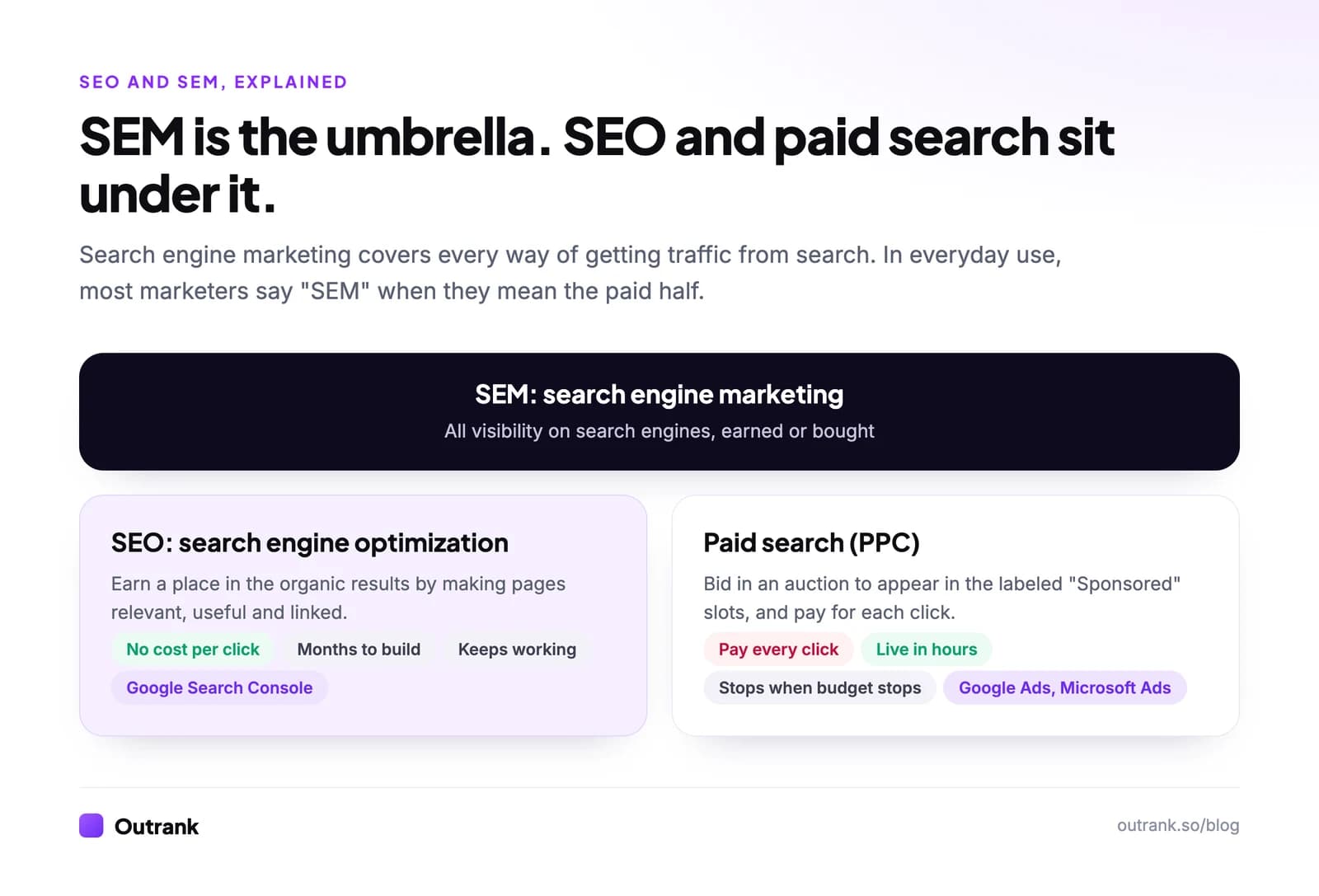
SEO (search engine optimization) means improving your website so it ranks in the unpaid, organic results of Google and other search engines. SEM (search engine marketing) means every way of getting visibility on search engines, paid or earned, but in everyday marketing it almost always refers to paid search ads, such as Google Ads, where you bid on keywords and pay for each click.
So SEO earns traffic slowly and keeps it; paid SEM buys traffic instantly and loses it when the budget stops. Below: both definitions, how they differ on cost and speed, what a click actually costs in 2026, how the two work together, and a short quiz to decide which to start with.
Key takeaways
- SEO = earning unpaid rankings in organic results. SEM = all search marketing; in practice it usually means paid search ads (PPC).
- Paid search is expensive and getting more so: the median Google Ads cost per click was $5.42 in 2026, and $9.87 for lawyers (WordStream, 13,474 campaigns).
- Ads don't improve organic rankings. Google says it doesn't accept payment to rank pages higher.
- SEO compounds but starts slowly: across Outrank customer sites, median Google clicks were +28% after 12 weeks and about 2× after 7 months.
- Most businesses benefit from both: ads to capture demand and test keywords now, SEO to lower the cost of every future visitor.
What SEO means
SEO is the practice of making your pages the most relevant and useful result for searches your customers make, so search engines rank them in the organic (unpaid) results. It has three parts:
- On-page SEO: choosing the right keyword for each page and writing content, titles and headings that answer that search better than other pages.
- Technical SEO: making sure search engines can crawl and index the site and that it loads fast and works on phones.
- Off-page SEO: earning links and mentions from other sites, which search engines treat as votes of confidence.
You don't pay Google anything for organic clicks. You pay with time, content and expertise, or by hiring help. The results take months to build, then keep working without a per-click cost. For the practical steps, see how to rank on Google or our do-it-yourself SEO plan.
What SEM means (and why the meaning changed)
Search engine marketing originally meant all marketing on search engines, with SEO and paid ads as its two halves. Over time, the industry started saying "SEO" for the organic half and "SEM" for the paid half, so today "SEM" in a job title, agency proposal or budget line almost always means paid search.
Related terms you'll see:
- PPC (pay-per-click): the billing model behind paid search. Often used as a synonym for SEM.
- SEA (search engine advertising): the term used in much of Europe for paid search. SEA + SEO = SEM.
- Google Ads and Microsoft Advertising: the two main paid search platforms. Microsoft's ads run on Bing and its partners.
- SERP: the search engine results page, where ads and organic results appear together.
Paid search also now reaches into AI answers: Google has been showing ads in AI Overviews in the US since 2024 and has been expanding them to more countries and testing them in AI Mode.
SEO vs SEM: the key differences
| SEO (organic) | SEM (paid search) | |
|---|---|---|
| Where you appear | Organic results, below the ads | Labeled "Sponsored" slots above and below organic results |
| How you pay | Time, content, tools or an SEO provider; no cost per click | Every click, through an auction |
| Speed | Usually months | Hours after the campaign is approved |
| When you stop | Rankings fade slowly | Traffic stops the same day |
| Targeting | Whatever queries your pages earn | Exactly the keywords, locations, times and devices you choose |
| Best for | Lowering the long-run cost per visitor, building authority | Launches, promotions, testing demand, high-margin leads |
| Main tool | Google Search Console | Google Ads, Microsoft Advertising |
How paid search works
Every time someone searches, Google runs an auction among advertisers bidding on matching keywords. Google says each ad's position depends on six factors: your bid, the quality of your ad and landing page, Ad Rank thresholds, how competitive the auction is, the context of the search (location, device, time), and the expected impact of your ad assets.
So the highest bid doesn't automatically win. A more relevant ad with a better landing page can rank higher and pay less per click. Google Ads also shows a 1–10 Quality Score per keyword based on expected CTR, ad relevance and landing page experience, but Google describes it as a diagnostic tool and says it is not an input in the ad auction.
What SEM costs in 2026
Clicks are not cheap, and the price depends heavily on your industry. WordStream's 2026 benchmarks, based on 13,474 US search campaigns between April 2025 and March 2026, put the median Google Ads cost per click at $5.42, the conversion rate at 8.18% and the cost per lead at $66.69. CPC has more than doubled since 2016, when it was $2.32.
Median Google Ads cost per click by industry, 2026
Attorneys & legal services
$9.87
Home & home improvement
$8.33
Dentists & dental services
$8.00
Business services
$5.87
All industries
$5.42
Real estate
$3.22
Travel
$2.14
Restaurants & food
$2.05
At $5.42 a click, 1,000 visitors a month costs about $5,400, every month. The same 1,000 visitors from organic search cost nothing per click once you rank, which is why SEO usually wins over a long enough horizon and paid search usually wins over a short one.
SEO has costs too, just structured differently: your own hours, tools, or a provider. In Ahrefs' survey of 439 SEO providers, the most common monthly retainer was $501–$1,000. Automated platforms such as Outrank, which researches keywords, publishes an article a day and builds backlinks, start at $99 a month (pricing).
Does SEM help SEO?
Not directly. Google states that it doesn't accept payment to rank a site higher, and paid and organic results are ranked by separate systems. Running ads won't lift your organic positions, and stopping ads won't hurt them.
They help each other indirectly, through data and coverage:
- Test keywords with ads before investing in content. A two-week campaign shows which searches convert. Write SEO pages for the winners.
- Link Google Ads to Search Console. The Paid & organic report shows queries where you have ads, organic rankings or both, so you can spot gaps and overlap.
- Use organic titles that win clicks as ad copy, and ad headlines with high CTR as title tag ideas.
- Defend your brand name. Competitors can bid on it. Our guide to the benefits of running search ads for brand keywords covers when it pays.
- Cover more of the results page for your most valuable keywords: an ad on top and an organic result below leave less room for competitors.
SEO or SEM: which should you start with?
Answer four questions for a recommendation.
4-question decision helper
Should you start with SEO, paid search, or both?
Question 1 of 4
How soon do you need customers from search?
The quiz simplifies, but the logic holds: paid search suits urgent, high-value, well-funded situations; SEO suits tight budgets, long horizons and beatable results pages. Most established businesses end up running both.
Measuring SEO and SEM side by side
Compare them on cost per lead or customer, not on clicks:
- SEM: Google Ads reports cost, clicks and conversions directly. Cost per lead = spend ÷ leads.
- SEO: Search Console shows organic clicks; Google Analytics 4 shows the leads or sales they produce (filter by the Organic Search channel). Cost per lead = what you spent on content, tools and time ÷ organic leads.
Expect paid search to look better in month one and SEO to look better by month twelve. For a deeper look at traffic channels, see organic search vs direct traffic and the main website traffic sources.
FAQ
What is the difference between SEO and SEM?
SEO earns unpaid rankings in organic search results by improving your content, site and links. SEM is the broader term for all marketing on search engines, but most people use it to mean paid search ads, where you bid on keywords and pay per click. SEO is slower and cheaper per visitor over time; paid SEM is immediate and costs money for every click.
Is SEO part of SEM?
Technically yes. Search engine marketing originally covered both organic and paid search. In everyday use, though, "SEM" has come to mean paid search, and "SEO" the organic side, so many people treat them as two separate disciplines.
Is SEM the same as PPC?
Almost. PPC (pay-per-click) is the billing model where you pay each time someone clicks your ad, and paid search is the most common form of PPC. Since "SEM" usually means paid search, the terms are often used interchangeably, though PPC can also include ads on social networks and other sites.
Is SEM better than SEO?
Neither is better in general. SEM is better when you need traffic immediately, are testing an offer, or sell something valuable enough to pay $5 or more a click. SEO is better for lowering your long-term cost per visitor and building authority. Most businesses do best with both.
Does paying for Google Ads improve SEO rankings?
No. Google says it doesn't accept payment to rank pages higher in organic results, and ads and organic rankings are handled by separate systems. Ads can still help SEO indirectly by showing which keywords convert before you invest in content.
What does SEA mean in marketing?
SEA stands for search engine advertising, the term common in Europe for paid search ads. In that vocabulary, SEM is the umbrella that includes both SEA (paid) and SEO (organic).