SEO for manufacturers means ranking for the spec-driven searches engineers and buyers use to find suppliers, such as "5-axis CNC machining titanium", "ISO 13485 injection molding" or "custom aluminum extrusion", and turning those visits into requests for quote (RFQs). The searches are low-volume and precise, several people weigh in on every purchase, and the pages that win are capability, material, industry and certification pages with real specifications. Blog posts help, but they come second.
This guide is the do-it-yourself version for contract manufacturers, machine shops, fabricators and industrial suppliers. If you sell services or software to businesses, our B2B SEO playbook fits better.
Key takeaways
- Manufacturing searches combine a process, a material, a tolerance or certification, and an industry. Each common combination deserves a page with real specs.
- B2B buyers first contact sellers 61% of the way through their buying journey, and the winning vendor is already on the day-one shortlist 95% of the time (6sense, 2025). Your website does the early selling.
- 69% of B2B buyers report inconsistencies between a supplier's website and what its sellers tell them (Gartner, 2025). Publish the tolerances, machines and certifications you actually have.
- Keep specs in HTML pages that Google can read and link from, and make the RFQ form accept CAD files.
- In Outrank's study, 71% of 28 manufacturing and industrial sites grew their Google clicks, from a median 528 to 812 per 28 days: steady, slower growth than average.
How engineers and buyers search for suppliers
Three kinds of people search for a manufacturer, and they type different things:
- Design engineers look for capability and design help: processes, materials, tolerances, design guidelines.
- Buyers and procurement look for qualified suppliers: certifications, location, capacity, lead times.
- Quality and compliance check certifications and quality systems before a supplier is approved.
And they rarely buy alone. Forrester's State of Business Buying 2026 counts on average 13 internal stakeholders and nine external participants influencing a B2B purchase. Your pages have to answer each of them.
They also do most of their homework before they talk to you. In 6sense's 2025 Buyer Experience Report, a survey of just under 4,000 B2B buyers, the first contact with a seller came 61% of the way through the buying journey, and the winning vendor was already on the day-one shortlist 95% of the time. Gartner found that 61% of B2B buyers prefer a rep-free buying experience and 69% see inconsistencies between a supplier's website and what its sellers tell them. If your website doesn't show what you can make, you're not on the shortlist.
Map the search patterns to the pages that should rank:
| Search pattern | Example | Page that should rank |
|---|---|---|
| Process + material | "titanium CNC machining" | Process page with a section (or page) per material |
| Process + industry | "medical device contract manufacturing" | Industry page |
| Certification | "AS9100 machine shop", "ISO 13485 injection molding" | Certification page, plus mentions on process pages |
| Capability | "tight tolerance machining", "large format laser cutting" | Process page with a tolerance and size table |
| Location | "metal fabrication near me", "contract manufacturer Ohio" | Google Business Profile and a location page |
| Design question | "injection molding wall thickness guidelines" | Design guide |
| Comparison | "CNC machining vs 3D printing for prototypes" | Comparison guide |
Search volumes for these are small. A search with 30 monthly visits can still bring the one RFQ that turns into a multi-year contract, so judge keywords by deal value, not volume. Our guide to long-tail keyword research shows how to find them, and the B2B keyword value calculator in our B2B guide puts a number on them.
Build the pages buyers look for
Most manufacturing websites have a home page, an "About us", a single "Capabilities" page listing everything in one paragraph and a contact form. That structure can't rank for "titanium CNC machining" because no page is about it.
Build these instead:
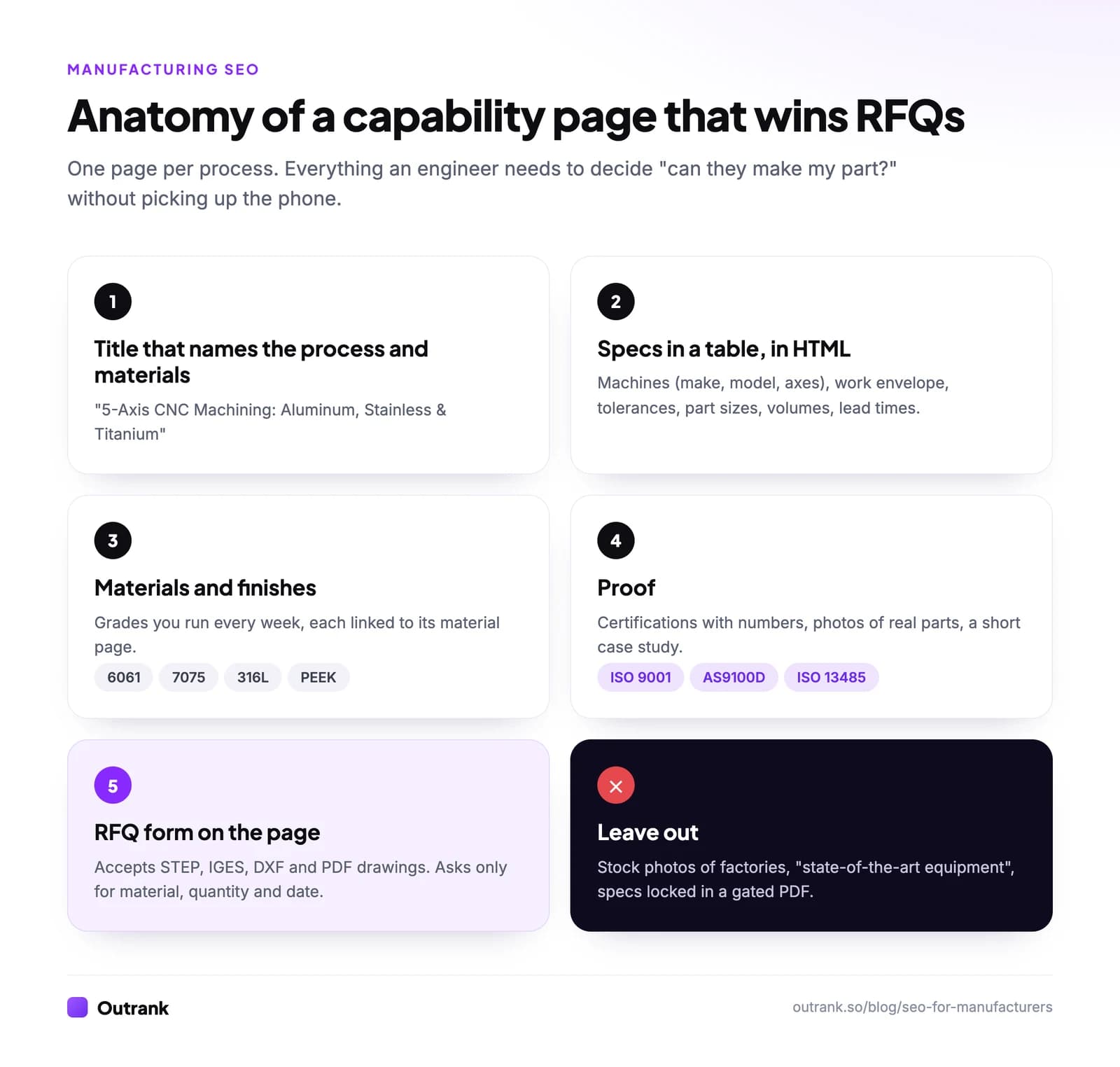
- One page per process (CNC milling, CNC turning, sheet metal fabrication, injection molding, extrusion, welding). Name the process and main materials in the title ("5-Axis CNC Machining: Aluminum, Stainless and Titanium"). Each page lists the machines you run (make, model, axes, work envelope), tolerances you hold, part size limits, volumes (prototype to production), lead times, secondary operations and inspection equipment. Show photos of real parts.
- Material pages or sections for each material family and the grades you stock or machine regularly (6061 vs 7075 aluminum, 316L stainless, PEEK). Explain properties, typical applications and the finishes you offer.
- Industry pages for the sectors you serve, with the requirements each one has. Aerospace buyers look for AS9100D, medical device buyers for ISO 13485, defense buyers for ITAR registration, everyone for ISO 9001.
- A quality and certifications page with certificate numbers, scope, the certifying body and downloadable certificates.
- Case studies (with the customer's permission): the part, material, tolerance achieved, quantity and lead time.
The online manufacturing platforms show what thorough looks like. Protolabs' CNC machining page breaks capabilities into milling and turning and lists every material by family, and its design tips library covers topics like "Solving Wall Thickness Issues in Molded Parts". Xometry's CNC page has a section for each alloy family. Fictiv's CNC page includes a tolerance section, finishing options, a downloadable design guide and an FAQ answering "What tolerances can your CNC machines achieve?". A job shop can't match their scale, but it can match their specificity with its own machine list and its own parts.
Use this checklist to audit your site, page by page:
Interactive checklist
Manufacturing website SEO checklist
0/21
Capability pages
0/6Proof and trust
0/4RFQ and conversion
0/4Technical
0/4Local and directories
0/3Your progress is saved in this browser, so you can come back to it later.
Make the RFQ the easiest thing on the page
An engineer who has read your tolerance table and decided you're a candidate wants to send a drawing. Every extra field, mandatory phone call or "contact us for capabilities" step loses some of them.
- Accept files. A quote request without a drawing is a conversation, not an RFQ. Allow multiple files and common CAD formats.
- Ask for the minimum: contact details, material, quantity, target date. Optional fields can cover finish, certifications required and NDA.
- Offer an NDA up front if you work with sensitive designs. Engineers often won't upload a drawing without one.
- Say what happens next. Who will reply and roughly when, only if you can keep the promise.
- Keep specs ungated. Gating a datasheet behind a form hides it from Google and annoys the engineer. Gate nothing that helps someone decide whether you can make their part.
Content that engineers actually read
Once the core pages exist, content brings in engineers earlier, when they're still designing the part:
- Design guides with your real numbers: minimum wall thickness, recommended draft angles, standard vs tight tolerances, hole and thread guidelines.
- Comparison guides: process vs process (CNC machining vs die casting for 1,000 parts), material vs material (6061 vs 7075), finish vs finish (Type II vs Type III anodizing).
- Cost drivers: what makes a machined part expensive and how to design around it. Engineers search for this, and few suppliers answer it honestly.
- Glossary-style explainers for terms buyers outside engineering need (first article inspection, PPAP, lead time vs cycle time).
Technical content has to be right; a wrong tolerance in a design guide costs you credibility with exactly the reader you want. Outrank can research and draft the long tail of explainers and how-tos and publish them on a schedule, and its Human Curated option adds editors who fact-check every article. Have an engineer review anything with numbers in it.
Directories and links that matter in manufacturing
Industrial buyers still use supplier directories, and the links are relevant. Prioritize:
- Industrial directories such as Thomasnet, and your trade association's member directory.
- Supplier and "where to buy" pages on your customers' and distributors' sites.
- Trade show exhibitor lists, which often link to exhibitors.
- Certification registries and your certifying body's client listings.
- Local business and economic development organizations, which often profile local manufacturers.
Our guide on how to build backlinks covers outreach. For a steady supply of in-context links without outreach, Outrank's backlink exchange places links inside relevant articles on other sites in its network.
Measure RFQs, not rankings
Rankings and traffic are leading signals; RFQs and won business are the result. Set up:
- Key events in Google Analytics 4 for RFQ submissions, CAD uploads, clicks on phone numbers and email addresses, and datasheet downloads. Our guide to using Google Analytics covers the setup.
- A source field in your CRM for every RFQ, plus a "How did you hear about us?" question on the form. Self-reported answers catch the engineer who found you on Google and called three weeks later.
- Search Console queries per page, to see which specs and materials bring visitors, and where to add a section or a new page.
Report quarterly, not weekly. With long sales cycles, a design-stage visit in March can become a production order in October.
What results to expect
Manufacturing grows more slowly than most niches in Outrank's data, which fits a market with few, precise searches. In Outrank's study of Search Console data from 2,119 sites:
Share of sites that grew Google clicks after starting with Outrank
Manufacturing & industrial
28 sites · 528 → 812
71%
B2B services
111 sites · 124 → 389
79%
All sites in the study
297 → 814
75%
The median manufacturing site went from 528 to 812 clicks per 28 days, about 1.5×, compared with about 2.7× for the median site overall. Fewer clicks, but each one is more likely to be an engineer with a drawing. If you want someone to run all of this for you, Outrank Agency is the done-for-you option, with every article reviewed by human editors and SEO specialists; see Outrank Agency. Agencies that specialize in B2B are compared in our B2B SEO services list.
FAQ
What is SEO for manufacturers?
SEO for manufacturers is the work of getting a manufacturing company's capability, material, industry and certification pages to rank in Google for the searches engineers and buyers use to find suppliers, and turning those visits into requests for quote. It focuses on specific, low-volume searches where each visitor can be worth a large contract.
What keywords should a manufacturing company target?
Target combinations of process, material, certification and industry, such as "titanium CNC machining", "ISO 13485 injection molding" or "aerospace sheet metal fabrication", plus design questions engineers ask ("injection molding wall thickness"). Your Search Console queries and your sales team's RFQs are the best sources of the exact terms your buyers use.
How long does SEO take for a manufacturing company?
Expect three to six months before new capability pages bring steady traffic, and longer before that shows up as won business because of long sales cycles. In Outrank's study, the median manufacturing site grew from 528 to 812 clicks per 28 days, slower than the 2.7× median across all niches.
Is SEO worth it for a B2B manufacturer with few searches?
Usually yes, because the value of one customer is high. A capability page that ranks for a search with 20 visits a month can produce a handful of RFQs a year, and one won contract can pay for years of SEO. Judge keywords by the value of the deals behind them, not by search volume.
Should manufacturers put spec sheets in PDFs?
Offer PDFs for download, but put the key specs (tolerances, materials, sizes, certifications) in the HTML of the page as well. Google can index PDFs, but HTML pages are easier for buyers to scan, easier to link to and update, and they carry your RFQ form.