

To start a blog that makes money, pick a niche where readers buy things, launch the blog on your own domain (you can do it for free), publish posts that target low-competition keywords on a fixed schedule, collect email addresses from the first day, and add income streams as traffic arrives: affiliate links first, then ads, then your own products. Plan for a year. In a 2025 survey of 187 bloggers, the median took 12 months to earn a first dollar.
This is the launch plan, step by step, with the decisions that matter at each stage and a checklist you can tick off as you go.
Key takeaways
- The order is niche, blog, keywords, publishing rhythm, email list, then monetization. Skipping ahead is why most new blogs earn nothing.
- You can launch for $0. Outrank Blogs hosts a blog on your own domain free up to 10,000 visits a month; Blogger and Substack are free too.
- Target small keywords first. The keywords Outrank picks for its customers have a median difficulty of 14 and 170 searches a month.
- Post count drives traffic. Surveyed blogs with 100 to 299 posts averaged 22,714 monthly pageviews; blogs under 50 posts averaged 1,152.
- Expect slow, then faster. Median 12 months to a first dollar and 36 months to a full-time income in Productive Blogging's 2025 survey.
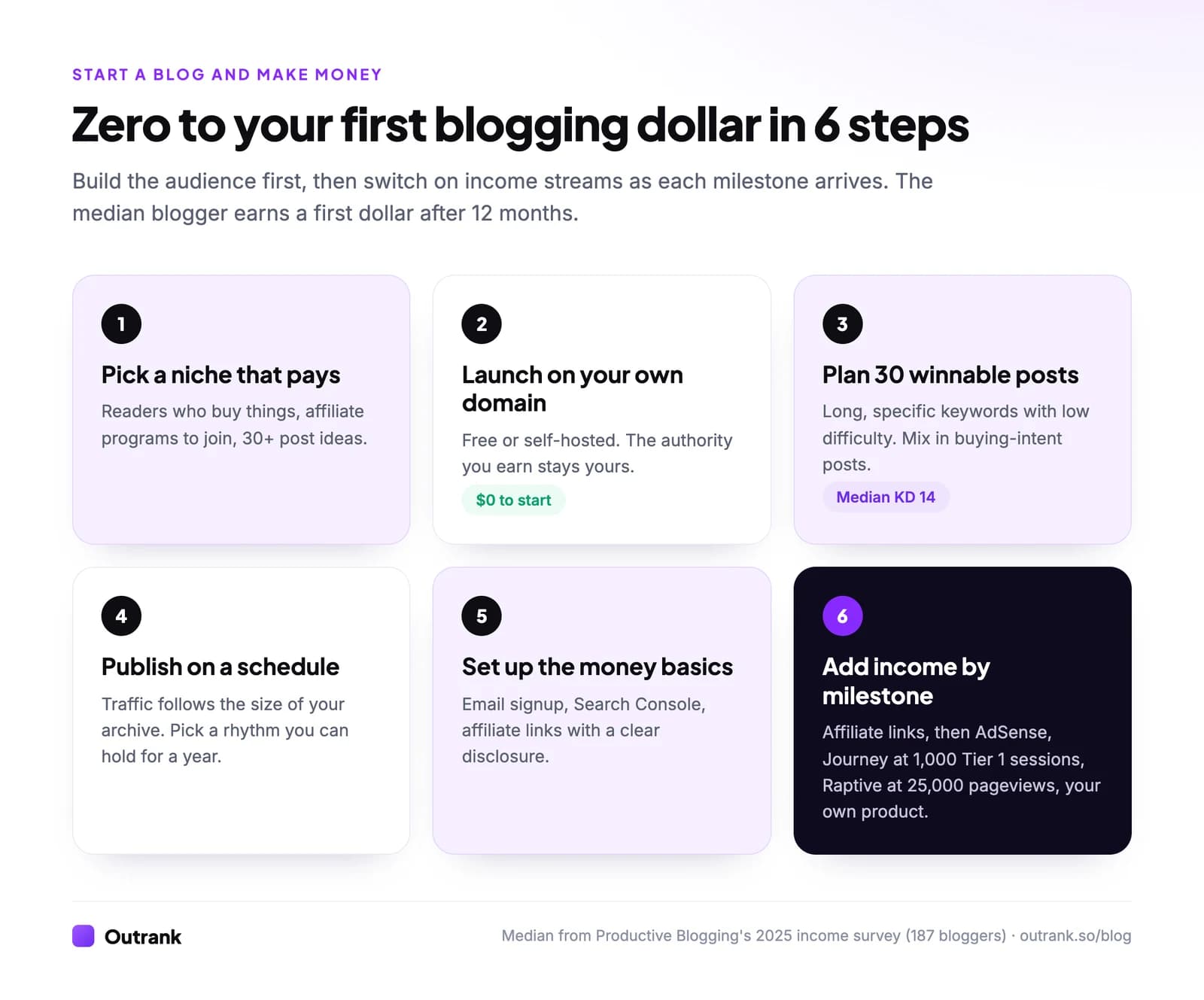
Step 1: Pick a niche that can pay
A profitable blog niche has readers who spend money on the problem you write about. Passion helps you keep writing; buyers are what make it pay. Check three things before you commit:
- Products to recommend. Search "[your niche] affiliate program" and "best [product] for [audience]". If brands run programs and reviews rank, money moves through this niche.
- Questions you can answer 100 times. List 30 post ideas in ten minutes. If you stall at 12, the niche is too narrow or not yours.
- A narrow first angle. "Personal finance for freelancers" or "budget travel in Southeast Asia" is easier to own than the whole category. You can widen later.
Niche matters less than people think. The Productive Blogging income survey found personal finance and online business blogs reported the highest RPMs, but its author concluded that blog age, number of posts and number of revenue streams mattered more than niche.
Step 2: Launch the blog on your own domain
Where you host decides what you can sell and who owns the audience you build. Use your own domain from the start: the authority your posts earn then stays with you if you ever move.
| Option | Cost to start | Own domain | Ways to earn | Watch out for |
|---|---|---|---|---|
| Outrank Blogs | $0 up to 10,000 visits a month | Yes, free (subdomain, subfolder or its own domain) | Affiliate links, newsletter, your products and services | Custom scripts such as ad code need the paid plan |
| Self-hosted WordPress | Hosting plan and domain | Yes | Everything, through plugins | You maintain updates, speed and security |
| WordPress.com | Free; paid plans for plugins and ads | On paid plans | WordAds from the Premium plan | Free sites show WordPress.com's ads |
| Ghost(Pro) | From $18/month billed yearly | Yes | Paid memberships from the $29 Publisher plan | Monthly fee before you earn |
| Substack | $0 | One-time $50 for a custom domain | Paid subscriptions (Substack keeps 10%) | Built for newsletters more than search traffic |
Prices from WordPress.com, Ghost and Substack, October 2026.
If you want zero setup, Outrank Blogs gets a blog live in about a minute: five templates, newsletter forms with CSV export, cookie-free analytics, sitemap and structured data generated for you, plus three AI-written starter posts. Outrank never puts its own ads on your blog; free blogs carry a small "Published with Outrank" badge. If you want full control and plan to run display ads early, self-hosted WordPress is the standard choice: our WordPress blog setup guide walks through the install and how to monetize a WordPress blog covers the plugins.
Step 3: Plan your first 30 posts around keywords you can win
A new blog has no authority, so it can't rank for "how to save money" yet. It can rank for "how to save money on groceries as a single parent". Build your first list from long, specific searches with low competition.
Our own data shows what winnable looks like. Across the 200,871 articles Outrank wrote for customer sites in the 90 days to October 2026, the median target keyword had a difficulty of 14 out of 100 (63% scored under 20) and 170 searches a month. Small keywords add up when you publish enough of them.
Split the first 30 posts roughly like this:
- 20 to 25 helpful posts answering specific questions in your niche. They earn trust, links and email signups.
- 5 to 10 buying-intent posts: comparisons, "best X for Y", reviews. These are the pages that earn affiliate commissions.
For the research itself, follow our guide to finding low-competition keywords, or try the free blog keyword generator to get a starting list.
Step 4: Publish on a schedule you can keep
Traffic follows the size of your archive. In the same income survey, average monthly pageviews rose sharply with post count:
Average monthly pageviews by number of blog posts
0–49 posts
1,152
50–99 posts
3,621
100–299 posts
22,714
300–499 posts
126,451
The cost is time. Orbit Media's 2026 survey of 1,042 bloggers puts the average post at 3 hours 20 minutes, so 30 posts is roughly 100 hours. Pick a rhythm you can hold for a year (two posts a week beats ten in one week and then silence), batch your research, and use our tips for writing blog posts faster.
If that's more hours than you have, Outrank can do the publishing: it researches keywords, writes an SEO article a day with images and internal links, and publishes it to your blog, including a free Outrank blog. The paid plan is $99 a month for 30 articles. Google doesn't penalize content for being AI-assisted; its guidance on AI content targets content made mainly to manipulate rankings, so review what goes out and add your own experience where you have it.
Step 5: Set up the money basics on day one
None of these earn much in month one. All of them cost you money if you add them late.
- Email signup form at the end of every post. The list is the audience no algorithm can take away, and it's who buys your first product.
- Google Search Console so you can see which queries you start appearing for, and Google Analytics or your blog's built-in analytics.
- One or two affiliate programs that fit your niche, linked from your buying-intent posts with a clear disclosure. The FTC suggests plain wording like "I get commissions for purchases made through links in this post".
- About and contact pages that say who writes the blog and why they know the subject. Brands check these before sponsoring you.
Step 6: Add income streams as you hit milestones
| Milestone | Add this |
|---|---|
| First posts live | Affiliate links on buying-intent posts, email signup |
| First steady traffic | Google AdSense (no traffic minimum) |
| 1,000 sessions a month from the US, UK, Canada or Australia | Apply to Journey by Mediavine |
| Readers asking you the same question | A small digital product or a service offer |
| 25,000 monthly pageviews | Apply to Raptive; pitch sponsors with a media kit |
Ad network rules come from Mediavine and Raptive (October 2026). For what each stream pays per 1,000 pageviews and how to run it, read our companion guide on how to make money with a blog. For a platform-by-platform comparison, see website monetization platforms.
What to expect in year one
Honest numbers, so you don't quit in month four:
- Months 1 to 3: Google discovers and indexes your pages. Little traffic is normal.
- Months 4 to 12: long-tail posts start ranking and the first affiliate commissions arrive. Just over a quarter of surveyed bloggers earned something within six months; the median took 12.
- Year two and three: income compounds as older posts climb and the archive grows. The survey's median for a full-time income was 36 months, and 28% got there within two years.
The same pattern shows up in our own data on existing sites. Across 2,119 sites that started publishing with Outrank, median Google clicks were up 7% after 28 days, 27% after 84 days and 2.0× by month seven. Three slow months, then it compounds.
Interactive checklist
Blog launch checklist, from zero to first dollar
0/15
Foundation
0/4Content
0/4Money basics
0/3Growth milestones
0/4Your progress is saved in this browser, so you can come back to it later.
FAQ
How much does it cost to start a blog that makes money?
You can start for $0: Outrank Blogs hosts a blog on your own domain for free up to 10,000 visits a month, and Blogger and Substack are free too. Self-hosted WordPress costs a domain plus a hosting plan, and WordPress.com charges for plugins and ad features. Spend on content and time before you spend on tools.
How long does it take to make money from a new blog?
In Productive Blogging's 2025 survey of 187 bloggers, the median blogger earned a first dollar after 12 months and reached a full-time income after 36. Just over a quarter earned something within six months. Publishing more posts on low-competition keywords is the main way to move faster.
Can you start a blog for free and make money?
Yes. On a free Outrank blog you can earn from affiliate links, your own products and services, and an email list, and Outrank never adds its own ads. Running ad network code needs the paid plan. Blogger also supports AdSense on free blogs, while free WordPress.com sites show WordPress.com's ads instead of yours.
How many blog posts do you need before you make money?
There's no fixed number, but income tracks post count closely. In the 2025 income survey, blogs with fewer than 50 posts averaged $17 a month, 100 to 299 posts $548, and 300 to 499 posts $5,086. Affiliate commissions can start with your first few buying-intent posts.
Do I need to write every post myself?
No. Many bloggers write their key posts themselves and use writers or AI tools for the rest. Google's guidance says it rewards helpful content however it's produced and targets content made mainly to manipulate rankings, so review everything before it goes live and add first-hand experience where you can.
What is the best niche to start a blog and make money?
Pick a niche where readers buy products or services and where you can write 100+ useful posts. Personal finance and online business reported the highest RPMs in the 2025 income survey, but the same survey found blog age, post count and the number of revenue streams mattered more than niche. Start narrow and widen once you rank.