

Healthcare SEO is the work of getting a healthcare organization's website (a medical practice, hospital, telehealth service, health brand or medtech company) to appear in Google, Google Maps and AI assistants when people search for symptoms, treatments and providers. It follows the same basics as any SEO, with one big difference: Google treats health as a "Your Money or Your Life" topic, so its systems give extra weight to expertise and trust, and medical content has to agree with established expert consensus.
The demand is enormous. Google's Chief Health Officer said in March 2026 that people ask Search more than a billion health questions every day. This guide covers how Google judges health content, an eight-step strategy for SEO in healthcare, the privacy rules that trip up medical websites, and what our data shows for health sites.
Key takeaways
- Health is a YMYL topic. Google's helpful content guidance says its systems give even more weight to content with strong E-E-A-T, and YMYL pages must match established expert consensus.
- Every medical page should show who wrote it, who reviewed it and when. Google calls fabricated author profiles and credentials deceptive and a signal of a low-quality page.
- Win the four kinds of healthcare searches with four kinds of pages: condition explainers, treatment pages, provider and location pages, and cost or insurance pages.
- Keep Google Analytics and ad pixels off patient portals and logged-in pages: Google doesn't sign BAAs for Analytics, and HHS guidance on authenticated pages still applies.
- In our data, 81% of 95 health and wellness sites grew their Google clicks after they started publishing with Outrank, from a median 490 to 1,447 clicks per 28 days.
What is healthcare SEO?
Healthcare SEO (also called medical SEO) is search engine optimization for organizations that provide or sell health services and products. The goal is to rank for the searches patients, caregivers and buyers make, and to turn that visibility into appointments, sign-ups or sales.
"Healthcare" covers very different businesses, and the right strategy depends on which one you are:
| Type of healthcare organization | What people search | What wins |
|---|---|---|
| Medical practices, dental offices, clinics | "dermatologist near me", "urgent care open now", "[treatment] in [city]" | Google Business Profile, service and location pages, reviews |
| Hospitals and health systems | Conditions, specialties, locations, doctor names | A crawlable doctor directory, location pages, a condition library |
| Telehealth and digital health | "online ADHD assessment", "[condition] treatment online" | Condition and treatment pages, clear pricing, where the service is available |
| Health and wellness brands | "does magnesium help with sleep", ingredient and product questions | Evidence-based articles reviewed by experts, honest product claims |
| Healthcare B2B, SaaS and medtech | "EHR for small practices", "HIPAA compliant forms" | Comparison pages, compliance pages, case studies |
If you run a single practice or a small group of clinics, most of your growth comes from local search. Our local SEO playbook for medical practices covers that side step by step; dental offices can start with SEO for dentists. This guide covers the strategy that applies to every healthcare website.
Why SEO in healthcare is different: YMYL and E-E-A-T
Google's Search Quality Rater Guidelines (current version dated September 11, 2025) describe "Your Money or Your Life" (YMYL) topics as those that "could significantly impact the health, financial stability, or safety of people". Health is the first category on the list. Raters use these guidelines to evaluate Google's results; their ratings don't rank individual pages, but they show what Google's systems are built to reward.
Three ideas from Google's own documents shape healthcare SEO:
- Trust comes first. E-E-A-T stands for Experience, Expertise, Authoritativeness and Trust, and the guidelines say "the most important member at the center of the E-E-A-T family is Trust."
- Some advice must come from experts. The guidelines separate personal experience (a patient describing life with a condition, which can be valuable) from information that "must come from experts", such as treatment options or medication safety in pregnancy. For medical advice, "consistency with well-established expert consensus is important."
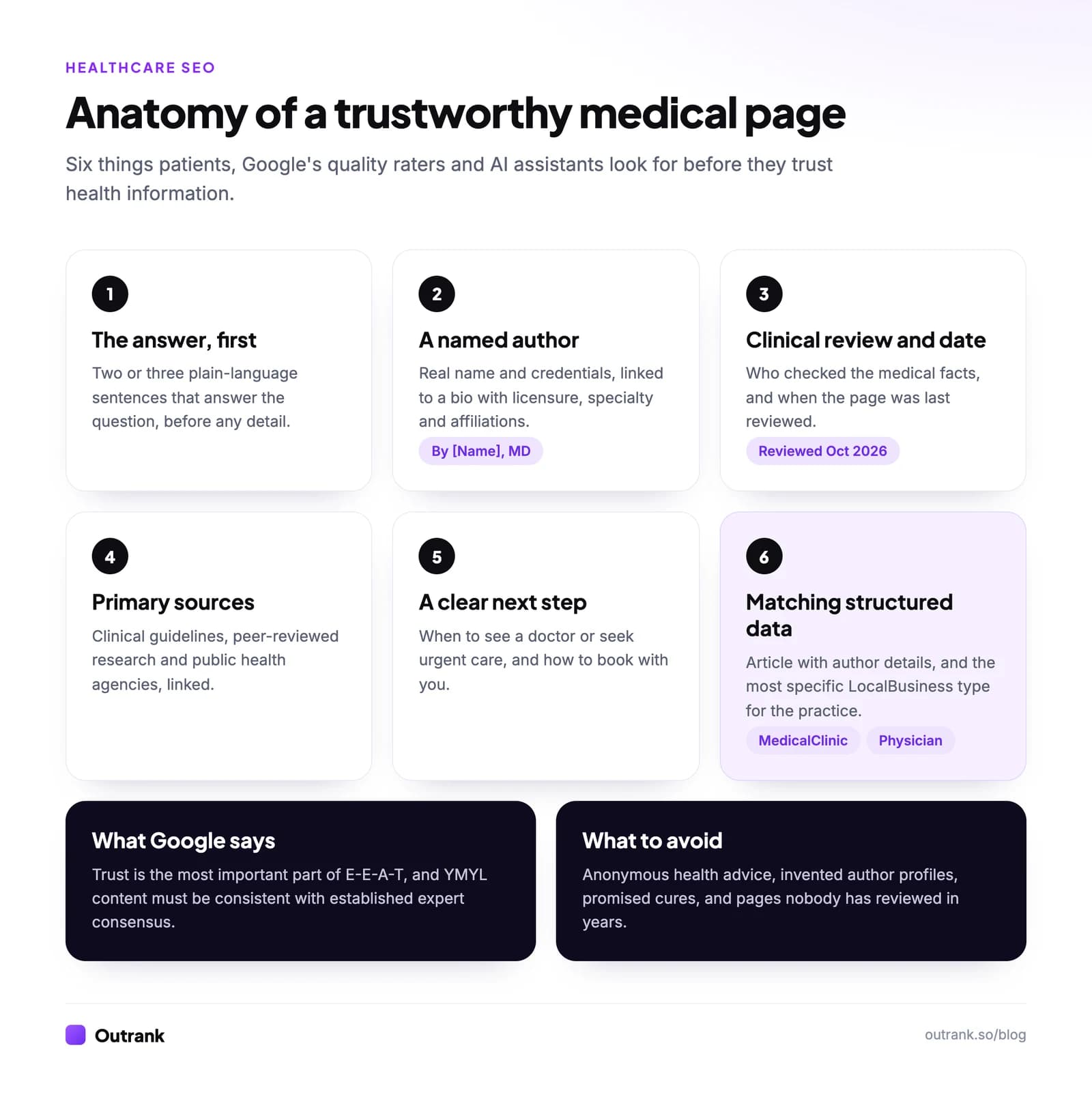
- YMYL pages get extra scrutiny. Google's guide to creating helpful, reliable, people-first content says its systems give "even more weight to content that aligns with strong E-E-A-T" on YMYL topics. It asks whether pages carry a byline where one is expected, and it calls made-up author profiles (fake headshots, invented credentials) deception and "a signal of a low-quality page."
In practice, that means a health page written anonymously, unsourced or out of date competes at a disadvantage against a hospital or a clinician-reviewed publisher, however well it's optimized.
Healthcare SEO strategy: 8 steps
This is the order we'd work in for any healthcare website. Steps 1 to 5 build the foundation; steps 6 to 8 are what compound.
- 1
Map your services, conditions and locations to real searches
List every service, treatment, condition you treat and location you serve. For each, find the phrases patients use (Google autocomplete, People also ask, and your own Search Console queries). Patients search "knee pain when climbing stairs", not "patellofemoral pain syndrome". - 2
Build one strong page per service, condition and location
Each page answers one search well. Thin pages that swap a city name or a condition name are doorway pages and rarely hold rankings. - 3
Prove expertise on every medical page
Show the author's name and credentials, a clinical reviewer and the date of the last review, and cite primary sources (clinical guidelines, peer-reviewed studies, public health agencies). Link each name to a real bio page. - 4
Win local search
Complete a Google Business Profile for each location (and each public-facing practitioner where Google's rules allow it), keep name, address and phone identical everywhere, and ask every patient for a review. - 5
Fix the technical basics
Fast mobile pages, a crawlable doctor directory and location finder, clean URLs, an XML sitemap, and structured data using the most specific type (MedicalClinic, Dentist, Physician). - 6
Keep tracking and forms privacy-safe
No analytics or ad pixels on patient portals or logged-in pages, no health details in URLs, and form or chat vendors that sign a business associate agreement (BAA) where they handle patient data. - 7
Publish patient education every week
Answer the questions patients ask before and after a visit. This is where most search demand sits, and it feeds your service pages with internal links. - 8
Earn links and mentions from credible sources
Hospital affiliations, university pages, medical associations, local news, community health events and expert quotes for journalists. A handful of relevant links beats hundreds from directories.
Keyword research for healthcare: the four search intents
Healthcare searches fall into four groups, and each needs a different page type:
| Search intent | Example searches | Page that wins |
|---|---|---|
| Symptom or condition | "why does my jaw click", "what causes plantar fasciitis" | Condition explainer, reviewed by a clinician |
| Treatment or procedure | "PRP injection recovery time", "is LASIK painful" | Treatment page with candidacy, risks, recovery and cost |
| Provider or location | "pediatrician near me", "sports medicine clinic austin" | Location or service page, plus Google Business Profile |
| Cost, insurance and logistics | "MRI cost without insurance", "dermatologist that takes medicaid" | Pricing, insurance and FAQ pages |
Most healthcare sites over-invest in the third group and ignore the other three. Yet symptom and treatment questions are where patients start, and the long, specific versions are far less competitive. Across all industries, the keywords Outrank picks for its customers have a median difficulty of 14 out of 100 and a median of 170 searches a month (Outrank platform data, 90 days to October 2026), because winnable long-tail questions add up faster than one head term you can't rank for. Our guides to long-tail keyword research and low-competition keywords show the method.
Creating medical content that ranks and stays accurate
Good health content answers the question in plain language in the first paragraph, then gives the detail a patient needs to decide what to do next. Great health content also makes its trustworthiness visible. Use this checklist before you publish any medical page:
Interactive checklist
Medical content review checklist
0/11
Expertise and accountability
0/3Accuracy
0/4Usefulness
0/4Your progress is saved in this browser, so you can come back to it later.
On AI-assisted writing: Google doesn't ban it, but its helpful content guidance asks how content was made and expects automation to be disclosed where readers would expect it. For health topics, an AI draft is only a starting point: a clinician has to check every claim before it's published. If you use Outrank for patient education, you can have articles saved as drafts in your CMS so a clinician reviews them first, or add our Human Curated Service, where editors fact-check and polish every article.
Technical SEO for healthcare websites
Healthcare sites tend to be large and messy: many locations, many providers, appointment systems on separate domains, PDFs nobody updates. Focus on:
- Architecture. A clear hierarchy of services, conditions, locations and providers, linked to each other. A doctor directory that only works through a search box is invisible to Google; give every provider a crawlable profile page.
- Structured data. Google has no medical-specific rich result, so schema here is about understanding rather than stars. Use the most specific LocalBusiness subtype for each location (MedicalClinic, Dentist, Physician; schema.org also has IndividualPhysician and PhysiciansOffice), Article markup with author details on content pages, and optionally MedicalWebPage with
reviewedByandlastReviewed. Two things not to expect: star ratings from reviews you collect about your own business (Google treats those as ineligible), and FAQ rich results, which Google stopped showing in May 2026. - Speed and mobile. Patients search on phones, often in a hurry. Check Core Web Vitals in Search Console and fix the slowest templates first.
- Sitemaps and indexing. Keep the sitemap limited to pages you want found, and watch Search Console's Pages report for provider and location pages Google hasn't indexed. Our guide on how to make a sitemap covers setup on each CMS.
HIPAA and SEO: analytics, pixels and forms
This is where healthcare marketing gets into real trouble, so it's worth getting right. (This is general information, not legal advice; check your setup with your compliance team.)
In December 2022, the US Department of Health and Human Services' Office for Civil Rights (OCR) published a bulletin on online tracking technologies used by HIPAA-covered entities, revised in March 2024. On June 20, 2024, a federal court in Texas (American Hospital Association v. Becerra) vacated the part that treated an IP address combined with a visit to a public, unauthenticated page about health conditions or providers as protected health information. HHS withdrew its appeal in August 2024.
The rest of the guidance still stands, and it covers the pages that matter most:
- Tracking on authenticated pages (patient portals, telehealth platforms) generally has access to protected health information.
- Vendors that receive protected health information need a business associate agreement (BAA).
- Login and registration pages that collect credentials are covered too.
Google's own position on Analytics is explicit: it does not offer business associate agreements for Google Analytics and says Analytics tags shouldn't be placed on authenticated pages such as patient portals.
Reviews are the other HIPAA trap: OCR has fined practices for replying to online reviews in ways that confirmed someone was a patient. Our medical practice playbook lists the enforcement cases and gives reply templates that stay compliant.
Healthcare SEO in AI search
AI answers now sit on top of many health searches, and they're under unusual scrutiny. In January 2026, after a Guardian investigation into misleading health answers, Google removed AI Overviews for some liver blood test queries, while saying its clinicians found that in many instances the information was not inaccurate.
For a healthcare website, the path into AI answers is the same one that leads to Google rankings. In our study of AI citations across 200 sites, Google impressions were the strongest predictor of how often AI assistants cited a site, sites with Domain Rating 30 or higher got 29 times the citations of sites under 10, and two-thirds of sites with fewer than 50 pages visible in Google had no AI citations at all. Build depth and trust in Google first; AI visibility follows. If you want to see where you stand, Outrank's AI visibility tracking shows when ChatGPT, Perplexity, Gemini, Copilot and Google's AI features mention you.
What results to expect from healthcare SEO
SEO for healthcare is slow at first and compounds later. Across the 2,119 sites in our AI SEO agent study, median Google clicks were up 7% after the first 28 days, 27% after about three months, and double by month seven. Health sites did better than most niches:
81%
of health and wellness sites grew their Google clicks
95 sites, latest 28 days vs the 28 days before joining Outrank
490 → 1,447
median Google clicks per 28 days
Same health and wellness sites, before vs after
16,359
health and wellness articles Outrank wrote
For 298 health and wellness sites, 90 days to October 2026
This is observational data, not a controlled experiment, and about one in five health sites didn't grow. But it shows that a health site publishing helpful, consistent content has better-than-average odds.
Measure progress with numbers you can collect without touching patient data:
- Search Console: clicks and impressions by page group (conditions, treatments, locations, providers).
- Google Business Profile: calls, direction requests and website clicks per location.
- Bookings from organic search: counted in a booking system that has a BAA, or as aggregate totals your front desk reports.
Who should do your healthcare SEO?
- In-house: works when you have a marketer and clinicians willing to review content on a schedule.
- A healthcare SEO agency: worth it for hospital systems and multi-location groups with complex technical and compliance needs. Ask how they handle clinical review and tracking compliance before you sign.
- Automation plus clinical review: for practices and health brands whose bottleneck is publishing consistently. Outrank researches keywords, writes and publishes patient-education articles to your CMS daily, and can hold them as drafts for clinician sign-off.
Whichever route you choose, the rule is the same: a qualified person reviews every medical claim before it goes live.
FAQ
What is healthcare SEO?
Healthcare SEO is search engine optimization for medical practices, hospitals, telehealth services, health brands and other healthcare organizations. It aims to rank their pages in Google, Google Maps and AI assistants for the symptoms, treatments, providers and locations people search for. Because health is a "Your Money or Your Life" topic, it puts extra emphasis on expertise, accuracy and trust.
Why is SEO important for healthcare?
People ask Google more than a billion health questions every day, according to Google's Chief Health Officer in March 2026. Patients research symptoms and treatments and compare providers before they book, so a practice or health brand that doesn't appear in those searches loses patients to competitors that do.
How do you do SEO for a healthcare website?
Map your services, conditions and locations to the searches patients make, build one strong page for each, and show who wrote and reviewed every medical page. Then complete a Google Business Profile for each location, fix technical basics like speed and structured data, keep analytics off patient portals, publish patient education weekly, and earn links from credible local and medical sources.
What does YMYL mean in healthcare SEO?
YMYL stands for "Your Money or Your Life", Google's label for topics that could significantly affect people's health, finances or safety. Health is the first YMYL category, so Google's systems give extra weight to experience, expertise, authoritativeness and trust on medical pages, and expect content to match established expert consensus.
Can healthcare websites use Google Analytics?
Yes, on public pages that don't expose protected health information. Google says it doesn't offer business associate agreements for Google Analytics, so its tags shouldn't be placed on patient portals, logged-in pages or forms that collect health details. Many healthcare organizations measure SEO with Search Console, which needs no tracking code, and use HIPAA-compliant analytics where they need more.
Does medical content need to be written by a doctor?
Not necessarily written, but it should be reviewed by a qualified clinician. Google's rater guidelines say some health information "must come from experts" and that medical advice should be consistent with expert consensus. Show the reviewer's name, credentials and review date on the page, and never invent author profiles.
How long does healthcare SEO take?
Expect early movement within one to three months and meaningful growth after six months or more. In our data, the median site's Google clicks were up 27% after about three months and doubled by month seven, and 81% of health and wellness sites grew their clicks.