


For a clinic or medical office, SEO for healthcare mostly means local SEO: showing up in Google's map results and top listings when someone nearby searches for your specialty, a treatment or "doctor near me". The fastest way to get there is a 90-day sequence: set up Google Business Profiles correctly for each location and practitioner (weeks 1–2), build one page per service and location (weeks 3–6), run a steady, HIPAA-safe review program (from week 4), and publish patient education and earn local links (weeks 6–12).
This playbook is written for independent practices, therapy offices, urgent care and multi-location clinic groups (dental offices can also use our SEO for dentists guide). For the bigger picture (how Google judges medical content, E-E-A-T and tracking rules), read our complete healthcare SEO guide alongside it.
Key takeaways
- Google lets doctors, dentists and other practitioners have their own Business Profile, but the naming rules depend on whether they work alone or in a group practice.
- 47% of consumers won't use a business with fewer than 20 reviews, and 74% only care about reviews from the last three months (BrightLocal, 2026). Practices need a steady flow, not a one-off push.
- Never confirm someone is a patient in a public review reply. HHS has penalized practices $10,000 to $50,000 for doing it.
- Give every treatment and every location its own page. A single Services page can't rank for any one of them.
- In our data, 81% of 95 health and wellness sites grew their Google clicks after they started publishing with Outrank, from a median 490 to 1,447 clicks per 28 days.
How patients pick a practice online
Patients compare practices the way they compare any local business: on the map, on star ratings and on how recent the reviews are. BrightLocal's Local Consumer Review Survey 2026, a survey of 1,002 US adults, found that:
What consumers look at before choosing a local business
Read online reviews for local businesses
97%
Only care about reviews from the last 3 months
74%
Use Google to read reviews
71%
Need a rating of 4 stars or more
68%
Won't use a business with fewer than 20 reviews
47%
Two practical conclusions. Your Google Business Profile is often seen before your website, so it gets the first two weeks of this plan. And reviews decay: a practice with 300 reviews, none from this year, looks less active than one with 60 recent ones.
The 90-day plan at a glance
Tick each item as you finish it; your progress is saved in this browser.
Interactive checklist
90-day local SEO checklist for medical practices
0/16
Weeks 1–2 · Google Business Profile
0/4Weeks 1–3 · Consistent listings
0/2Weeks 3–6 · Pages that rank
0/4From week 4 · Reviews
0/3Weeks 6–12 · Content and links
0/3Your progress is saved in this browser, so you can come back to it later.
Weeks 1–2: Google Business Profile for practices and doctors
Healthcare has its own rules in Google's guidelines for representing your business. Doctors, dentists and other "individual practitioners" can have their own profile, but how you set it up depends on the practice:
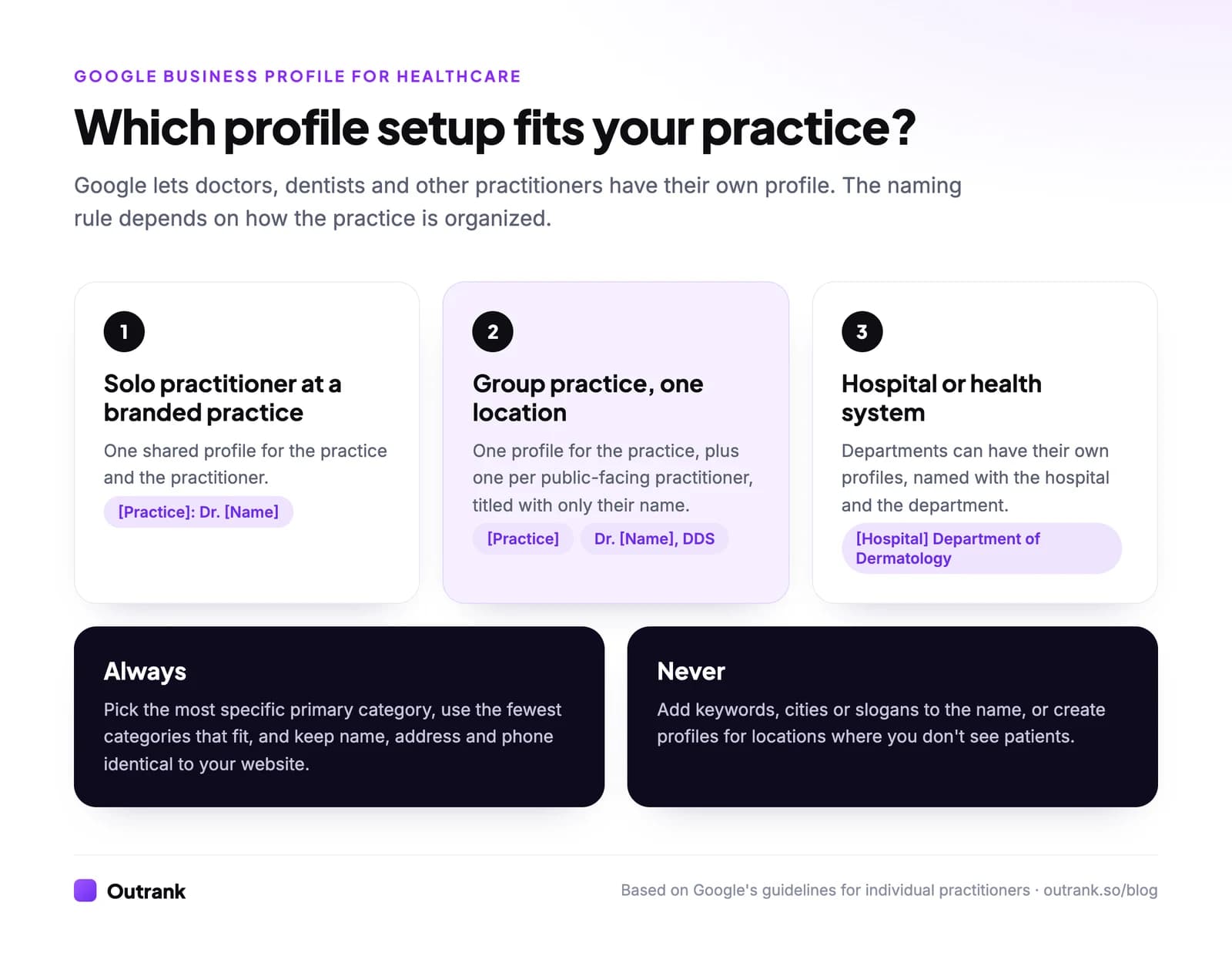
- Solo practitioner at a branded practice: create one shared profile, named in the format "[Practice name]: [Practitioner name]".
- Group practice at one location: the practice gets its own profile, and each public-facing practitioner can have a separate profile whose title includes only the practitioner's name (titles such as "Dr." or "MD" are allowed), not the practice name.
- Hospitals and health systems: departments can have their own profiles, named with the hospital and department.
- Categories: Google asks you to choose the fewest categories that describe your core business. Pick the most specific primary category (for example, a pediatric dentist rather than a general dentist) and add only what's true.
Never add keywords or cities to your business name (for example, "[Practice name] | Best Dentist Downtown"). It breaks Google's guidelines and can get the profile suspended.
Fill every field patients use to decide: hours, holiday hours, phone, appointment link, services, accepted insurance where the profile offers it, accessibility details and photos. Then post an update when something changes (new provider, new service, flu shots in stock).
Directories that matter in healthcare
Beyond Google, patients look up doctors on healthcare directories, and those listings often rank on page one for your own name. Claim and correct your profiles on Healthgrades, Zocdoc, Vitals and WebMD Care, plus the provider directories of every insurer you accept. Keep the name, address and phone number identical to your website and Google profile, and update all of them the same day when anything changes.
Weeks 3–6: Service and location pages that rank
Most practice websites have one "Services" page listing everything. It can't rank for any single treatment. Give every service, treatment and location its own page.
A service page template that works:
- 1
H1: [Treatment] in [City]
For example: Physical therapy for back pain in Denver. One page per treatment, written for the patient deciding whether to book. - 2
What it is and who it's for
A plain-language explanation in the first paragraph, then the conditions it treats and who is a good candidate. - 3
What to expect
Before, during and after the appointment, how many sessions, recovery time, and when results usually show. - 4
Cost and insurance
Price ranges or self-pay prices if you can publish them, and which insurers you accept. Patients search for this and few practices answer it. - 5
Who provides it
The clinicians who perform it, linked to their bio pages with credentials. - 6
Questions and next step
The questions your front desk hears most, answered in two or three sentences each, then a clear booking button and phone number.
Location pages need what a patient needs to arrive: the address, a map, parking and public transport, hours, which doctors work there and which services are offered at that site. Add MedicalClinic, Dentist or Physician structured data with the same name, address and phone as the Google profile. If you serve nearby towns without an office there, mention them on the relevant pages rather than creating a near-identical page per town; pages that only swap the city name rarely rank and can count as doorway pages.
From week 4: Reviews without breaking HIPAA
A review program has two parts: asking every patient, and replying safely.
Asking for reviews
Send every patient the same request after their visit, by text or email, with a direct link to your Google review form. Ask everyone, not only the patients you expect to be happy: the US Federal Trade Commission's rule on fake reviews, in force since October 21, 2024, bans fake reviews, incentives tied to a positive (or negative) review, and suppressing negative ones. Don't offer discounts or gifts in exchange for reviews, and don't let staff review the practice.
Use the calculator to see how quickly a steady request routine builds the review count patients look for:
Interactive calculator
How long until you reach your review target?
Months to reach your target
3
- New reviews per month
- 16
- Reviews in any 3-month window
- 48
Replying without disclosing patient information
Replying to reviews is good practice, and it's where practices get fined. The HHS Office for Civil Rights has penalized providers for review replies that confirmed someone was a patient or discussed their care:
| Practice | What happened | Penalty | Announced |
|---|---|---|---|
| Elite Dental Associates, Dallas | Disclosed patient information in replies to Yelp reviews | $10,000 settlement | October 2019 |
| Dr. U. Phillip Igbinadolor, DMD & Associates, North Carolina | Disclosed patient information responding to an online review | $50,000 civil money penalty | March 2022 |
| New Vision Dental, California | Disclosed patient information in review replies | $23,000 settlement | December 2022 |
| Manasa Health Center, New Jersey | Disclosed patient information responding to a negative review | $30,000 settlement | June 2023 |
The rule that keeps you safe: never confirm or deny that the reviewer is a patient, and never mention a visit, a treatment, a date or anything from their record, even if they mentioned it first. Reply about your practice's policies, not about the person. Templates your privacy officer can adapt:
- Positive review: "Thank you for taking the time to share this. Our team works hard to make every visit easy, and we're glad to hear it."
- Negative review: "We're sorry to read this. We take every concern seriously, but privacy rules prevent us from discussing anyone's care online. Please call our practice manager at [phone] so we can talk directly."
- Review that names a treatment or diagnosis: use the negative-review template. Don't repeat or reference any medical detail.
Have every reply follow an approved template, and route anything unusual to your privacy officer before posting. (This is general information, not legal advice.)
Weeks 6–12: Patient education and local links
Your service pages capture people ready to book. Patient-education articles reach people one step earlier, and they're how a practice site grows beyond its own name in search.
What to write. For two weeks, have the front desk and clinicians log the questions patients ask. Each recurring question is an article: "how long does a root canal take to heal", "can I exercise after a cortisone shot", "what to bring to your first physical therapy appointment". Planning content around questions rather than keywords also helps you show up in AI answers, and these long, specific searches are the easiest to win (see long-tail keyword research). Answer in the first paragraph, link to the matching service page, and have a clinician review it with their name and the review date on the page. Two to four articles a month, every month, beats twenty in a burst.
Where local links come from. Practices have link sources most businesses don't:
- Hospital affiliation and referral-partner pages
- State and specialty medical society directories
- University and residency program pages for faculty and alumni
- Local news health columns and expert quotes (offer your clinicians as sources)
- Sponsorships and community health events: school sports physicals, health fairs, charity runs
- The local chamber of commerce and business associations
Each one is relevant and local, which is exactly what helps a practice rank in its area. Our guide on how to build backlinks covers outreach in more depth.
How to track results without touching patient data
You can measure local SEO without placing a single tracking pixel near patient data:
- Google Business Profile performance: calls, direction requests, website clicks and bookings per location, built into the profile.
- Google Search Console: clicks and impressions for your service, location and article pages. It needs no tracking code on your site.
- Booking and call counts: totals from your scheduling system or call-tracking vendor. If a vendor handles patient information, make sure it signs a business associate agreement.
Keep Google Analytics and ad pixels off patient portals and booking steps that collect health details; our healthcare SEO guide explains the HHS guidance and Google's position on Analytics.
What results to expect
Local profile changes can show within weeks; content and links compound over months. Across the 2,119 sites in our AI SEO agent study, median Google clicks were up 27% after about three months and doubled by month seven, and health sites outperformed the average:
Share of sites that grew Google clicks after starting with Outrank
Sports & fitness
25 sites · 1,071 → 3,106
88%
Health & wellness
95 sites · 490 → 1,447
81%
All niches
1,383 sites · 297 → 814
75%
Legal & compliance
50 sites · 737 → 1,575
72%
SaaS & tech
183 sites · 265 → 765
70%
These are Outrank customers, not a controlled experiment, and roughly one in five health sites didn't grow. The pattern behind the growth is the one in weeks 6–12: helpful pages published every week. Outrank handles that part for practices: it finds the questions patients search, writes the articles and publishes them to your site, and can save each one as a draft so a clinician signs off before it goes live.
FAQ
How do medical practices get more patients from Google?
Complete a Google Business Profile for each location with the right category, hours, photos and appointment link, and build a steady flow of recent reviews. Then give every service and location its own page, publish patient-education articles that answer common questions, and earn links from local and medical organizations.
Can doctors have their own Google Business Profile?
Yes. Google treats doctors, dentists and other practitioners as individual practitioners who can have their own profile. In a group practice, the practice has one profile and each public-facing practitioner can have a profile titled with only their name. A solo practitioner at a branded practice should share one profile named "[Practice name]: [Practitioner name]".
How should a medical practice respond to online reviews under HIPAA?
Reply in general terms without confirming or denying that the reviewer is a patient, and never mention their visit, treatment or any detail from their record, even if they shared it. Invite them to call the practice to discuss it privately. HHS has penalized practices between $10,000 and $50,000 for review replies that disclosed patient information.
Is it legal to ask patients for reviews?
Yes, asking patients for honest reviews is legal and common. What's prohibited under the FTC's rule on fake reviews (effective October 21, 2024) is buying or faking reviews, offering incentives conditioned on a positive or negative review, and suppressing negative ones. Ask every patient the same way, without rewards.
How many reviews does a medical practice need?
There's no fixed number, but BrightLocal's 2026 survey found 47% of consumers won't use a business with fewer than 20 reviews and 68% want a rating of 4 stars or higher. Recency matters too: 74% only care about reviews from the last three months, so aim for new reviews every month rather than a large total.
Which directories should a medical practice be listed on?
Start with Google Business Profile, Apple Business Connect and Bing Places, then claim your profiles on Healthgrades, Zocdoc, Vitals and WebMD Care and the provider directories of every insurer you accept. Keep the name, address and phone number identical everywhere.
How long does local SEO take for a clinic?
Profile and listing fixes can improve map visibility within weeks. Rankings for service pages and articles usually take three to six months or longer, depending on competition. In our data, the median site's Google clicks were up 27% after about three months and doubled by month seven.