


Content automation is the use of software (templates, rules and AI models) to create, format, publish and distribute content with little or no manual work per piece. The Associated Press has used it since 2014 to write thousands of earnings stories a quarter, Shopify stores use it to draft product descriptions, and AI SEO agents use it to research, write and publish a blog article every day.
Below you'll find the four types of content automation, a five-level model to place your own team, real examples, and what a fully automated pipeline produces, using data from the 200,871 articles Outrank generated in the last 90 days.
Key takeaways
- Content automation covers four different things. Data-to-text templates, generative AI drafting, workflow automation and personalization.
- It is old news in journalism. By 2015 AP was automatically writing more than 3,000 earnings stories per quarter, ten times what its reporters had produced.
- Most marketing teams are at the "assisted" level. In Semrush's 2026 survey, 64% of SEO and content professionals use a human-led, AI-assisted workflow.
- A fully automated SEO pipeline mostly writes long-tail explainers. 54% of Outrank's last 200,871 articles were explainers and the median target keyword had 170 searches a month.
- Automation is a multiplier, not a strategy. Google's spam policies target pages generated at scale without adding value, whoever or whatever wrote them.
Content automation, defined
Content automation is a system in which software performs one or more steps of content production (research, writing, formatting, publishing, distribution or personalization) according to rules you set, so the work happens without a person starting each piece.
Two things it is not:
- It is not just scheduling. Queuing a post in Buffer automates one click. Content automation usually means the software also produces or transforms the content.
- It is not the same as marketing automation. Marketing automation decides who gets which email and when, through tools like HubSpot or ActiveCampaign. Content automation produces what those emails, pages and posts contain. Our guide on how to automate content marketing covers how the two work together in practice.
The four types of content automation
Every content automation system falls into one of these types, or chains several together.
| Type | How it works | Real example | Best for |
|---|---|---|---|
| Data-to-text templates | Structured data fills a written template with rules for wording | AP's earnings stories, built with Automated Insights and Zacks Investment Research | Reports, sports recaps, listings, anything with clean data |
| Generative AI drafting | A language model writes from a prompt, a brief or source material | Shopify's Sidekick drafting product descriptions and blog posts in the admin | Articles, product copy, social posts, emails |
| Workflow automation | Triggers move content between tools and publish it | "New blog post" in WordPress creates social drafts in Buffer via Zapier | Publishing, distribution, approvals, reporting |
| Personalization | Rules or models swap content blocks for each visitor or segment | Smart content on HubSpot pages (Content Hub Professional) that shows different text to different visitor segments | Websites, email, onboarding |
Data-to-text is the oldest and the most reliable: the facts come from the data, so the output cannot invent a number that isn't in the feed. Generative AI is the most flexible and the riskiest, because, as Google's own guidance puts it, generative models predict a likely sequence of words rather than retrieve facts. That's why review steps matter more for type 2 than for type 1.
The 5 levels of content automation
A useful way to place your team is to ask which stages software runs without a person starting them.
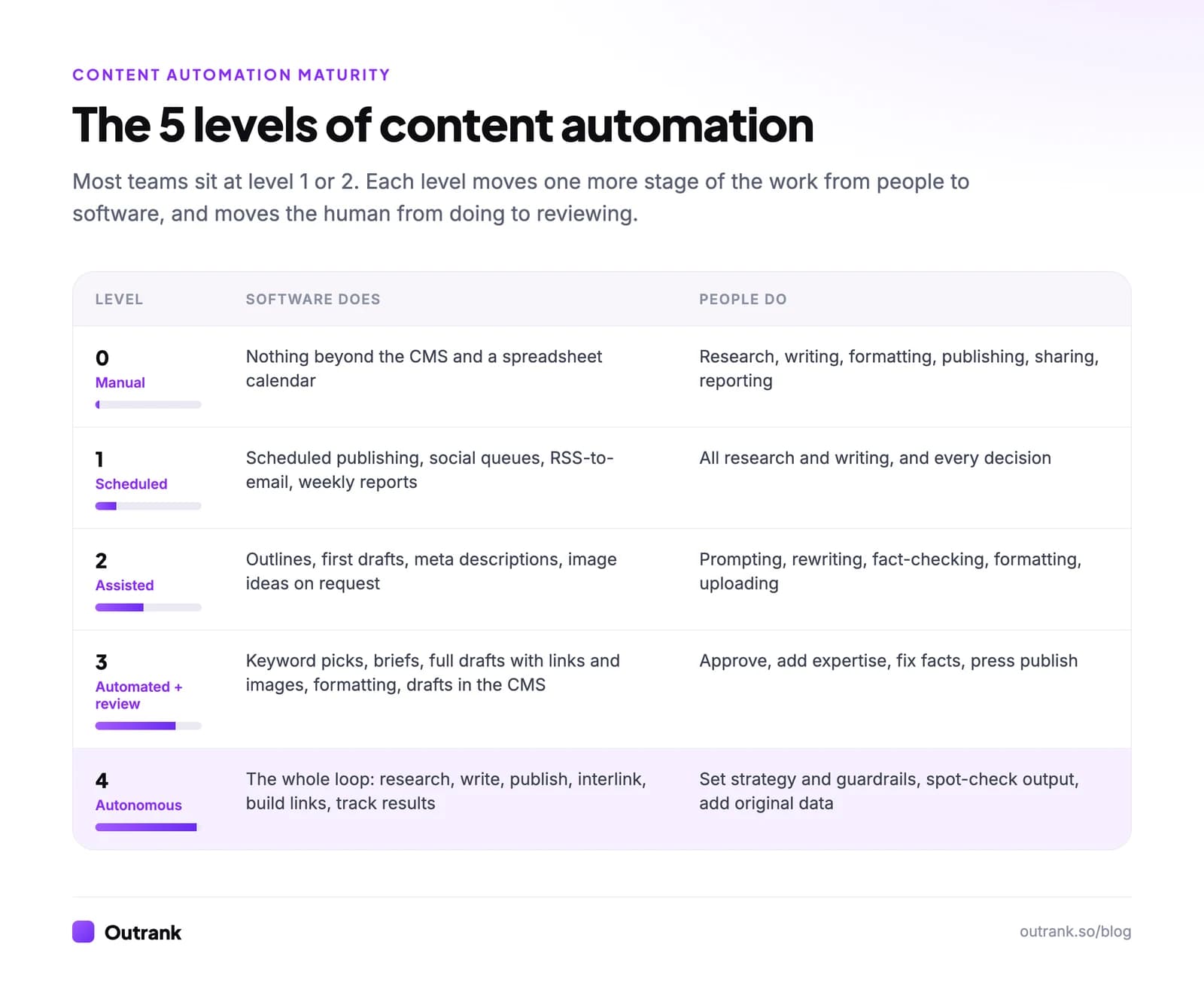
- Level 0, manual. People research, write, format, publish, share and report. Software is the CMS and a spreadsheet.
- Level 1, scheduled. Publishing, social queues, RSS-to-email and reports run on schedules. All writing is still human.
- Level 2, assisted. AI produces outlines and drafts on request. People prompt, rewrite, fact-check and upload. This is where most teams are: 64% of SEO and content professionals describe their workflow as human-led and AI-assisted (Semrush, 2026).
- Level 3, automated with review. The system picks keywords, writes full articles with links and images, and places them in the CMS as drafts. People approve, add expertise and publish.
- Level 4, autonomous. The full loop runs on its own: research, writing, publishing, internal linking, link building and tracking. People set strategy and guardrails and spot-check.
Moving up a level saves time only if the level below works. Automating drafts while publishing is still a manual copy-paste into WordPress just moves the bottleneck.
What a fully automated content pipeline produces: Outrank's data
Most articles about content automation describe it in the abstract. Here is what one running system actually produced. Outrank is a level 4 system for SEO content: it picks keywords, writes articles, publishes them to the customer's CMS and builds backlinks. These are its numbers for the 90 days to October 19, 2026.
200,871
SEO articles generated in 90 days
For 4,348 websites
37
languages
88.6% English, then German, Spanish, French, Danish
~21,000
characters in the median article
Roughly 3,000 to 3,500 words
99.99%
articles shipped with a featured image
200,846 of 200,871
Volume has held steady at about 70,000 to 75,000 articles a month since April 2026:
Articles written by Outrank each month
Hover or tap the chart for exact values.
Three things the data shows about automation done well:
- It goes after the long tail. The median targeted keyword has 170 monthly searches and a keyword difficulty of 14; 97% of articles target keywords under 1,000 searches a month and 63% target difficulty under 20. Automation makes the long tail economical: a human team rarely justifies four hours on a 170-search keyword, a pipeline can cover hundreds of them (here is how to find long-tail keywords worth targeting).
- It favors explainers and how-tos. 54% of articles were explainer guides, 27% how-to guides, 7% roundups and 4% comparisons. Those are the formats with stable search intent that a template can serve well.
- It publishes where the site already lives. In the same 90 days, 1,195 sites published to WordPress, 1,009 through a webhook or headless setup, 342 to Shopify, 269 to a Next.js blog, 111 to Webflow and 100 to Wix. Automation that requires a new CMS rarely survives.
Does it work? In Outrank's study of 2,119 sites, the median site reached 2.0× its previous Google clicks about seven months after joining, 75.4% of sites gained clicks and 24.4% lost them. Sites that published automatically grew more often than sites that didn't (76.8% vs 62.5%). The results page publishes the full curve and raw data.
Real examples of content automation
- Financial news. In a 2015 update, the Associated Press said that, working with Automated Insights and Zacks Investment Research, it was generating more than 3,000 stories about US corporate earnings each quarter, a tenfold increase over what its reporters had produced. Staff were freed from data-processing work, not replaced.
- Local news. AP's AI program lists newsrooms that automate the writing of public safety incidents into their CMS and the transcription and summarizing of recorded video into an article's first framework.
- E-commerce. Shopify's Sidekick generates product descriptions and blog posts from inside the admin, which matters for a store with thousands of SKUs and no copywriter.
- SEO blogging. Life Purpose App, run by a solo founder, published 450 automated articles through a webhook and grew from 513 to 2,309 monthly Google clicks between May 2025 and May 2026, with impressions up 24.7×.
- Distribution. A common no-code setup: a new WordPress post triggers Zapier, which asks ChatGPT for social copy and drops drafts into Buffer for approval. Our content repurposing strategies show more of these chains.
Benefits and risks
| Area | What you gain | What can go wrong |
|---|---|---|
| Speed and volume | Content ships daily instead of when someone has time | Volume without value can trip Google's scaled content abuse policy |
| Consistency | Every page gets a title tag, meta description, FAQ, image and internal links | Every page can also share the same blind spots and phrasing |
| Coverage | Hundreds of long-tail queries a human team would skip | Thin pages on topics nobody searches waste crawl budget |
| Cost | Far lower cost per article | Factual errors scale too if nobody checks sensitive topics |
The risk column is why trust is still low. In Ahrefs' 2026 survey, only 2.7% of marketers trusted AI-generated content with no human review, and 66% trusted it after a human reviewed it. Pick your level based on how much a mistake would cost you: a garden blog can run at level 4, a medical clinic should stay at level 3.
How to start
- Write down your workflow and mark each stage manual, scheduled or automated.
- Automate the stage with the most repetitive hours and the lowest risk first, which is usually publishing and distribution.
- Add AI drafting next, with a named reviewer.
- Move to automated research and publishing once drafts consistently need only light edits.
The step-by-step version, with workflows to copy and an hours-saved calculator, is in our guide on how to automate content marketing. To see where automation fits in the whole production process, read our content creation workflow template, and for tools by job, our SEO automation tools roundup.
FAQ
What is content automation?
Content automation is the use of software, templates and AI to create, format, publish and distribute content with little manual work per piece. It ranges from scheduled publishing to fully automated systems that research, write and publish articles on their own. People still set the strategy and review what matters.
What are examples of content automation?
The Associated Press automatically writes thousands of corporate earnings stories each quarter from financial data. Shopify's Sidekick drafts product descriptions inside the store admin. AI SEO tools like Outrank research keywords, write articles and publish them to a CMS every day, and Zapier workflows turn new blog posts into social media drafts.
What is automated content creation?
Automated content creation is the production step of content automation: software writes the text, images or video instead of a person. It uses either data-to-text templates, which turn structured data into sentences, or generative AI models, which write from a prompt or brief.
Is automated content good for SEO?
It can be. Google judges content on quality and usefulness, not on how it was produced, but generating many pages without adding value may violate its scaled content abuse policy. Automated articles that target real searches, answer them accurately and get reviewed on sensitive topics can rank well.
What tools are used for content automation?
Common tools are AI writers (ChatGPT, Claude, Jasper), AI SEO platforms that also publish (Outrank), workflow tools (Zapier, Make, n8n), social schedulers (Buffer, Hootsuite), and marketing platforms with personalization (HubSpot). Most teams combine one production tool with one workflow tool.