A content creation workflow is the fixed sequence of stages every piece of content goes through, from topic to published and measured, with one owner and a clear "done when" for each stage. For a blog article that sequence has nine stages: topic, brief, draft, edit, SEO check, visuals, publish, distribute and measure. Done by hand, budget about eight hours per article; drafting alone averages 3 hours 20 minutes, according to Orbit Media's 2026 survey of 1,042 content marketers.
This page gives you the template: each stage with its owner, inputs, finish line and time budget, the statuses to set up in Trello, Asana, Notion or ClickUp, versions for a solo creator, a small team and an agency, and a checklist to run on every article.
Key takeaways
- A workflow is not a calendar. The calendar says when content ships; the workflow says how every piece gets from idea to published.
- Give each stage exactly one owner and a written "done when". Most delays happen in handoffs nobody owns.
- Budget about 8 hours per article done by hand. Drafting is the biggest block at about 3 hours 20 minutes (Orbit Media, 2026).
- Measure at 4 and 12 weeks, not day 2. A typical editorial article reaches its peak traffic a median of four months after publication (Fractl).
- Software can now run most stages. Outrank automates topic, brief, draft, SEO checks, images and publishing, leaving people to review and add expertise.
What is a content creation workflow?
A content creation workflow is a repeatable process that defines the stages, owners, deadlines and approval points a piece of content passes through before and after it is published. It answers three questions for every piece: what happens next, who does it, and how do we know it is finished.
Three terms people mix up:
- Content strategy decides what to publish and why. Our guide to building a content strategy covers it.
- Editorial calendar decides when each piece ships. See how to create an editorial calendar.
- Workflow decides how each piece moves from idea to live page. That is this page.
The 9-stage content creation workflow
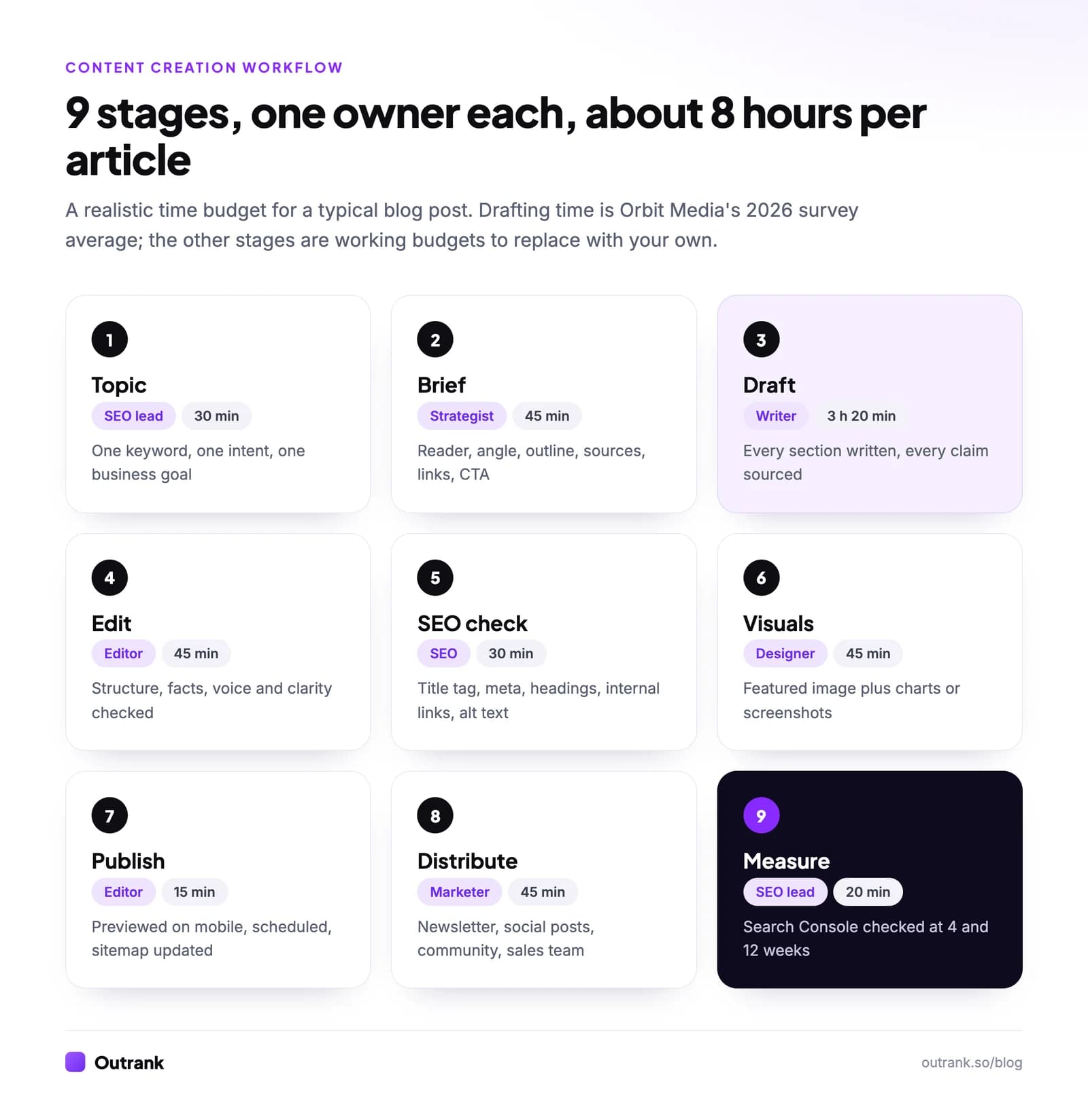
| Stage | Owner | Input | Done when | Time budget | Tools |
|---|---|---|---|---|---|
| 1. Topic | SEO or content lead | Keyword research, customer questions | One primary keyword, search intent and business goal are written down | 30 min | Search Console, Semrush, Ahrefs, free keyword tool |
| 2. Brief | Strategist | Topic, top 10 results | Reader, angle, H2 outline, sources, internal links and CTA are agreed | 45 min | Google Docs, Frase, brief template |
| 3. Draft | Writer | Brief | Every section is written and every claim has a source | 3 h 20 min | Google Docs, ChatGPT or Claude for outlines |
| 4. Edit | Editor | Draft | Structure, facts, voice and clarity pass review | 45 min | Grammarly, Hemingway, suggestion mode |
| 5. SEO check | SEO | Edited draft | Title tag, meta description, headings, internal links and alt text are set | 30 min | Rank Math, Yoast, Surfer, Clearscope |
| 6. Visuals | Designer | Final draft | Featured image plus any chart or screenshot are in place | 45 min | Canva, Figma, screenshots |
| 7. Publish | Editor | Approved page | Previewed on mobile, scheduled, live URL logged | 15 min | WordPress, Webflow, Shopify |
| 8. Distribute | Marketer | Live URL | Newsletter, social posts, communities and sales team have it | 45 min | Buffer, Hootsuite, email tool |
| 9. Measure | SEO or content lead | 4 and 12 weeks of data | Clicks, impressions and top queries are logged, next action decided | 20 min | Search Console, GA4 |
The time budgets are working estimates; replace them with your own after you've timed five articles. The total, around eight hours, is why most teams publish less than they plan to.
What each stage needs to get right
1. Topic: one keyword, one intent, one goal
Write three lines before anyone starts: the primary keyword, what the searcher wants (learn, compare, buy, fix), and what the article should do for the business (signups, demo requests, links). If you can't write the third line, the article probably shouldn't exist. Search Console's Performance report is the cheapest source of topics: queries where you sit on page 2 are articles waiting to be written.
2. Brief: decide the angle before the writing starts
A brief prevents the most expensive rewrite, which is the one after the draft is finished. Include: the target reader, the angle (what this page says that the top 10 results don't), an H2 outline built from the questions people search, required sources, 3 to 5 internal links, and the call to action. Our content brief examples show eight formats.
3. Draft: write to the brief, source as you go
Writers should add the source link next to every number while drafting, not in edit. It halves the fact-checking time and stops unsourced claims from slipping through.
4. Edit: two passes, not one
First pass for structure and accuracy (does it answer the query in the first paragraph, is every claim right), second pass for line editing (clarity, voice, length). Mixing them means you polish sentences you later delete.
5. SEO check: the 10-minute on-page list
Title tag under 60 characters with the keyword first, meta description of 120 to 155 characters, one H1, logical H2s, descriptive image alt text, links to 3 to 5 related pages and from at least one older page to the new one. The SEO copywriting checklist has the full list.
6. Visuals: explain, don't decorate
One featured image plus anything that explains faster than text: a chart of real data, an annotated screenshot, a process diagram. Stock photos of people pointing at laptops add page weight and nothing else.
7. Publish: preview, schedule, log
Preview on a phone, check the URL slug, schedule, then log the live URL in your tracker. If the page matters, request indexing in Search Console with the URL Inspection tool.
8. Distribute: plan it in the brief
Decide the channels at brief stage so the writer can produce quotable lines and the designer can make social versions at the same time. Our content distribution strategy and content repurposing strategies cover what to make from one article.
9. Measure: check at 4 and 12 weeks, then refresh
New pages take months to settle. Fractl's content decay research found a typical editorial article peaks a median of four months after publication. Check Search Console at 4 weeks (is it indexed, what queries does it show for) and 12 weeks (is it moving, does the title need rewriting), then put underperformers into your content audit for a refresh.
Set it up in your project tool
Every project tool works (Trello, Asana, Notion, ClickUp, Airtable, Monday). What matters is that the board mirrors the workflow. Use these statuses as columns:
Backlog → Briefed → Drafting → In edit → SEO check → Ready → Scheduled → Published → Refresh due
And these fields on every card: primary keyword, owner of the current stage, due date for the current stage, brief link, draft link, live URL, publish date.
Two rules keep the board honest. First, a card can only move forward when the "done when" of its stage is met. Second, cap how many cards sit in In edit at once (three per editor is a sensible start). A pile-up there is the most common reason content ships late.
Workflow examples by team size
| Team | Who does what | How to run it |
|---|---|---|
| Solo creator or founder | You own every stage | Batch by stage: brief four articles on Monday, draft on Tuesday and Wednesday, edit and publish on Thursday. Switching roles per article wastes the most time. |
| Small team (2 to 4 people) | Lead owns topic, brief and measure; writer drafts; one person edits and publishes | Weekly 30-minute pipeline review of the board. Freelancers fit at stage 3 only, with a brief. |
| Agency or multi-site team | Strategist per client, shared writer and editor pool, SEO specialist for stages 5 and 9 | Client approval as a named step between 4 and 5, with a 48-hour default so it doesn't stall. Standard briefs per client. |
Where AI and automation fit in the workflow
AI is already part of most workflows: 64% of SEO and content professionals use a human-led, AI-assisted process (Semrush, 2026). The question is which stages to hand over.
- Good fits: keyword research and clustering (stage 1), brief outlines from the ranking pages (2), first drafts of explainers and how-tos (3), meta tags and alt text (5), images (6), publishing (7) and social drafts (8).
- Keep human: the angle and original insight in the brief, expertise and examples in the draft, fact-checking, and the decision about what to change after measuring.
Trust follows the same line. In Ahrefs' 2026 survey, only 2.7% of marketers trusted AI-generated content without human review.
Fully automated, the workflow looks different. Outrank runs stages 1 to 7 on its own: it picks a keyword your site can win, builds the outline from the pages that rank, writes the article (the median is about 21,000 characters, roughly 3,000 to 3,500 words), adds internal links, an FAQ and a featured image (99.99% of the 200,871 articles it wrote in the last 90 days shipped with one), then publishes to your CMS or holds the article as a draft for review. Your team keeps the editing, expertise and measuring. Outrank's results data shows why volume matters: sites publishing 30 or more articles a month reached a median 2.27× their starting Google clicks, against 1.07× for sites publishing under five. For the step-by-step setup, see how to automate content marketing.
Per-article workflow checklist
Tick the items as each article moves through the stages. Your progress is saved in this browser.
Interactive checklist
Content creation workflow checklist
0/17
Plan
0/3Create
0/4Optimize and publish
0/6Distribute and measure
0/4Your progress is saved in this browser, so you can come back to it later.
Common bottlenecks and how to fix them
| Symptom | Usual cause | Fix |
|---|---|---|
| Drafts get rewritten from scratch | No brief, or the brief skipped the angle | Make "brief approved" a required status before drafting |
| Articles sit in review for weeks | Too many reviewers, no deadline | One approver per article, 48-hour default |
| Publishing day is chaos | Formatting and images done at the end | Move visuals to stage 6 and publish from a template |
| Nobody knows if content works | Measurement isn't a stage | Add 4- and 12-week checks as cards with owners |
| Output drops when one person is away | Stages live in one head | Document each stage's "done when" in the card template |
FAQ
What is a content creation workflow?
A content creation workflow is the repeatable sequence of stages a piece of content goes through, such as topic, brief, draft, edit, SEO check, visuals, publish, distribute and measure. Each stage has an owner, an input and a clear finish line, so content moves forward without meetings to ask what happens next.
What are the stages of a content creation workflow?
For a blog article, the usual stages are topic selection, brief, draft, edit, SEO and on-page check, visuals, publishing, distribution and measurement. Small teams often merge edit and SEO check, and agencies add a client approval step between editing and publishing.
How long does it take to create a blog post?
Drafting averages 3 hours 20 minutes per post according to Orbit Media's 2026 survey. Adding research, briefing, editing, on-page SEO, images, publishing and promotion, a realistic total is around 8 hours per article when every stage is done by hand. Automation tools can cut most of the non-writing time.
What tools help manage a content workflow?
Project tools like Trello, Asana, Notion, ClickUp or Airtable hold the board and statuses. Google Docs handles drafts and reviews, Rank Math or Yoast covers on-page checks in WordPress, and Search Console measures results. AI SEO tools like Outrank can automate research, writing and publishing.
How do you automate a content creation workflow?
Start with the stages that follow rules: scheduled publishing, social distribution and reporting. Then automate keyword research, outlines and drafts with a human review step before publishing. Tools like Outrank run research, writing and publishing end to end, while people keep the editing and strategy.