

To write a travel blog post people read, give each post one job (an itinerary, a destination guide, a practical how-to or a cost breakdown), collect specific notes while you travel (prices, times, names, what went wrong), open with the answer the reader came for, and organise the rest around the reader's trip rather than your diary. Then edit for specifics: every vague sentence ("the views were amazing") becomes a fact only you could know ("the first bus of the day reaches the summit car park before the cloud rolls in").
This is a writing guide. If you want to study 20 live travel blogs first, see our companion piece on travel blog examples. Here you get the method: the four post types, a field-notes template, an answer-first structure, a worked rewrite and a checklist to run before you publish.
Key takeaways
- One post, one job. Itineraries, destination guides, practical how-tos and cost breakdowns are the four travel posts people search for; personal essays build voice but rarely get found.
- Take notes on the road, not at home. Prices with dates, opening times, transport legs and mistakes are the details that make a post useful and impossible to fake.
- Google's own checklist asks whether content shows first-hand expertise, "for example... visiting a place". Show it with dated prices, your own photos and specific names.
- Free stays and press trips are material connections under FTC guidance. Disclose them at the top of the post.
- In Outrank's study of 2,119 sites, 81% of travel and hospitality sites grew Google clicks, from a median 136 to 932 per 28 days.
The four travel posts worth writing
Most travel writing fails because the post doesn't know what it is for. Pick one job per post:
| Post type | The reader's question | Must include | Example title |
|---|---|---|---|
| Itinerary | "How should I spend X days in Y?" | Day-by-day plan, map, travel times between stops, where to sleep each night | "4 days in Madeira without a car: a bus-based itinerary" |
| Destination guide | "Is Y worth it, and what do I do there?" | When to go, where to stay by budget, top things to do, getting around | "Kotor, Montenegro: where to stay, when to go and what to skip" |
| Practical how-to | "How do I do this specific thing?" | Exact steps, current prices, what can go wrong | "How to get from Tokyo to Mount Fuji's Fifth Station by public bus" |
| Cost breakdown | "How much will this trip cost me?" | Real spending by category, the month you paid it, a cheaper and a pricier version | "What 10 days in Vietnam cost us in March 2026, item by item" |
There is a fifth kind, the personal essay ("What a week alone in Lapland taught me about silence"). Essays build your voice and loyal readers, but people rarely search for them. Write them, just don't expect them to bring new readers on their own. A good mix: three useful posts for every essay.
Step 1: Take field notes while you travel
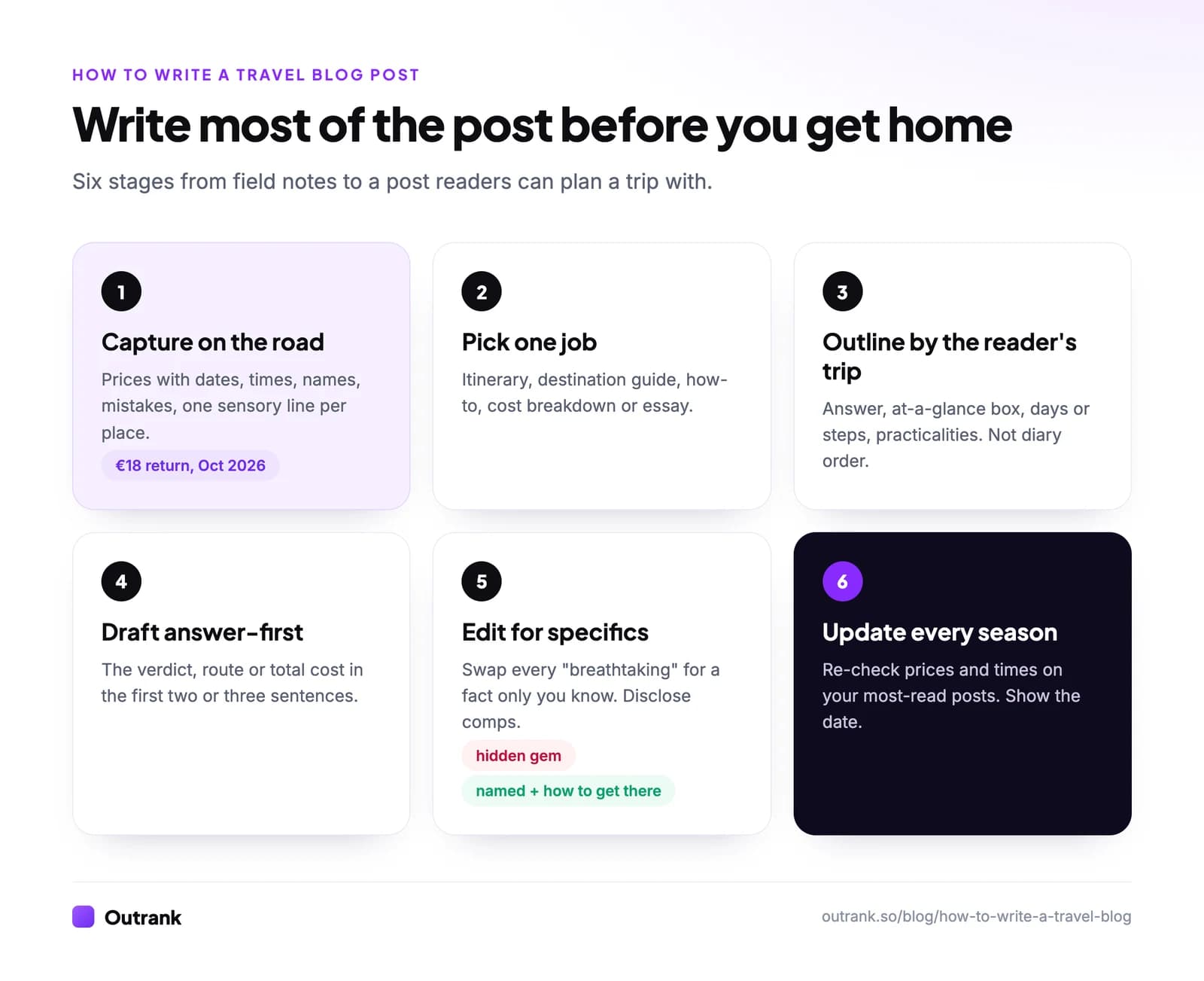
Details fade within days. Keep a note on your phone for each place, and fill in these fields as you go:
| Capture | Example note |
|---|---|
| Prices with the date | "Cable car return €18 (October 2026), cash or card" |
| Times and durations | "Bus 56 every 30 min, 40 min ride, last one back 18:15" |
| Names | The bakery, the guesthouse, the trail, the bus company, the viewpoint |
| What went wrong | "Ticket machine took cards only, no queue at the second entrance" |
| What you'd do differently | "Go at 8:00, by 11:00 the path is a queue" |
| Sensory one-liners | One sound, one smell, one moment, for the opening paragraph |
| Photos with purpose | The entrance, the sign, the queue, the view, the plate, not just the view |
Voice notes on a long bus ride work too. The goal is to come home with the facts that make a post useful, so writing becomes assembly rather than remembering.
Step 2: Choose the question, then outline by the reader's trip
Before writing, finish this sentence: "This post helps someone who is planning to ___." If you can't, the post has no job.
Then outline in the order the reader will use the information, not the order you lived it:
- The answer in two or three sentences (the route, the verdict, the total cost).
- At a glance: a short box with the key facts (days needed, best time to go, rough budget, how to get there).
- The body, organised by day, by area or by step.
- Practicalities: getting there, getting around, where to stay, what to book ahead.
- What you would change and who this trip is not for.
Diary order ("We woke up, had breakfast, then...") is the most common reason travel posts lose readers in the first scroll.
Step 3: Write the opening first, and make it the answer
The first paragraph has one job: tell the reader they are in the right place and give them the core answer. Compare:
Before: "[Island] has always been on my bucket list, and when we finally booked our flights last spring, I couldn't wait to explore this magical place. Little did I know..."
After: "You can see [island]'s highlights in four days without renting a car. Base yourself in [main town], use the public buses for the two big walks on days two and three, and book one guided tour for the remote north. Below is the route day by day, with bus times, costs (checked [month, year]) and the one walk to skip."
Fill the brackets with your own trip. Notice what changed: a verdict, the whole plan in one breath, a date, and a promise of specifics. You can add a personal line after that; just don't make readers wade through it first.
Step 4: Replace every vague sentence with a specific one
This is the edit that turns a generic travel post into one only you could write. The examples are illustrative; use your own numbers:
| Vague | Specific |
|---|---|
| "The views were breathtaking." | "From the top you can see both coasts at once, but only before about 10:00, when the cloud rolls in." |
| "It's quite expensive." | "Dinner for two with wine was €64 at a mid-range place on the harbour (October 2026)." |
| "Getting there is easy." | "Take the airport bus to the centre (€5, 30 minutes), then walk 10 minutes uphill." |
| "Highly recommend!" | "If you only have one morning, do this walk instead of the cable car." |
| "A hidden gem." | Name it, say why few people go, and say how to get there. |
Specifics are also what Google looks for. Its guide to creating helpful content asks whether content clearly demonstrates first-hand expertise, giving visiting a place as an example. Dated prices, named places and your own photos are how a page shows that you were there.
Step 5: Photos, captions and maps
- Use your own photos. They prove you went, and stock images of the same famous viewpoint add nothing.
- Caption with information, not adjectives: "The queue at 11:00; at 8:00 there was nobody."
- Write alt text that describes the scene for readers using screen readers, and name files descriptively (our guide on how to name images for SEO covers both).
- Compress before uploading. Travel posts are image-heavy, and many readers open them on a phone abroad; see how to optimize images for the web.
- Add a map for itineraries and walks, even a simple one with numbered stops.
Step 6: Disclose, date and update
- Disclose comps at the top. The FTC's guidance says a material connection includes a brand giving you free or discounted products or services, and that disclosures hidden on an About page or at the end of a post are likely to be missed (FTC Disclosures 101). A free hotel night or a press trip counts.
- Date your prices ("in October 2026") so readers can judge them.
- Show an updated date and actually update: re-check prices and opening times once a season for your most-read posts. Our content audit template helps you decide which ones to refresh first.
Step 7: Edit with this checklist before you publish
Interactive checklist
Travel blog post checklist
0/14
Purpose
0/3Specifics
0/5Media
0/3Trust and links
0/3Your progress is saved in this browser, so you can come back to it later.
Step 8: Get the post found
Travel is crowded at the top ("things to do in Paris") and wide open in the long tail ("Paris with a toddler in February", "Lisbon to Sintra by train on a Sunday"). Target the long, specific version of each question. Across 200,871 articles Outrank wrote for 4,348 sites in the last 90 days, the median target keyword had 170 monthly searches and a difficulty of 14 out of 100 (Outrank platform data, 90 days to October 2026). Small searches, but a new travel blog can win them, and they add up.
The niche rewards consistent publishing. In Outrank's study of 2,119 sites, 81% of travel and hospitality sites grew their Google clicks after joining, with the median rising from 136 to 932 clicks per 28 days. The study is observational, so take it as a benchmark. If you run a travel business and need more posts than you can write, Outrank can research keywords and publish an SEO article to your blog every day; for a personal travel blog, use it for practical how-tos and keep the trip reports in your own words.
Link every post to its neighbours (the itinerary to the where-to-stay guide, the cost breakdown to both) and read our guide on optimizing blog posts for SEO for the on-page basics. Running a hotel, tour company or rental? Our guide to SEO for travel businesses covers direct bookings.
Not set up yet? You can start a travel blog for free on your own domain with Outrank Blogs (free up to 10,000 visits a month), on Blogger or WordPress.com; how to start a blog for free compares them. Photographing your trips seriously? See blogging for photographers.
FAQ
How do you write a travel blog post?
Pick one job for the post (an itinerary, a destination guide, a how-to or a cost breakdown), take notes on prices, times and names while you travel, open with the answer the reader came for, organise the body around their trip, and edit out vague praise in favour of specifics. Add your own photos, a map and a dated update line.
How do I start a travel blog post?
Start with the answer, not the backstory. In two or three sentences, give the verdict, the route or the total cost, then promise what the post covers. A personal line can follow, but readers decide whether to stay within the first paragraph.
What should a travel blog post include?
A clear answer up front, an at-a-glance box (days, best time to go, budget, how to get there), the main body organised by day, area or step, practical sections on transport and where to stay, dated prices, your own captioned photos, a map where useful, and any disclosure of free stays or tours.
How long should a travel blog post be?
As long as the job requires. A practical how-to can be a few hundred words; a multi-day itinerary with transport, accommodation and costs is naturally much longer. Cut anything that doesn't help the reader plan, such as diary filler and generic history copied from elsewhere.
How do I make my travel writing less boring?
Replace adjectives with facts. "Breathtaking views" tells readers nothing; "you can see both coasts from the top, but only before 10:00" tells them something useful and shows you were there. Short paragraphs, one sensory detail per scene and honest notes on what disappointed you also help.
Do travel bloggers have to disclose free trips?
Yes, in the US and many other countries. The FTC treats free or discounted products and services, including hotel stays and press trips, as a material connection that should be disclosed clearly, next to the content, not only on an About page or at the end of the post.