The best travel blog examples each do one job better than a guidebook. Nomadic Matt owns budget travel: his Southeast Asia guide, updated January 2026, puts a backpacker budget at $50 a day. Earth Trekkers, a family of four, writes day-by-day itineraries with maps, train times and trip costs. Adventurous Kate has written about solo female travel since 2010.
Below are 20 travel blogs that were live on October 19, 2026, in a sortable table, then 11 real travel blog posts broken down by format, the anatomy of a post that ranks, a sample structure you can copy, and a short quiz to pick the model that fits you.
Key takeaways
- Every strong travel blog picks a narrow reader. Budget backpackers, families, solo women, food travelers and points collectors each have their own leading blogs.
- The posts that get found are practical. Day-by-day itineraries, budget guides, "X vs Y" comparisons and packing lists answer what people type into Google.
- Real numbers build trust. Nomadic Matt publishes suggested daily budgets ($50, $100 and $200 a day for Southeast Asia) and Earth Trekkers lists average trip costs.
- First-hand travel is the moat. Earth Trekkers says it plans and pays for all of its own travel, and Nomadic Matt says it doesn't accept sponsored trips.
- Dates matter in travel. The guides above show an "updated" date from 2026, because prices, trains and opening hours change.
What is a travel blog?
A travel blog is a blog that publishes first-hand trip reports, destination guides and travel advice, written by people who made the trips. The good ones work less like diaries and more like a friend who has just been there: specific places, real prices, honest trade-offs.
Four things separate the travel blogs below from the millions of abandoned ones:
- A narrow reader. "Travel" is not a niche. "Solo women who want to travel safely" (Adventurous Kate) or "people with celiac disease who want to eat abroad" (Legal Nomads) is.
- Proof they went. Named places, their own photos, and what went wrong.
- Numbers. Daily budgets, train times, nights per city, entrance costs.
- Search-shaped formats. Itineraries ("two weeks in Spain"), comparisons ("Bali vs Lombok") and packing lists match what travelers search before a trip.
20 travel blog examples to study (checked October 2026)
Every blog below loaded on October 19, 2026. Founders and start dates come from each blog's own About page. Sort by niche or filter by name.
20 travel blog examples, all live October 19, 2026
| What to copy | |||
|---|---|---|---|
| Nomadic Matt | Budget travel | Matt Kepnes, since 2008 | Destination guides with costs, suggested daily budgets and money-saving tips, plus books and courses. |
| Earth Trekkers | Family adventure travel | Tim, Julie, Tyler and Kara | Day-by-day itineraries with maps, transport legs and average trip costs. 74 countries visited. |
| Adventurous Kate | Solo female travel | Kate McCulley, since 2010 | Safety-first advice for women traveling alone, and candid monthly recaps. 102 countries. |
| The Blonde Abroad | Solo and female travel | Kiki (Kiersten) Rich | Strong visual branding, plus women-only group trips sold to readers. |
| Expert Vagabond | Adventure travel and photography | Matthew Karsten, traveling since 2010 | Photography-led adventure posts from more than 70 countries, paired with YouTube videos. |
| Hey Nadine | Video-first travel | Nadine Sykora | A blog built around her travel videos, with posts that expand on each one. |
| The Broke Backpacker | Budget backpacking | Will Hatton (writing since 2013) and a team | Long regional backpacking guides and first-hand 'X vs Y' posts. |
| Be My Travel Muse | Solo female adventure | Kristin Addis, since 2012 | Personal adventure stories that lead into adventure tours and paid trip planning for women. |
| Legal Nomads | Food and gluten-free travel | Jodi Ettenberg, since 2008 | Celiac-safe eating guides and translation cards, a niche almost nobody else served. |
| Migrationology | Food travel | Mark Wiens, since 2009 | Street-food guides paired with YouTube food videos. |
| Indie Traveller | Independent backpacking | Marek Bron, since 2012 | Candid do-it-yourself guides, with a stated policy of not using AI to write content. |
| Hand Luggage Only | Travel, food and photography | Lloyd and Yaya, since 2014 | Started in a Cambridge college room; strong photography and an audience built across social platforms. |
| Alex in Wanderland | Long-term travel and diving | Alex Baackes, since 2009 | A niche inside a niche: scuba diving destinations, written by a PADI ambassador. |
| Lost With Purpose | Off-the-beaten-track travel | Alex Reynolds, traveling since 2016 | Practical guides to less-visited countries, plus honest writing on responsible tourism. |
| A Dangerous Business | Travel with a job and a home base | Amanda Williams | Itineraries and weekend trip guides for people who are not digital nomads. 60+ countries. |
| Y Travel Blog | Family travel | Caz and Craig Makepeace, online since 2010 | Destination guides and itineraries written by a family that travels together. |
| Solo Traveler | Solo travel | Janice Waugh, since 2009 | Tips, destinations and deals for people who travel alone, at any age. |
| The Points Guy | Points, miles and credit cards | Brian Kelly, since 2010 | Points valuations and card reviews: travel content built around a money question. |
| One Mile at a Time | Airlines and premium travel | Ben Schlappig | Daily posts, airline and first-class cabin reviews, written by the founder himself. |
| Rick Steves' Europe | Europe travel | Rick Steves | A guidebook author's weekly travel column, organized by destination. |
Click a column header to sort.
The budget guide model: Nomadic Matt, The Broke Backpacker, Indie Traveller
Matt Kepnes started Nomadic Matt in 2008 and built it on one promise: travel costs less than you think. His Southeast Asia Budget Travel Guide shows the template. Things to see and do, how to stay safe, where to stay, travel costs, suggested budgets, money-saving tips, how to get around, when to go and booking resources, in that order. The suggested budgets are concrete: $50 a day for backpackers, $100 midrange, $200 upscale.
The Broke Backpacker (founded by Will Hatton, now written by a team) and Indie Traveller (Marek Bron, since 2012) follow the same logic for independent backpackers. Notice how The Broke Backpacker titles its posts in first person: "How I'd Backpack Southeast Asia" and "I've Been to Bali and Lombok - Here's How I'd Choose". The title itself is proof of experience.
Copy this: one costs section with real numbers in every destination guide, and an updated date at the top.
The itinerary model: Earth Trekkers and A Dangerous Business
Earth Trekkers is a family of four (Tim, Julie, Tyler and Kara) who spent 13 months traveling around the world and have now visited 74 countries. Their stated rule: "we write the guides that we wished we had when planning the same trip." Two Weeks in Spain: Madrid, Barcelona, Seville & Granada (By Train) has a 14-day overview, a route map, one section per day, the high-speed train legs with approximate times and booking sites, nights per city, and average trip costs.
A Dangerous Business by Amanda Williams targets a reader most travel blogs ignore: people who keep their job and home base and travel in the time they have, with weekend trip guides and detailed itineraries.
Copy this: the day list at the top. Readers decide in seconds whether the pace suits them.
The solo female travel model: Adventurous Kate, Be My Travel Muse, The Blonde Abroad
Kate McCulley started Adventurous Kate in 2010 "to show women what it's like to travel solo" and has since visited 102 countries. Her posts lead with safety ("Top 10 Travel Safety Tips for Women", "Solo Female Travel in New Orleans: How to Stay Safe and Have Fun!") because that is the first question her readers ask.
Be My Travel Muse (Kristin Addis, since 2012) and The Blonde Abroad (Kiki, who left corporate wealth management in 2011) both turned their audience into trips they lead or organize, a revenue line that only works when readers trust the person behind the page.
Copy this: answer the safety question directly and early, from your own experience.
The video-first model: Hey Nadine and Migrationology
Hey Nadine describes itself as a blog of travel videos and vlogs; Nadine Sykora's footage spans more than 13 years. Migrationology is Mark Wiens' food travel blog, started in 2009, where YouTube food videos and written guides like The Ultimate Bangkok Food Tour! feed each other. If you are deciding between the two formats, read our take on blogging vs vlogging.
Copy this: embed the video in the post, then add what video can't hold: addresses, prices, opening hours.
The niche-inside-a-niche model: Legal Nomads, Alex in Wanderland, The Points Guy
Jodi Ettenberg founded Legal Nomads in 2008 as a break from law. As someone with celiac disease, she created detailed gluten-free translation cards and a gluten-free travel guide that serves a reader no general travel blog serves well. Alex in Wanderland does the same for scuba divers. The Points Guy (Brian Kelly, since 2010) and One Mile at a Time built entire businesses on one money question: how to travel better with points and miles.
Copy this: the smaller and more specific the reader, the easier it is to become their first stop.
11 travel blog post examples by format
A travel blog is the site; these are single posts worth studying, grouped by the format they use.
| Format | Travel blog post example | What to copy |
|---|---|---|
| Budget destination guide | Southeast Asia Budget Travel Guide (Nomadic Matt) | Suggested budgets at three levels: $50, $100 and $200 a day |
| Two-week itinerary | Two Weeks in Spain (By Train) (Earth Trekkers) | Day list, map, train legs, nights per city, trip costs |
| Weekend itinerary | How to Spend Three Days in Savannah (Adventurous Kate) | A short, finishable plan for a city people visit for a long weekend |
| Big tips list | 100 Travel Tips for Paris (Adventurous Kate) | A number in the title that promises depth |
| Safety advice | Top 10 Travel Safety Tips for Women (Adventurous Kate) | Answers the biggest worry of the blog's core reader |
| Comparison | I've Been to Bali and Lombok - Here's How I'd Choose (The Broke Backpacker) | First-person experience stated in the title |
| Regional backpacking guide | How I'd Backpack Southeast Asia (The Broke Backpacker) | One long guide that links out to every country guide |
| Food guide | The Ultimate Bangkok Food Tour! (Migrationology) | Specific dishes and places, backed by video |
| Packing list | My Ultimate Travel Packing List (Everything I Carry) (Migrationology) | The writer's own kit, not a generic list |
| Niche resource hub | Gluten Free Travel: Eat Safely As a Celiac, Anywhere in the World (Legal Nomads) | One page that serves an underserved reader completely |
| Personal recap | AK Monthly Recap: August-September 2026 (Adventurous Kate) | Where she went, what worked, what didn't: the human side readers return for |
Itineraries, comparisons and packing lists rank because they match how people plan. Monthly recaps rarely rank, but they build the loyalty that makes readers subscribe. A healthy travel blog needs both.
Anatomy of a travel blog post that gets found
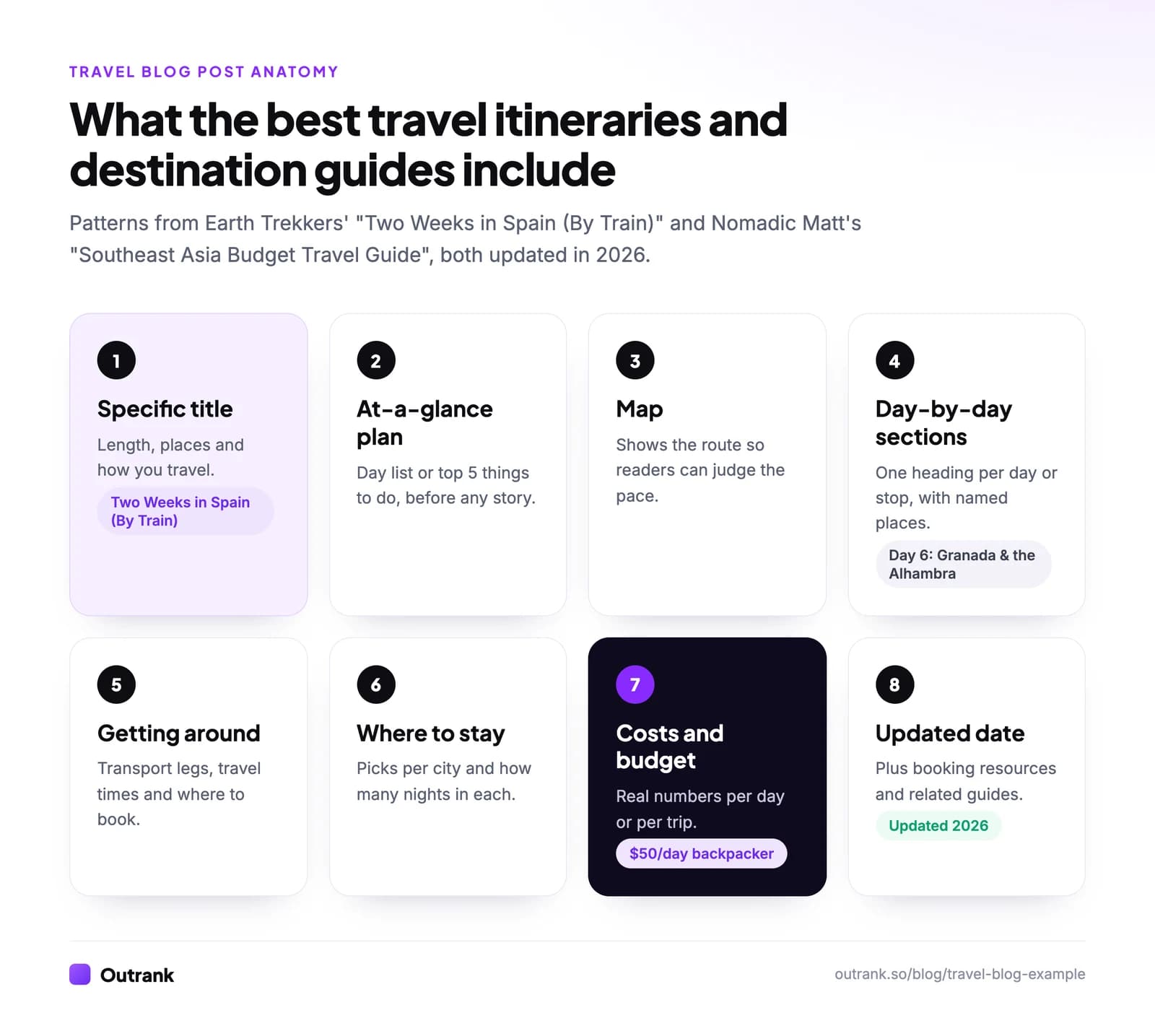
Put the two strongest examples side by side, Earth Trekkers' Spain itinerary and Nomadic Matt's Southeast Asia guide, and the same eight parts show up:
- A specific title: length, places and how you travel ("Two Weeks in Spain: Madrid, Barcelona, Seville & Granada (By Train)").
- An at-a-glance plan before any story: the day list, or the top five things to do.
- A map of the route, so readers can judge the pace.
- Day-by-day or stop-by-stop sections, each with named places ("Day 6: Granada & the Alhambra").
- Getting around: transport legs, travel times and where to book.
- Where to stay: picks per city and how many nights in each.
- Costs: a daily or per-trip budget with real numbers.
- An updated date, booking resources and links to related guides.
If you're writing your first one, our guide on how to write a travel blog walks through each part.
A sample travel blog post structure you can copy
Here is a fill-in structure for the most useful first post a travel blogger can write, a short city itinerary. It follows the anatomy above.
Title: [Number] Days in [City]: A [Budget/Family/Solo] Itinerary ([Season] [Year])
- Two-sentence intro: who this is for and when you went. "I spent three days in [City] in [month] with [who]. This plan suits [type of traveler] who [want X]."
- At a glance: Day 1, Day 2, Day 3, one line each.
- Map of the stops.
- Day 1: morning, afternoon, evening. Name every place and add one practical detail (price, booking tip, best time).
- Day 2 and Day 3, same format.
- Where to stay: one budget pick and one midrange pick, with the neighborhood and why.
- Getting around: from the airport or station, and inside the city.
- What it cost: your real spend per day, broken into lodging, food, transport and activities.
- What I'd do differently: one or two honest notes.
- Updated date and links to your related posts.
Use your own photos, and write the costs down while you travel. That one habit is the difference between a diary entry and a guide someone bookmarks.
Which travel blog model fits you?
Answer three questions to see which of the blogs above to study first.
3-question decision helper
Which travel blog model should you copy?
Question 1 of 3
How do you usually travel?
How the travel blogs above make money
Their own pages show five revenue lines, usually combined:
- Affiliate links and booking resources: Nomadic Matt lists booking resources and credit card recommendations with an advertiser disclosure; The Points Guy reviews credit cards.
- Books and digital products: Nomadic Matt has written How to Travel the World on $75 a Day and Ten Years a Nomad; Earth Trekkers sells eBooks through Etsy; Migrationology sells eBooks and t-shirts.
- Video ads: Migrationology and Hey Nadine earn from YouTube alongside the blog.
- Group trips and tours: The Blonde Abroad promotes an all-female Maldives trip for readers, and Be My Travel Muse offers adventure tours.
- Courses and services: Nomadic Matt sells a blogging course; Be My Travel Muse offers trip planning.
It takes time. In Productive Blogging's 2025 income survey, bloggers took a median of 12 months to earn their first dollar. Our guide on how to make money with a blog covers which methods pay at which traffic level.
How to get a new travel blog found on Google
Big travel blogs have a decade of links behind them. A new blog wins on the long tail: specific searches the big sites haven't covered well, like "2 days in [smaller city] with kids", "[town] by train from [city]" or "is [place] safe for solo female travelers". Our guide to long-tail keyword research shows how to find them, and SEO for travel businesses covers the technical side.
Consistency matters as much as topic choice. In Outrank's study of 2,119 sites, 81% of travel and hospitality sites grew their Google clicks after they started publishing with Outrank, with median clicks per 28 days rising from 136 to 932. The study is observational, so treat it as a pattern, not a promise. Outrank finds low-competition keywords, writes the articles and publishes them to your blog every day; you still bring the first-hand trips that make a travel blog worth reading.
FAQ
What is an example of a travel blog?
Nomadic Matt is a classic example of a travel blog: Matt Kepnes has published budget travel guides there since 2008, each with costs, suggested daily budgets and money-saving tips. Earth Trekkers (family itineraries) and Adventurous Kate (solo female travel) are two other well-known examples.
What are the best travel blogs to follow in 2026?
For budget travel, follow Nomadic Matt and The Broke Backpacker. For detailed itineraries, Earth Trekkers. For solo female travel, Adventurous Kate and Be My Travel Muse. For food, Migrationology and Legal Nomads. For points and premium travel, The Points Guy and One Mile at a Time. All were live and publishing in October 2026.
What should a travel blog post include?
A strong travel blog post includes a specific title, an at-a-glance plan, a map, day-by-day or stop-by-stop sections with named places, how to get around, where to stay, real costs and an updated date. Earth Trekkers' "Two Weeks in Spain (By Train)" includes every one of these.
How do you write a sample travel blog post?
Start with a short itinerary of a trip you have already taken: a title like "3 Days in [City]: A Budget Itinerary", a two-sentence intro, a day list, one section per day with named places and prices, where you stayed, what it cost and what you'd change. Write costs down during the trip so the numbers are real.
Do travel blogs still work in 2026?
Yes, when they are specific and first-hand. Generic "top 10 things to do" lists compete with huge publishers and AI answers, but itineraries, real budgets, comparisons and niche guides still earn search traffic and loyal readers. Most of the blogs above have been publishing for more than a decade.
How do I start a travel blog?
Pick a narrow reader, choose a platform (a free one is fine to start), and publish three practical posts from trips you have already taken before worrying about design. Our guides on how to start a blog for free and how to write a travel blog cover the setup and the writing.