To start an interior design blog, first decide which kind you are building: a designer blog that wins local clients (project case studies, costs, process) or a creator blog that builds an audience (renovations, room reveals, sources, affiliate links). Then set it up on your own domain, publish posts built around your own photos with full source lists, and promote finished rooms on Pinterest and Instagram while Google indexes your archive. Room reveals and "how much does it cost" posts are the two formats that do the most work in this niche.
This guide covers both routes, a room reveal checklist you can reuse for every project, what live interior blogs do in October 2026, and what Outrank's data says about home and garden sites in Google.
Key takeaways
- Pick a route first. A designer blog is judged by inquiries; a creator blog is judged by audience and affiliate income. The posts, metrics and platforms differ.
- Home and garden is one of the busiest niches in Outrank's data, with 17,852 articles published for 338 sites in 90 days.
- In Outrank's study of 2,119 sites, 82% of home and garden sites grew Google clicks after joining, from a median 282 to 1,104 clicks per 28 days.
- A room reveal post should include before photos, matching after angles, paint colours by brand and name, every source, and a budget.
- Use your own photos, or photos you have permission to publish, with credit. Pinned images from other people are not free to repost.
Two kinds of interior design blog
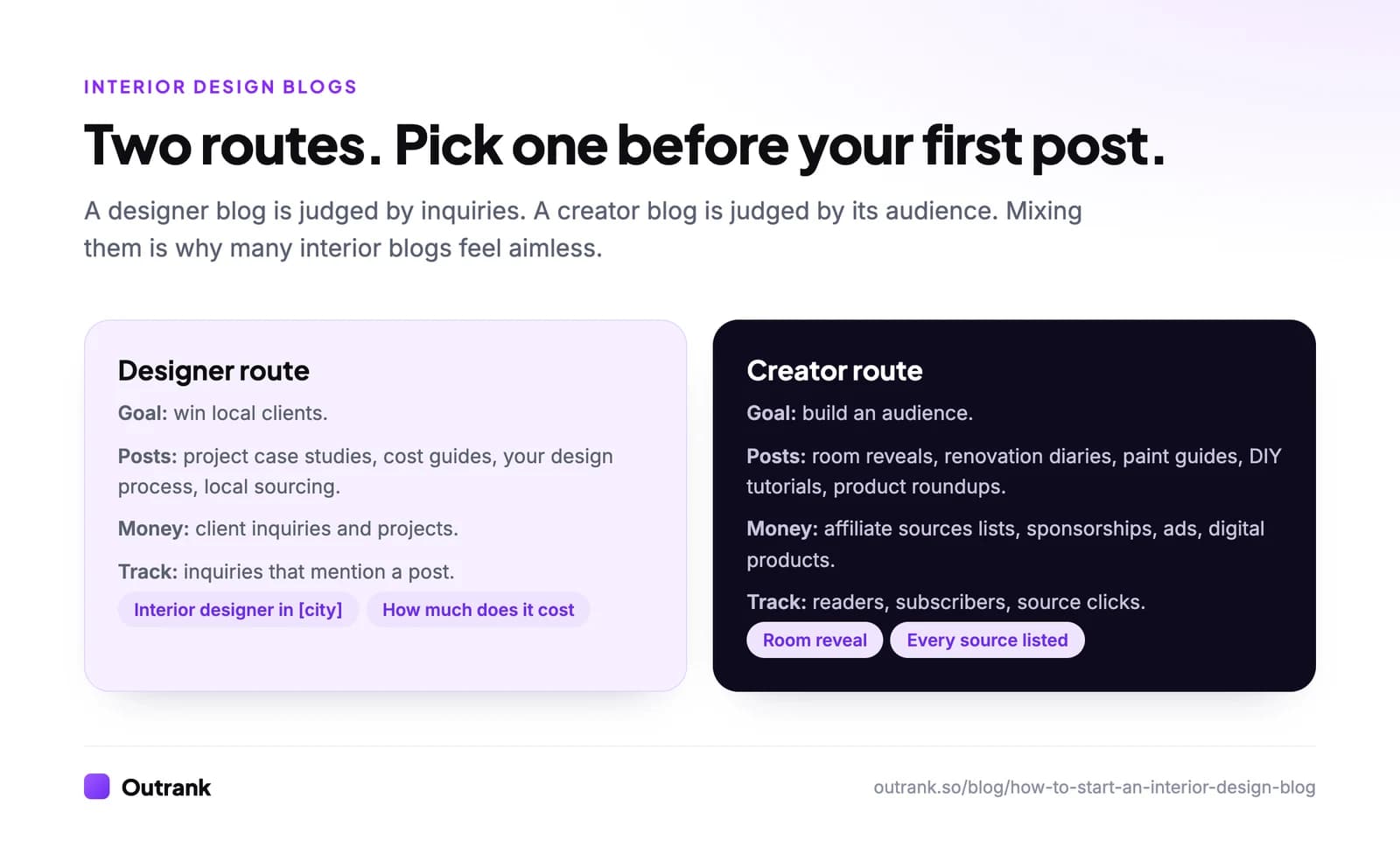
Most advice mixes these two up, which is why so many interior design blogs feel aimless.
The designer route. You run (or are starting) an interior design business, and the blog's job is to bring in clients. Posts show your process and finished projects, answer what clients ask before hiring you, and target local searches ("interior designer in Leeds", "how much does a kitchen redesign cost in Austin"). Success is measured in inquiries, not page views.
The creator route. You are renovating and decorating your own home (or styling for others) and want an audience. Posts are renovation diaries, room reveals, product roundups and DIY tutorials. Income comes from affiliate links, sponsorships and ads. Success is measured in readers, email subscribers and clicks on sources.
You can do both later. Starting with one keeps your first 30 posts coherent.
What live interior design blogs do (October 2026)
| Blog | Route | What to copy |
|---|---|---|
| Young House Love | Creator | Sherry and John Petersik organise the site by house (current house, beach house, duplex) and keep a Before & Afters section. New posts in October 2026 explain the what, why and how of each renovation choice. |
| Room for Tuesday | Creator | Navigation by renovation topic (paint and stain, tile and flooring, lighting, cabinetry), by room, and "Home Tour and Sources" pages for every room in the house. |
| The Design Files | Editorial | "Australia's go-to destination for design inspiration, since 2008": homes, architecture and interiors from other people, edited like a magazine. |
| Design*Sponge | Editorial (closed) | Ran for 15 years; its archives now live at the Library of Congress. A reminder that a good archive outlives the blog. |
The pattern for creators: a sources page per room. Readers want to buy the lamp they just saw, and a clear, disclosed sources list is where affiliate income comes from.
Step 1: Set up the blog on your own domain
Use your name or studio name. For designers, the blog should live on the same domain as your portfolio, ideally at yourstudio.com/blog, so every post strengthens the site clients find you on.
Platform options, with October 2026 details:
- Outrank Blogs (free up to 10,000 visits a month): a blog on your own domain or in a
/blogsubfolder of your existing site at no cost, with five templates, dark mode and SEO files set up for you. It has no built-in shop or booking system, so link out to yours. - Squarespace or Wix: good if you also want booking, a portfolio and a shop in one place (paid plans).
- Self-hosted WordPress: maximum control, with plugins for galleries and affiliate links; you handle updates. Our WordPress blog setup guide walks through it.
- Showit: popular with creative businesses that want drag-and-drop design with a WordPress blog behind it (from $27 a month billed annually with a basic blog).
Whatever you pick, set up an About page with your photo, a contact or inquiry form, and a disclosure page for affiliate links before your first post.
Step 2: Write posts people search for
For designers (winning clients):
| Post | Example title | Why it works |
|---|---|---|
| Project case study | "A 1930s semi in Didsbury: opening up the kitchen for a family of five" | Shows your work and your area to local searchers. |
| Cost guide | "How much an interior designer costs in Manchester in 2026 (our real fees)" | Answers the question every prospect has; pre-qualifies leads. |
| Process | "What happens in our first three design meetings" | Lowers the fear of hiring you. |
| Local sourcing | "Where we source vintage furniture in the North West" | Local, specific, linkable by local businesses. |
For creators (building an audience):
| Post | Example title | Why it works |
|---|---|---|
| Room reveal | "Our guest bedroom reveal: before and after, every source and the budget" | The core format: inspiration plus shopping list. |
| Paint guide | "The 9 greige paints we have used, photographed in north and south light" | Specific comparisons readers search for before buying paint. |
| Product roundup | "Rechargeable wall lights we have actually tested" | Strong affiliate potential, if honest. |
| DIY tutorial | "How we limewashed a brick fireplace (and what we would change)" | Searchable, step by step, shows real experience. |
Both lists work because they are specific. Generic posts ("10 living room ideas") compete with every magazine. Across 200,871 articles Outrank wrote for 4,348 sites in the last 90 days, the median target keyword had a difficulty of 14 out of 100 and 170 monthly searches (Outrank platform data, 90 days to October 2026). Home and garden was one of the busiest categories, with 17,852 articles for 338 sites.
It also tends to work. In Outrank's study of 2,119 sites, 82% of home and garden sites grew their Google clicks after joining, with the median rising from 282 to 1,104 clicks per 28 days. The study is observational, so read it as a benchmark rather than a promise. If you have more projects than time to write them up, Outrank can research keywords and publish an SEO article to your blog every day; add your own project photos and sources to each.
Step 3: Build every room reveal the same way
A reveal post is where interior blogs earn trust, links and income. Use this checklist for each one:
Interactive checklist
Room reveal post checklist
0/16
Photos
0/5Details readers ask for
0/5Disclosure and links
0/3Promotion
0/3Your progress is saved in this browser, so you can come back to it later.
Step 4: Photos, credits and copyright
Interior design is visual, which makes it easy to get wrong:
- Use your own photos of your own projects, or professional photos you have a licence to publish. A photographer's licence for your portfolio may not cover sponsored blog posts or Pinterest; ask.
- Never repost images from Pinterest or other blogs as if they were yours. Pinterest images belong to whoever created them. Link to the source, or ask permission and credit the owner.
- Optimise images for speed: Google says lossy WebP images are 25 to 34% smaller than comparable JPEGs (WebP). Our guide to optimizing images for the web covers sizes and formats, and how to name images for SEO covers file names and alt text.
Step 5: Get found on Pinterest and Google
Pinterest is a search engine for ideas, and home decor is one of its core topics. Treat it as a traffic channel: vertical images, a keyword-rich pin title ("small bathroom with green tiles and brass taps"), and every pin linking to the matching post.
Google brings the long-term traffic. Three habits matter most:
- Answer one question per post, in the words people search ("how to choose a rug size for a living room").
- Interlink your posts: progress posts link to the reveal, reveals link to the sources page, tutorials link to both. See why internal links matter for SEO.
- Designers: build local signals. A Google Business Profile, a page per service area, and project posts that name the neighbourhood. Our guide to SEO for small businesses covers the local basics.
Step 6: How interior design blogs make money
| Income source | Route | What to know (October 2026) |
|---|---|---|
| Client inquiries | Designer | The main return for a designer blog. Track inquiries that mention a post. |
| Affiliate links (Amazon, retailers, creator platforms such as LTK) | Creator | Amazon's US rate card pays 3% on furniture, home and home improvement. Retailer programmes vary. |
| Sponsored posts and brand partnerships | Both | Label them clearly; the FTC expects disclosure next to the endorsement, not only on an About page (FTC Disclosures 101). |
| Digital products | Both | E-design packages, paint colour guides, renovation planners. |
| Display ads | Creator | Worth it once traffic is steady; compare networks in our ad networks guide. |
For the full menu, read how to make money with a blog. Photographing your own projects? Our guide to blogging for photographers covers image-heavy blogs in more depth, and how to start a nutrition blog shows how another niche handles trust and disclosure.
FAQ
How do I start an interior design blog?
Decide whether the blog should win clients (designer route) or build an audience (creator route), set it up on your own domain, and publish posts built around your own photos: project case studies and cost guides for designers, room reveals and sources lists for creators. Promote finished rooms on Pinterest and Instagram while Google indexes your archive.
What should I write about on an interior design blog?
Room reveals with before and after photos, paint colour guides, sourcing roundups, DIY tutorials, and, for designers, project case studies, cost guides and explanations of your process. Specific titles, such as one room, one budget or one paint colour, compete better than general "ideas" posts.
Do interior designers need a blog?
Not strictly, but a blog is the easiest way to give Google pages to rank beyond your homepage and to show prospects how you work. Project posts that name the neighbourhood and cost guides that answer "how much" questions are the two formats most likely to bring inquiries.
How do interior design bloggers make money?
Creators earn mainly from affiliate links on sources lists, sponsored posts and display ads, plus digital products such as e-design packages. Designers earn indirectly, through client inquiries the blog brings in. Amazon's US Associates programme paid 3% on furniture and home products in October 2026.
Can I use photos from Pinterest on my interior design blog?
Not as your own. Images on Pinterest belong to the people who created them, so either use your own photos, ask the owner for permission and credit them, or link to the original post instead of reposting the image.
What is a room reveal post?
A room reveal is a post showing a finished room, usually with before and after photos from the same angles, the paint colours used, a full list of sources, a budget and lessons learned. It is the signature format of home decor blogs because it combines inspiration with a shopping list.