

There is no stable ranking in ChatGPT or Perplexity. Ask the same buyer question twice, or change a single word, and the list of recommended brands can change. In SparkToro's January 2026 study of 2,961 runs across ChatGPT, Claude and Google's AI, there was less than a 1-in-100 chance that ChatGPT or Google's AI would give the same list of brands twice. The number worth tracking is your visibility rate: the share of answers that mention you across many phrasings and repeat runs.
This page shows why the lists move, a test that takes about 15 minutes per buyer question, and how to win the phrasings you lose.
Key takeaways
- In SparkToro's study (600 volunteers, 12 prompts, 2,961 runs, November to December 2025), the odds of ChatGPT or Google's AI repeating the same brand list were under 1 in 100. The same order: about 1 in 1,000.
- Presence is steadier than position: across 994 headphone answers, Bose, Sony, Sennheiser and Apple each appeared in 55% to 77% of them.
- In our own test, changing "best" to "shortlist" in a Perplexity prompt swapped Fathom out for Sembly AI. One run can't tell you whether the word or chance did it, and that's the point.
- Measure a visibility rate, not a rank: 3 phrasings × 3 runs × 2 assistants gives you 18 answers per buyer question. Count how many name you and your top competitor.
- Assistants rewrite your question into web searches before answering, so each phrasing can pull different pages. Being the clearest answer for each phrasing is the lever you control.
One word, one brand gone
On July 20, 2026 we asked Perplexity, logged out, for the five best AI meeting note takers for a small business. It named Otter.ai, Fireflies.ai, Avoma, Fathom and Granola. Then we changed one word, "best" to "shortlist". Fathom vanished and Sembly AI took its slot.
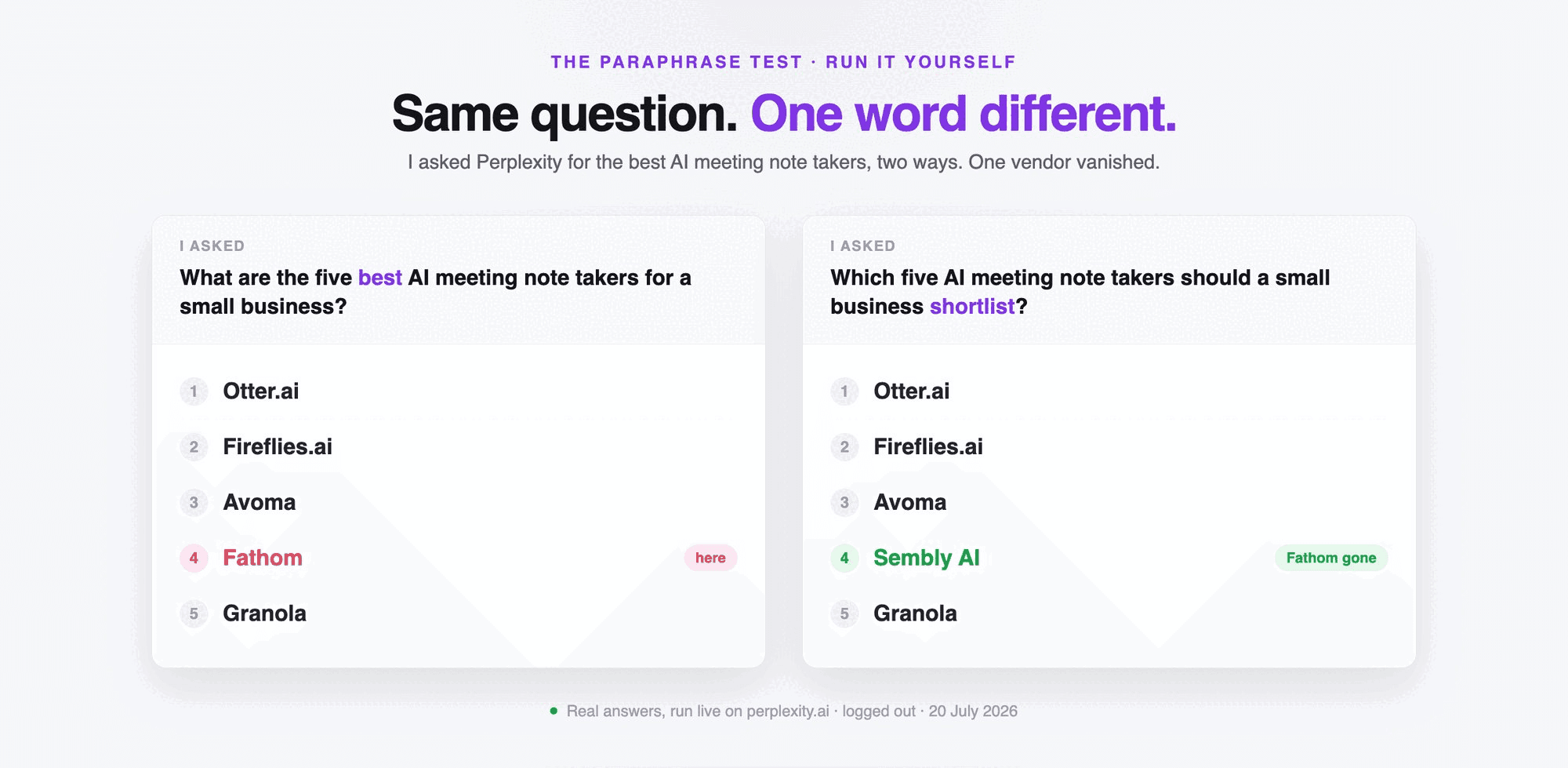
Was it the word? Maybe. SparkToro's data says the same prompt, run twice, often changes the list too. Either way the conclusion is the same: if your brand shows up for one phrasing on one run, you don't have an AI ranking. You have a coin flip.
Why AI recommendations change
Answers are generated, not looked up. A language model writes each answer fresh, with some built-in randomness, and the consumer apps run on default settings. That's why SparkToro saw identical lists less than 1 time in 100 and identical order about 1 time in 1,000.
Your question gets rewritten before anything is searched. Assistants with web search turn a prompt into one or more search queries, often called query fan-out. "Best" and "shortlist" can produce different searches, which retrieve different pages, which name different brands. Why ChatGPT skips your site shows how to see the exact searches ChatGPT runs, and Outrank's query fan-out study found machine-written queries already showing up in Search Console for 79% of the 111 sites analysed.
Context leaks in. Logged-in memory, location and earlier messages all shape the answer, which is why tests should run logged out in a fresh window.
Models and indexes keep changing. A test from three months ago describes a system that no longer exists.
What holds steady is the consideration set. SparkToro collected 142 human-written prompts about headphones that barely resembled each other (average semantic similarity 0.081), yet the assistants kept answering from a fairly consistent group of brands. The order shuffles; the shortlist is stickier. Your job is to get into that shortlist for every way a buyer asks.
The paraphrase test (15 minutes per question)
- 1
Pick three buyer questions
Choose the questions that lead to revenue, for example "best CRM for a five-person agency". Skip vanity questions about your brand name. - 2
Write three phrasings of each
Use templates like best [category] for [customer], which [category] should [customer] shortlist and alternatives to [competitor] for [customer]. - 3
Run each phrasing three times per assistant
Use ChatGPT and Perplexity at minimum, logged out, in a fresh private window for every run. - 4
Log every brand named
A sheet with four columns is enough. Phrasing, run, assistant, brands mentioned. - 5
Count and compare
Count the answers that name you and the answers that name the competitor you lose deals to, then enter both in the calculator below.
Interactive calculator
What's your AI visibility rate?
Your visibility rate
38.9%
- Answers checked
- 18
- Your competitor's visibility rate
- 72.2%
- Competitor's lead in percentage points (negative means you lead)
- 33
There's no universal pass mark, so compare yourself with the brands that win deals from you. For reference, category leaders in SparkToro's headphones data appeared in 55% to 77% of answers, and one hospital showed up in 69 of 71 answers (97%) for its prompt. If you're far behind your main competitor, look at which phrasings you vanish from. That's your to-do list.
How to win the phrasings you lose
Each phrasing hides a slightly different question, and each one needs a page that answers it directly. For "best" questions that page is usually a list: in our AI citation benchmark of 96 questions, 73% of the sources ChatGPT, Perplexity, Gemini and Claude cited for "best X" questions were listicles.
| Phrasing | What the buyer is really asking | The page that wins it |
|---|---|---|
| best [category] for [customer] | Which options are strongest for someone like me? | A ranked roundup with criteria, prices and who each option suits |
| which [category] should [customer] shortlist | How do I narrow the field? | An evaluation guide: criteria, must-haves, red flags, a comparison table |
| alternatives to [competitor] | What else is like this, and why switch? | An honest alternatives page that names the competitor and the trade-offs |
| [category] for [specific use case] | Does it fit my situation? | A use-case page with real examples, numbers and limits |
Then work the outside signals. Get onto the third-party lists assistants quote (how to get into the listicles AI quotes). Check which phrasings already pull your pages: Bing's AI Performance report lists the grounding queries Copilot used to cite you. And plan content around the questions buyers ask rather than single keywords (why your content plan should be questions, not keywords).
Breadth matters because assistants retrieve from what ranks. In Outrank's study of AI citations across 200 sites, Google impressions were the strongest predictor of AI citations (Spearman 0.80), and none of the 110 sites with 400 or more Google-visible pages had zero citations. More good pages, answering more phrasings, means more chances to be the page an assistant lands on.
FAQ
Why does ChatGPT give different answers to the same question?
ChatGPT generates every answer fresh with some randomness, and when it searches the web it may run different searches each time. SparkToro's 2026 study found less than a 1-in-100 chance that ChatGPT returns the same list of brands twice for the same prompt. Memory, location and conversation history add more variation.
Why do AI recommendations change when I rephrase the question?
Assistants turn your prompt into web searches before answering, and different words produce different searches, which retrieve different pages. A small change like "best" to "shortlist" can surface a different set of sources and therefore different brands. The core set of brands tends to be steadier than the exact list.
How do I track my brand's visibility in ChatGPT?
Run a fixed set of buyer questions in several phrasings, several times each, logged out, and count the share of answers that mention you. Repeat monthly. Paid AI visibility trackers automate the same idea at a larger scale, and Bing Webmaster Tools shows citation data for Copilot for free.
Is ranking position in AI answers a useful metric?
Not on its own. SparkToro found identical ordering in roughly 1 of 1,000 runs, so a "#2 in ChatGPT" claim reflects one sample. Visibility rate, the percentage of answers that mention you, held much steadier and is the better number to report.
How many prompts should I test?
Start with three buyer questions, three phrasings each, run three times on two assistants: 54 answers in total. That's enough to see which phrasings you win and lose. Add more runs if the result sits close to your competitor's.