A website SEO audit service reviews your site's technical health, content, links and search visibility, then hands you a prioritized list of fixes. Expect to pay $0 for an automated audit, $500 to $2,000 for a typical agency audit (the range 66% of agencies charge per project, per SE Ranking's survey), and $5,000 to $10,000 for a senior consultant's deep audit of a large site. The price matters less than one test: every finding should come with evidence, impact, a specific fix, an owner and an effort estimate.
This guide covers the kinds of audit you can buy, what the report must contain, where to find a provider for a small budget, and a free 60-minute audit you can run before paying anyone.
Key takeaways
- SEO audit prices: free (automated), $101 to $250 (the most common freelancer project bracket), $500 to $2,000 (most agency projects), $5,001 to $10,000 (the most common consultant bracket), per Ahrefs and SE Ranking surveys.
- A useful audit is a ranked to-do list, not a crawl export. Each finding needs issue, evidence, impact, fix, owner and effort.
- Your first audit is free: Search Console's Indexing → Pages report lists every reason Google isn't indexing your pages.
- Audits in 2026 should check AI search readiness too: in Outrank's study of 200 sites, 67% of sites with fewer than 50 Google-visible pages had zero AI citations.
- Give an auditor read-only Search Console access. Google advises against granting write access at the audit stage.
What a website SEO audit covers
An SEO audit is a structured review of everything that affects how a site performs in search, ending in a list of fixes ranked by impact. A full audit covers five areas; a technical audit covers only the first.
| Area | What gets checked | Typical tools |
|---|---|---|
| Technical | Indexing, crawl errors, redirects, canonicals, Core Web Vitals, mobile, structured data, JavaScript rendering | Search Console, a crawler (Screaming Frog, Sitebulb), PageSpeed Insights |
| On-page and content | Titles, headings, thin or duplicate pages, keyword cannibalization, content gaps against competitors | Search Console Performance report, a keyword tool |
| Links | Referring domains, anchor text, lost links, spammy patterns, gaps against competitors | Ahrefs, Semrush, Search Console Links report |
| Local (if relevant) | Google Business Profile, reviews, name/address/phone consistency, location pages | Google Business Profile, local rank trackers |
| AI search readiness | Whether AI crawlers can read your pages, citations in ChatGPT, Perplexity and AI Overviews | robots.txt review, AI visibility tracking |
If you only need the first row, a technical SEO service is cheaper and more focused. If you run a local business, our guide to SEO services for small business shows what to buy after the audit. For a do-it-yourself version of the full audit, use our website auditing checklist or the step-by-step guide to doing a website audit.
The five kinds of SEO audit and what they cost
| Audit type | Who does it | What you get | Typical price |
|---|---|---|---|
| Automated audit | A tool | A scored list of detected issues, no business context | Free to the price of a tool subscription |
| Freelancer audit | One SEO specialist | A crawl plus manual review, usually a spreadsheet and a call | $101 to $250 is the most common freelancer project bracket; experienced freelancers charge more (Ahrefs) |
| Agency audit | An SEO agency | Technical, content and link review, written report, walkthrough call | 66% of agencies price projects at $500 to $2,000 (SE Ranking) |
| Consultant deep audit | A senior specialist | Diagnosis of a specific problem (traffic drop, migration, large site) with a roadmap | $5,001 to $10,000 is the most common consultant project bracket (Ahrefs) |
| Enterprise audit | Agency or consultancy with log analysis | Segment-level analysis of hundreds of thousands of URLs, often with implementation support | Engagements from about $5,000 upward; most agencies on the Moz Recommended List list a $5,000+ minimum |
Price follows site size and depth, not the number of "checks" on the sales page. A 40-page service business needs a few hours of expert review. A 200,000-URL store with filters, several languages and a JavaScript front end needs days.
Where to find an SEO audit service on a small budget
If you want a detailed audit and prioritized action list without agency pricing, these are the realistic options, from cheapest:
- Run the free audit below and our free SEO audit tool, which groups technical, on-page and AI-search checks into a prioritized report and ends with a fix prompt you can paste into ChatGPT, Claude or your developer's editor.
- Hire a freelancer for a fixed-scope audit. Ask for a sample report first. A clear spreadsheet ranked by impact is worth more than a 60-page PDF.
- Buy a one-off agency audit as a trial before any retainer. Most agencies will sell one; it tells you how they think.
- Use an agency directory with stated price ranges, such as the Moz Recommended List, to avoid quotes far outside your budget.
What the audit report must contain
A good audit report has four parts: a one-page summary (the three to five things that matter most), the findings, a prioritized plan, and the baseline numbers you'll measure against. The findings are where most audits fail.
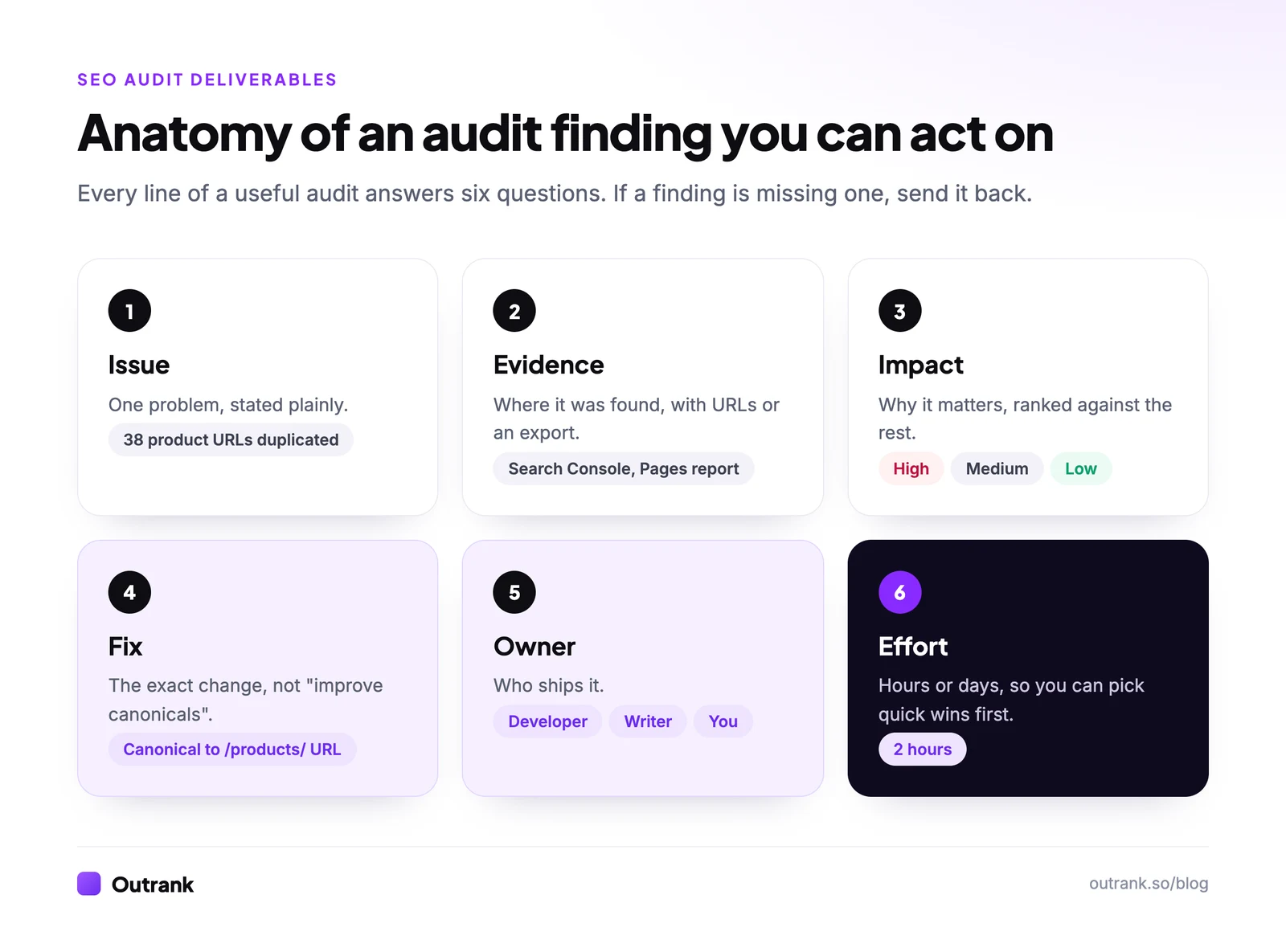
Here is the difference between an automated line and a usable finding:
| Automated audit line | Usable audit finding | |
|---|---|---|
| Issue | "Duplicate content detected (38)" | 38 product pages are indexed under two URLs each |
| Evidence | Tool score | Search Console → Pages → "Duplicate without user-selected canonical", export attached |
| Impact | "Medium" (for every issue) | High: these are the best-selling products |
| Fix | "Improve canonicalization" | Point the canonical tag on collection-path URLs to the /products/ URL |
| Owner and effort | None | Developer, about 2 hours |
The example is illustrative, but the format is the point. If a provider can't show you findings written like the right-hand column, keep looking.
Run a free 60-minute SEO audit first
Do this before you buy anything. You'll either fix the obvious problems yourself or brief a provider far more precisely.
- 1
Indexing (15 minutes)
In Google Search Console, open Indexing → Pages. Note how many pages are indexed vs not indexed and each reason. "Crawled - currently not indexed" and "Duplicate without user-selected canonical" are the most common money leaks. Our guide to fixing crawled but not indexed covers the first. - 2
Performance (10 minutes)
Open Performance → Search results, compare the last 3 months with the previous period, and sort pages by click loss. Pages with many impressions and a low click-through rate need better titles; pages that lost clicks need updating. - 3
Speed and experience (10 minutes)
Check Experience → Core Web Vitals for URL groups marked Poor, then test one example URL in PageSpeed Insights. Targets: LCP 2.5 s or less, INP 200 ms or less, CLS 0.1 or less. - 4
Crawl (15 minutes)
Crawl the site with Screaming Frog (free up to 500 URLs). Export 4xx errors, redirect chains, missing or duplicate titles and pages with no internal links. - 5
Links and AI visibility (10 minutes)
Check Links in Search Console for your top linked pages and linking sites. Then search your brand and main service in ChatGPT and Perplexity and note whether you appear. Run our free audit for an AI-readiness check.
Turning the audit into a plan
Sort every finding by impact and effort, then work in this order:
- High impact, low effort: do this week. Usually indexing blockers, broken redirects on important pages, missing or duplicated titles on top pages.
- High impact, high effort: schedule as projects. Template speed fixes, JavaScript rendering, merging cannibalizing pages, a content plan for missing topics.
- Low impact, low effort: batch into a monthly clean-up.
- Low impact, high effort: skip. Most "warnings" in automated tools live here.
Then decide who ships what. Technical fixes go to your developer, content fixes to writers, link and local work to whoever does outreach. If the audit shows the site simply doesn't have enough pages answering what customers search, that is a content problem no technical fix will solve. A content gap analysis turns that finding into a list of pages to write.
Why AI search readiness now belongs in the audit
Pages that Google barely sees rarely get cited by AI assistants either. In Outrank's study of AI citations across 200 sites, Google impressions were the strongest predictor of AI citations, 67% of sites with fewer than 50 Google-visible pages had zero AI citations, and none of the 110 sites with 400+ visible pages had zero. An audit should therefore check that AI crawlers aren't blocked in robots.txt or by your CDN, and if AI assistants already cite you. Outrank's AI visibility tracking monitors mentions across ChatGPT, Perplexity, Gemini, Copilot, AI Overviews and AI Mode.
How to choose an SEO audit service
Watch a real one first. This video shows an SEO auditing a niche travel blog live, which gives you a feel for what an expert looks at beyond a tool's score:
Then hold every provider to this list. Google's guide Do you need an SEO? adds a useful rule: during an audit, grant only read access to Search Console.
Interactive checklist
SEO audit service checklist
0/13
Before you buy
0/4When the report arrives
0/5Red flags
0/4Your progress is saved in this browser, so you can come back to it later.
How often to get an SEO audit
Once a year for a stable site, plus a check before and after any redesign, CMS change or domain migration. Large sites and sites that ship code every week are better off monitoring continuously (Search Console email alerts, a scheduled crawl) and running a deep audit every six months.
Between audits, the work is content and links, which is what Outrank automates: keyword research, an SEO article published every day to your CMS, and backlinks placed inside relevant articles on other sites. If you'd rather have someone handle the content end to end, Outrank Agency does it for you with human editors and SEO specialists reviewing every article.
FAQ
How much does a website SEO audit cost?
Automated audits are free or included in SEO tools. Freelancer audits often cost a few hundred dollars, most agency audits $500 to $2,000 (66% of agencies in SE Ranking's survey price projects in that range), and senior consultants most often $5,001 to $10,000 per project. Large and complex sites cost more because they take longer to analyze, not because they get more "checks".
Where can I get a detailed SEO audit of my website?
Start free with Google Search Console and an automated audit such as Outrank's free SEO audit. For a detailed human audit, hire a freelancer or agency for a fixed-scope project, ask for a sample report, and use directories with stated price ranges to stay within budget.
Which audit services give a prioritized action list on a small budget?
Look for a fixed-price freelancer or small-agency audit whose sample report ranks findings by impact and effort, rather than a scored list of every warning. Automated tools that group issues by severity are a good free starting point, but someone still needs to judge which fixes matter for your business.
What is the difference between a technical SEO audit and a full SEO audit?
A technical audit checks whether search engines can crawl, render and index your site: errors, redirects, canonicals, speed and structured data. A full SEO audit adds content quality, keyword targeting, backlinks, local listings and, increasingly, AI search visibility.
Can I do an SEO audit myself?
Yes, for small and mid-sized sites. Search Console, PageSpeed Insights and a crawler cover most technical checks, and the 60-minute audit above covers the essentials. Hire help when you can't tell which issues matter, after a traffic drop, or before a migration.
How long does an SEO audit take?
A free self-audit takes about an hour. A professional audit of a small site typically takes a few days to a couple of weeks, including the report and a walkthrough call; audits of large sites with log file analysis can take several weeks.