
An SEO strategy template is a planning document that ties one business goal to the keywords, pages, technical fixes, links and metrics that should get you there. The template below has eight sections, each a table you can copy into Google Sheets, Google Docs or Notion: strategy brief, baseline and goals, keyword opportunity matrix, content roadmap, technical fixes, authority plan, measurement dashboard and refresh log.
You also get a filled-in SEO plan example for a fictional company, a scoring formula for choosing keywords, and a 90-day SEO roadmap you can tick off as you go. Expect the first pass to take an afternoon.
Key takeaways
- A useful SEO plan answers five questions: what organic search should produce for the business, which queries are worth winning, which pages and fixes get you there, how you'll earn authority, and how you'll measure it.
- Score keywords on business value, intent fit, ranking feasibility, click value and content advantage, minus effort. Volume comes second.
- Click value now varies by page type: on the same sites, free tools and calculators earned 2.11× the CTR of articles at positions 4 to 10, while "what is" definitions earned 0.52× (Outrank study of 6.2M pages).
- Track non-brand clicks and conversions, not rankings alone. Search Console's branded queries filter, available to all eligible sites since March 2026, makes the split easy.
- Work in 90-day cycles: audit and baseline in week 1, publish from week 3, optimise pages ranking 4 to 20 in month 3, then rebuild the plan.
What is an SEO strategy (and how is it different from an SEO plan)?
An SEO strategy is your bet about which audience you'll help, which topics you can win and what business result those rankings should create. An SEO plan is the strategy turned into dated tasks with owners. An SEO roadmap is the plan laid out on a timeline, usually 90 days.
People search for all three interchangeably, and the template below covers all three: sections 1 to 3 are the strategy, sections 4 to 6 are the plan, and the 90-day roadmap at the end is the timeline. An SEO content strategy is narrower: it's sections 3 and 4 on their own.
Most free templates are content calendars with nicer formatting. A calendar tells you what to publish on Tuesday. It doesn't tell you why that page matters, or how you'll know it worked. That's the gap this template fills.
The SEO strategy template at a glance
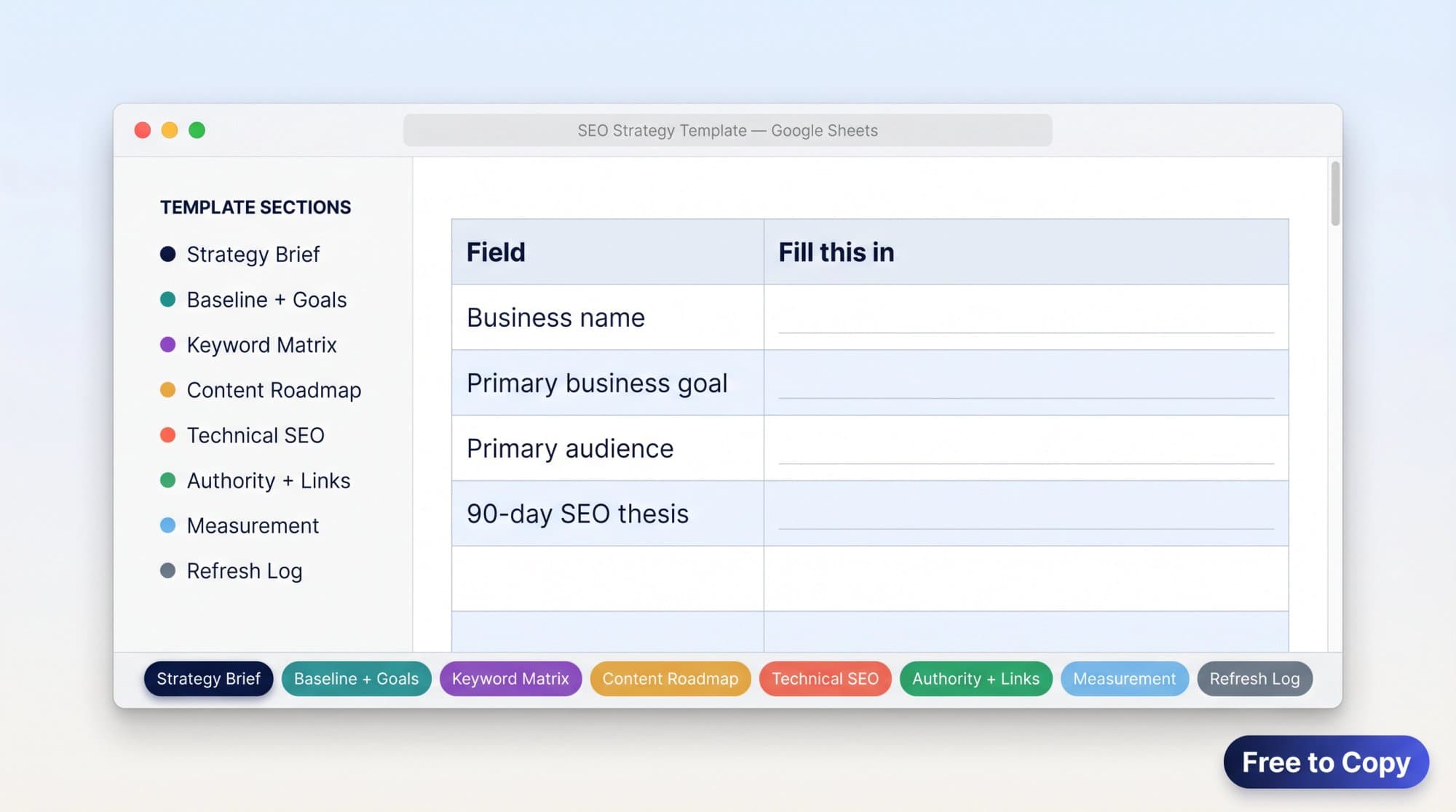
| Section | What it decides | Update it |
|---|---|---|
| 1. Strategy brief | Goal, audience, constraints and your 90-day thesis | Quarterly |
| 2. Baseline and goals | Where you are now and what success looks like | Quarterly |
| 3. Keyword opportunity matrix | Which topics to target first, with a score | Monthly |
| 4. Content roadmap | What to publish, update, merge or delete, and when | Weekly |
| 5. Technical fixes | What stops important pages being crawled, indexed or understood | Weekly |
| 6. Authority and internal links | How priority pages earn links, inside and outside your site | Monthly |
| 7. Measurement dashboard | Which numbers you review, where they come from, how often | Monthly |
| 8. Refresh log | Which existing pages to improve and what happened after | Monthly |
To use it: create one tab (or one Docs heading) per section, paste the table, and fill it top to bottom. Don't skip section 1. Keyword research without a goal produces a list; with a goal, it produces a plan.
1. Strategy brief
Free template · fill it in here
Strategy brief
| Field | Fill this in |
|---|---|
| Business and website | |
| SEO owner and review cadence | |
| Primary business goal | |
| Highest-value conversion | |
| Average customer value | |
| Primary audience | |
| Geographic focus | |
| SEO model | |
| Top 3 search competitors | |
| Unique advantage | |
| Constraints | |
| Capacity | |
| 90-day SEO thesis |
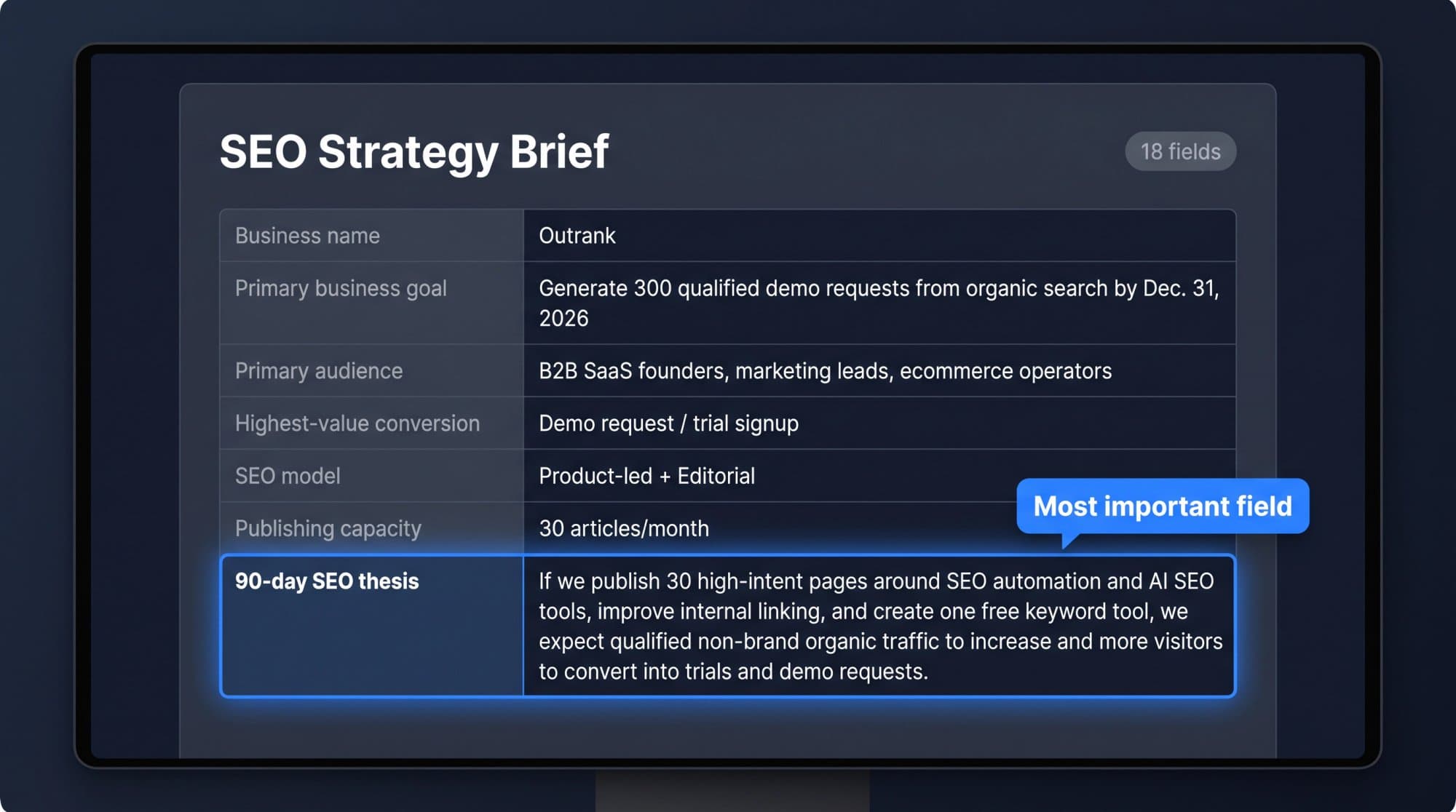
The thesis is the field that matters most. It forces you to name the audience, the work and the expected result in two sentences. If you can't write it, the strategy isn't clear yet. A good one reads like: "If we publish 20 comparison and template pages for freelance designers and fix our indexing errors, we expect non-brand clicks to double and 40 trial signups a month from organic by the end of Q1."
2. Baseline and goals
You can't tell whether a plan worked without a starting point. Pull the numbers on day one and write them down.
Free template · fill it in here
Baseline and goals
| Metric | Today | 90 days | 6 months | 12 months | Source |
|---|---|---|---|---|---|
| Non-brand organic clicks (28 days) | Search Console | ||||
| Total organic clicks (28 days) | Search Console | ||||
| Impressions (28 days) | Search Console | ||||
| Pages indexed | Search Console | ||||
| Keywords in top 3 / top 10 | Rank tracker or Search Console | ||||
| Organic conversions | GA4 or CRM | ||||
| Organic conversion rate | GA4 or CRM | ||||
| Referring domains | Ahrefs, Semrush or similar | ||||
| AI citations or mentions | Manual checks or an AI visibility tool |
Search Console now separates branded and non-branded queries for you. Google introduced the branded queries filter in the Performance → Search results report on November 20, 2025, and it has been available to all eligible sites since March 11, 2026 (top-level properties with enough query volume). Use the non-branded view as your main growth number: it measures people who found you without already knowing your name.
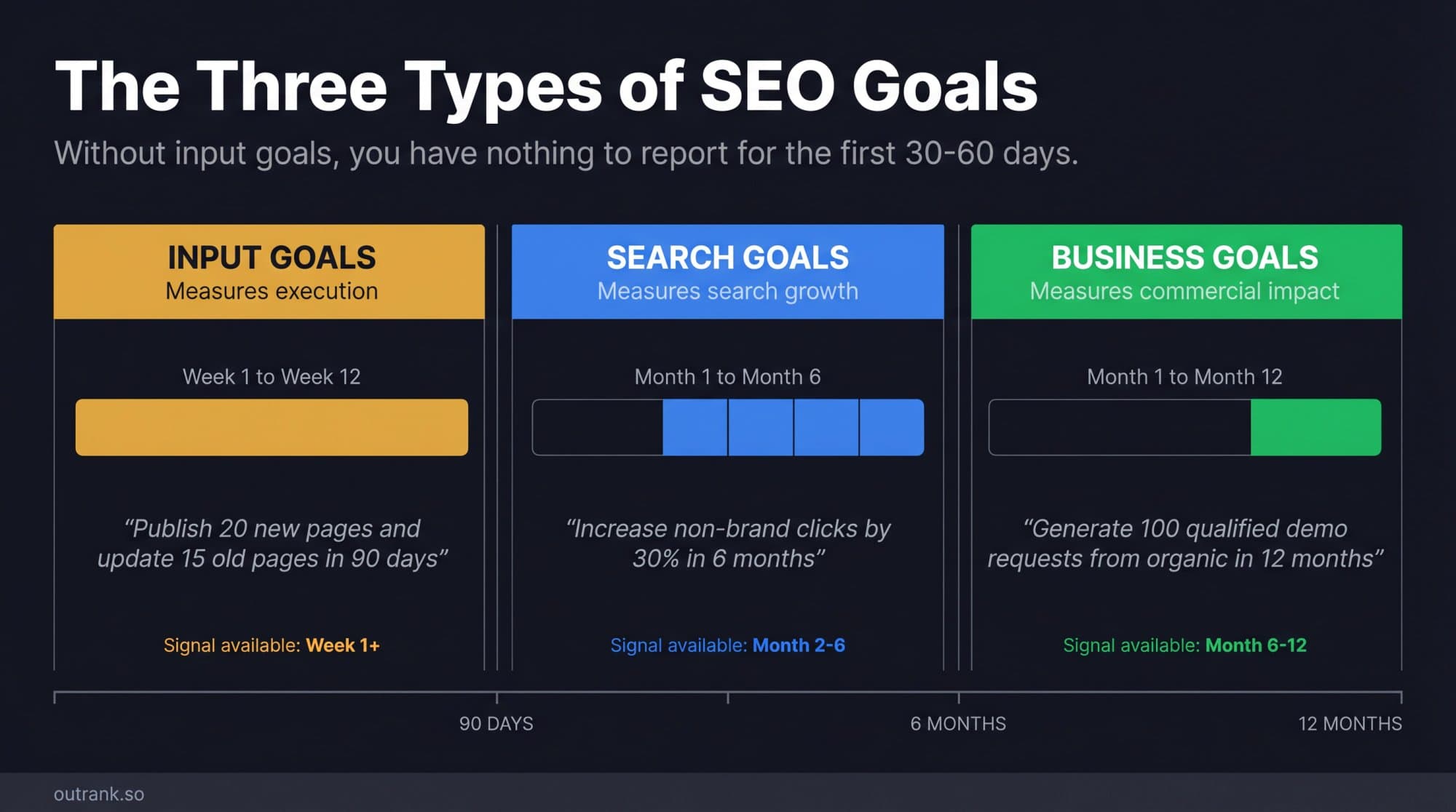
Set three kinds of goals, not one:
| Goal type | Example | Signal shows up |
|---|---|---|
| Input goal | Publish 20 new pages and update 15 old ones in 90 days | Week 1 onward |
| Search goal | Grow non-brand clicks 30% in 6 months | Month 2 onward |
| Business goal | 100 qualified demo requests from organic in 12 months | Month 6 onward |
Input goals are the ones teams skip, and the reason they need them: SEO results lag the work by months. In Outrank's study of 2,119 sites, the median site was up 7% after its first 28 days of publishing, 27% after 84 days, and 2.0× by month seven. Without input goals you have nothing to report in month one, and no way to tell a strategy problem from a timing problem.
3. Keyword opportunity matrix
This is the core of the template. Sorting a keyword export by search volume gives you topics that are too competitive, attract the wrong people, or get answered in full on the results page. The matrix makes the trade-offs visible before you spend a week on a page.
Free template · fill it in here
Keyword opportunity matrix
| Keyword / topic | Cluster | Intent | Page type | Business value | Intent fit | Feasibility | Click value | Advantage | Effort | Score | Target URL | Action |
|---|---|---|---|---|---|---|---|---|---|---|---|---|
Priority score = Business value + Intent fit + Feasibility + Click value + Advantage − Effort
Effort is the only score where higher is worse, which is why it's subtracted. The maximum is 24. Anything above 15 goes on the roadmap; anything under 10 waits.
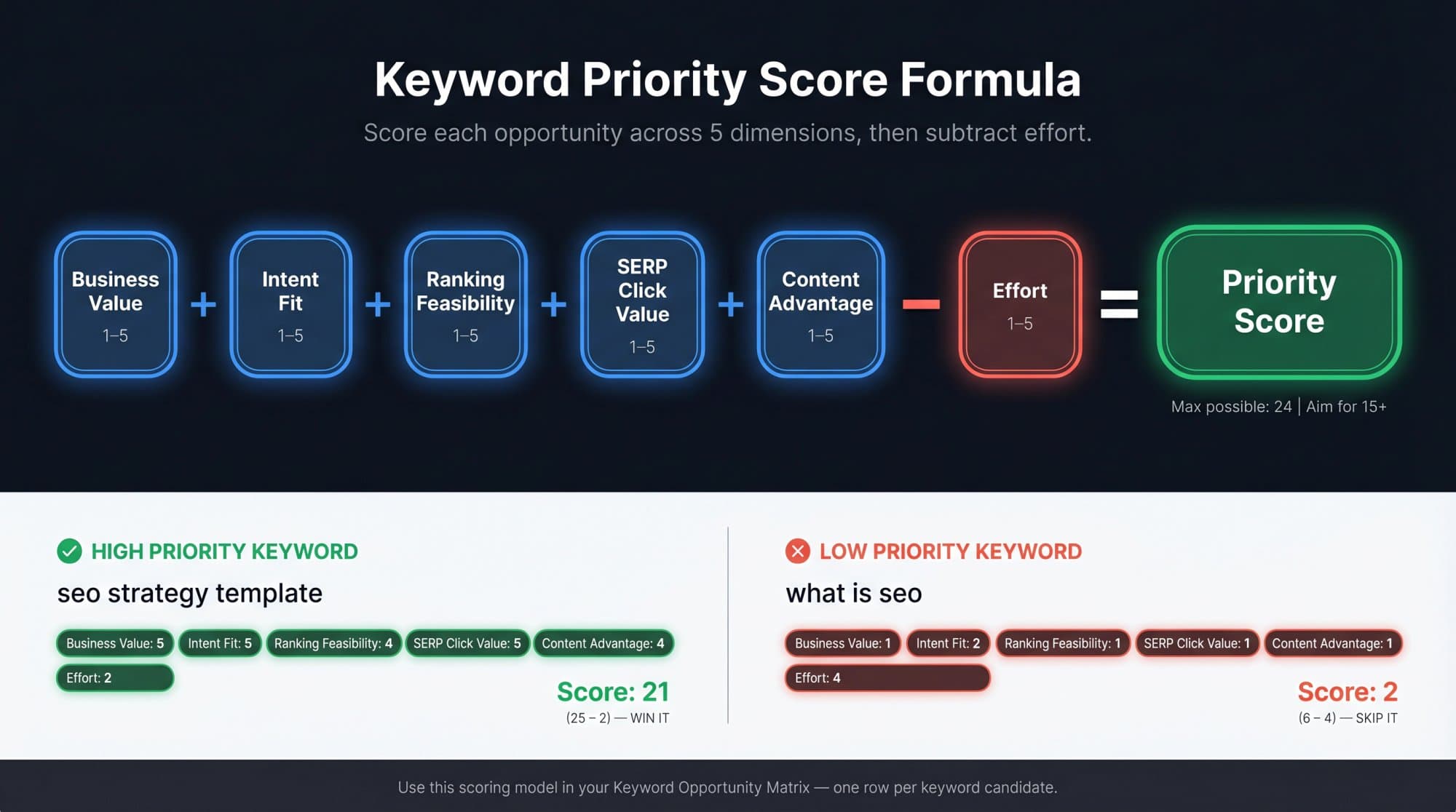
Scoring guide:
| Score | Business value | Intent fit | Feasibility | Click value | Advantage | Effort |
|---|---|---|---|---|---|---|
| 1 | No path to revenue | Barely related | Top results are far stronger | Fully answered on the results page | Nothing unique to add | Fast and easy |
| 3 | Useful mid-funnel topic | Clear match | Competitive but realistic | Some reasons to click | We can organise it better | A standard page |
| 5 | Direct buying intent | Perfect match | Weak or outdated top results | Searcher needs a tool, template or detailed process | We can make the best result | Needs new product, data or dev work |
Three notes on scoring in 2026:
- Feasibility: low-difficulty keywords are where most new sites win. Across 183,540 articles Outrank wrote in the 90 days to October 2026, the median keyword difficulty was 14 and 63% targeted a difficulty under 20. Our guide to keyword difficulty explains how to judge it from the results page instead of a tool score alone.
- Click value: AI answers take clicks from simple questions. Ahrefs found that an AI Overview correlates with a 58% lower click-through rate for the top-ranking page (300,000 keywords, December 2025 data), and Pew Research found people clicked a result in 8% of visits with an AI summary against 15% without one.
- Page type changes the odds. In Outrank's study of 6.2 million pages, free tools and calculators earned 2.11× the CTR of the same sites' articles at positions 4 to 10, "best X" listicles 0.69× and "what is" definitions 0.52×. Score click value high when the searcher needs something they can use, low when one sentence answers them.
Group the scored rows into clusters before you plan pages; see keyword clustering. For the research itself, our keyword research tutorial walks through finding the rows in the first place, and Outrank's free blog keyword generator gives you a seed list from your URL.
4. Content roadmap (your SEO content strategy template)
Every page on the roadmap needs a cluster, a target query and a job (capture a lead, support a product page, earn links). If it has none of those, it waits.
Free template · fill it in here
Content roadmap
| Publish date | Status | Cluster | Target query | Page type | URL | Primary CTA | Links in from | Links out to | Owner | Unique value | Refresh by |
|---|---|---|---|---|---|---|---|---|---|---|---|
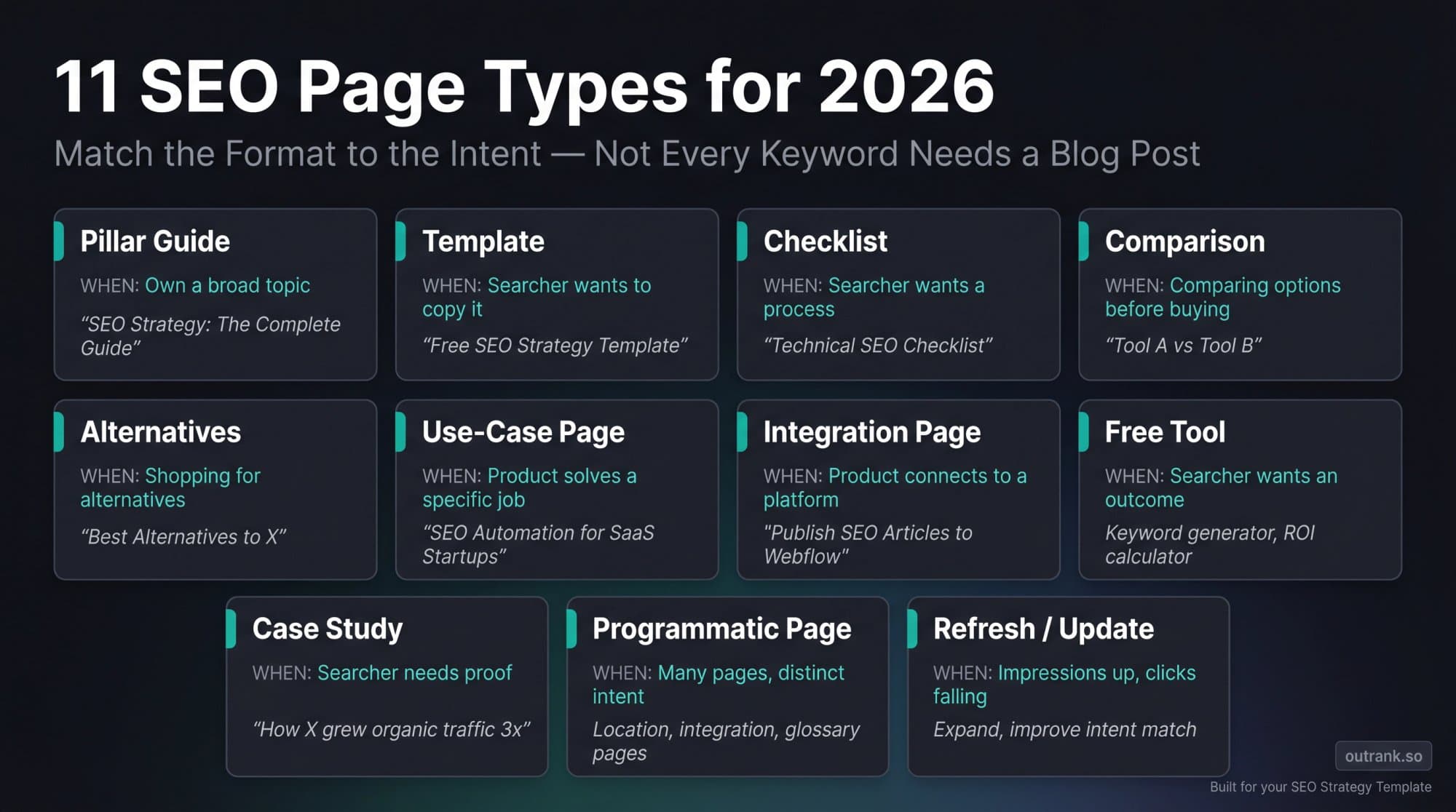
The most common mistake here is answering every keyword with a blog post. "Best X" and "X vs Y" queries want comparisons; "X template" wants something copyable; "X calculator" wants a tool; "X near me" wants a service page. Google's helpful content guidance asks whether a page adds original information compared with what already ranks, and the format is often where that originality comes from.
Before drafting each page, write a short brief: target query, reader's goal, what the top results miss, the unique value you'll add, required sources and internal links. Our content brief template has the full field list.
5. Technical fixes
A page that's accidentally noindexed, blocked by robots.txt or orphaned won't rank however good it is. Keep technical work in the same plan as content so it gets prioritised against it, not after it.
Free template · fill it in here
Technical fixes
| Issue | Priority | Affected URLs | Impact | Owner | Fix | Status | Due |
|---|---|---|---|---|---|---|---|
Where to find the rows: Search Console's Indexing → Pages report lists why pages aren't indexed, Experience → Core Web Vitals flags slow templates, and a crawler (Screaming Frog's free version handles 500 URLs) finds broken links, redirect chains, missing titles and duplicate pages. The full list of checks is in our technical SEO audit checklist.
Two rules worth writing into the plan. Robots.txt controls crawling, not indexing; to keep a page out of Google, use noindex (Google's robots.txt guide). And since June 15, 2026, Google enforces a spam policy against "back button hijacking", sites that interfere with a visitor's browser navigation, so check any script that changes browser history.
6. Authority and internal linking plan
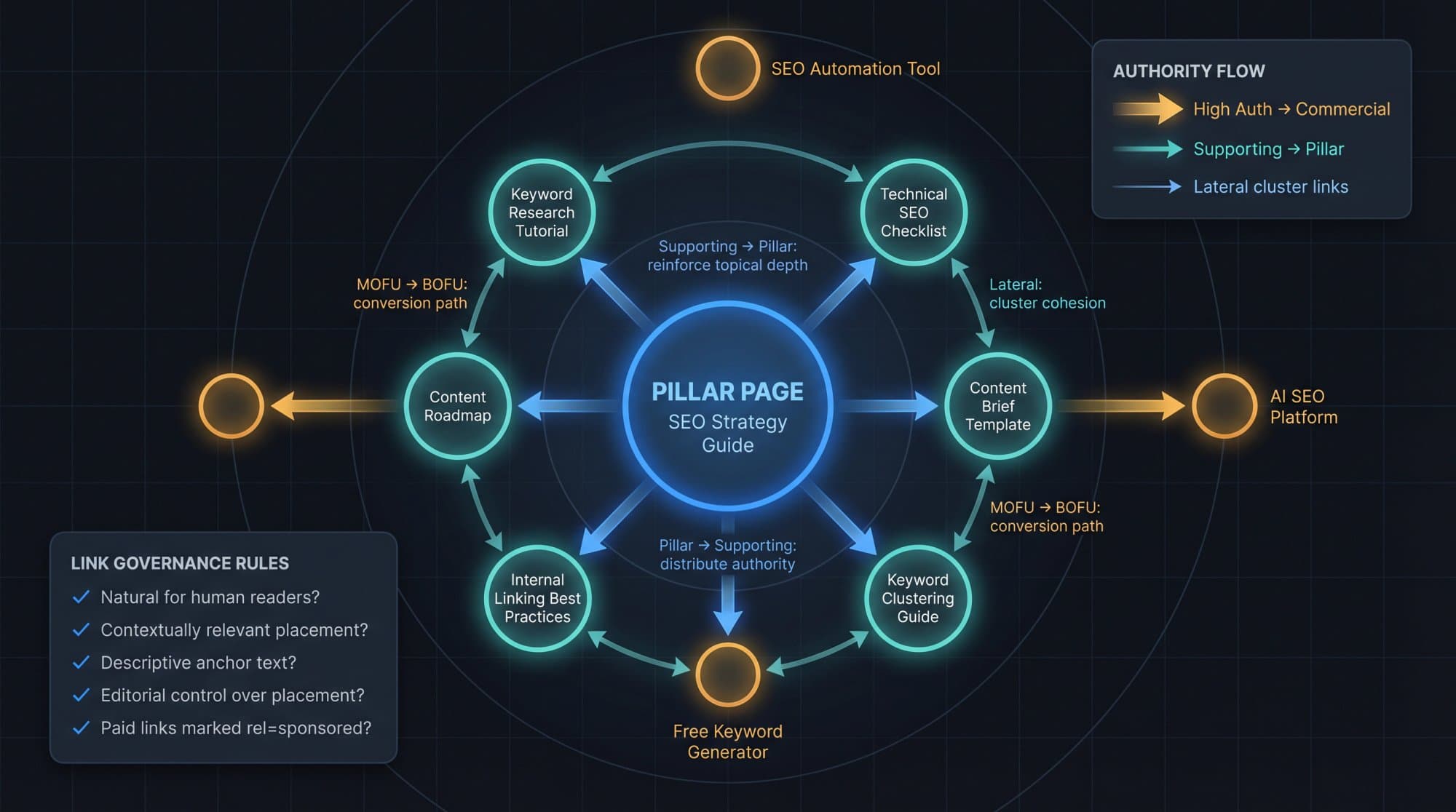
Content answers "what should we rank for?" Authority answers "why should Google trust this page over the others?" Start with internal links, the part you fully control. Google's link guidance says every page you care about should be linked from at least one other page on your site, with descriptive anchor text.
Free template · fill it in here
Authority and internal linking plan
| Priority page | Cluster | Internal links now | Internal links to add | From which pages | Anchor ideas | External links needed? | Link angle | Owner | Status |
|---|---|---|---|---|---|---|---|---|---|
For external links, write your rules down before anyone starts. Google's link spam policy lists buying links for ranking purposes, excessive link exchanges, using automated programs to create links, low-quality directory links and optimised anchors in guest posts as spam. A link that would make sense to a reader if Google didn't exist, placed in relevant content with a natural anchor, passes the test. More on building a cluster in our guide to topical authority.
7. Measurement dashboard
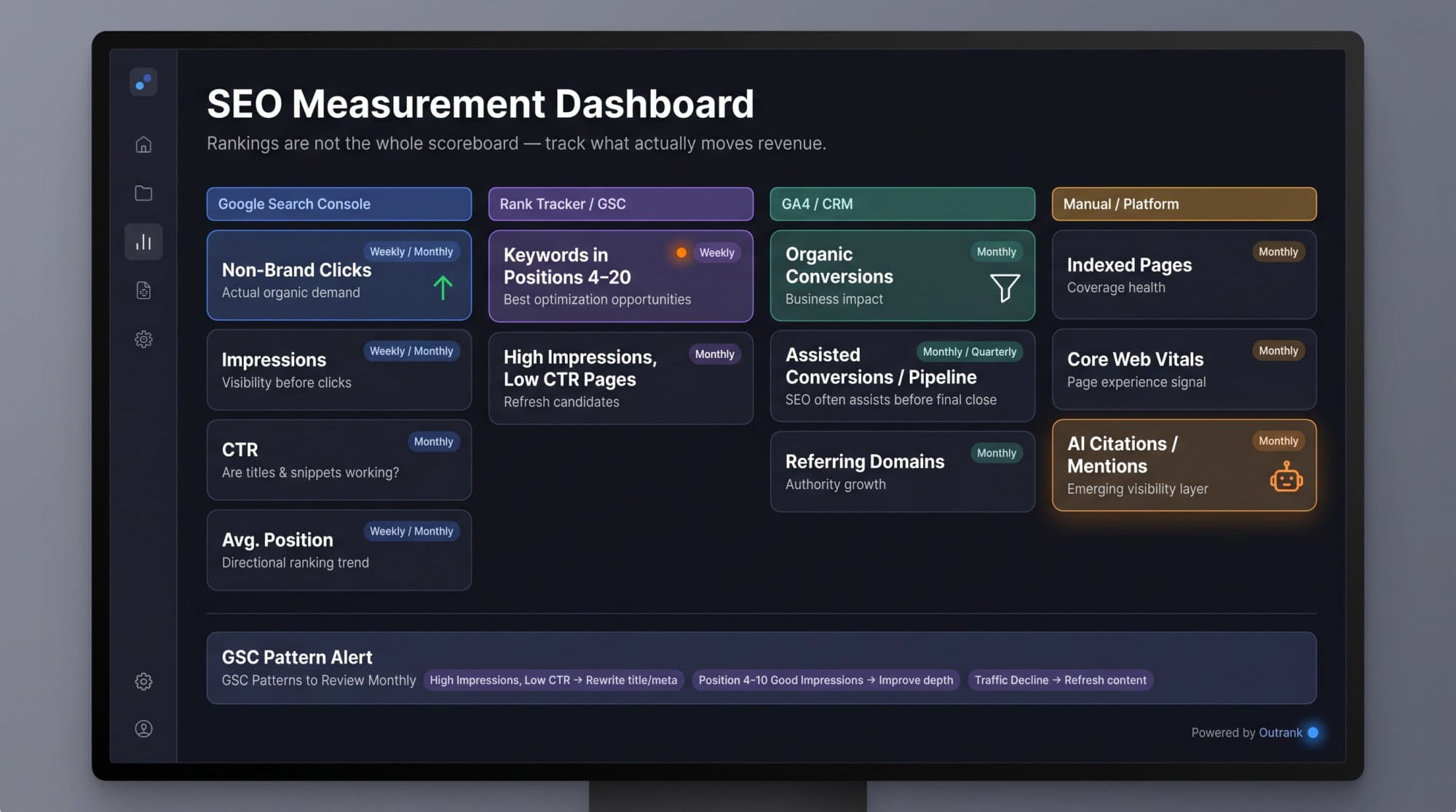
Rankings are one signal. The dashboard should show visibility, clicks, conversions and how much of the plan actually got done.
Free template · fill it in here
Measurement dashboard
| Metric | Why it matters | Tool | Review | This month |
|---|---|---|---|---|
| Non-brand clicks | Real discovery, beyond people who already know you | Search Console | Monthly | |
| Impressions and CTR | Visibility, and whether titles earn the click | Search Console | Monthly | |
| Pages ranking 4 to 20 | Your cheapest upcoming wins | Search Console or rank tracker | Monthly | |
| Organic conversions and pipeline | Business impact | GA4 and CRM | Monthly | |
| Pages published and refreshed | Execution against input goals | Your roadmap | Weekly | |
| Indexed pages | Coverage of what you publish | Search Console | Monthly | |
| Referring domains | Authority growth | Ahrefs, Semrush or similar | Monthly | |
| AI citations and mentions | Visibility in ChatGPT, Perplexity and AI Overviews | Manual checks or an AI visibility tracker | Monthly |
Expect impressions and clicks to diverge. In Outrank's zero-click study of 415 sites, median impressions grew 2.18× between October 2025 and August 2026 while clicks grew 22% and CTR fell 40%. A plan judged on impressions looks great; judge it on clicks and conversions.
Patterns to check every month:
| Pattern in Search Console | What it means | What to do |
|---|---|---|
| High impressions, low CTR | People see you and don't click | Rewrite the title and description; see how to improve CTR |
| Position 4 to 10 with good impressions | Close to the top results | Deepen the page, add internal links, refresh data |
| Position 11 to 20 | Page two | Fix intent match, expand, add links |
| One query split across several URLs | Cannibalisation | Merge, redirect or differentiate |
| Traffic but few conversions | Wrong intent or weak CTA | Change the offer or the page type |
When you report upward, our guide to creating SEO reports covers how to turn this into something leadership reads.
8. Refresh log
Updating a page that already has impressions is usually faster than ranking a new one. Google's helpful content guidance warns against changing dates without substantially changing the page, so log what you actually changed.
Free template · fill it in here
Refresh log
| URL | Last updated | Trigger | Problem | Change made | Owner | Date | Clicks before (28 days) | Clicks after (28 days) |
|---|---|---|---|---|---|---|---|---|
Refresh first: pages with high impressions and low CTR, pages ranking 4 to 20, pages with outdated years, prices or screenshots, and pages that compete with each other. A content audit finds them in bulk.
SEO strategy plan example (filled in)
Here is the template filled in for Northwind Invoicing, a fictional invoicing app for freelancers, so you can see how the pieces connect. The company and numbers are invented for illustration; replace them with yours.
Strategy brief (excerpt):
| Field | Example |
|---|---|
| Primary business goal | 60 trial signups a month from organic search by the end of Q2 |
| Highest-value conversion | Free trial signup |
| Primary audience | Freelance designers and developers in the US and UK |
| SEO model | Product-led editorial: templates and calculators that lead to the app |
| Unique advantage | Real invoice templates from the product, a late-fee calculator, data from anonymised invoices |
| Capacity | 8 new pages a month, 4 developer hours a month |
| 90-day thesis | If we publish invoice templates and calculators for freelancers and fix our 140 non-indexed pages, non-brand clicks double and trials from organic reach 60 a month. |
Keyword matrix (first five rows):
| Topic | Page type | Value | Fit | Feasibility | Click value | Advantage | Effort | Score | Action |
|---|---|---|---|---|---|---|---|---|---|
| freelance invoice template | Template | 5 | 5 | 3 | 5 | 5 | 2 | 21 | Create |
| late payment fee calculator | Free tool | 4 | 5 | 4 | 5 | 4 | 3 | 19 | Create |
| how to invoice as a freelancer | Guide | 4 | 4 | 3 | 3 | 4 | 2 | 16 | Update existing post |
| invoicing software for freelancers | Comparison | 5 | 5 | 2 | 4 | 3 | 3 | 16 | Create |
| what is an invoice | Definition | 1 | 2 | 2 | 1 | 1 | 2 | 5 | Skip |
Goals: input (8 new pages a month, 10 refreshes in 90 days), search (non-brand clicks 2× in 6 months), business (60 organic trials a month by end of Q2).
Notice what the matrix does: the definition query would probably bring the most traffic, and it scores lowest because it has no path to a trial and an AI answer covers it in one sentence.
Your 90-day SEO roadmap template
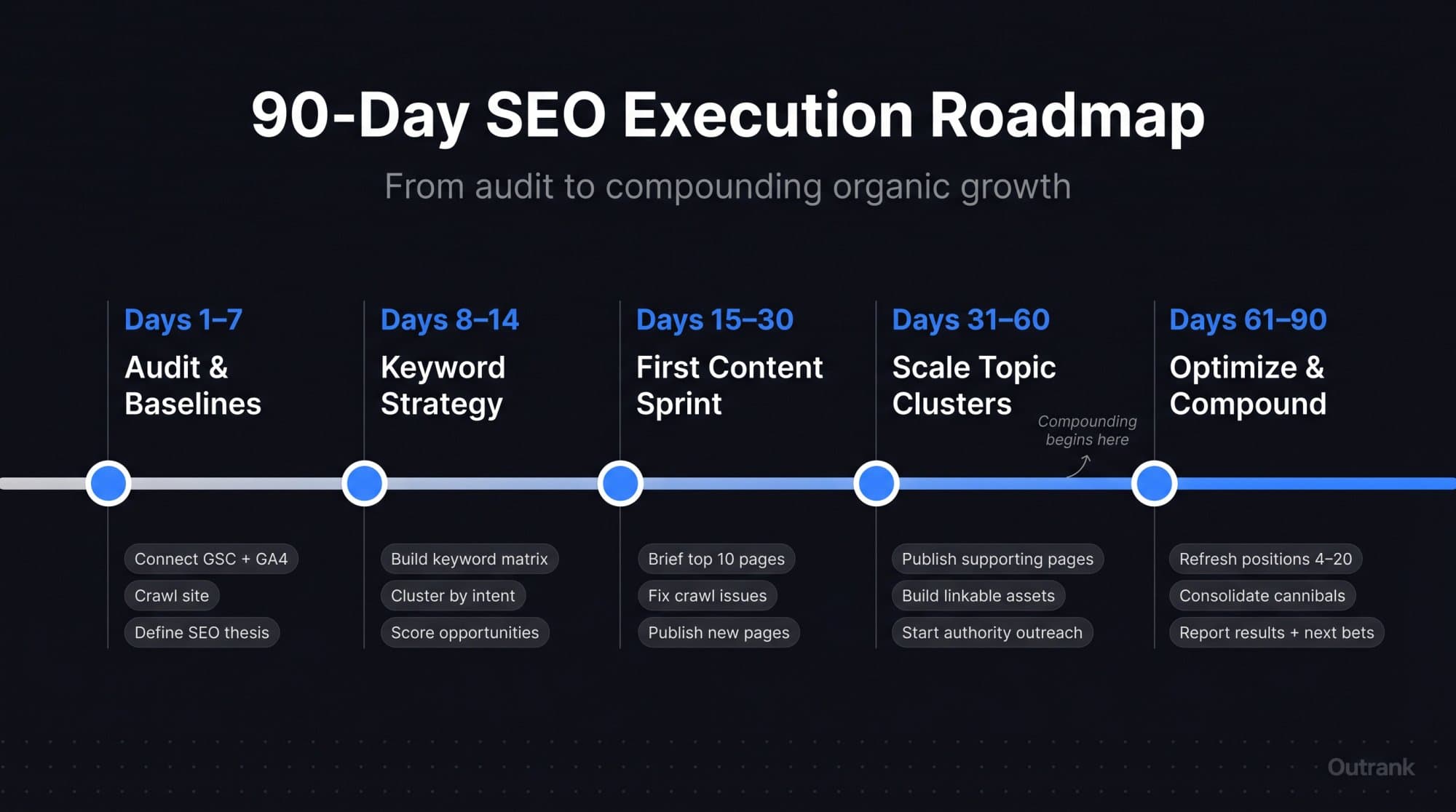
Tick items as you go; your progress is saved in this browser. Use it as an SEO project plan: assign an owner to each line in your own copy.
Interactive checklist
90-day SEO roadmap
0/26
Days 1 to 7: audit and baseline
0/6Days 8 to 14: keyword strategy
0/5Days 15 to 30: first content sprint
0/5Days 31 to 60: build clusters
0/5Days 61 to 90: optimise and review
0/5Your progress is saved in this browser, so you can come back to it later.
At day 90, ask four questions: did we ship what we planned, are impressions and clicks growing for priority clusters, are more pages entering positions 4 to 20, and are organic visitors converting? The answers decide where the next cycle's effort goes.
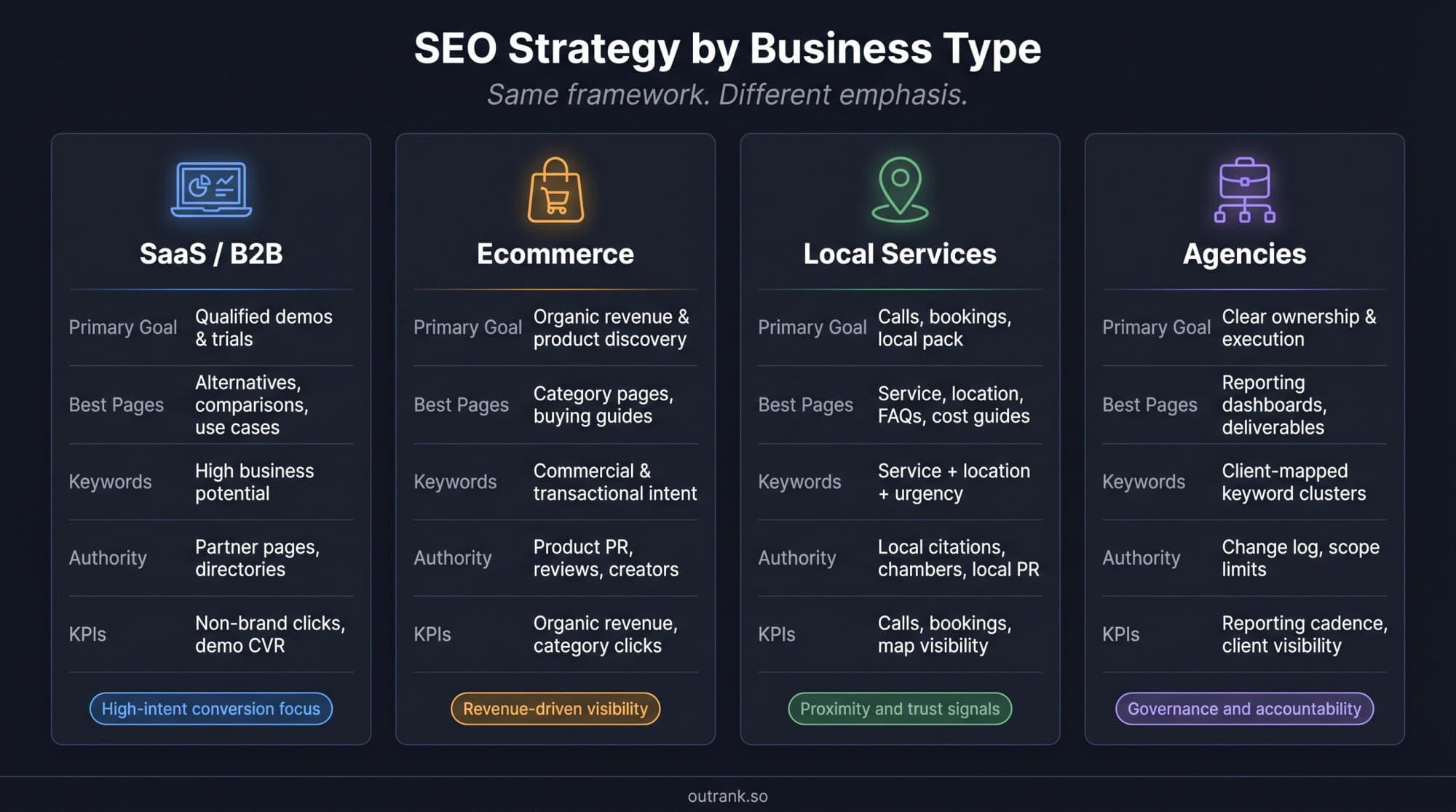
How to adapt the template by business type
| SaaS and B2B | Ecommerce | Local services | Agencies | |
|---|---|---|---|---|
| Primary goal | Demos, trials, pipeline | Organic revenue | Calls, bookings, quotes | Client results and retention |
| Best page types | Comparisons, alternatives, use cases, integrations, calculators | Category pages, buying guides, product education | Service pages, location pages, cost guides | Same as the client's model |
| Technical focus | Clean indexing of docs and app pages | Faceted navigation, canonicals, product schema | LocalBusiness schema, mobile speed | Repeatable audits across sites |
| Authority focus | Partners, integrations, expert content | Product PR, reviews, creators | Local citations, associations, reviews | Client case studies |
| Key KPI | Non-brand clicks to trial or demo | Organic revenue per category | Calls and map visibility | Reporting against each client's goal |
For agencies running this template across many clients, add columns for client approver, revision deadline and monthly deliverables, and see our guide to SEO software for agencies for the reporting side.
How to turn this template into a document or PDF
If you need an SEO strategy document to share or a PDF to attach to a proposal, paste the eight tables into a Google Doc under eight headings, add a one-page summary at the top (goal, thesis, the three goals, the first 10 pages), then use File → Download → PDF document. Keep the working version in Sheets or Notion, where the matrix and roadmap get updated; the PDF is a snapshot.
Where automation fits
You can run all of this by hand, and for the strategy sections (1, 2 and 7) you should. The sections that eat time are the repetitive ones: keyword research, writing, publishing, internal linking and link building.
Outrank automates that execution layer. It researches keywords your site can rank for, writes and publishes one long article a day (30 a month) to WordPress, Webflow, Shopify, Wix, Framer, Notion, Ghost, Next.js or a webhook, adds internal links, and places links to your site inside relevant articles on other sites in its network. It costs $99 a month, with a 3-day trial. It doesn't decide your business goal or replace your judgment on which pages convert; use the template for that, and review what it publishes.
On Outrank's results page, the median site reached 2.04× its pre-Outrank Google clicks after seven months, and sites publishing 30 or more articles a month grew faster (2.27×) than those publishing fewer than five (1.07×). That's a correlation across sites, not a promise, but it matches what the 90-day plan above assumes: consistent publishing, compounding over months.
FAQ
What is an SEO strategy template?
An SEO strategy template is a reusable planning document that connects a business goal to the keywords, pages, technical fixes, links and metrics needed to reach it. A good one includes a strategy brief, baseline and goals, a scored keyword matrix, a content roadmap, a technical fix list, an authority plan, a KPI dashboard and a refresh log.
What should an SEO plan include?
An SEO plan should include one measurable business goal, a baseline from Search Console and analytics, a prioritised list of keywords mapped to pages, a publishing and update schedule with owners, technical fixes, a link plan, and the metrics you'll review each month. It should split branded from non-branded clicks and track conversions, not only rankings.
How do I write an SEO strategy document?
Start with a one-page summary: the business goal, the audience, a two-sentence 90-day thesis and three goals (input, search, business). Then add the working sections: keyword matrix, content roadmap, technical fixes, authority plan and KPI dashboard. Keep the document short enough that the team rereads it every month.
How long should an SEO plan cover?
Plan in 90-day cycles inside a 12-month goal. Ninety days is long enough to publish, get pages indexed and see early ranking movement, and short enough to change course. Review tasks weekly, the roadmap monthly and the whole strategy every quarter.
Is SEO still worth it with AI Overviews?
Yes, but measure it differently. AI Overviews correlate with a 58% lower CTR for the top result (Ahrefs, 300,000 keywords), so favour page types searchers still click, such as templates, tools, comparisons and detailed processes, and judge success on non-brand clicks and conversions rather than impressions.
How do I make an SEO roadmap?
List the work from your keyword matrix, technical fixes and authority plan, then sequence it into phases: audit and baseline first, keyword strategy next, then a first content sprint, cluster building, and optimisation of pages ranking 4 to 20. Give every task an owner and a week, and review it at day 90.