

To start an anonymous blog, create a new email address used only for the blog, sign up on a blogging platform with it, publish under a pen name, and keep everything that could identify you (your photos' metadata, your payment details, your analytics code, personal details in your posts) separate from your real identity. For a quick start, Write.as and Telegraph let you publish without an account at all. For a blog you want to grow, use a separate account on any platform, or your own domain with WHOIS privacy turned on.
How far you go depends on who you are hiding from. This guide starts there, then covers free platforms, the setup, the six leaks that unmask most anonymous bloggers, and how to grow and earn without showing your face.
Key takeaways
- Decide who you are hiding from first. A pen name hides you from coworkers and family; hiding from a determined investigator or a government needs Tor, separate devices and much stricter habits.
- Write.as and Telegraph let you publish without creating an account. Every platform that requires an account still knows the email and IP address you used.
- Anonymous to readers is not anonymous to the platform. Hatena's Anonymous Diary, for example, hides the poster's ID but requires a Hatena ID and discloses poster information when its rules or the law require it.
- The leaks that expose people are small ones, such as a reused email, photo GPS data, a card payment or a Google Analytics or AdSense ID shared with another site you own.
- On your own domain, use a registrar with free WHOIS privacy (Cloudflare Registrar and Porkbun include it) and confirm your name does not show in a domain lookup.
First, decide how anonymous you need to be
"Anonymous" covers very different needs, and the right setup for a hobby blog would be dangerous for a whistleblower. Pick your level:
| Level | Hiding from | Typical blogger | What it takes |
|---|---|---|---|
| 1. Pen name | Coworkers, family, people who search your name | Personal stories, health, side projects, an opinionated hobby blog | A separate email, a pseudonym, no identifying details or photos |
| 2. Strong pseudonym | Determined readers, doxxers, an employer looking for you | Industry insiders, critics, writers in a small community | Level 1, plus domain privacy, a separate browser profile, scrubbed metadata, no shared tracking codes or payment trails |
| 3. High risk | Companies with lawyers, police, governments | Whistleblowers, activists, journalists' sources | Level 2, plus Tor Browser, devices and networks never linked to you, and expert guidance |
If you are at level 3, a blog may not be the safest channel at all. Read the EFF's Surveillance Self-Defense guides first, and consider passing documents to journalists through a secure submission system instead of publishing them yourself.
Most people searching for this are at level 1 or 2, and the rest of this guide is written for them.
Free platforms for an anonymous blog
| Option | Account needed | What readers see | What the operator knows | Best for |
|---|---|---|---|---|
| Write.as | No, you can write anonymously without signing up | No name, or any pen name you choose | No account or email needed for anonymous posts | Quick essays, one-off posts |
| Telegraph | No | A title and an optional author name you type | No account or email needed | Single pages, statements |
| Hatena Anonymous Diary (はてな匿名ダイアリー) | Yes, a Hatena ID | No poster ID is shown | Your Hatena ID; Hatena may disclose poster information under its rules | Japanese-language anonymous diaries |
| Blogger, WordPress.com, Substack or Outrank Blogs with a separate account | Yes, a separate email | Your pen name | The email and IP address you signed up with | A real blog you want to grow, with posts, archives and subscribers |
| Self-hosted WordPress or Ghost | Hosting and a domain | Your pen name and your domain | Your host and registrar know your account and payment details | Full control at levels 2 and 3 |
A few notes on these:
- Write.as is the closest thing to no-strings anonymous publishing. A full blog with a custom domain needs Write.as Pro ($6 a month billed yearly, October 2026).
- About Hatena. If you searched for an anonymous Hatena blog: Hatena Blog itself publishes under your Hatena ID and blog address, so anonymity there means a separate Hatena ID that is never linked to your name. Hatena's separate Anonymous Diary is built for anonymous posting: it needs a Hatena ID to post, does not display it, does not show images, and states that Hatena handles content removal and disclosure of poster information according to its own rules.
- Hosted platforms with a pen name work well for level 1. Create the account with your blog-only email, set the display name to your pseudonym, and leave the profile photo empty or use an illustration. Our guide on how to start a blog for free compares what each free plan includes.
How to start an anonymous blog, step by step
- 1
Choose a pen name that leads nowhere
Not a variation of your name, your gamer tag or your old usernames. Search it first, and grab the matching social handles so nobody else does. - 2
Create a blog-only email address
Use a privacy-focused provider such as Proton Mail or Tuta, sign up while connected through a VPN, and never use the address for anything else. Do not add your personal phone number as a recovery option if the provider lets you skip it. - 3
Use a separate browser profile for the blog
A dedicated browser profile (or a separate browser) keeps the blog's logins, cookies and extensions away from your personal accounts. Never log in to the blog and your personal email in the same profile. - 4
Pick the platform
For level 1, any hosted platform with your new email. For level 2, your own domain gives you control, but buy it with privacy in mind (next step). Our WordPress blog setup guide covers the self-hosted route. - 5
Register the domain with privacy turned on
Choose a registrar that includes free WHOIS privacy, such as Cloudflare Registrar or Porkbun, and check it is active after purchase. Avoid .us domains, which do not allow privacy protection. - 6
Strip metadata before every upload
Remove EXIF data (camera, date and GPS location) from photos with a tool like ExifCleaner or ImageOptim, and check documents and PDFs for the author field. - 7
Write the About page as your persona
Explain what the blog covers and why you write anonymously, without your city, job title, age or any story only you could tell.
Here is a short walkthrough of creating an anonymous email account from Tuta, one of the providers above:
The 6 leaks that unmask anonymous bloggers
You do not need to be hacked to be identified. Small connections between the blog and your real life, put together by someone patient, are enough.
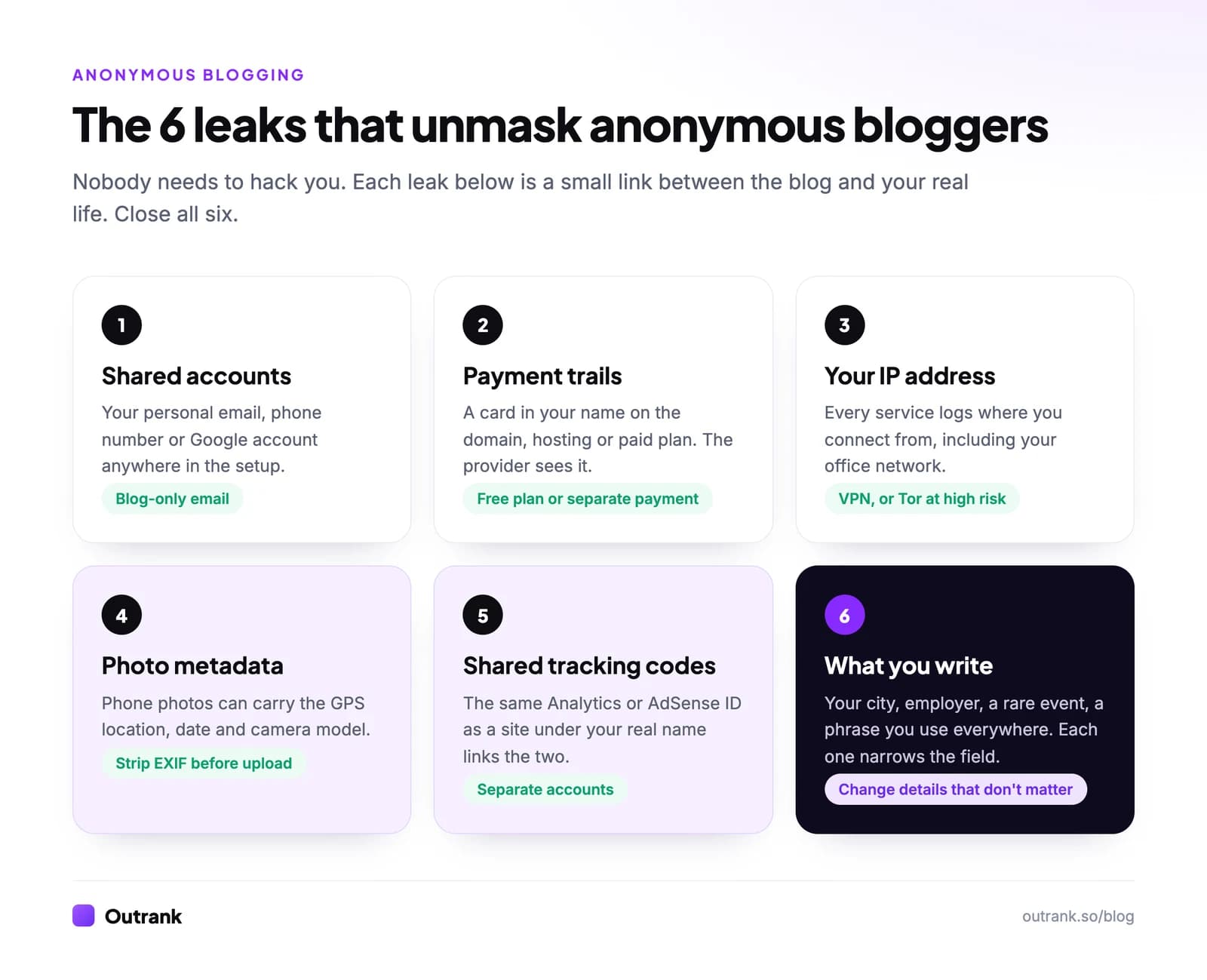
- Shared accounts. Using your personal email, phone number or Google account anywhere in the setup. One password-reset email can connect everything.
- Payment trails. A card in your name on the domain, hosting or paid plan. Readers never see it, but the provider does, and it can be disclosed under legal process. At level 2 and above, that matters.
- Your IP address. Every service logs the address you connect from. Writing from your office network is the classic mistake; the EFF's guide to blogging safely warned about it back in 2005. Use a reputable no-logs VPN, or Tor Browser at level 3.
- Photo and document metadata. Phone photos can carry GPS coordinates. Strip them before uploading, every time.
- Shared tracking codes. If your anonymous blog uses the same Google Analytics, Tag Manager or AdSense ID as a site under your real name, free lookup tools can link the two. Investigators at Bellingcat documented the technique years ago (Bellingcat). Use separate accounts for analytics and ads, or cookieless analytics with no shared ID.
- What you write. Your city, your employer's size, a rare event you attended, a colleague's quirk, a turn of phrase you use everywhere. Each detail narrows the field. Change specifics that do not matter to the story, and be careful with comments, which you should moderate before they appear.
Grow an anonymous blog without showing your face
Anonymous blogs grow the same way other blogs do, minus personal branding:
- Search. Posts that answer specific questions bring readers for years, and nobody needs to know who wrote them. Start with long-tail questions in your niche; our guide on finding low-competition keywords shows how.
- Communities. Take part in forums and subreddits under your pen name, and share a post only when it answers the question being asked.
- Email. Collect subscribers from the first post. A newsletter is an audience you keep even if you have to move platforms.
- Structure. Link posts to each other so readers and search engines find the rest of your work. See why internal links matter for SEO.
If the anonymous blog is for a business or a side project and the bottleneck is writing, a tool like Outrank can research keywords and publish articles to the blog for you, so it grows without you writing every post.
Can you make money from an anonymous blog?
Yes, but understand what stays private. Ad networks, affiliate programs and payment processors pay real people, so they ask for your legal name, payout details and often tax information. Readers never see that; the companies do. That is fine at level 1 and usually at level 2. At level 3, do not monetize.
- Affiliate links work from the first post and never show your name to readers.
- Display ads need meaningful traffic first; our guide to the best ad networks for bloggers covers the thresholds.
- Digital products and paid subscriptions sell under your pen name through platforms that handle payment and delivery.
For the full picture of income options, see how to make money with a blog.
Anonymous is not lawless
Anonymity protects your identity from readers, not from legal process. Platforms, registrars and hosts can be ordered to disclose who is behind an account, and many publish rules on when they do it, as Hatena does for its Anonymous Diary. Writing anonymously is legal in most countries; defamation, harassment, leaking confidential information you are bound to protect and copyright infringement are not, whether or not your name is on it. If you write about your employer or about real people, the EFF's legal guide for bloggers is a good start (it covers US law).
Interactive checklist
Anonymous blog launch checklist
0/11
Identity
0/4Setup
0/4Every post
0/3Your progress is saved in this browser, so you can come back to it later.
FAQ
Can I start an anonymous blog for free?
Yes. Write.as and Telegraph let you publish without creating an account. For a blog you want to grow, create a free account on Blogger, WordPress.com, Substack or Outrank Blogs with an email used only for the blog, and publish under a pen name.
Is Hatena Blog anonymous?
Not by default: Hatena Blog publishes under your Hatena ID and blog address, so you would need a separate Hatena ID that is never linked to your name. Hatena's Anonymous Diary (anond.hatelabo.jp) is designed for anonymous posts and does not show the poster's ID, but it still requires a Hatena ID, and Hatena can disclose poster information under its rules.
Can a blogging platform see who I am?
Yes, unless you post without an account. Any platform you sign up for knows the email address you used and the IP address you connected from, and paid plans know your payment details. That information can be disclosed under the platform's policies or a court order.
How do people find out who runs an anonymous blog?
Usually by connecting small details: a reused email or username, GPS data in a photo, a card payment, a Google Analytics or AdSense ID shared with a site under the owner's real name, or personal details in posts and comments. Closing those six leaks prevents most casual identification.
Do I need a VPN to blog anonymously?
For a simple pen-name blog, a VPN is a sensible precaution rather than a must. If you are hiding from an employer or anyone who could obtain the platform's logs, use a reputable no-logs VPN every time you work on the blog, and Tor Browser if the stakes are high.
Is it legal to blog anonymously?
In most countries, yes. Anonymity does not make illegal content legal, though: defamation, harassment and leaking confidential information can still lead to court orders that require platforms to reveal who you are.