Page speed has little effect on whether ChatGPT, Perplexity or Google's AI features cite you, as long as your site isn't badly broken. A Search Engine Land analysis of 107,352 pages visible in Google's AI Overviews and AI Mode found no reliable citation advantage from better Core Web Vitals once pages cleared the basic thresholds; only severe failures went with weaker AI visibility. The speed that does matter is how fast your server returns HTML (time to first byte), because most AI crawlers read raw HTML and never render your page.
Below: a five-minute test you can run yourself, why PageSpeed scores miss what AI crawlers experience, and the short list of speed fixes worth making.
Key takeaways
- Core Web Vitals act as a gate, not a lever: past the basic thresholds, faster pages showed no reliable AI citation advantage in a 107,352-page analysis of AI Overviews and AI Mode.
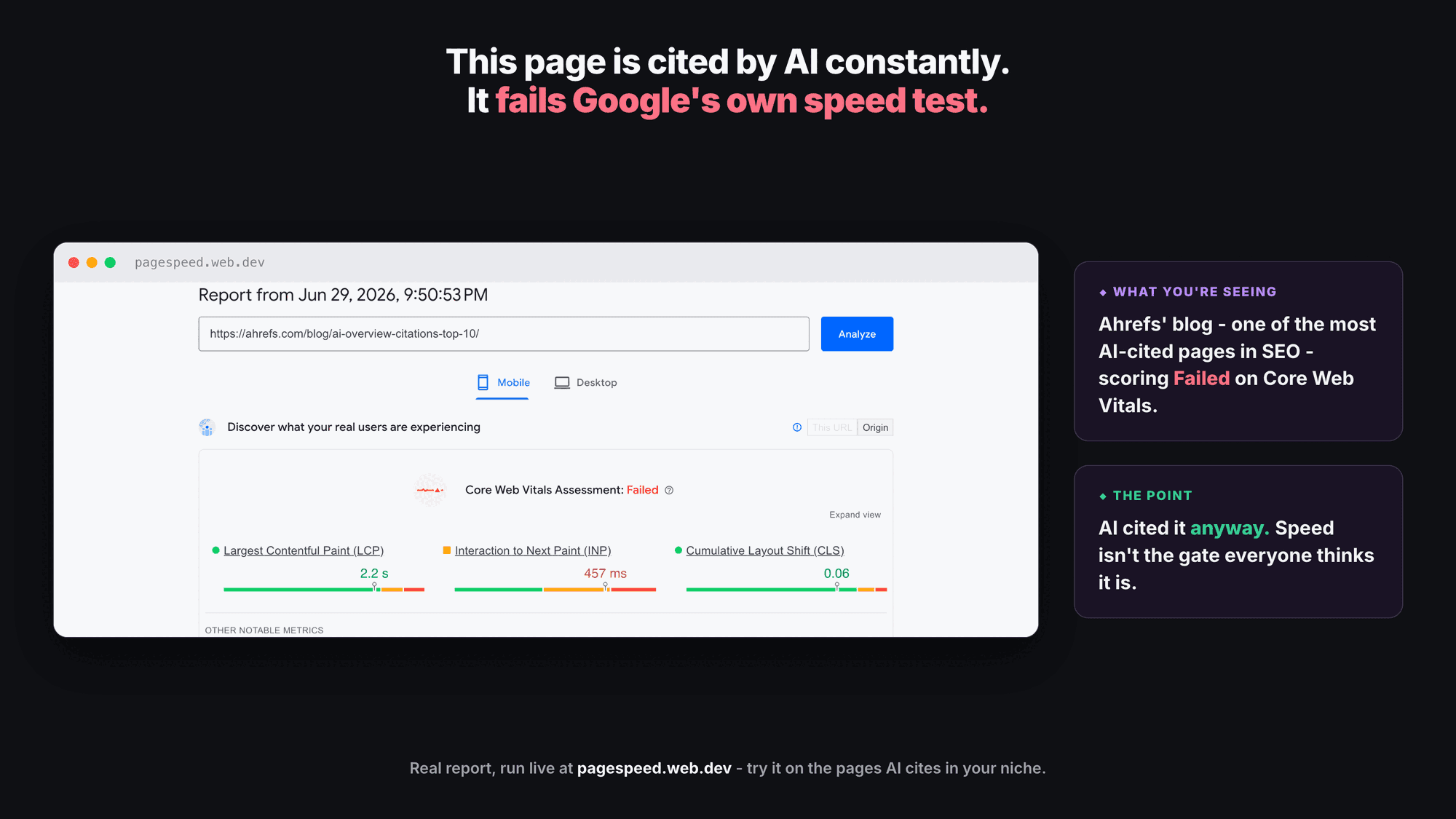
- Heavily cited pages often fail Google's speed test. Ahrefs' post on AI Overview citations failed Core Web Vitals on mobile when we checked it on June 29, 2026 (INP 457 ms).
- The crawlers behind ChatGPT, Claude and Perplexity don't run JavaScript, so they never experience LCP, INP or layout shift. They do wait for your server.
- Watch time to first byte: Google's web.dev guidance calls 0.8 seconds or less good and over 1.8 seconds poor.
- Speed isn't what separated cited sites in Outrank's 200-site study. Google impressions were the strongest predictor of AI citations (Spearman 0.80).
The short answer: speed is a gate, not a lever
The usual advice goes: speed up your site or AI won't cite you. It sounds right, and it's mostly wrong.
The best large dataset so far is a Search Engine Land analysis of 107,352 pages that appear in Google's AI Overviews and AI Mode, published in January 2026. Its finding: improving Core Web Vitals beyond the baseline thresholds did not reliably improve AI visibility. The only measurable relationship sat at the extremes, where pages with severe performance failures did worse. That study covers Google's AI features, not ChatGPT or Perplexity, but those assistants have even less reason to care, as you'll see below.
So a badly broken page can hurt you. A page that is merely imperfect is fine.
Prove it yourself in five minutes
- 1
Ask an AI a real question in your niche
Use ChatGPT or Perplexity, logged out. Note the pages it cites. - 2
Test each cited page
Paste each URL into PageSpeed Insights (free, no signup) and look at the Core Web Vitals Assessment for mobile. - 3
Count the failures
You will usually find cited pages that fail. Those pages are being quoted anyway.
We ran this on some of the most-cited sources in SEO in June 2026. Ahrefs, Semrush and Search Engine Land pages all failed Google's Core Web Vitals assessment on the day we checked, and AI assistants cite them constantly. For step one, our free AI citation tool asks ChatGPT, Perplexity, Gemini and Claude the same question and lists every page they cite.
Why PageSpeed scores miss what AI crawlers see
PageSpeed Insights measures how a page behaves in a real browser for real users: how fast the main content paints, how quickly it responds to a tap, how much the layout jumps. The crawlers that feed ChatGPT, Claude and Perplexity don't use a browser. Vercel's analysis of AI crawler traffic found that OpenAI's crawlers, ClaudeBot and PerplexityBot fetch JavaScript files but don't execute them. They request your HTML, read it and leave.
| Metric | What it measures | Does an AI crawler experience it? |
|---|---|---|
| Largest Contentful Paint (LCP) | When the biggest element renders in a browser | No, nothing is rendered |
| Interaction to Next Paint (INP) | How fast the page reacts to clicks and taps | No, crawlers don't click |
| Cumulative Layout Shift (CLS) | How much the layout jumps while loading | No |
| Time to First Byte (TTFB) | How long your server takes to start sending the HTML | Yes, every request waits for it |
| Content in the raw HTML | Whether the text exists before JavaScript runs | Yes, it's all they read |
Google is the partial exception: Gemini uses Googlebot's infrastructure, which renders JavaScript. Core Web Vitals are still worth passing for Google Search itself. Google says good Core Web Vitals align with what its core ranking systems "seek to reward" (Google Search Central), and slow pages frustrate visitors. Those are reasons to fix them for people, not for AI citations. Our technical SEO audit checklist covers the usual fixes.
The one speed that matters: time to first byte
Time to first byte (TTFB) is the time between a request and the first byte of the HTML response. It's the only speed metric every crawler feels.
- Google's thresholds: web.dev calls a TTFB of 0.8 seconds or less good and anything over 1.8 seconds poor. TTFB isn't a Core Web Vital, so PageSpeed's pass or fail label doesn't reflect it.
- Slow servers get crawled less: Google's crawl budget documentation says that when response times rise, Googlebot lowers its crawl limit and crawls less. Server errors and 429 responses lower it too.
- Live fetchers make people wait: ChatGPT-User, Claude-User and Perplexity-User fetch your page while someone waits for an answer. OpenAI doesn't publish a timeout, so a slow or overloaded server is a risk you can't size. Fast is the only safe setting.
To check TTFB for a page, run this in a terminal (run it twice: the first request may miss the cache):
curl -o /dev/null -s -w "TTFB: %{time_starttransfer}s\n" https://yoursite.com/your-pagePageSpeed Insights also shows field TTFB under Other notable metrics when Chrome has enough real-user data for the page.
What to fix (and what to skip)
Interactive checklist
AI crawler speed and access check
0/8
Speed crawlers actually feel
0/3Access
0/3Content
0/1Core Web Vitals (for Google and your visitors)
0/1Your progress is saved in this browser, so you can come back to it later.
What to skip: chasing a 100 PageSpeed score for AI's sake, stripping images or animations that help people buy, and rebuilding a site because a cited competitor is "faster". None of that changes what a crawler reads.
Where the effort should go instead
Once your server is quick and the HTML holds the answer, AI visibility comes down to having the right pages and enough authority. In Outrank's study of AI citations across 200 sites, the strongest predictor of citations was Google impressions (Spearman 0.80), followed by pages earning clicks (0.72), with Domain Rating (0.43) and verified backlinks (0.40) further back. Speed wasn't one of the variables we measured, so that study can't rule it in or out, but visibility and coverage clearly carried the weight.
That's the slow, hard part: a page for every question your buyers ask, written so the answer sits in plain text near the top. Outrank researches those questions, writes the articles and publishes one a day to your CMS. To see which of your pages AI already cites, open Bing's free AI Performance report. If you want a quick technical baseline first, the free grader in is your website ready for AI agents checks server-rendered content and status codes in one scan.
FAQ
Does page speed affect AI SEO?
Only at the extremes. A 107,352-page analysis of Google's AI Overviews and AI Mode found no reliable citation advantage from better Core Web Vitals once pages passed the basic thresholds, while severely slow pages did worse. Keep your server fast and your site functional, then put effort into content and authority.
Do Core Web Vitals affect ChatGPT citations?
There's no evidence they do. ChatGPT's crawlers don't render pages or run JavaScript, so they never experience LCP, INP or CLS, the metrics Core Web Vitals measure. What they do experience is how quickly your server returns HTML.
What is a good time to first byte?
Google's web.dev guidance says a TTFB of 0.8 seconds or less is good and anything over 1.8 seconds is poor. Measure it on your most important pages with PageSpeed Insights field data or a simple curl command, and cache HTML at a CDN if it's slow.
Do AI crawlers render JavaScript?
Most don't. Vercel's analysis found that OpenAI's crawlers, Anthropic's ClaudeBot and PerplexityBot download JavaScript files without executing them. Gemini is the exception because it relies on Googlebot, which renders pages.
Is page speed still a Google ranking factor?
Yes, as part of page experience. Google recommends good Core Web Vitals and says they align with what its core ranking systems seek to reward, but relevance and content quality carry far more weight. Speed rarely outweighs a better answer.