

AI SEO for a small business means two things. First, using AI to do the repetitive SEO work a small team never has time for: keyword research, first drafts, images, publishing, internal links. Second, shaping your website so Google and AI assistants (ChatGPT, Perplexity, Google AI Overviews) can understand it, rank it and cite it. The first saves hours every week; the second decides whether customers find you at all.
This playbook shows which tasks to hand to AI and which to keep, what the work actually costs, how local businesses show up in AI answers, and a 30-day plan to start.
Key takeaways
- AI use alone doesn't move results. 92.4% of content marketers now use AI for blogging, yet AI use shows no correlation with stronger results (Orbit Media, 2026). The workflow and the knowledge you add make the difference.
- The average blog post takes 3 hours 20 minutes to write (Orbit Media, 2026). Eight posts a month is roughly 27 hours, which is the time AI can give back.
- AI visibility is built on Google visibility. In Outrank's study of 200 sites, Google impressions were the strongest predictor of AI citations, and 67% of sites with fewer than 50 Google-visible pages had zero AI citations.
- When Google shows an AI summary, users click a traditional result in 8% of visits versus 15% without one (Pew Research Center, 2025). Pages that answer clearly and get cited matter more than ever.
- Keep a human approval step for prices, guarantees, and anything legal, medical or financial.
Why small businesses need AI SEO now
Small businesses have always had the same SEO problem: the work never stops, and the team is small. Research, keyword mapping, writing, editing, images, publishing, internal links, technical checks and reporting eat the hours that should go to customers.
AI changes the economics of that work. It handles repetitive research and production, and leaves the owner or marketer to supply what software can't: customer objections, local context, product knowledge and a credible point of view. The goal isn't publishing generic articles faster. It is turning a fragmented workflow into one a small team can keep running every week.
Owners already see this. In an October 2025 survey of 803 U.S. business owners by Digital Third Coast, 83% said SEO still has value, two in five had used AI to help with SEO, and 78% of those said it made a positive difference (survey). If you are new to SEO itself, start with our SEO for small business guide.
Practical rule: use AI to remove low-value repetition, not to remove human accountability.
How AI changes search visibility: two different jobs
AI SEO is easier to manage when you separate two roles that often get mixed up.
AI as an internal assistant. Software helps you research topics, cluster keywords, summarize competing pages, draft outlines, write metadata and run a publishing queue. It needs your business context and your review.
AI as an external search surface. Google AI Overviews, AI Mode, ChatGPT and Perplexity read public pages, summarize them and sometimes cite the sources. Your content has to work for a person scanning a results page and for a machine looking for a clear, trustworthy passage to reuse.
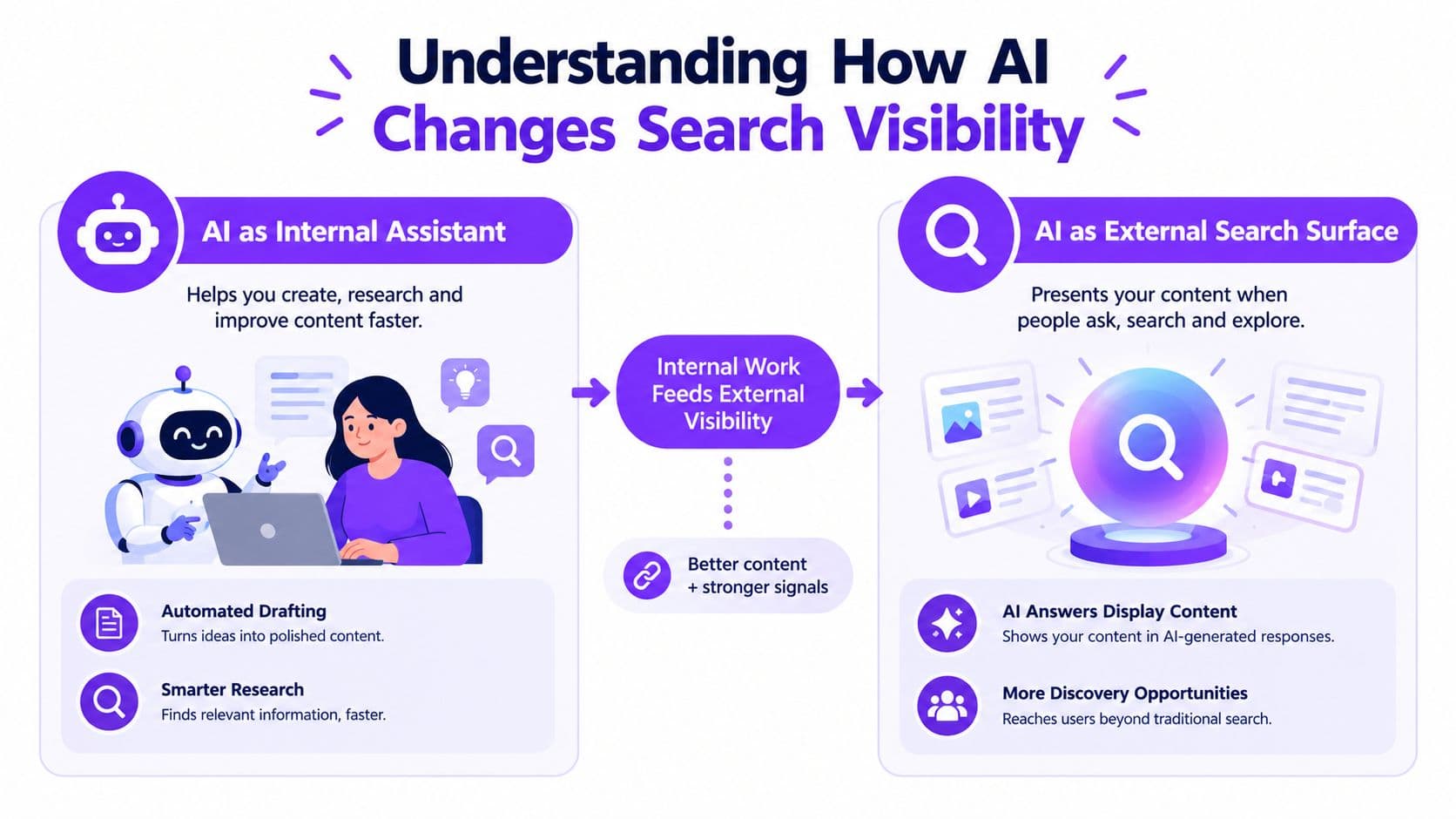
The two connect more tightly than most people expect. In Outrank's study of AI citations across 200 sites, the number of Google impressions a site earned was the strongest predictor of how often AI assistants cited it (Spearman correlation 0.80), and none of the 110 sites with 400+ Google-visible pages had zero citations. A small site with a dozen pages is rarely visible to either. And AI assistants mostly quote articles: across the 2,671 sources in our benchmark of ChatGPT, Perplexity, Gemini and Claude, 74% were blog content and 7% were product or landing pages.
What to automate and what to keep human
| Task | Let AI do it | Keep a human on it |
|---|---|---|
| Keyword research | Finding long-tail questions, grouping them, checking volume and difficulty | Deciding which topics lead to your services |
| Briefs and outlines | Headings, questions to answer, internal link targets | Adding what only you know: prices, process, local details |
| Drafting | First drafts, rewrites, summaries, FAQ answers | Checking every fact, claim and promise |
| Images | Featured images, diagrams, alt text | Real photos of your team, work and premises |
| Publishing | Formatting, metadata, scheduling, pushing to the CMS | Final approval on regulated or sensitive topics |
| Internal links | Suggesting links between related pages | Making sure each article leads to the right service page |
| Reporting | Pulling Search Console data, flagging drops | Judging whether leads and sales actually moved |
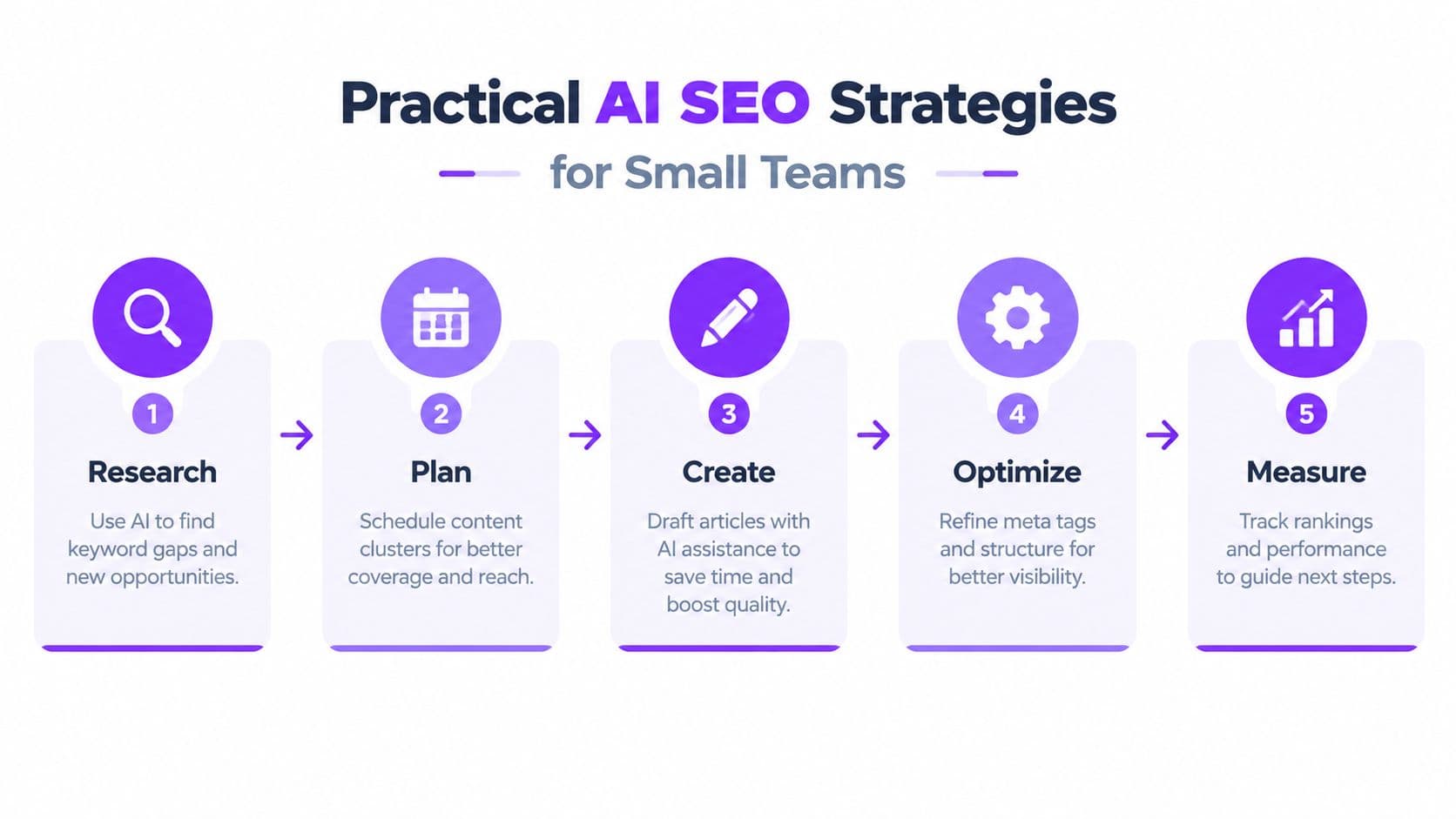
A practical AI SEO workflow for small teams
Small teams don't need a complicated stack. They need clear handoffs, a review point, and a firm line between what software automates and what needs judgment.
Start with customer language
Pull questions from sales calls, support emails, reviews, contact forms and conversations with staff. Ask an AI assistant to group them by intent: learning, comparing, solving a problem, hiring a provider. Then validate the groups against search data before committing, because AI can invent demand or merge terms that mean different things. Our guide to long-tail keyword research shows how to check.
Build a cluster around a commercial page
Don't publish a disconnected list of articles. Pick a core service, then map supporting questions to it. A home renovation company might cover planning permission, material choices, project timelines and how to choose a contractor, each article linking naturally to the renovation service page.
Let AI outline, then add what only you know
An AI outline gives coverage; coverage isn't an advantage. Add eligibility rules, trade-offs, process stages, common mistakes, maintenance obligations and signs that a different solution fits better. Keep a short brand voice document with approved terms, claims you can support and words you avoid, and give the AI your own source material instead of asking it to imitate an industry tone.
Add a review gate before publishing
Check that each page answers the intended question, describes your service accurately, links to the right service page and gives a clear next step. Inspect every factual statement: AI tools produce confident but wrong details, especially about regulations, prices, compatibility, safety and health. The business owner stays responsible for what is on the site.
Measure work done and business movement
Track output first (pages published, links added, outdated offers fixed, indexing issues resolved), then outcomes: qualified form submissions, calls, bookings and sales.
What your content workflow costs: a quick calculator
Compare doing it all by hand with automating production and keeping a review step. Replace the defaults with your own numbers.
Interactive calculator
In-house writing vs automated SEO content
Hours saved per month
22.4
- In-house cost per month
- $1,320
- Automated cost per month (tool + review time)
- $299
- Monthly difference
- $1,021
Building an automated content workflow
A fragmented setup looks cheap at first: one tool for keywords, another for drafts, a stock library for images, a document editor, and someone copying everything into the CMS. The handoffs are the real cost. Someone has to fix formatting, rename images, write alt text, add links, check headings, set the author and verify the published page. None of it is hard; together it makes publishing irregular.
| Fragmented setup | Integrated setup |
|---|---|
| Research in one app, drafts in another | Research and planning in one workflow |
| Images sourced and downloaded separately | Images prepared with the article |
| Manual copying and formatting into the CMS | Direct CMS connection |
| Internal links added as an afterthought | Links planned in the brief |
| Reporting stitched from several places | Performance checks follow the same queue |
Neither is automatically right. A specialist stack suits an experienced SEO who wants control of every step. An integrated platform makes more sense when the owner is also the researcher, editor, publisher and analyst.
Outrank is one integrated option. For $99 a month it finds keywords your site can rank for, writes and publishes 30 articles a month (one a day) with images, internal links and an FAQ, and connects to WordPress, Webflow, Shopify, Wix, Framer, Notion, Ghost, Next.js or a webhook. It also builds backlinks through its exchange. You can approve articles as drafts before they go live, and there is a 3-day free trial. It won't write your service pages for you or know your prices; that part stays with you. For a wider comparison, see our roundup of the best AI SEO tools and the best SEO tools for small businesses.
Whatever you use, keep a human approval point for legal, financial, medical, safety or pricing claims. Our guide to automating content marketing covers the handoffs in more detail.
AI SEO for local businesses
Local businesses win AI and map visibility through the same signals that win local search, plus clear, citable pages:
- Google Business Profile: complete categories, services, service area, hours, photos and a steady flow of reviews that mention the services you sell. It feeds Google's local results and maps, and it is the most structured description of your business Google has.
- Consistent business details: the same name, address and phone number on your site, profile and the directories you are listed in.
- One real page per service, and per location only where you genuinely operate, with prices or price ranges, process, service area and proof (photos, reviews, certifications). Dozens of near-identical city pages are doorway pages under Google's spam policies.
- Answer pages for real customer questions ("how often should a commercial kitchen hood be cleaned"), each opening with a direct answer and linking to the matching service.
- Tracking AI mentions: ask ChatGPT, Perplexity and Google AI Mode the questions your customers ask and note who gets named. Tools such as Outrank's AI visibility tracking automate that across ChatGPT, Perplexity, Gemini, Copilot, AI Overviews and AI Mode; no tool can promise an assistant will recommend you.
Trade-specific playbooks: plumbers, contractors, HVAC companies and restaurants.
Optimizing for AI Overviews and AI answers
Keyword stuffing was never durable, and it gives an answer engine no reason to pick you. Think of AI search optimization as writing passages that can be lifted out and still make sense.
Write answer-first sections
Open each important section with the direct answer, then explain. A page for "how often should a café clean its espresso machine" should answer in the first paragraph, then cover what changes the answer, what the process involves and when to call a professional. This matters because question searches trigger AI summaries often: Pew found that 60% of Google searches starting with "who", "what" or "why" produced one (Pew Research Center, 2025).
Use headings that state the question or decision. "What a commercial cleaning service includes" tells a reader and a machine what follows; "Our approach" tells neither.
Make expertise visible without selling
Show who stands behind the information, how you know it, and link to credible sources when a claim needs evidence. A useful answer that admits limits is more believable than a page that says you are perfect for everyone.
Use structure that supports extraction
- A one-sentence definition of the service or term, in the customer's words.
- Decision criteria: budget, location, urgency, compatibility, experience.
- A Q&A section for the questions customers ask before calling.
- Specific entities: products, places, certifications, materials, platforms.
- Evidence: sources, first-hand detail, photos of real work.
- A next step: quote, booking, comparison or related page.
Structured data (LocalBusiness, Service, Product) helps machines interpret a page when it matches what is visible; it won't rescue weak content. More in our guides on getting ChatGPT to recommend your product and why ChatGPT skips some sites.
Measuring ROI without drowning in data
Traffic isn't the outcome. A business can publish more, earn more impressions and still not get more qualified conversations. Connect visibility to actions that show buying intent:
| Area | What to check |
|---|---|
| Visibility | Impressions, indexed pages, rankings for priority queries, mentions in AI answers |
| Engagement | Clicks, engaged visits, calls, form starts, bookings |
| Local intent | Google Business Profile calls, direction requests, review activity |
| Commercial quality | Qualified leads, accepted quotes, booked appointments, sales |
| Efficiency | Hours spent researching, writing, publishing and updating |
Expect impressions to rise faster than clicks. Across 415 Outrank sites from October 2025 to August 2026, median impressions grew 2.18× while clicks grew 22% and CTR fell 40%, largely because of AI answers and SERP changes (zero-click study). Don't treat an AI mention as revenue either; connect it to branded searches, direct visits and lead quality. Our content marketing ROI guide shows how to tie production to outcomes.
Your first 30-day AI SEO campaign
Start with one commercial theme, not the whole website: a service with clear demand, the page that sells it, and the questions customers ask before buying.
- Days 1 to 5: connect Search Console and analytics, check that your core pages are indexed, and record current leads from organic and local sources.
- Days 6 to 10: collect customer questions, group them by intent, and choose one service page with several supporting topics.
- Days 11 to 20: create briefs, draft the supporting content, add first-hand expertise, build internal links and check every factual claim.
- Days 21 to 25: publish, check the pages on mobile, and confirm titles, descriptions, links, images and calls to action.
- Days 26 to 30: check indexing and early impressions, record qualified actions, and adjust before the next cluster.
Our guide on how to use AI for SEO has task-by-task prompts and checks for each step.
FAQ
Can AI do SEO for a small business?
AI can do most of the production work: keyword research, outlines, drafts, images, metadata, internal links and publishing. It can't supply your prices, your process, your local knowledge or your judgment about which topics bring customers, so a person still needs to review and approve what goes live.
What is the best AI SEO tool for a small business?
It depends on where your time goes. If writing and publishing is the bottleneck, an all-in-one platform that researches, writes and publishes (such as Outrank) saves the most hours. If you already write well and need data, a research suite like Semrush or Ahrefs plus Google Search Console fits better.
Does Google penalize AI-generated content?
No, not for being AI-generated. Google's guidance says it rewards helpful content however it is produced, and its spam policies target content made at scale mainly to manipulate rankings. AI content that is accurate, specific and reviewed is treated like any other content.
How much does AI SEO cost for a small business?
An all-in-one AI SEO platform typically costs around $100 a month (Outrank is $99 for 30 articles a month), compared with paying a writer for several hours per article. Add your own review time, which the calculator above lets you estimate.
Is there an AI SEO platform for local businesses?
Several tools cover parts of it: Google Business Profile management tools for reviews and listings, AI content platforms for service and answer pages, and AI visibility trackers for mentions in ChatGPT, Perplexity and AI Overviews. Outrank covers content, backlinks and AI visibility tracking; profile and review management needs a separate local SEO tool.