To write a sports article, lead with the most newsworthy fact (usually the result and the reason it happened), prove it with the turning point, the key numbers and real quotes, and finish with what the result means for what comes next. Game recaps and breaking news use this "inverted pyramid" order; profiles and features can open with a scene and tell the story in narrative order. Before you file, check every name, score and statistic against the official box score.
This guide gives you the structure, templates for six common types of sports article, one real game (Super Bowl LIX) written three different ways, where to find stats and quotes, the style rules sports desks follow, and a checklist to run before you publish.
Key takeaways
- Put the result and the reason in the first sentence. A reader who stops after one paragraph should still know what happened and why.
- Choose one angle per article. The turning point, a player, a tactic or a streak, not all of them.
- Use numbers that explain, not numbers that decorate. Two or three stats that prove your angle beat a pasted box score.
- Never invent or "tidy up" quotes. Attribute every quote to a named person and where it was said.
- Timely recaps fade fast; evergreen sports guides keep earning search traffic. Sites in Outrank's sports & fitness group had the highest share growing Google clicks (88% of 25 sites).
The 6 types of sports article (and when to write each)
| Type | When | Structure | Opening example |
|---|---|---|---|
| Game recap (game story) | Right after a game | Inverted pyramid: result, turning point, stats, quotes, context | "[Team] beat [team] [score] on [day] as [reason]." |
| Preview | Before a game or season | What's at stake, form, key matchup, prediction | "Both teams arrive unbeaten, and the matchup to watch is…" |
| Player or coach profile | Any time, often tied to a milestone | Narrative: scene, background, turning points, now | A specific moment from their career or training |
| Analysis (tactical or statistical) | After a game or a run of games | Claim, evidence (stats, clips, diagrams), counter-argument, conclusion | "The reason [team]'s defense collapsed is not effort. It's…" |
| Opinion column | When a debate is live | Clear position, three supporting points, the other side, verdict | A bold, defensible claim in one sentence |
| Feature | Human-interest stories | Narrative arc with a nut graf explaining why it matters now | A scene, a person, a detail |
If you're new to sports writing, start with recaps. They teach the discipline every other type needs: speed, accuracy and choosing what matters.
How to write a game recap, step by step
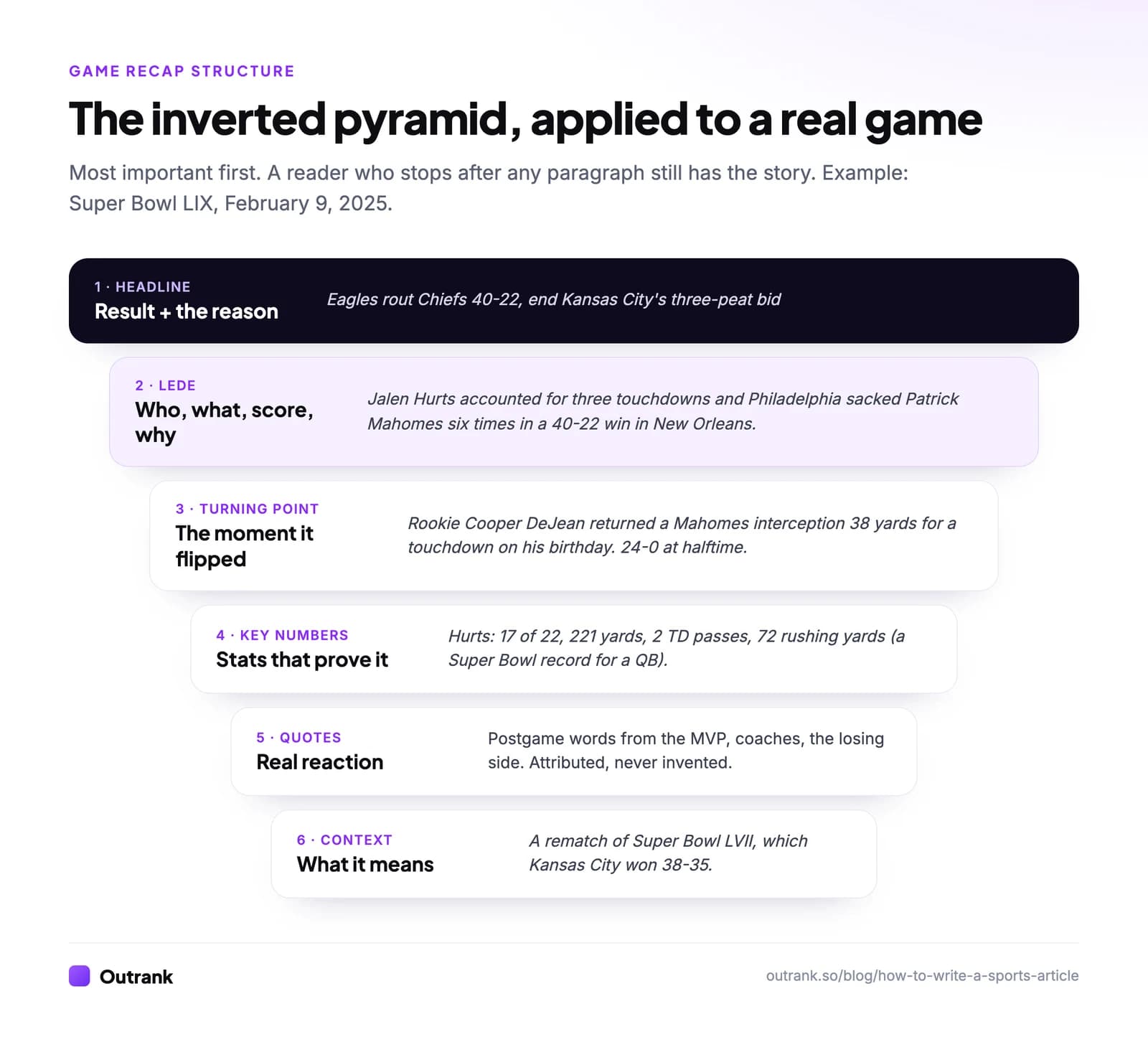
The inverted pyramid puts the most important information first and the least important last. Nielsen Norman Group notes it suits online reading because people skim, and a reader who reads only one paragraph still gets the core message. It also lets an editor cut from the bottom without losing the story.
- 1
Find the angle before you write
Ask what decided the game. A turning point, a standout performance, a tactical change, a streak that ended. Pick one. That's your lede. - 2
Write the lede (one sentence)
Who won, the score, where or when, and the reason. Lead with the angle, not the weather or the crowd. - 3
Add the turning point
The play, decision or run that flipped the game, with the time or quarter and the score at that moment if you have it. - 4
Prove it with two or three numbers
Pick stats that support your angle. Weave them into sentences ("…sacked six times, a career high") instead of listing them. - 5
Add quotes from the people involved
The winning and losing sides, ideally reacting to the moment in your lede. Use the strongest line, attributed by name. - 6
Close with context
What the result means for the standings, the season, a record, or the next game. - 7
Write the headline last
The result plus the reason, with team or player names people search. Keep it factual and specific.
One real game, written three ways
Here is Super Bowl LIX (February 9, 2025, Caesars Superdome, New Orleans) written as a recap, an analysis and a feature. The facts, from the game's Wikipedia entry: Philadelphia beat Kansas City 40-22 after leading 24-0 at halftime; Jalen Hurts completed 17 of 22 passes for 221 yards and two touchdowns, ran for 72 yards (a Super Bowl record for a quarterback) and a touchdown, and was named MVP; Patrick Mahomes was sacked a career-high six times; rookie Cooper DeJean returned an interception 38 yards for a touchdown on his birthday; the Chiefs were chasing the first three-peat in NFL history.
1. Recap lede (news):
Jalen Hurts accounted for three touchdowns and the Philadelphia Eagles sacked Patrick Mahomes six times in a 40-22 win over the Kansas City Chiefs in Super Bowl LIX on Sunday, ending Kansas City's bid for the first three-peat in NFL history.
Who, what, score, when and why, in one sentence. Everything after it supports that sentence.
2. Analysis lede (tactics):
Kansas City's offense didn't lose Super Bowl LIX so much as never get started. Philadelphia sacked Patrick Mahomes six times, the most of his career, and the Chiefs didn't score until the final minute of the third quarter.
This makes a claim (the pass rush decided it) and promises to prove it. The rest of the piece would break down how the Eagles generated pressure, with clips or diagrams.
3. Feature lede (human interest):
Cooper DeJean spent his 22nd birthday in New Orleans doing something no player had done in Super Bowl history: scoring a touchdown on his birthday. The rookie cornerback stepped in front of a Patrick Mahomes pass in the second quarter and ran it back 38 yards.
A feature starts with a person and a detail, then widens out. It can take its time, because the reader already knows the result.
Same game, three different first sentences. The angle decides the structure, the stats you pick and the quotes you look for.
Where to find stats and quotes
Stats. Start with the official box score from the league or competition, then use reference sites for history and context: Pro Football Reference for the NFL, Basketball Reference for the NBA, FBref for soccer and Baseball Reference for MLB. Cross-check anything surprising in a second source.
Quotes. Press conferences and mixed-zone interviews if you have access; official team and league media (transcripts, videos) if you don't. Local and school sports are easier: coaches and players are often happy to talk after the game if you ask politely and quickly. If you take a quote from another outlet's interview, credit the outlet.
Context. Standings, streaks, records and head-to-head history turn a result into a story. A "first since" or "most since" line is often your best second paragraph, as long as you've verified it.
Style rules most sports desks follow
- Scores: figures, winner first, with a hyphen: "Philadelphia won 40-22." This is AP style, which most US newsrooms use.
- Names: full name on first reference ("Jalen Hurts"), surname after ("Hurts"). Check the spelling against the official roster.
- Tense and attribution: past tense for what happened ("Hurts threw for 221 yards"), and "said" for quotes. It's neutral and never distracts.
- Active verbs: "DeJean intercepted Mahomes" beats "Mahomes was intercepted by DeJean".
- Clichés: cut "gave 110 percent", "a game of two halves", "left it all on the field" and "it is what it is" (unless it's a quote you're reporting).
- Jargon: match your reader. A team blog can say "Cover 2"; a general news site should explain it in a few words.
Pre-filing checklist
Interactive checklist
Sports article checklist
0/15
Accuracy
0/5Structure
0/4Style
0/3Publishing online
0/3Your progress is saved in this browser, so you can come back to it later.
Writing sports articles for a blog or website
If you publish sports content on your own site, two kinds of articles behave very differently in search.
Timely articles (recaps, previews, breaking news) spike for a few days and then fade. Fractl's 2026 analysis found the typical content piece loses about 76% of its peak traffic within three months of peaking. Big outlets win most of these searches on day one.
Evergreen articles (how a rule works, how to choose equipment, training guides, the history of a rivalry, "best" lists that you update) keep earning visits for years. Fractl found how-to articles were the most durable format, still holding roughly 30% of peak traffic a year later.
For a small sports blog, the evergreen side is usually where search traffic comes from. That's also what Outrank's data suggests: in our study of 2,119 sites, the 25 sports and fitness sites had the highest share of sites growing Google clicks of any niche (88%), with median clicks rising from 1,071 to 3,106 per 28 days. Outrank's articles are explainers and how-to guides rather than match reports, which is the evergreen side of sports content. If you want to publish that kind of content consistently, Outrank finds the keywords, writes the articles and publishes them to your site every day, while you keep writing the timely pieces that need your voice.
For the blogging side, see how to start a blog for free, our blog post ideas and the SEO content writing tips that apply to any niche. For general article craft, how to write a good article covers the fundamentals.
FAQ
How do you start a sports article?
Start with the most important fact and why it happened. For a game recap, that means the winner, the score and the reason in one sentence, for example the decisive play or performance. For a feature or profile, you can open with a short scene or a striking detail, then explain in the next paragraph why the story matters now.
What is the structure of a sports article?
Most news-style sports articles follow the inverted pyramid: headline, a lede with the result and the reason, the turning point, supporting statistics, quotes, and context such as standings or what comes next. Features and profiles use a narrative structure instead, with a scene-setting opening, a nut graf that explains the point, and a story told roughly in order.
How long should a sports article be?
It depends on the type and the outlet. Recaps are usually the shortest because they need to be fast and focused on one game; analysis pieces, profiles and features run longer because they explain or tell a story. Write enough to support your angle with evidence and quotes, then stop.
How do you write a sports article for a school newspaper?
Cover your school's games the same way professionals do: lead with the result and the reason, use the official scorebook for numbers, and get quotes from the coach and a player or two right after the game. Check name spellings with the team roster, and focus on what your classmates care about, such as individual players and what the result means for the season.
How do I become a sports writer with no experience?
Build a portfolio by writing regularly about a sport or team you know well, on your own blog or for a student, local or fan publication. Recaps of local games teach speed and accuracy, and a few strong analysis pieces show you can think. Pitch small outlets with specific story ideas and links to your best three articles.