

To start a blog in India, pick a niche you can write 50 posts about, choose a platform (free on Blogger or Outrank Blogs, or WordPress on an Indian host such as Hostinger from ₹69 a month), register a .in or .com domain (₹899 and ₹1,499 a year at Hostinger's list prices), connect Google Search Console and publish 15 to 20 posts that answer specific questions Indian readers type into Google. Add income once traffic arrives: AdSense pays Indian publishers by wire transfer, and Amazon.in Associates pays 4.72% on books in its October–November 2026 rate card.
This guide covers the India-specific parts generic guides skip: real rupee prices checked on October 19, 2026, a cost calculator, which Indian languages AdSense accepts, and the three rules (ASCI, DPDP and GST) that apply once you earn.
Key takeaways
- You can start for ₹0. Blogger is free with no visit limit, and Outrank Blogs is free up to 10,000 visits a month with your own domain.
- Self-hosted WordPress on Hostinger India costs ₹3,312 upfront for 48 months (₹69 a month), then renews at ₹289 a month. Budget for the renewal, not the teaser.
- Phones carried 77.3% of Indian web traffic in September 2026 (StatCounter), so check every post on a phone before you publish.
- AdSense accepts Hindi, Bengali, Tamil, Telugu, Marathi, Gujarati, Kannada, Malayalam, Punjabi and Urdu sites, so a regional-language blog can earn from ads.
- Label every paid post (ASCI), publish a clear privacy notice (DPDP Rules, notified November 14, 2025) and check GST once service income nears ₹20 lakh a year.
Is it worth starting a blog in India in 2026?
Yes, if you pick a narrow topic and write from experience. India had 1.03 billion internet users in October 2025, 70% of the population, according to DataReportal's Digital 2026 India report. Most of them search in English, Hindi or a regional language on a phone, and many of their questions still have no good answer written for Indian prices, laws and products.
The blogs that win here are specific. Four live examples, all checked on October 19, 2026:
| Blog | Niche | What to copy |
|---|---|---|
| Digital Inspiration (labnol.org) | Google apps and productivity how-tos | Amit Agarwal has run it since 2004 and states it takes no sponsored content. Trust is the product. |
| freefincal | Data-driven DIY investing | Free tools (mutual fund screeners, a portfolio tracker) bring readers back, and new posts go up daily. |
| Hebbars Kitchen | Indian vegetarian recipes | Menus organised the way Indians cook: dosa, idli, chutney, rasam, sambar. |
| Discover with Dheeraj | Himalayan travel (Ladakh, Spiti) | The blog formerly called Devil on Wheels now sells group tours from its own calendar. |
None of them is "a lifestyle blog about everything". Each one owns a topic, and each earns in a way that fits that topic. If you are still wondering whether you missed the boat, our take on whether it is too late to start a blog walks through the numbers.
Step 1: Pick a niche Indian readers search for
A good niche sits where three things overlap: you know it first-hand, Indians search for it, and something in it pays. Test an idea in an evening:
- Search demand. Open Google Trends with the region set to India and compare candidate topics over 12 months. Then type your topic into Google and note the "People also ask" questions.
- The 50-title test. Write 50 post titles. If you stall at 20, the niche is too narrow or you are not interested enough.
- Money check. If you plan to recommend products, look up the category on the Amazon.in Associates fee schedule before you commit (rates below).
- Language. English reaches the widest audience. A Hindi or regional-language blog faces fewer competitors, and AdSense supports Hindi, Bengali, Tamil, Telugu, Marathi, Gujarati, Kannada, Malayalam, Punjabi and Urdu (Google's supported-language list). Odia and Assamese are not on that list as of October 2026, so plan affiliate or product income instead of ads for those.
Narrow beats broad. "Mutual funds for salaried people under 30" is a blog. "Finance" is a magazine you cannot staff.
Step 2: Choose a platform
You have two routes: a hosted platform (nothing to maintain, free or cheap) or self-hosted WordPress (full control, a few hundred rupees a month). Prices below were checked on October 19, 2026.
| Platform | Cost | Own domain | Ads shown to readers | Best for |
|---|---|---|---|---|
| Blogger | Free, no visit limit | Free to connect | None unless you add AdSense | Hobby blogs that must stay free forever |
| Outrank Blogs | Free up to 10,000 visits a month | Free (subdomain or subfolder) | None; a small "Published with Outrank" footer badge | New blogs that want SEO basics done for them |
| WordPress.com | Free plan; custom domain from the Personal plan ($4 a month billed yearly) | Paid plans only | WordPress.com ads on the free plan | Beginners who want WordPress without servers |
| WordPress.org on Hostinger India | ₹69 a month on a 48-month term (Single), ₹139 (Premium) | Yes | None | Bloggers who want every plugin and full control |
Two honest caveats. Outrank Blogs launched in October 2026, so it has five templates and no plugin ecosystem, and it collects email subscribers but does not send newsletters (you export them or connect your email tool). Its interface labels come in seven European languages, but you can write posts in Hindi or any other language. Blogger, on the other hand, has no built-in email subscriptions and looks dated.
If you choose WordPress, our WordPress blog setup guide covers installation, permalinks and the first plugins. If you want to compare every free option first, read how to start a blog for free.
Step 3: Pick a domain (.in or .com)
Hostinger lists a .in domain at ₹899 a year and a .com at ₹1,499, with first-year promotions as low as ₹1 when you commit to a multi-year term (Hostinger domain search, October 19, 2026). Check the renewal price before you pay, because promotions apply to year one only.
- Choose .in when your audience is almost entirely Indian (local recipes, Indian tax, city guides). Google treats country-code domains as a signal that a site targets that country (Google's multi-regional sites guide).
- Choose .com when you want readers abroad too, such as the Indian diaspora or global tech readers.
Keep it short, skip hyphens and numbers, and say it out loud once: if you have to spell it for a friend, pick another.
What does it cost to start a blog in India?
Anywhere from ₹0 to about ₹11,000 over four years. The calculator uses Hostinger India's published prices from October 19, 2026. The teaser monthly rates require paying all 48 months upfront, and GST may be added at checkout.
Interactive calculator
What will your Indian blog cost?
Cash you pay on day one
₹4,211
- Domain cost in year one
- ₹899
- Total over four years
- ₹6,908
- Effective cost per month
- ₹144
- Hosting price per month after the 48-month term
- ₹289
A free platform plus a .in domain costs ₹899 a year. Self-hosted WordPress on the Single plan with a .in domain is ₹4,211 on day one. Both are cheaper than most people expect, and neither buys you readers: posts do.
Step 4: Set up the blog so Google can find it
Do these once, on day one:
- Mobile first. Phones carried 77.3% of Indian web traffic in September 2026, against 22.1% for desktops (StatCounter). Pick a light theme and preview every post on a cheap Android phone.
- Clean URLs. On WordPress, go to Settings → Permalinks and choose "Post name" so links read
yourblog.in/sip-vs-lump-sum, not?p=123. - Search Console. Add the site in Google Search Console, verify it, and submit your sitemap (
/sitemap.xmlon most platforms). Outrank Blogs generates the sitemap, robots.txt and structured data for you; on WordPress a plugin does it. - Three pages before launch. About (who you are and why readers should trust you), Contact, and a Privacy notice (more in the rules section below).
Step 5: Write your first 20 posts with Indian specifics
The fastest way to get indexed is to answer questions nobody has answered well for India. Long, low-competition questions are where new blogs win: across 200,871 articles Outrank wrote for 4,348 sites in the last 90 days, the median target keyword had a difficulty of 14 and 170 monthly searches (Outrank platform data, 90 days to October 2026). Our guide to finding low-competition keywords shows how to find them for free.
Make every post unmistakably Indian:
| Generic title | Indian, specific title |
|---|---|
| How to save tax | Section 80C options for a ₹12 lakh salary, ranked by lock-in period |
| Best budget phones | Best phones under ₹15,000 for Jio 5G, tested for a month |
| Ladakh travel guide | Ladakh by bike in June: permits, route and fuel stops from Manali |
| Easy dinner recipes | 20-minute dinners with a pressure cooker and no onion or garlic |
Use rupee prices with the month you checked them, name the app or bank you used, add your own photos, and update the post when prices change. Google's own guidance asks whether content shows "first-hand expertise", such as having actually used a product or visited a place (Creating helpful content).
Publish two or three posts a week for the first two months if you can. If you cannot, Outrank can research keywords and publish SEO articles to your blog every day (on WordPress, Outrank Blogs and other platforms), in English or Hindi. Treat it as a draft you edit with your own experience, not a replacement for it.
Step 6: How bloggers in India get paid
| Income source | How you get paid in India | What to know (October 2026) |
|---|---|---|
| Google AdSense | Wire transfer to your Indian bank account | Wire is the only AdSense payment option listed for India (Google's payment options table). Needs steady traffic to matter. |
| Amazon.in Associates | Commission on purchases | Beauty 8%, apparel 7.5%, books 4.72%, kitchen 4%, electronics 2.80%, computers 2.45%, mobile phones 1%, all iPhone models 0%. |
| Your own products (ebooks, templates, courses) | Payment gateway or storefront | Razorpay lists a 2% standard fee; Instamojo's free plan charges 5% + ₹3 per transaction. |
| Sponsored posts and brand deals | Bank transfer or UPI from the brand | Must carry a clear "ad" or "sponsored" label (see below). |
| Services (writing, consulting, tours) | Direct from clients | Discover with Dheeraj turned a travel blog into a tour business. |
Those Amazon.in rates explain why gadget blogs struggle on affiliate income alone: a ₹15,000 phone earns about ₹150 at 1%, while a ₹1,500 skincare order earns ₹120 at 8%. Pick your niche with that in mind, and read our guide to making money with a blog or the comparison of ad networks for bloggers when traffic arrives.
The rules: ASCI, DPDP and GST
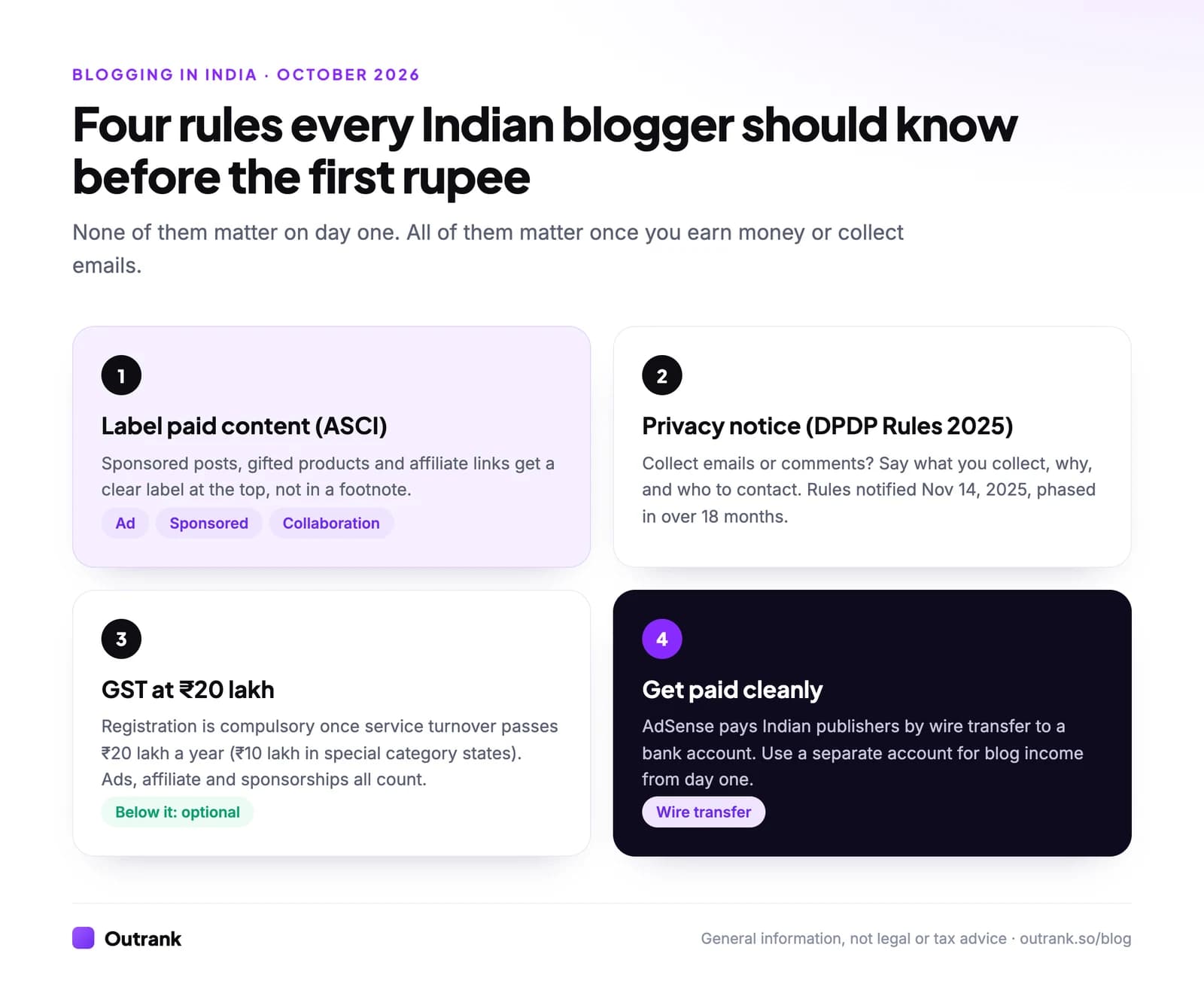
Three sets of rules apply once your blog earns money or collects emails. This is general information, not legal or tax advice; ask a chartered accountant once income is regular.
- Disclose paid content (ASCI). The Advertising Standards Council of India published guidelines for influencer advertising in digital media in May 2021. Label sponsored posts, gifted products and affiliate links clearly at the top of the post, with words such as "Ad", "Sponsored" or "Collaboration", not a hidden footnote.
- Protect personal data (DPDP). The government notified the Digital Personal Data Protection Rules, 2025 on November 14, 2025, with an 18-month phased compliance timeline (PIB release). If you collect emails or comments, publish a plain-language notice explaining what you collect and why, give a contact for data requests, and keep only what you need.
- GST. Registration becomes compulsory once aggregate turnover from services crosses ₹20 lakh a year, or ₹10 lakh in special category states (ClearTax summary of GST registration limits). Ad, affiliate and sponsorship income counts toward that turnover.
A sole proprietorship needs no separate registration to start. Open a separate bank account for blog income anyway: it makes AdSense wires, brand payments and tax filing far easier.
Should you blog in English, Hindi or a regional language?
Blog in the language your readers search in and that you write best. English gives you the largest pool of searches and advertisers. Hindi and regional languages give you fewer competitors per question, and AdSense supports ten Indian languages. The trade-off is monetization: affiliate programmes and brand budgets are still mostly in English, so a Tamil or Marathi blog often earns more from its own products, local sponsors or services than from Amazon links.
You can also run both: write in English first, then translate your 10 best posts and track which version earns clicks in Search Console. Our guide to SEO localization explains how to structure multi-language pages so they don't compete with each other.
Building in another country? Our sister guides cover starting a blog in Nigeria and starting a blog in South Africa, with local prices and payout options.
FAQ
How much does it cost to start a blog in India?
You can start for ₹0 on Blogger or Outrank Blogs, or ₹899 a year if you add a .in domain. Self-hosted WordPress on Hostinger India's Single plan costs ₹3,312 for 48 months upfront (₹69 a month), then renews at ₹289 a month, as of October 2026. Add the domain and any paid theme on top.
Can I start a blog in Hindi and earn from AdSense?
Yes. Hindi is on Google's list of languages AdSense supports, along with Bengali, Tamil, Telugu, Marathi, Gujarati, Kannada, Malayalam, Punjabi and Urdu. Odia and Assamese were not on the list in October 2026, so blogs in those languages should plan affiliate, product or sponsorship income instead.
How do Indian bloggers get paid by Google AdSense?
Google lists wire transfer to a bank account as the AdSense payment method for India. You add your bank details in AdSense under Payments, and Google pays once your balance passes the payment threshold shown in your account and your identity and address are verified.
Do bloggers in India need GST registration?
Only once aggregate turnover from services crosses ₹20 lakh in a financial year (₹10 lakh in special category states). Ad revenue, affiliate commissions and sponsorships all count as service income. Below the threshold, registration is optional; a chartered accountant can tell you if voluntary registration makes sense for you.
Is .in or .com better for an Indian blog?
Choose .in if your readers are almost all in India, because Google treats country-code domains as a signal of the target country and readers recognise it as local. Choose .com if you also want readers abroad. Both cost under ₹1,500 a year at Hostinger's October 2026 list prices.
Which is better for beginners in India, Blogger or WordPress?
Blogger is free forever and simple, but it looks dated and has no email subscriptions. WordPress gives you every theme and plugin, but you pay for hosting and handle updates. If you want a free blog on your own domain with sitemaps and structured data set up for you, Outrank Blogs is a third option, free up to 10,000 visits a month.